

皇冠同花顺优化(RFO)
 397
397
 2
2

目录
概述
有多种方式可解决优化问题,其中遗传算法占据了特殊的地位,因其能够模拟自然演化过程,从而有效探索搜索空间。传统的遗传算法使用解的二进制编码,这需要将真实数字转换为二进制格式。这种变换不仅增加了复杂度,也显著拉低了算法的权重。在现代社会,最小化计算成本扮演着决定性角色,方法的生产率往往直接与其速度成正比。而为了解决这个问题,我迸发出一个思路,如何在保留遗传算子的同时,用更简单、更低能耗的运算替代最难的真实数字转换计算。
我的算法,皇冠同花顺优化(RFO),是一种新的优化问题解决方法,保留了遗传算法的主要优势,但采用了解的更直接表述方式。关键思路是将搜索空间的每个坐标划分为扇区,类似于一手扑克牌是由确定排位的单张卡牌组成。取代比特位字符串操作,算法管理排位映射(扇区编号),这令搜索空间的拓扑结构得以自然预留。
以我观点,该方式的主要优点在于实现简单、且直观明了(处置“映射”更直观,远超比特位字符串),并且无需真实数字编码和解码,同时保留遗传算法的组合属性。在本文中,我们将详细探讨该算法的实现,以及决策修改算子的特性。
扑克牌比喻不仅赋予了算法的名字,也很好地描述了其本质:正如在牌局中玩家努力收集最佳牌面组合,算法将不同解的扇区结合起来,逐渐形成最优的“牌面”。正如扑克牌中每张卡牌都有自己的排位和花色,算法中每个扇区也有其数值和搜索空间中的位置。在这种情况下,正如真实游戏一样,不仅单张卡牌的价值重要,还要看它们在整体组合中的互动。
值得注意的是,该方式能视作把离散优化思路推广到连续空间的情况,这为理论分析和实际应用开创出有趣的前景。正如扑克牌结合了机遇和策略元素,RFO 将随机搜索与有向优化结合起来,令其有效应对复杂的多变量问题。
算法的实现
皇冠同花顺优化(RFO)算法基于将搜索空间表示为离散扇区的理念,类似于扑克牌中如何排位。在传统的遗传算法中,所有坐标的数值(优化的参数)都被转换为二进制代码,并折叠成类似染色体的序列,这需要额外的计算成本。在 RFO 中,我们放弃了该方式,转而采用更简单、更直观的表述。
取代二进制编码,我们而是将搜索空间的每个坐标拆分为扇区,赋予类似扑克牌的数值 — 从 J 到 A(J、Q、K、A)。排位的数量(扇区数)在算法的外部参数中指定,可以是任意整数值。因此,搜索空间中的任意点都能表示为一组映射,每个映射根据坐标对应一个特定的扇区。该方式不仅简化了计算,还保留了遗传算法的组合属性。
在优化期间,算法遵照“牌型”工作 — 代表不同解的一组卡牌。交叉和突变算子直接应用于“牌型”(一组卡牌),每副牌型模拟一条染色体,允许探索搜索空间,而无需二进制来回转换。
下面的示意图(图例 1)清晰展示了这一原理。它展示了一个三维搜索空间,坐标为 X、Y 和 Z,每个坐标被划分到与排位映射对应的扇区。右侧是“牌型”的示例 — 算法在寻找最优解时形成的各种卡牌组合。
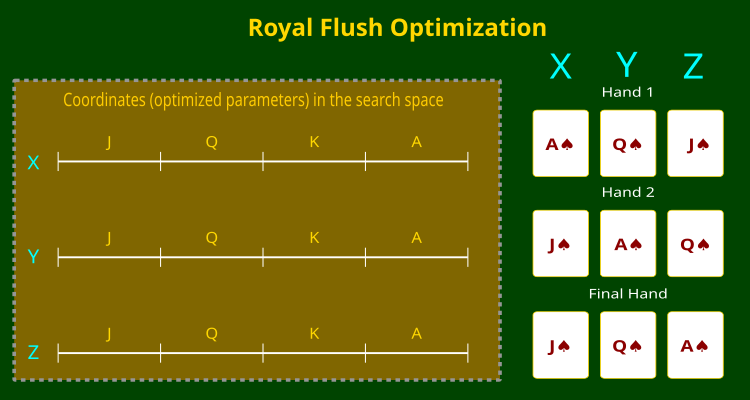
图例 1. RFO 算法及坐标分区到卡牌底牌排位
我们转至编写皇冠同花顺优化(RFO)算法的伪代码:
- 设定“牌桌”上的玩家人数(种群规模)
- 判定“底牌”的大小(每个维度的扇区数量)
- 设定“叫注”(突变)的概率
- 创建初始“牌型” — 随机生成每个坐标的卡牌排位
- 将排位变换为扇区内随机偏移的真实数值
- 对于牌桌上的每个位置:
- 使用二次选择法选择“对手”(较强的“牌型”拥有更高的选中机会)
- 复制当前的“牌型”(解)
- 执行三次换牌:
- 随机选择三个“切割”点
- 排序切割点
- 随机选择一个起始点(0 或 1)
- 当前牌型与对手牌型互换
- “叫注”(变异概率)是可能的 — 卡牌排位按给定概率随机变化
- 将获得的映射排位转换为真实坐标值
- 计算每副“牌型”(目标函数的值)的数值
- 记住发现的最佳组合(全局最佳解)
- 将当前牌型与之前的底牌合并
- 按它们的分值排序所有“牌型”
- 最好的“牌型”会传给下一代
接下来是编写算法代码。编写 S_RFO_Agent 结构,代表游戏过程中包含“牌型”信息的对象。
结构字段:
- card [] — 存储卡牌真实数值的数组。
- f — 牌型值(适应度函数值)。
- cardRanks [] — 表示“卡牌排位”(扇区编号)的整数数组。
init ()方法初始化结构,取单个“坐标”参数,指定“牌型”中的卡牌数量。
//——————————————————————————————————————————————————————————————————————————————
// Structure for representing a single "hand"
struct S_RFO_Agent
{
    double card [];       // cards
    double f;             // value of the fitness function ("hand value")
    int    cardRanks [];  // sector numbers ("map ranks")

    void Init (int coords)
    {
      ArrayResize (cardRanks, coords);
      ArrayResize (card,      coords);
      f = -DBL_MAX;       // initialization with minimum value
    }
};
//——————————————————————————————————————————————————————————————————————————————
C_AO_RFO 类实现该算法,并继承来自 C_AO 基类的属性和方法。我们来更详细地考察。
C_AO_RFO () 构造器为类变量设置数值,初始化参数:- popSize — 种群规模(扑克牌桌)设置为 50。
- deckSize — 底牌(或扇区)中的卡牌数量 - 1000。
- dealerBluff — 叫注(突变)概率设定为 3%(0.03)。
- 'params' 数组存储参数,大小调整为 3,并填充对应于 popSize、deckSize 和 dealerBluff 的数值。
SetParams () 方法 — 该方法从 “params” 数组中提取数值,并将其分配给对应的类变量。
init () 方法设计用来按照传递的参数初始化类,譬如待优化参数的最小值和最大值、及其步长。
Moving() 和 Revision() 方法执行与洗牌和修改最佳组合相关的操作。
类字段:- deckSize — 维度中的扇区数量。
- dealerBluff — 突变概率。
- deck [], tempDeck [], hand [] — S_RFO_Agent 类型的数组,分别代表主要底牌、排序用的临时底牌、及当前牌型(后代)。
- cutPoints — 牌型中用来组合卡牌组变体的“切”点数量。
- tempCuts [] 和 finalCuts [] — 存储临时和最终“切”点索引的数组。
- 所用的方法包括 Evolution() — 负责执行卡牌排列的基本演化,以及 DealCard() — 负责将扇区转换为其真实数值。ShuffleRanks () 方法负责突变排位(从可用排排位中随机选择)。
//——————————————————————————————————————————————————————————————————————————————
class C_AO_RFO : public C_AO
{
  public:
  C_AO_RFO ()
  {
    ao_name = "RFO";
    ao_desc = "Royal Flush Optimization";
    ao_link = "https://www.mql5.com/en/articles/17063";

    popSize      = 50;      // "poker table" (population) size
    deckSize     = 1000;    // number of "cards" in the deck (sectors)
    dealerBluff  = 0.03;    // "bluff" (mutation) probability

    ArrayResize (params, 3);

    params [0].name = "popSize";      params [0].val = popSize;
    params [1].name = "deckSize";     params [1].val = deckSize;
    params [2].name = "dealerBluff";  params [2].val = dealerBluff;
  }

  void SetParams ()
  {
    popSize     = (int)params [0].val;
    deckSize    = (int)params [1].val;
    dealerBluff = params      [2].val;
  }

  bool Init (const double &rangeMinP  [],  // minimum values
             const double &rangeMaxP  [],  // maximum values
             const double &rangeStepP [],  // step change
             const int     epochsP = 0);   // number of epochs

  void Moving   ();
  void Revision ();

  //----------------------------------------------------------------------------
  int    deckSize;         // number of sectors in the dimension
  double dealerBluff;      // mutation probability

  S_RFO_Agent deck [];     // main deck (population)
  S_RFO_Agent tempDeck []; // temporary deck for sorting
  S_RFO_Agent hand [];     // current hand (descendants)

  private: //-------------------------------------------------------------------
  int cutPoints;           // number of cutting points
  int tempCuts  [];        // temporary indices of cutting points
  int finalCuts [];        // final indices taking the beginning and end into account

  void   Evolution ();     // main process of evolution
  double DealCard (int rank, int suit);  // convert sector to real value
  void   ShuffleRanks (int &ranks []);   // rank mutation
};
//——————————————————————————————————————————————————————————————————————————————
Init 方法旨在初始化 C_AO_RFO 类对象。
该方法首先调用一个函数,按给定参数执行标准初始化,如最小值和最大值、以及参数变化步长。如果初始化失败,方法终止,并返回 “false”。初始化参数成功之后,方法继续准备存储“牌型”和“底牌”信息的数据结构。这涉及调整存储“牌型”和“底牌”的数组大小,以便匹配种群规模。
该方法随后使用一种特殊方法初始化“牌型”数组中的每个元素,其基于指定的坐标进行配置。类似地,还会准备和初始化 “deck” 和 “temp deck” 数组。该方法设定交叉算法所需的切点数量。在该情况下,设定三个切点(这是实验后找到的最佳值)。然后,设置数组来存储临时和最终的切点。在结尾处,方法返回 “true” 值,确认初始化已成功完成。
//——————————————————————————————————————————————————————————————————————————————
bool C_AO_RFO::Init (const double &rangeMinP  [],
                     const double &rangeMaxP  [],
                     const double &rangeStepP [],
                     const int     epochsP = 0)
{
  if (!StandardInit (rangeMinP, rangeMaxP, rangeStepP)) return false;

  //----------------------------------------------------------------------------
  // Initialize structures for storing "hands" and "decks"
  ArrayResize (hand, popSize);
  for (int i = 0; i < popSize; i++) hand [i].Init (coords);

  ArrayResize (deck,     popSize * 2);
  ArrayResize (tempDeck, popSize * 2);
  for (int i = 0; i < popSize * 2; i++)
  {
    deck     [i].Init (coords);
    tempDeck [i].Init (coords);
  }

  // Initialize arrays for cutting points
  cutPoints = 3;  // three cutting points for a "three-card" crossover
  ArrayResize (tempCuts,  cutPoints);
  ArrayResize (finalCuts, cutPoints + 2);

  return true;
}
//——————————————————————————————————————————————————————————————————————————————
Moving 方法负责在 RFO 算法中“移动”、或更新种群状态的过程。
检查状态 — 方法首先执行条件检查,判定初始化“发牌”是否完成。如果情况并非如此(revision == false),该方法会执行初始化。
初始化初始分布 — 方法迭代遍历种群的所有元素,为种群的每个元素(每副"牌型")创建一组卡牌。内环路会迭代遍历每个所需数量的卡牌,并执行以下动作:
- 从底牌随机抽取一张卡牌排位。
- 然后调用该方法,基于生成的排位发牌。
- 生成的映射由一个函数进行调整,其检查是否在给定范围内,并根据指定参数进行必要改变。
- 最后,接收到的映射值被设置到 “a” 数组。
更新状态 — 初始化完成后,“revision” 被设置为 “true”,表示初始分布已完成,无需再次初始化。
调用 Evolution () 方法 — 如果初始发牌已经完成,该方法将继续执行牌型的洗牌和发牌的演化过程。
//——————————————————————————————————————————————————————————————————————————————
void C_AO_RFO::Moving ()
{
  //----------------------------------------------------------------------------
  if (!revision)
  {
    // Initialize the initial "distribution"
    for (int i = 0; i < popSize; i++)
    {
      for (int c = 0; c < coords; c++)
      {
        hand [i].cardRanks [c] = u.RNDminusOne (deckSize);
        hand [i].card      [c] = DealCard (hand [i].cardRanks [c], c);
        hand [i].card      [c] = u.SeInDiSp (hand [i].card [c], rangeMin [c], rangeMax [c], rangeStep [c]);

        a [i].c [c] = hand [i].card [c];
      }
    }

    revision = true;
    return;
  }

  //----------------------------------------------------------------------------
  Evolution ();
}
//——————————————————————————————————————————————————————————————————————————————
Revision 方法负责寻找“牌型”的最佳“组合”,评估其适用性,并更新整体底牌。
寻找最佳组合:
- 该方法首先初始化 bestHand 变量,其存储所有种群成员的最佳牌型索引。
- 然后执行一个环路,迭代遍历种群中的所有元素(从 0 到 popSize)。在环路内,该方法取每副 “a” 牌型的适应度值,并与当前最佳 fB 值比较。
- 如果当前牌型的适应度值大于 fB,则会更新最佳值,并将该“牌型”的索引赋予 bestHand 变量。
如果找到最佳牌型,其卡牌会复制到 cB 数组之中,这样最佳组合状态(全局最佳解)就得以保存。该方法随后将 “hand” 数组中每副牌型的适应度值更新为等于 “a” 数组对应数值。这是确保每副牌型的适用性数据都会如期最新的必要步骤。更新适应度值之后,“hand” 数组中的当前牌型会从 popSize 位置(即种群的末端)开始添加普通 “deck” 数组。
最后,该方法用一个独立的 tempDeck 临时数组,为 “deck” 数组进行排序,以便按组合值布置底牌 。在据后续组合选择期间,选择有价值的卡牌组合来提升概率,这令我们能从中受益。
//——————————————————————————————————————————————————————————————————————————————
void C_AO_RFO::Revision ()
{
  // Search for the best "combination"
  int bestHand = -1;

  for (int i = 0; i < popSize; i++)
  {
    if (a [i].f > fB)
    {
      fB = a [i].f;
      bestHand = i;
    }
  }

  if (bestHand != -1) ArrayCopy (cB, a [bestHand].c, 0, 0, WHOLE_ARRAY);

  //----------------------------------------------------------------------------
  // Update fitness values
  for (int i = 0; i < popSize; i++)
  {
    hand [i].f = a [i].f;
  }

  // Add current hands to the general deck
  for (int i = 0; i < popSize; i++)
  {
    deck [popSize + i] = hand [i];
  }

  // Sort the deck by combination value
  u.Sorting (deck, tempDeck, popSize * 2);
}
//——————————————————————————————————————————————————————————————————————————————
Evolution 方法负责该算法的主要逻辑,即在牌桌上玩家的“牌型”之间换牌,“叫注”取位,并更新卡牌的真实数值。
该方法从一个环路开始,迭代遍历种群中的所有元素。执行以下动作:
选择一名对手:
- 选择对手时,会生成一个随机数字,然后将其平方,以提升选择范围(选中对手的概率与其排名相交)。这令您更有可能选择最佳的牌型组合。
- 随机数由 u.Scale 函数进行缩放,以获得对手的索引。
当前的牌型(来自 “deck” 数组)会被复制到 “hand” 数组当中。该方法为牌型生成随机的“切”点。这些切点判定了两副牌型之间哪些卡牌要交换。切点会被排序,并为它们添加边界;第一个边界设置为 “0”,最后一个边界设置为 “coords - 1”。该方法选择一个随机起点,调用 u.RNDbool () 开始换牌。换牌之后,有机会“叫注”。
将排位转换为真实数值:- 在最后的环路中,调用 DealCard 方法将卡牌排位转换为其数值,并检查是否遵从既定界限。
- 之后,包含最终卡牌数值的 “a” 数组会被更新。
//——————————————————————————————————————————————————————————————————————————————
void C_AO_RFO::Evolution ()
{
  // For each position at the table
  for (int i = 0; i < popSize; i++)
  {
    // Select an opponent based on their rating (probability squared to enhance selection)
    double rnd = u.RNDprobab ();
    rnd *= rnd;
    int opponent = (int)u.Scale (rnd, 0.0, 1.0, 0, popSize - 1);

    // Copy the current hand
    hand [i] = deck [i];

    // Define cutting points for card exchange
    for (int j = 0; j < cutPoints; j++)
    {
      tempCuts [j] = u.RNDminusOne (coords);
    }

    // Sort cutting points and add borders
    ArraySort (tempCuts);
    ArrayCopy (finalCuts, tempCuts, 1, 0, WHOLE_ARRAY);
    finalCuts [0] = 0;
    finalCuts [cutPoints + 1] = coords - 1;

    // Random selection of a starting point for exchange
    int startPoint = u.RNDbool ();

    // Exchange cards between hands
    for (int j = startPoint; j < cutPoints + 2; j += 2)
    {
      if (j < cutPoints + 1)
      {
        for (int len = finalCuts [j]; len < finalCuts [j + 1]; len++) hand [i].cardRanks [len] = deck [opponent].cardRanks [len];
      }
    }

    // Possibility of "bluffing" (mutation)
    ShuffleRanks (hand [i].cardRanks);

    // Convert ranks to real values
    for (int c = 0; c < coords; c++)
    {
      hand [i].card [c] = DealCard (hand [i].cardRanks [c], c);
      hand [i].card [c] = u.SeInDiSp (hand [i].card [c], rangeMin [c], rangeMax [c], rangeStep [c]);

      a [i].c [c] = hand [i].card [c];
    }
  }
}
//——————————————————————————————————————————————————————————————————————————————
DealCard 方法是皇冠同花顺优化算法的关键元素,将搜索空间中的离散扇区变换为连续坐标值。该方法取两个参数作为输入:“rank” — 卡牌的排位,及 “suit” — 坐标索引(花色)。
变换由两个阶段组成。首先,计算一个扇区(suitRange)的大小,即整个搜索范围除以扇区数量。然后在所选扇区内生成特定值。u.RNDprobab() 随机偏移量确保每个扇区内空间的均匀探索,“rank” 定义搜索空间中的基准位置。
该方式能够把解的离散表示、与连续搜索空间的扇区结合,提供全局与局部搜索之间的平衡。
//——————————————————————————————————————————————————————————————————————————————
double C_AO_RFO::DealCard (int rank, int suit)
{
  // Convert the map rank to a real value with a random offset within the sector
  double suitRange = (rangeMax [suit] - rangeMin [suit]) / deckSize;
  return rangeMin [suit] + (u.RNDprobab () + rank) * suitRange;
}
//——————————————————————————————————————————————————————————————————————————————
ShuffleRanks方法实现了皇冠同花顺优化算法中的突变机制,权当处置卡牌排位时的“叫注”。给定一个排位数组的引用,方法迭代遍历每个坐标,并按 dealerBluff 概率,将当前排位替换为底牌中有效排位范围中的随机值。这一过程能够比作扑克牌中玩家意外更换了牌型中的卡牌,这为游戏引入了不可预测性。这种突变机制旨在帮助算法避免陷入局部最优,并在优化期间维持可能解的多样性。
//——————————————————————————————————————————————————————————————————————————————
void C_AO_RFO::ShuffleRanks (int &ranks [])
{
  // Rank shuffle (mutation)
  for (int i = 0; i < coords; i++)
  {
    if (u.RNDprobab () < dealerBluff) ranks [i] = (int)MathRand () % deckSize;
  }
}
//——————————————————————————————————————————————————————————————————————————————
测试结果
RFO 算法测试结果:
RFO|Royal Flush Optimization|50.0|1000.0|0.03|
=============================
5 Hilly's; Func runs: 10000; result: 0.8336125672709654
25 Hilly's; Func runs: 10000; result: 0.7374210861383783
500 Hilly's; Func runs: 10000; result: 0.34629436610445113
=============================
5 Forest's; Func runs: 10000; result: 0.8942431024645086
25 Forest's; Func runs: 10000; result: 0.7382367793268382
500 Forest's; Func runs: 10000; result: 0.24097956383750824
=============================
5 Megacity's; Func runs: 10000; result: 0.6315384615384616
25 Megacity's; Func runs: 10000; result: 0.5029230769230771
500 Megacity's; Func runs: 10000; result: 0.16420769230769366
=============================
All score: 5.08946 (56.55%)
最终得分 56.55% 是一个非常值得尊敬的结果。在可视化中,算法并未表现出任何特殊行为;看起来像是独立点的散落。
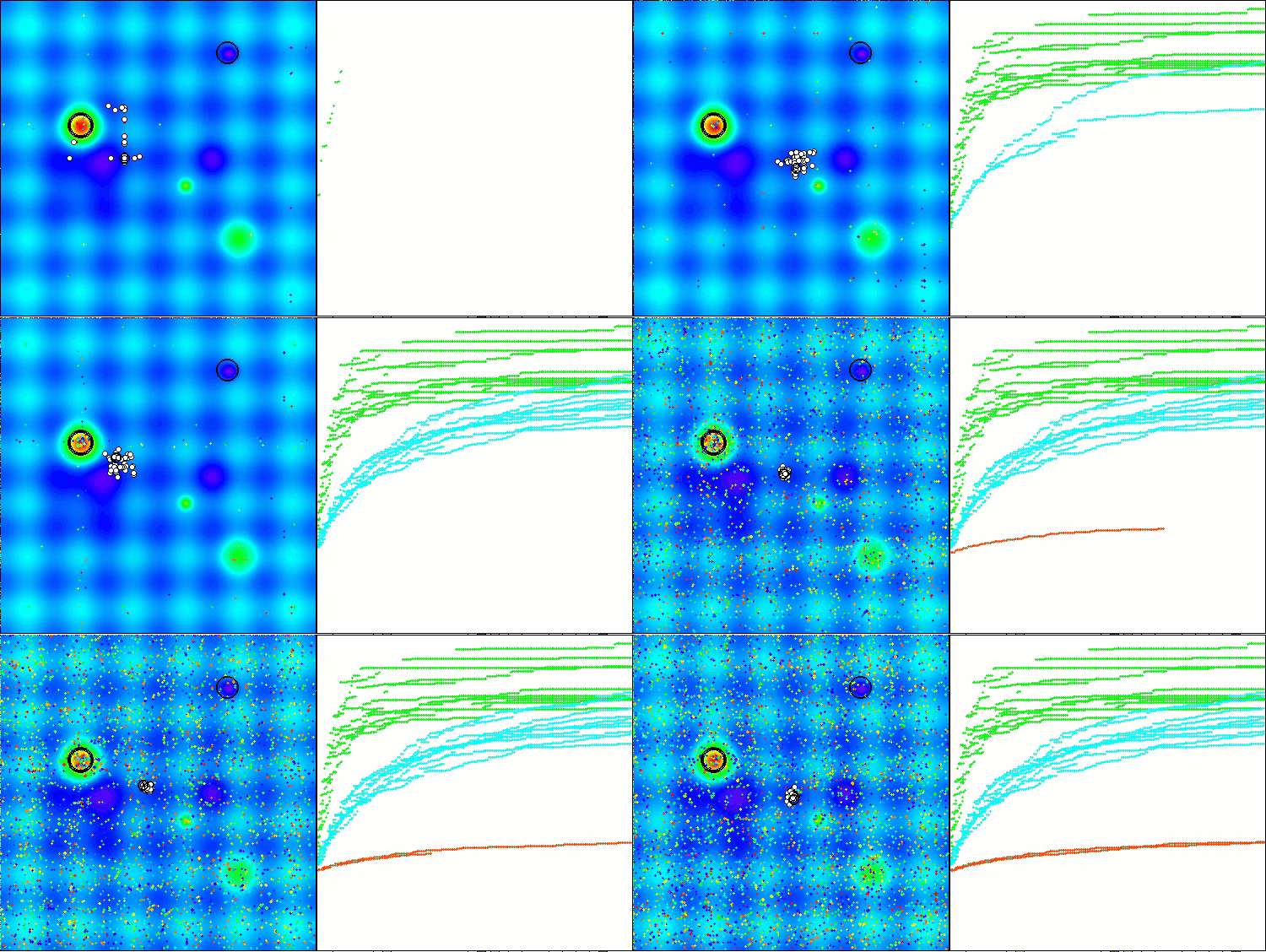
Hilly 测试函数得出的 RFO
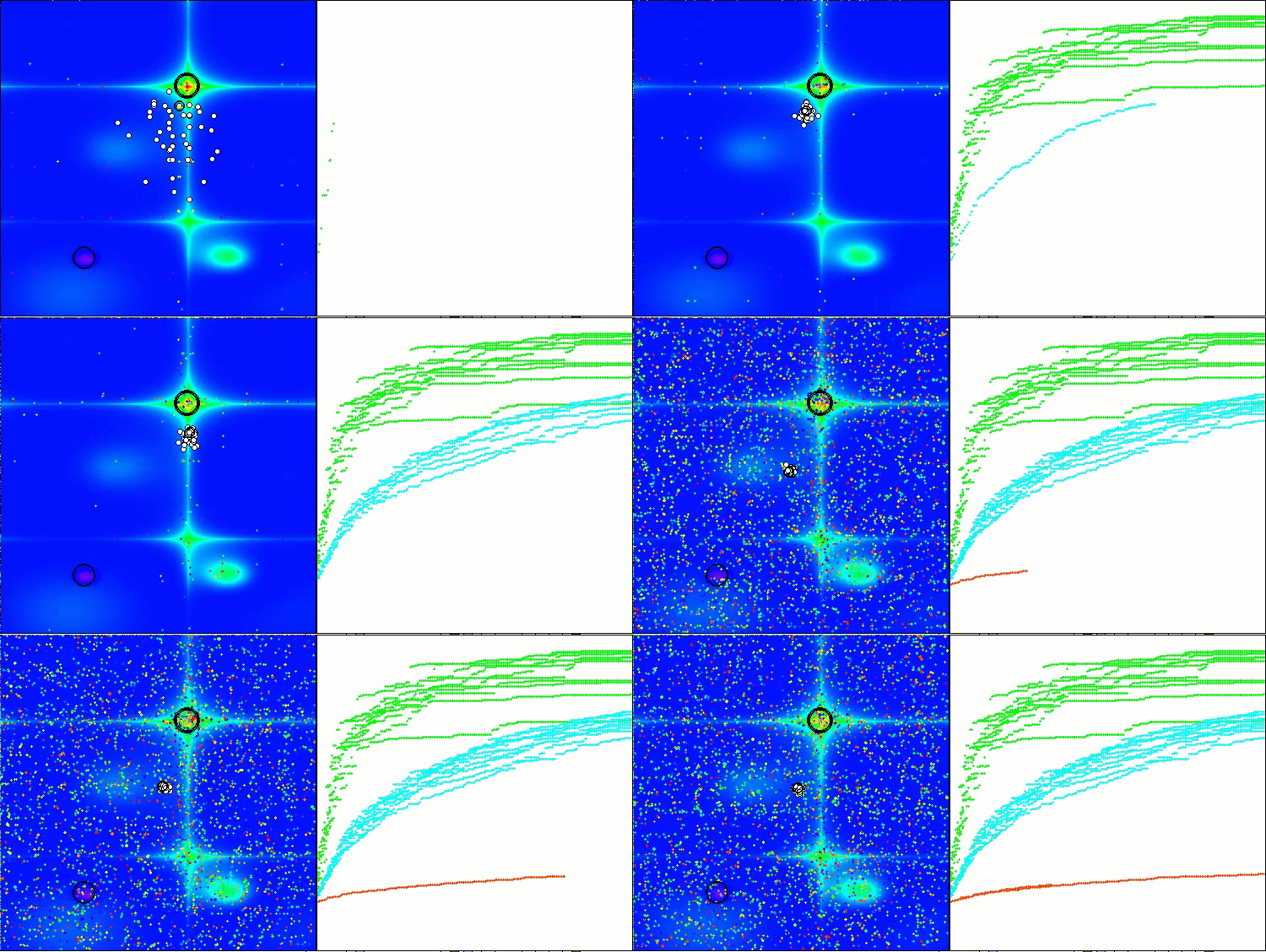
Forest 测试函数得出的 RFO
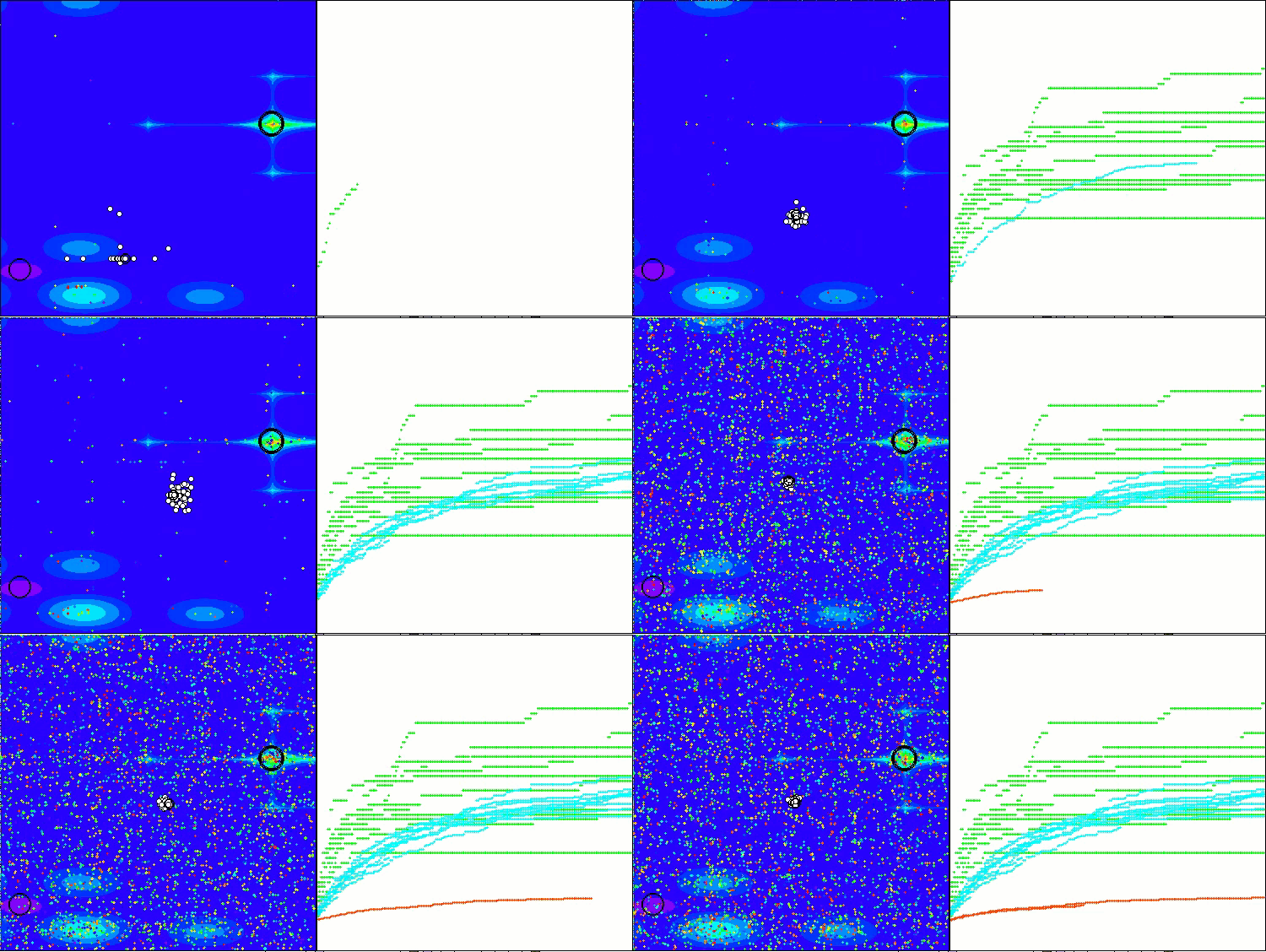
Megacity 测试函数得出的 RFO
基于测试结果,RFO 优化算法排位第 15,入选最强已知算法的行列。
| # | AO | 说明 | Hilly | Hilly 最终 | Forest | Forest 最终 | Megacity (离散) | Megacity 最终 | 最终结果 | 最大 % | ||||||
| 10 p (5 F) | 50 p (25 F) | 1000 p (500 F) | 10 p (5 F) | 50 p (25 F) | 1000 p (500 F) | 10 p (5 F) | 50 p (25 F) | 1000 p (500 F) | ||||||||
| 1 | ANS | 跨邻域搜索 | 0.94948 | 0.84776 | 0.43857 | 2.23581 | 1.00000 | 0.92334 | 0.39988 | 2.32323 | 0.70923 | 0.63477 | 0.23091 | 1.57491 | 6.134 | 68.15 |
| 2 | CLA | 密码锁算法(joo) | 0.95345 | 0.87107 | 0.37590 | 2.20042 | 0.98942 | 0.91709 | 0.31642 | 2.22294 | 0.79692 | 0.69385 | 0.19303 | 1.68380 | 6.107 | 67.86 |
| 3 | AMOm | 动物迁徙优化 M | 0.90358 | 0.84317 | 0.46284 | 2.20959 | 0.99001 | 0.92436 | 0.46598 | 2.38034 | 0.56769 | 0.59132 | 0.23773 | 1.39675 | 5.987 | 66.52 |
| 4 | (P+O)ES | (P+O)进化策略 | 0.92256 | 0.88101 | 0.40021 | 2.20379 | 0.97750 | 0.87490 | 0.31945 | 2.17185 | 0.67385 | 0.62985 | 0.18634 | 1.49003 | 5.866 | 65.17 |
| 5 | CTA | 彗尾算法(joo) | 0.95346 | 0.86319 | 0.27770 | 2.09435 | 0.99794 | 0.85740 | 0.33949 | 2.19484 | 0.88769 | 0.56431 | 0.10512 | 1.55712 | 5.846 | 64.96 |
| 6 | TETA | 时间演化旅行算法(joo) | 0.91362 | 0.82349 | 0.31990 | 2.05701 | 0.97096 | 0.89532 | 0.29324 | 2.15952 | 0.73462 | 0.68569 | 0.16021 | 1.58052 | 5.797 | 64.41 |
| 7 | SDSm | 随机扩散搜索 M | 0.93066 | 0.85445 | 0.39476 | 2.17988 | 0.99983 | 0.89244 | 0.19619 | 2.08846 | 0.72333 | 0.61100 | 0.10670 | 1.44103 | 5.709 | 63.44 |
| 8 | AAm | 射箭算法 M | 0.91744 | 0.70876 | 0.42160 | 2.04780 | 0.92527 | 0.75802 | 0.35328 | 2.03657 | 0.67385 | 0.55200 | 0.23738 | 1.46323 | 5.548 | 61.64 |
| 9 | ESG | 社会群体演变(joo) | 0.99906 | 0.79654 | 0.35056 | 2.14616 | 1.00000 | 0.82863 | 0.13102 | 1.95965 | 0.82333 | 0.55300 | 0.04725 | 1.42358 | 5.529 | 61.44 |
| 10 | SIA | 模拟各向同性退火(joo) | 0.95784 | 0.84264 | 0.41465 | 2.21513 | 0.98239 | 0.79586 | 0.20507 | 1.98332 | 0.68667 | 0.49300 | 0.09053 | 1.27020 | 5.469 | 60.76 |
| 11 | ACS | 人工协同搜索 | 0.75547 | 0.74744 | 0.30407 | 1.80698 | 1.00000 | 0.88861 | 0.22413 | 2.11274 | 0.69077 | 0.48185 | 0.13322 | 1.30583 | 5.226 | 58.06 |
| 12 | DA | 辩证算法 | 0.86183 | 0.70033 | 0.33724 | 1.89940 | 0.98163 | 0.72772 | 0.28718 | 1.99653 | 0.70308 | 0.45292 | 0.16367 | 1.31967 | 5.216 | 57.95 |
| 13 | BHAm | 黑洞算法 M | 0.75236 | 0.76675 | 0.34583 | 1.86493 | 0.93593 | 0.80152 | 0.27177 | 2.00923 | 0.65077 | 0.51646 | 0.15472 | 1.32195 | 5.196 | 57.73 |
| 14 | ASO | 无政府社会优化 | 0.84872 | 0.74646 | 0.31465 | 1.90983 | 0.96148 | 0.79150 | 0.23803 | 1.99101 | 0.57077 | 0.54062 | 0.16614 | 1.27752 | 5.178 | 57.54 |
| 15 | RFO | 皇冠同花顺优化(joo) | 0.83361 | 0.73742 | 0.34629 | 1.91733 | 0.89424 | 0.73824 | 0.24098 | 1.87346 | 0.63154 | 0.50292 | 0.16421 | 1.29867 | 5.089 | 56.55 |
| 16 | AOSm | 原子轨道搜索 M | 0.80232 | 0.70449 | 0.31021 | 1.81702 | 0.85660 | 0.69451 | 0.21996 | 1.77107 | 0.74615 | 0.52862 | 0.14358 | 1.41835 | 5.006 | 55.63 |
| 17 | TSEA | 龟壳进化算法(joo) | 0.96798 | 0.64480 | 0.29672 | 1.90949 | 0.99449 | 0.61981 | 0.22708 | 1.84139 | 0.69077 | 0.42646 | 0.13598 | 1.25322 | 5.004 | 55.60 |
| 18 | DE | 差别演化 | 0.95044 | 0.61674 | 0.30308 | 1.87026 | 0.95317 | 0.78896 | 0.16652 | 1.90865 | 0.78667 | 0.36033 | 0.02953 | 1.17653 | 4.955 | 55.06 |
| 19 | CRO | 化学反应优化 | 0.94629 | 0.66112 | 0.29853 | 1.90593 | 0.87906 | 0.58422 | 0.21146 | 1.67473 | 0.75846 | 0.42646 | 0.12686 | 1.31178 | 4.892 | 54.36 |
| 20 | BSA | 鸟群算法 | 0.89306 | 0.64900 | 0.26250 | 1.80455 | 0.92420 | 0.71121 | 0.24939 | 1.88479 | 0.69385 | 0.32615 | 0.10012 | 1.12012 | 4.809 | 53.44 |
| 21 | HS | 和声搜索 | 0.86509 | 0.68782 | 0.32527 | 1.87818 | 0.99999 | 0.68002 | 0.09590 | 1.77592 | 0.62000 | 0.42267 | 0.05458 | 1.09725 | 4.751 | 52.79 |
| 22 | SSG | 树苗播种和生长 | 0.77839 | 0.64925 | 0.39543 | 1.82308 | 0.85973 | 0.62467 | 0.17429 | 1.65869 | 0.64667 | 0.44133 | 0.10598 | 1.19398 | 4.676 | 51.95 |
| 23 | BCOm | 细菌趋化性优化 M | 0.75953 | 0.62268 | 0.31483 | 1.69704 | 0.89378 | 0.61339 | 0.22542 | 1.73259 | 0.65385 | 0.42092 | 0.14435 | 1.21912 | 4.649 | 51.65 |
| 24 | ABO | 非洲水牛优化 | 0.83337 | 0.62247 | 0.29964 | 1.75548 | 0.92170 | 0.58618 | 0.19723 | 1.70511 | 0.61000 | 0.43154 | 0.13225 | 1.17378 | 4.634 | 51.49 |
| 25 | (PO)ES | (PO)进化策略 | 0.79025 | 0.62647 | 0.42935 | 1.84606 | 0.87616 | 0.60943 | 0.19591 | 1.68151 | 0.59000 | 0.37933 | 0.11322 | 1.08255 | 4.610 | 51.22 |
| 26 | TSm | 禁忌搜索 M | 0.87795 | 0.61431 | 0.29104 | 1.78330 | 0.92885 | 0.51844 | 0.19054 | 1.63783 | 0.61077 | 0.38215 | 0.12157 | 1.11449 | 4.536 | 50.40 |
| 27 | BSO | 头脑风暴优化 | 0.93736 | 0.57616 | 0.29688 | 1.81041 | 0.93131 | 0.55866 | 0.23537 | 1.72534 | 0.55231 | 0.29077 | 0.11914 | 0.96222 | 4.498 | 49.98 |
| 28 | WOAm | wale 优化算法 M | 0.84521 | 0.56298 | 0.26263 | 1.67081 | 0.93100 | 0.52278 | 0.16365 | 1.61743 | 0.66308 | 0.41138 | 0.11357 | 1.18803 | 4.476 | 49.74 |
| 29 | AEFA | 人工电场算法 | 0.87700 | 0.61753 | 0.25235 | 1.74688 | 0.92729 | 0.72698 | 0.18064 | 1.83490 | 0.66615 | 0.11631 | 0.09508 | 0.87754 | 4.459 | 49.55 |
| 30 | AEO | 基于人工生态系统的优化算法 | 0.91380 | 0.46713 | 0.26470 | 1.64563 | 0.90223 | 0.43705 | 0.21400 | 1.55327 | 0.66154 | 0.30800 | 0.28563 | 1.25517 | 4.454 | 49.49 |
| 31 | ACOm | 蚁群优化 M | 0.88190 | 0.66127 | 0.30377 | 1.84693 | 0.85873 | 0.58680 | 0.15051 | 1.59604 | 0.59667 | 0.37333 | 0.02472 | 0.99472 | 4.438 | 49.31 |
| 32 | BFO-GA | 细菌觅食优化 - ga | 0.89150 | 0.55111 | 0.31529 | 1.75790 | 0.96982 | 0.39612 | 0.06305 | 1.42899 | 0.72667 | 0.27500 | 0.03525 | 1.03692 | 4.224 | 46.93 |
| 33 | SOA | 简单优化算法 | 0.91520 | 0.46976 | 0.27089 | 1.65585 | 0.89675 | 0.37401 | 0.16984 | 1.44060 | 0.69538 | 0.28031 | 0.10852 | 1.08422 | 4.181 | 46.45 |
| 34 | ABHA | 人工蜂巢算法 | 0.84131 | 0.54227 | 0.26304 | 1.64663 | 0.87858 | 0.47779 | 0.17181 | 1.52818 | 0.50923 | 0.33877 | 0.10397 | 0.95197 | 4.127 | 45.85 |
| 35 | ACMO | 大气云团模型优化 | 0.90321 | 0.48546 | 0.30403 | 1.69270 | 0.80268 | 0.37857 | 0.19178 | 1.37303 | 0.62308 | 0.24400 | 0.10795 | 0.97503 | 4.041 | 44.90 |
| 36 | ADAMm | 自适应动量估算 M | 0.88635 | 0.44766 | 0.26613 | 1.60014 | 0.84497 | 0.38493 | 0.16889 | 1.39880 | 0.66154 | 0.27046 | 0.10594 | 1.03794 | 4.037 | 44.85 |
| 37 | ATAm | 人工部落算法 M | 0.71771 | 0.55304 | 0.25235 | 1.52310 | 0.82491 | 0.55904 | 0.20473 | 1.58867 | 0.44000 | 0.18615 | 0.09411 | 0.72026 | 3.832 | 42.58 |
| 38 | ASHA | 人工洒水算法 | 0.89686 | 0.40433 | 0.25617 | 1.55737 | 0.80360 | 0.35526 | 0.19160 | 1.35046 | 0.47692 | 0.18123 | 0.09774 | 0.75589 | 3.664 | 40.71 |
| 39 | ASBO | 自适应社会行为优化 | 0.76331 | 0.49253 | 0.32619 | 1.58202 | 0.79546 | 0.40035 | 0.26097 | 1.45677 | 0.26462 | 0.17169 | 0.18200 | 0.61831 | 3.657 | 40.63 |
| 40 | MEC | 思维进化计算 | 0.69533 | 0.53376 | 0.32661 | 1.55569 | 0.72464 | 0.33036 | 0.07198 | 1.12698 | 0.52500 | 0.22000 | 0.04198 | 0.78698 | 3.470 | 38.55 |
| 41 | IWO | 入侵性杂草优化 | 0.72679 | 0.52256 | 0.33123 | 1.58058 | 0.70756 | 0.33955 | 0.07484 | 1.12196 | 0.42333 | 0.23067 | 0.04617 | 0.70017 | 3.403 | 37.81 |
| 42 | Micro-AIS | 微型人工免疫系统 | 0.79547 | 0.51922 | 0.30861 | 1.62330 | 0.72956 | 0.36879 | 0.09398 | 1.19233 | 0.37667 | 0.15867 | 0.02802 | 0.56335 | 3.379 | 37.54 |
| 43 | COAm | 布谷鸟优化算法 M | 0.75820 | 0.48652 | 0.31369 | 1.55841 | 0.74054 | 0.28051 | 0.05599 | 1.07704 | 0.50500 | 0.17467 | 0.03380 | 0.71347 | 3.349 | 37.21 |
| 44 | SDOm | 螺旋动力学优化 M | 0.74601 | 0.44623 | 0.29687 | 1.48912 | 0.70204 | 0.34678 | 0.10944 | 1.15826 | 0.42833 | 0.16767 | 0.03663 | 0.63263 | 3.280 | 36.44 |
| 45 | NMm | Nelder-Mead 方法 M | 0.73807 | 0.50598 | 0.31342 | 1.55747 | 0.63674 | 0.28302 | 0.08221 | 1.00197 | 0.44667 | 0.18667 | 0.04028 | 0.67362 | 3.233 | 35.92 |
| RW | 随机游走 | 0.48754 | 0.32159 | 0.25781 | 1.06694 | 0.37554 | 0.21944 | 0.15877 | 0.75375 | 0.27969 | 0.14917 | 0.09847 | 0.52734 | 2.348 | 26.09 | |
摘要
在研究和开发新的优化方法时,我们往往面临在效率与实现复度性之间寻求平衡的需求。皇冠同花顺优化(RFO)算法的研究成果亦引发了关于优化本质及改进方法的有趣问题。
通过观察算法的性能表现,其已达到理论最大值的 57%,我们见识到一个有趣的现象:有时简化比复杂化更有价值。RFO 证明,放弃复杂的二进制编码,转而采用更直接的基于扇区的方法,能够在维持足够高品质解的同时,显著提升算法性能。这令人联想到扑克牌中的状况,有时简单但更快的策略,比需要长时间计算的复杂策略更有效。
在思考 RFO 在优化算法家族中的地位时,可将其比作车辆的演变。正如节能城市车与强劲跑车的需求一样,优化算法领域同样存在专注不同优先级的方法空间。RFO 可被视为遗传算法的“低成本”变体,在性能与资源效率之间提供了合理的权衡。
总之,值得注意的是,RFO 的发展为进一步研究打开了有趣的前景。这或许只是基于扇区优化方法开发整一系列算法的第一步。该方法简洁优雅,结合其实用性,能成为创造平衡性能与计算效率新算法的灵感来源。
值得注意的是,扇区的划分是虚拟的,并未以数组形式分配内存。该 RFO 框架是进一步开发扑克牌算法改进版本的绝佳起点。
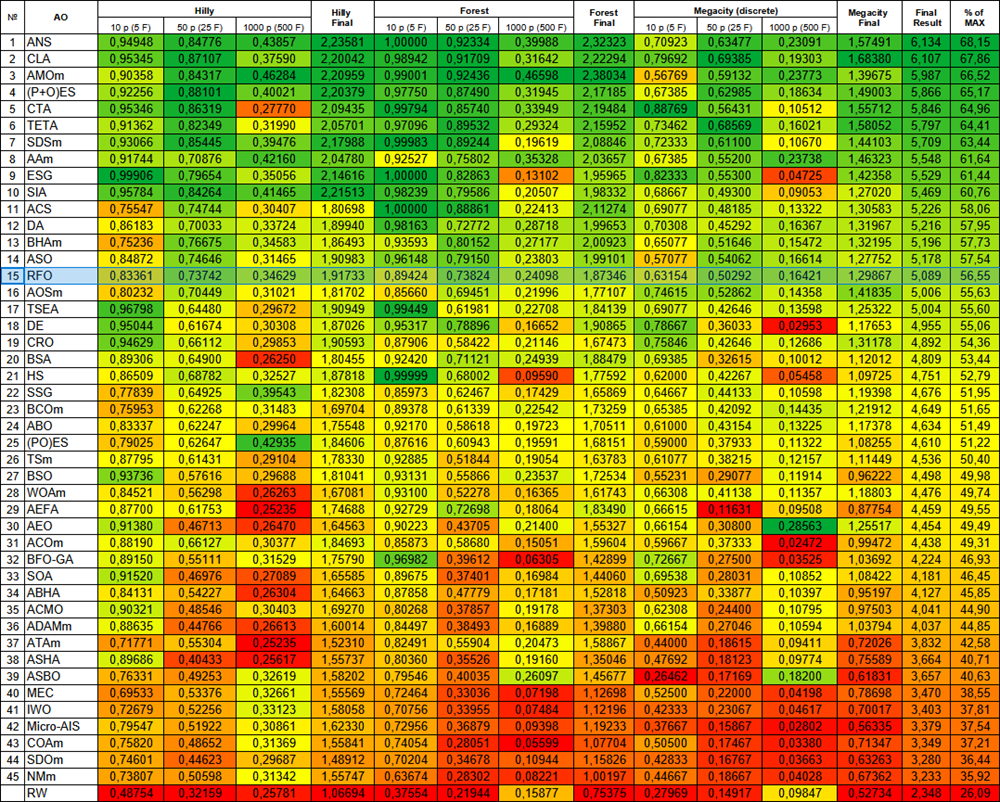
图例 2. 算法的颜色渐变根据相应测试
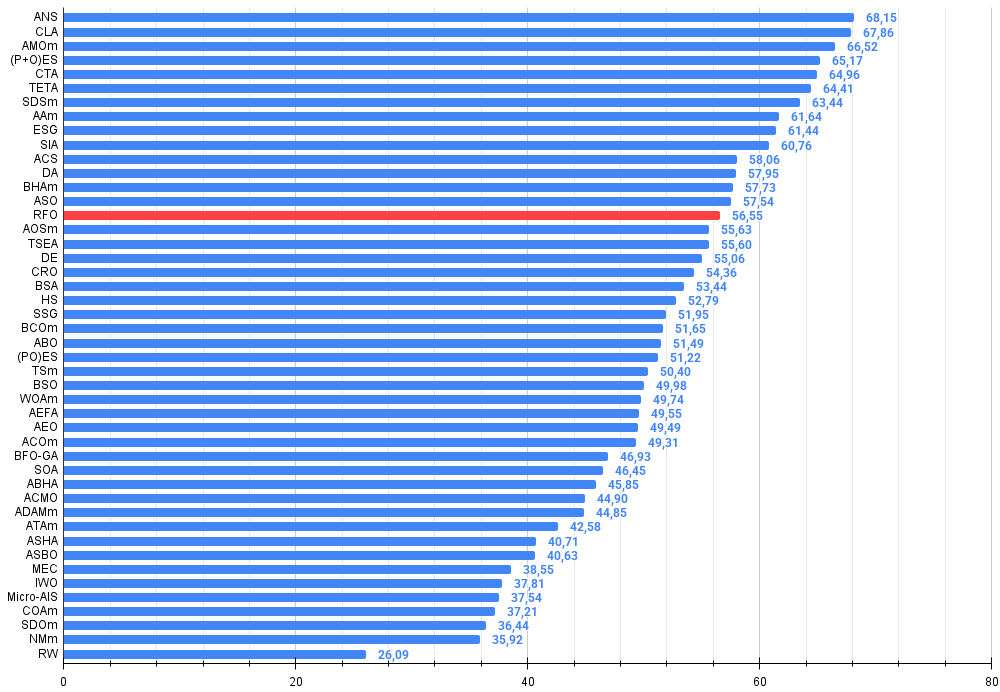
图例 3. 算法测试结果的直方图(从 0 到 100 刻度,越高越好,100 是理论上的最大可能结果,存档中有计算评分表的脚本)
RFO 优缺点:
优点:
- 外部参数很少,仅有两个,不包括种群规模。
- 简单的实现。
- 快速。
- 平衡良好,在多个维度的任务中表现出色。
缺点:
- 收敛准确率平均。
文章附有当前版本算法代码的存档。本文作者不对规范算法描述的绝对准确性负责。许多部分都进行了修改,以变提升搜索能力。文章中所给出的结论和判断基于实验结果。
文章中用到的程序
| # | 名称 | 类型 | 说明 |
|---|---|---|---|
| 1 | #C_AO.mqh | 包含 | 种群优化算法的父类 |
| 2 | #C_AO_enum.mqh | 包含 | 种群优化算法的枚举 |
| 3 | TestFunctions.mqh | 包含 | 测试函数库 |
| 4 | TestStandFunctions.mqh | 包含 | 测试台函数库 |
| 5 | Utilities.mqh | 包含 | 辅助函数库 |
| 6 | CalculationTestResults.mqh | 包含 | 比较表格中计算结果的脚本 |
| 7 | Testing AOs.mq5 | 脚本 | 所有种群优化算法的统一测试台 |
| 8 | Simple use of population optimization algorithms.mq5 | 脚本 | 一个简单的示例,用无可视化的群体优化算法 |
| 9 | Test_AO_RFO.mq5 | 脚本 | RFO 测试台 |
本文由MetaQuotes Ltd译自俄文
原文地址: https://www.mql5.com/ru/articles/17063
注意: MetaQuotes Ltd.将保留所有关于这些材料的权利。全部或部分复制或者转载这些材料将被禁止。
本文由网站的一位用户撰写,反映了他们的个人观点。MetaQuotes Ltd 不对所提供信息的准确性负责,也不对因使用所述解决方案、策略或建议而产生的任何后果负责。


 MQL5 中的交易策略自动化(第十五部分):可视化价格行为的谐波形态模式
 MQL5交易策略自动化(第十六部分):基于结构突破(BoS)价格行为的午夜区间突破策略
 交易中的神经网络:层次化双塔变换器(终篇)

在所有情况下,都需要在众多可能的解决方案中找到最佳解决方案。例如,具有自我优化功能 的顾问。