Anti EMA MT4
- Indicators
-
Evgeny Belyaev
 By subscribing to my MQL5 channel: https://www.mql5.com/en/channels/trendscalper , you will learn a lot of useful information about Forex and cryptocurrency trading.
 - Version: 1.0
- Activations: 5
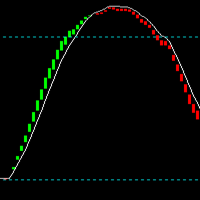
Trend trading is a strategy where traders aim to enter positions in the direction of the primary price movement and hold them until the trend reverses. Anti EMA MT4 is a professional indicator for the MetaTrader 4 terminal that can be a useful tool in such trading because it focuses on long-term price data, helping to identify sustained moves and avoid false signals caused by short-term fluctuations.
MetaTrader 5 version of Anti EMA: https://www.mql5.com/en/market/product/152766
One of the key differences between Anti EMA and conventional moving averages, such as the Simple Moving Average (SMA) or Exponential Moving Average (EMA), lies in weight distribution. Standard moving averages assign weights either uniformly or with decreasing emphasis on older prices, making them more sensitive to recent price action. In contrast, Anti EMA assigns greater weight to older prices and less to newer ones. This creates a line that better reflects historical context and is less reactive to market noise. For example, if a trend is just beginning to form, a standard EMA might quickly respond to a price spike, whereas this indicator incorporates more historical data to confirm whether the movement is genuinely sustainable.
In practice, this means the indicator helps filter out noise and highlight genuine trends. When price moves consistently in one direction, the indicator’s line will smoothly follow, acting as dynamic support or resistance. Traders can use it for entries—for instance, opening a long position when price closes above the line while the previous bar closed below, signaling a potential start of an uptrend. Bar-open alerts add convenience by notifying you of potential entry points without requiring constant chart monitoring.
Additionally, the time filter allows you to focus on active trading periods when trends are more likely to develop, reducing unnecessary signals outside trading sessions. This is especially useful for traders operating in volatile markets where conventional indicators may generate excessive false signals.
Anti EMA can be applied across various instruments: currency pairs, cryptocurrencies (Bitcoin, Ethereum, Solana), stocks (Apple or Tesla), stock indices (S&P 500 or NASDAQ), gold, and other metals—helping confirm robust trends and filter out market noise.
Ultimately, this indicator suits traders who prefer long-term analysis and seek a tool that emphasizes trend sustainability rather than reacting to every minor fluctuation. If you already use moving averages and wish to explore a variant that emphasizes historical data, this indicator can complement your strategy and support more confident decision-making.
Indicator Settings
The Anti EMA indicator offers flexible settings that allow you to tailor it to your trading strategy.
Below, I describe each parameter in detail to help you easily configure the tool to your needs.
- Period:
This is the core parameter defining the number of bars (candles) used to calculate the indicator. The default may be 14, but you can set it from 1 to 1000 or higher, depending on your timeframe.
A smaller period (e.g., 5–10) makes the line more responsive to price changes, useful for short-term trading but potentially increasing noise.
A larger period (20–50+) smooths the indicator, highlighting long-term trends and better filtering false signals. Recommendation: for daily charts, start with 21 to capture sustained moves without excessive noise.
- Applied price:
Selects the price type used in the calculation. The standard option is Close (closing price), which reflects the final outcome of the bar and suits trend analysis.
Other options include Open, High, Low, Median (average of High and Low), Typical (average of High, Low, and Close), or Weighted (weighted toward Close).
For this indicator, which emphasizes historical context, Close or Typical often work best as they incorporate the full range of the bar.
If trading volatile assets like cryptocurrencies, try Median to smooth out extreme spikes.
- Enable alerts in terminal:
A boolean switch (true/false) that activates sound and text notifications directly within the trading terminal.
When price crosses the indicator line (an entry signal), the indicator triggers an alert with a description, e.g., "Buy signal on EUR/USD H1".
This is convenient for traders unable to monitor charts continuously. Enable it if you're a beginner or trade manually—it saves time and helps avoid missing key moments.
- Enable push notifications:
Another boolean switch (true/false) that sends alerts to your mobile device via the MetaTrader 4 app.
It works similarly to terminal alerts but delivers real-time signals to your smartphone, even when the terminal is closed.
Ideal for mobile traders or those on the go. Ensure push notifications are enabled in your MT4 settings.
- Trading time filter:
Enables/disables (true/false) a time-based filter that restricts signals to specific hours only.
Useful for avoiding low-liquidity periods (e.g., nighttime in Forex) or focusing on active sessions (London or New York).
When enabled, the indicator ignores crossovers outside the specified window, reducing false signals.
For cryptocurrency markets, which operate 24/7, this may be less relevant, but for stocks or indices, it’s crucial to avoid signals during inactive hours.
- Trading session start hour:
An integer from 0 to 23 specifying the start hour of your active session in your broker’s terminal time (not your local computer time). For example, 8 means 08:00. Used together with the end hour. For the European session, try 7; for the U.S. session, use 13. This helps align the indicator with your region. Default is 0, which disables the filter.
- Trading session end hour:
An integer from 0 to 23 indicating the end of the session in your broker’s terminal time (not your local computer time). For example, 17 means 17:00. Works with the start hour to define a “window” for valid signals.
For a session from 9:00 to 17:00, set 9 and 17. Particularly useful in Forex to filter out noise from the Asian session.
A reliable assistant in trend trading
The Anti EMA indicator offers an innovative approach to trend assessment by prioritizing historical data to reduce sensitivity to market noise. This makes it suitable for a wide range of assets—from stock indices to precious metals—effectively filtering false signals and revealing the true potential of trending moves.
If you’re interested in indicators and trading tips, subscribe to my channel: https://www.mql5.com/en/channels/trendscalper . You’ll find useful tools for your strategies there.