
Signal Binary Option
- Indicators
- Konstantin Chechnev
- Version: 3.0
- Updated: 30 November 2025
- Activations: 5
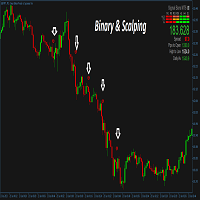
Signal indicator for binary options that is also used effectively on Forex and other markets. It is suitable for short-term grid trading on M1–M5 and includes step-by-step position scaling signals.
The indicator uses two-level adaptation: a basic speed profile (a “fast/smooth” setting right from the start) and auto-adaptation based on trade results, which adjusts the filters to the current market, taking into account series of winning and losing signals.
The model looks for short directional impulses on the chart and marks them with CALL (buy) and PUT (sell) arrows at bar close, without repainting. The indicator can also be used on classic Forex/CFD accounts, but due to the short trade horizon it is important to control spread and commissions so that costs do not “eat up” the main part of the move.
How it works
-
Uses its own multi-stage adaptive forecasting model instead of a standard set of classical indicators;
-
Analyzes the shape and slope of price movement, trend, and local volatility;
-
Processes signals through several levels of filtering for noise and abnormal spikes;
-
Prints an arrow only after all internal checks are passed — intelligent smoothing, anti-trend rejection logic, an adaptive extremes filter (tries not to give a signal at a potential reversal point), and a lightweight neural submodule that adjusts online to the market and blocks signals against its own forecast;
-
Uses auto-adaptation based on signal quality: tracks series of winning/losing trades, tightening or relaxing internal thresholds depending on statistics and drawdown depth;
-
A separate basic speed parameter defines the indicator’s character from the very beginning (fast-reacting, almost without smoothing, or smoother and more conservative), while auto-adaptation “fine-tunes” the parameters as history accumulates.
Key features
-
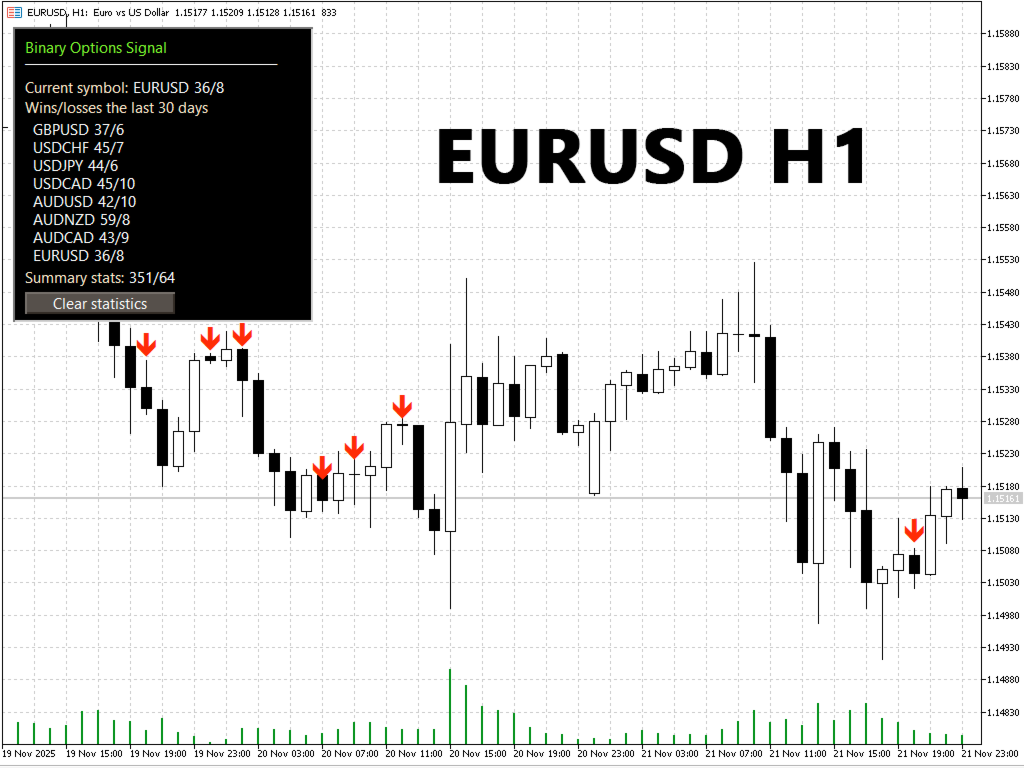
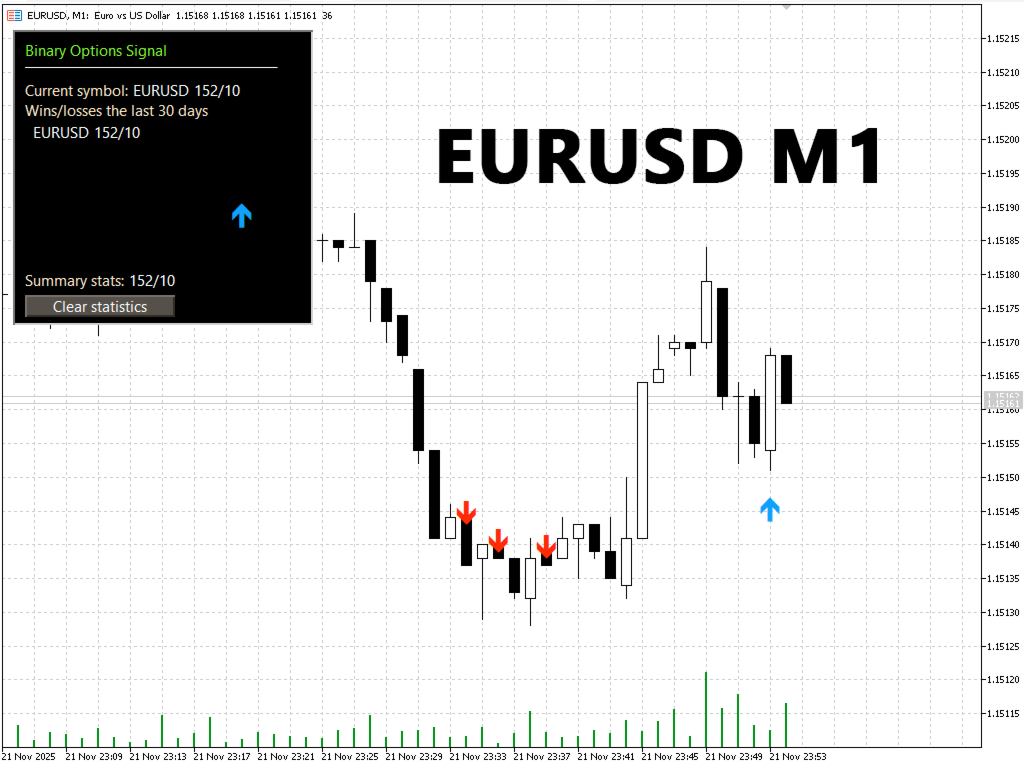
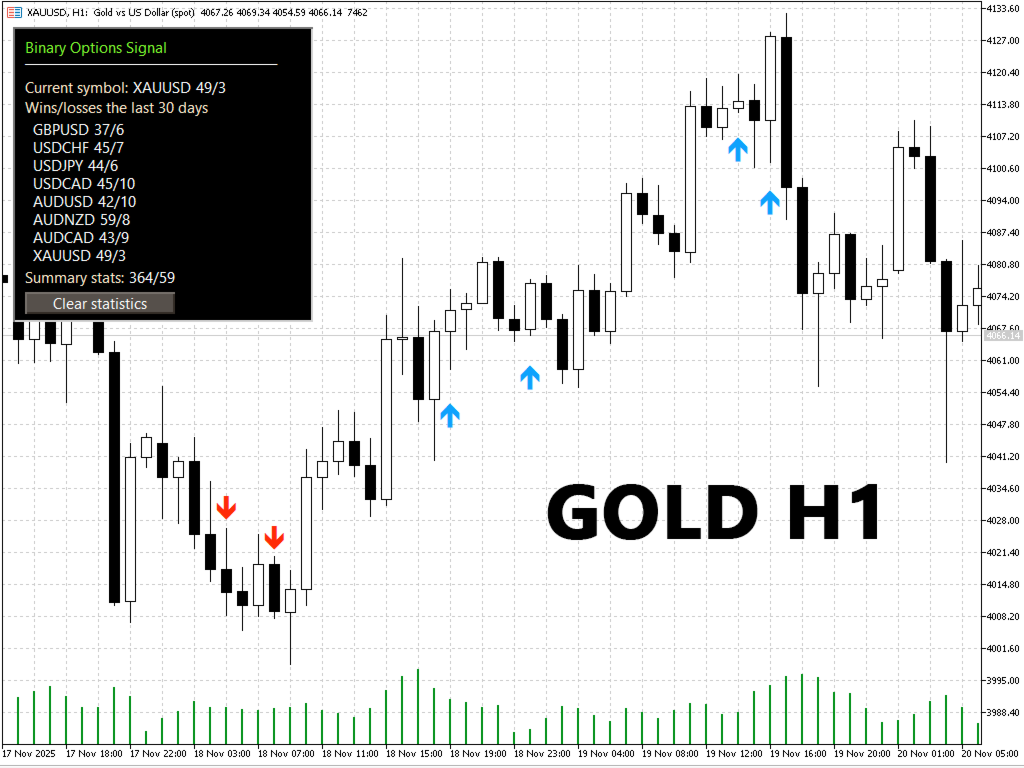
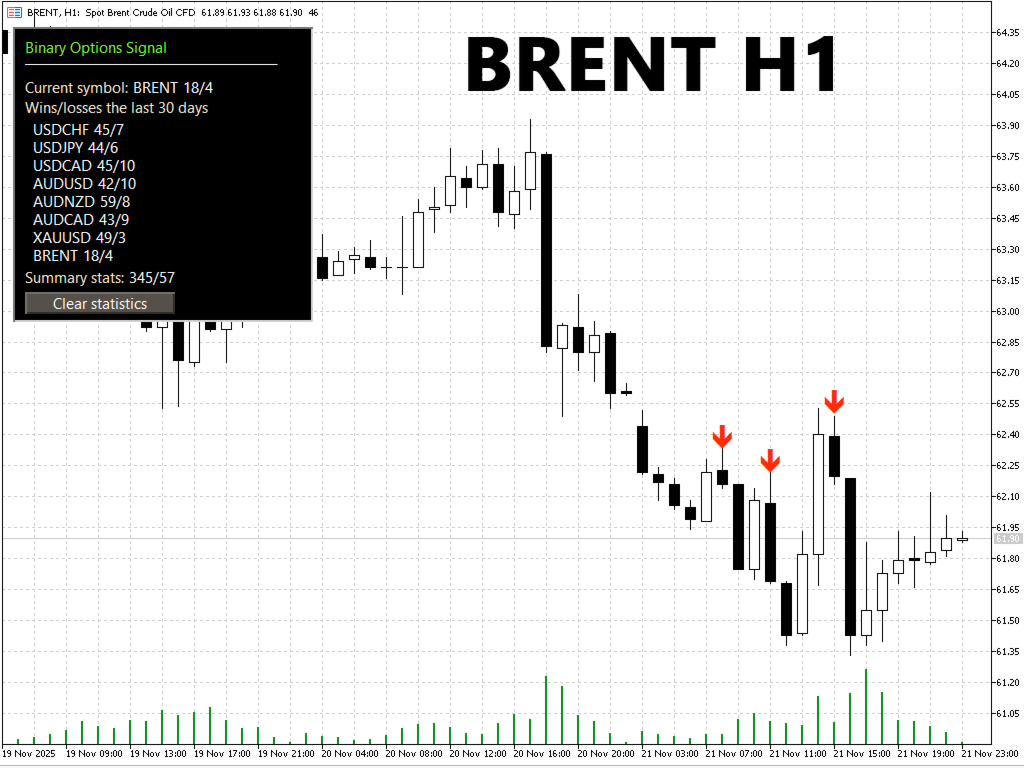
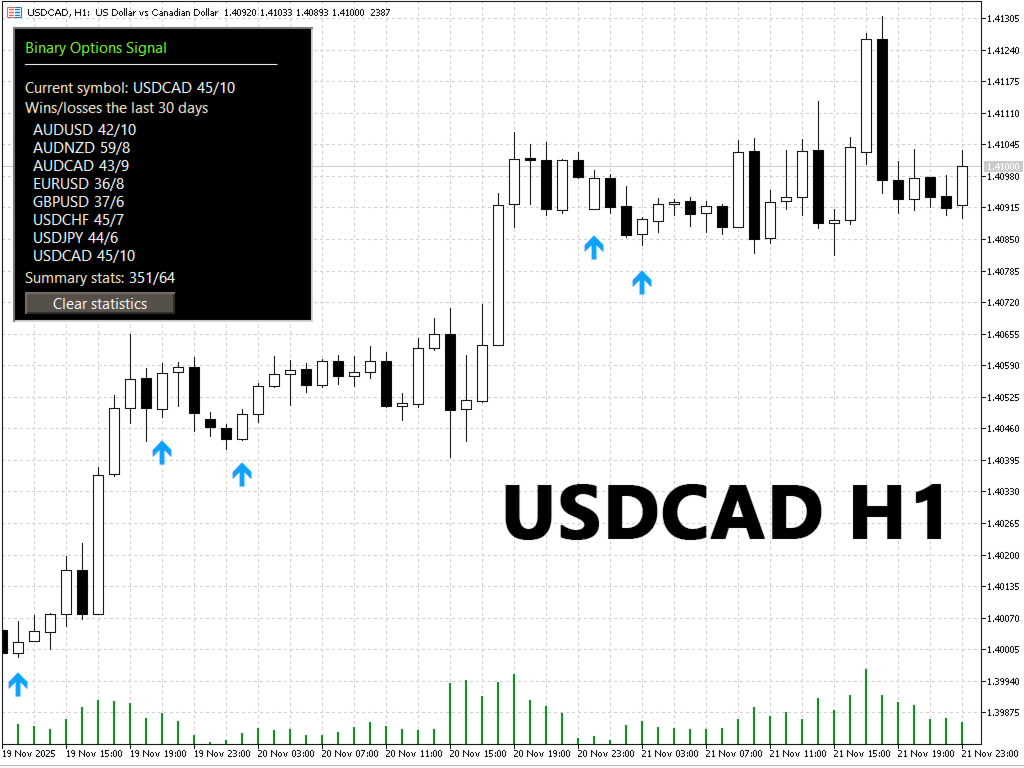
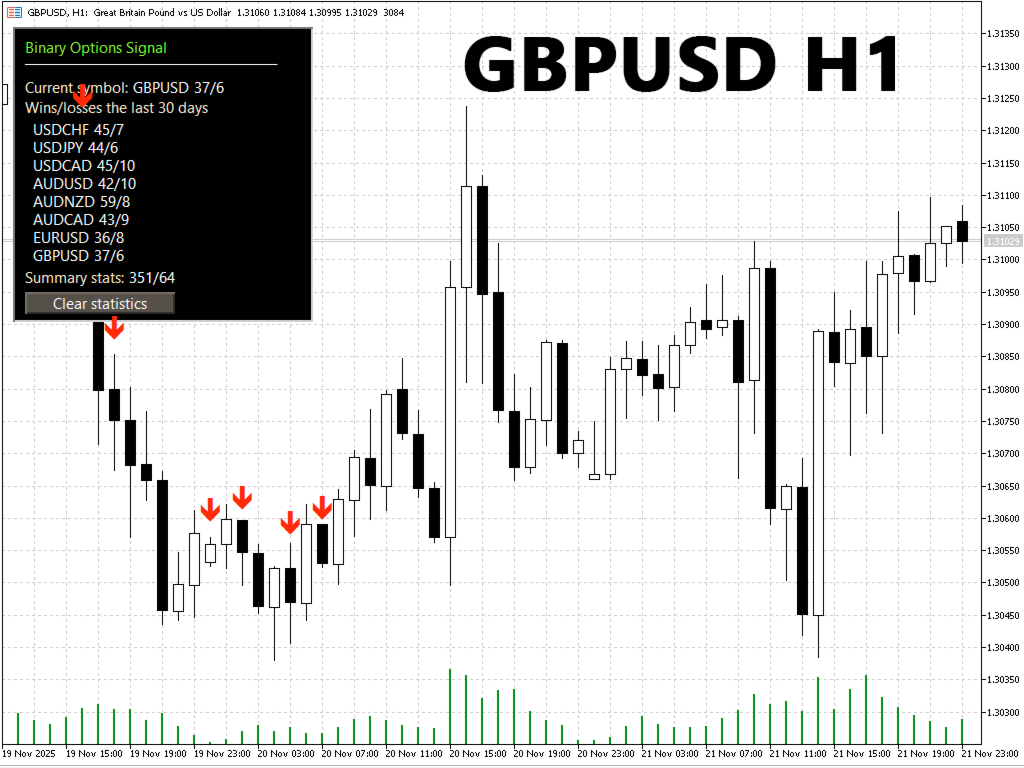
CALL/PUT arrow signals — arrow below the candle for buys, above the candle for sells;
-
Short-term trade focus — calculations are tuned to the nearest move over several bars, which is convenient for binary options and scalping entries;
-
Spike and extreme handling — dedicated filters help avoid entering the market on single spikes and “abnormal” bars that look like the final push of a move;
-
Adaptation to timeframe and volatility — basic speed/smoothness is set by a separate parameter, and auto-adaptation dynamically adjusts filter strictness based on recent results (win/loss series);
-
Built-in signal statistics — history, win/loss, total result in points, summary across several instruments, and the ability to reset statistics;
-
Multi-language support — automatic terminal language detection and automatic interface switching.
Practical value
The indicator helps quickly separate workable entry points from areas where it is better to wait: you simply see where the model suggests taking a direction (CALL/PUT) and where there are no signals. This simplifies decision-making in real time and reduces the number of chaotic trades.
The built-in statistics show how signals behaved historically, both for individual instruments and for the portfolio as a whole. This helps you select pairs, timeframes and settings for your own trading style and monitor the stability of the approach.
Auto-adaptation and the basic speed parameter allow you to use the same indicator both for more aggressive M1 grid work and for a calmer approach on higher timeframes, without manually “tweaking” dozens of internal parameters.
Important notes
The indicator does not trade automatically and does not guarantee profit. It provides analytical information about the current market state; the final result depends on the chosen instrument, timeframe, settings and personal trading system. Past performance does not guarantee future results.
Settings
Base Speed — basic speed/reactivity of the model.
Defines how the indicator works “out of the box”, before auto-adaptation starts to adjust anything.
Recommended range: 0.5…2.0.
-
Below 1.0 → smoother, more filtered start, less noise, fewer signals, focus on robustness;
-
Around 1.0 → balanced mode suitable for most instruments;
-
Above 1.0 → faster and more sensitive start: less smoothing, more potential signals, “fast” indicator mode.
For M1 it is usually set slightly above 1.0 (for example, 1.2–1.5), for H1 — closer to 1.0 or slightly below.
Aggressiveness of auto adaptation — auto-adaptation aggressiveness factor.
Defines how quickly and strongly the indicator reshapes its internal thresholds when statistics deteriorate or improve.
Recommended range: 0.0…5.0.
-
0.0–1.0 → soft adaptation, the model barely “jerks” parameters, changes are smooth;
-
1.0–3.0 → working range for live trading: reasonable balance between stability and responsiveness;
-
3.0–5.0 → aggressive adaptation: after loss series, the indicator quickly tightens filters, making signals rarer but more strict.
Max loss for enable auto adaptation — number of consecutive losing trades after which the enhanced adaptation mode is activated.
Recommended range: 1…10.
-
1 → maximum sensitivity: any single losing trade is treated as a reason to strengthen filtering (suitable for tests and aggressive scalping, but not for all markets);
-
2–3 → optimal for M1–M5: two–three losing trades in a row are considered a sign that the market has “broken” the current configuration and filters need to be tightened;
-
4 and above → calmer mode, suitable for higher timeframes and rare entries where single losses are not statistically significant.
Enable alert signal — enable/disable pop-up notifications when a signal appears.
-
true — on each new signal the indicator shows a pop-up window (and can play a sound/send notifications depending on terminal settings);
-
false — the indicator operates “silently”, signals are visible only on the chart and in the statistics panel.
All other internal parameters, periods and thresholds are calculated automatically and adjusted through the described auto-adaptation system — you do not need to manually tune dozens of values; it is enough to set three key parameters to match your trading style.



































-