
The Oracle Pro
- Indicators
-
Ottaviano De Cicco
 The best trades are already on your chart.
You just can't see them yet.
Merkava Labs: Institutional-grade MT5 systems that decode
what price has already revealed.
🌐 merkavalabs.com → See the structure.
📧 contact@merkavalabs.com - Version: 1.5
- Updated: 18 August 2026
- Activations: 10
The Oracle Pro: Synthetic Multi-Timeframe Bias Engine for MT5
☀️ Summer Launch Offer — Get The Oracle Pro for USD 199 (early buyers). Price rises with traction; final price USD 399.
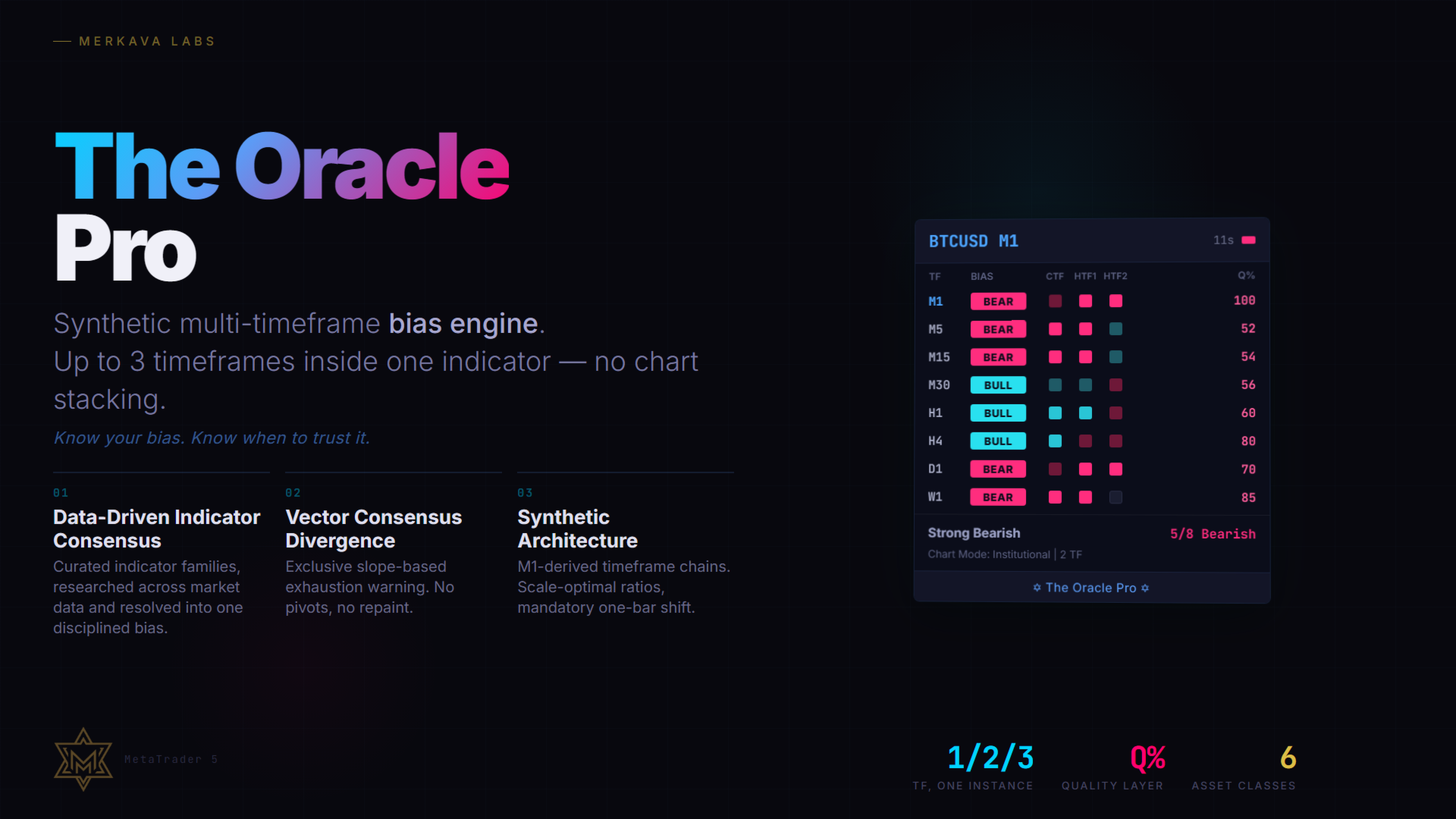
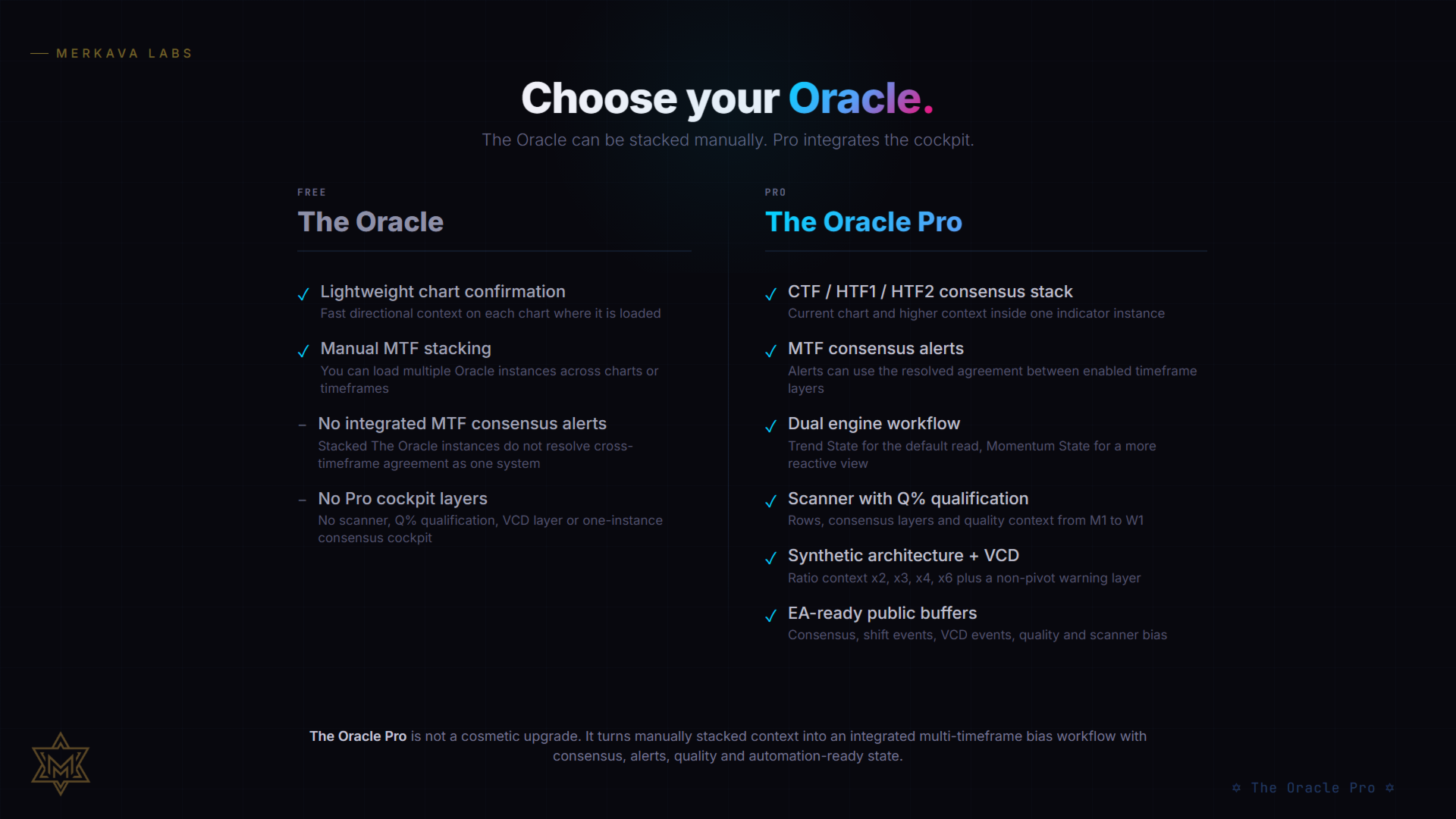
The Oracle Pro is a premium multi-timeframe bias engine for MetaTrader 5, built for demanding and professional traders. It answers one question with discipline: what is the directional bias on each timeframe right now, how strong is it, and how much do the timeframes agree? Everything is computed on closed bars only - no repainting.
The Oracle Pro is a multi-factor consensus system. It combines proprietary indicators and optimized algorithms into a single sophisticated consensus vector, then reads that vector across a current-timeframe and higher-timeframe stack inside one indicator instance - replacing the usual habit of stacking disconnected tools across several charts.
It is the professional evolution of the Oracle consensus approach: a complete rebuild as a premium operating console for traders who want depth, multi-timeframe context and divergence intelligence in one disciplined workflow.
A Bias Engine, Not a Signal Generator
The Oracle Pro is explicit about what it is. It is a multi-timeframe multi-factor bias indicator that gives you disciplined directional context. It is not a signal generator: it does not promise entries, exits or profits. The bias is context - you trade your own setups in its direction, and you stand down when the consensus is fractured or low quality. A filter that honestly says "not now" is the one you can trust when it says "now".
Built for Demanding Traders
- Sophisticated multi-factor consensus - the directional readout is built from a private multi-model architecture spanning several market dimensions, not from a single oscillator or trend line.
- One-instance MTF stack - current timeframe plus first and second higher timeframe are processed inside one indicator, with broker-aware anchoring for robust behavior around session gaps and post-weekend reconstruction.
- Exclusive Vector Consensus Divergence - VCD is available only inside The Oracle Pro across the Merkava Labs lineup.
- Dual state engine - choose the directional engine that fits your style: Trend State or Momentum State.
- Operating console - consensus bands, panel, scanner, quality readout, divergence markers and EA-ready buffers are designed as one professional workflow.
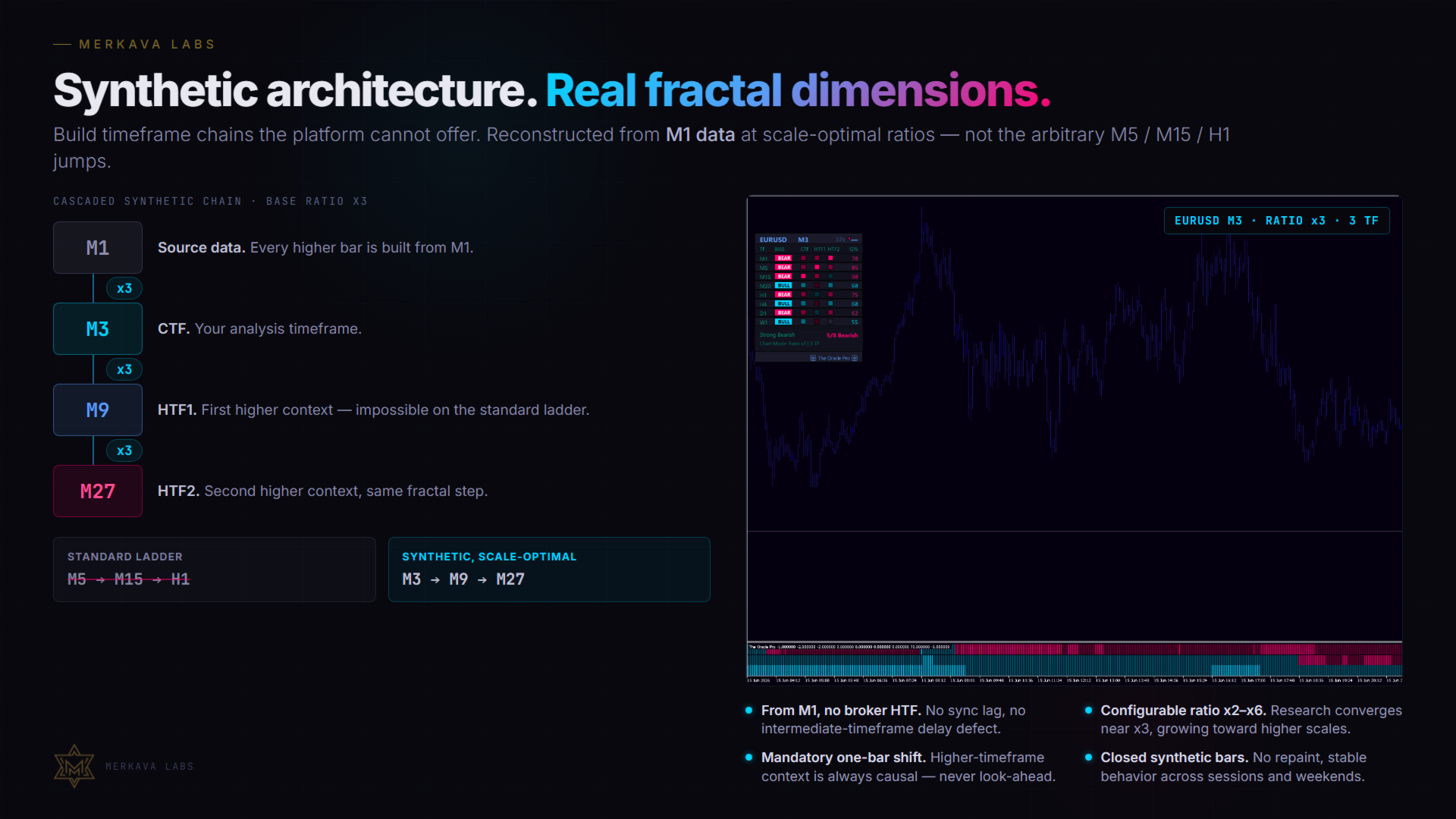
Synthetic Timeframe Architecture: Real Fractal Dimensions
The Oracle Pro reconstructs higher timeframes synthetically from M1 data through cascaded feeds. This removes the dependency on fragile broker higher-timeframe data and the documented intermediate-timeframe delay defect, and it unlocks something most indicators cannot do: timeframe chains that the standard platform ladder simply does not offer.
With a configurable base ratio, you can build genuinely scale-optimal chains - for example M3 / M9 / M27 - instead of being forced into the arbitrary M5 / M15 / H1 jumps. Merkava Labs research converges on a base ratio near 3x as the scientifically optimal separation between adjacent analysis scales, increasing toward higher timeframes. The Oracle Pro lets you explore these real fractal dimensions of price structure directly, on closed synthetic bars, with a mandatory one-bar shift so higher-timeframe context is always causal and never look-ahead.
The Dual State Engine
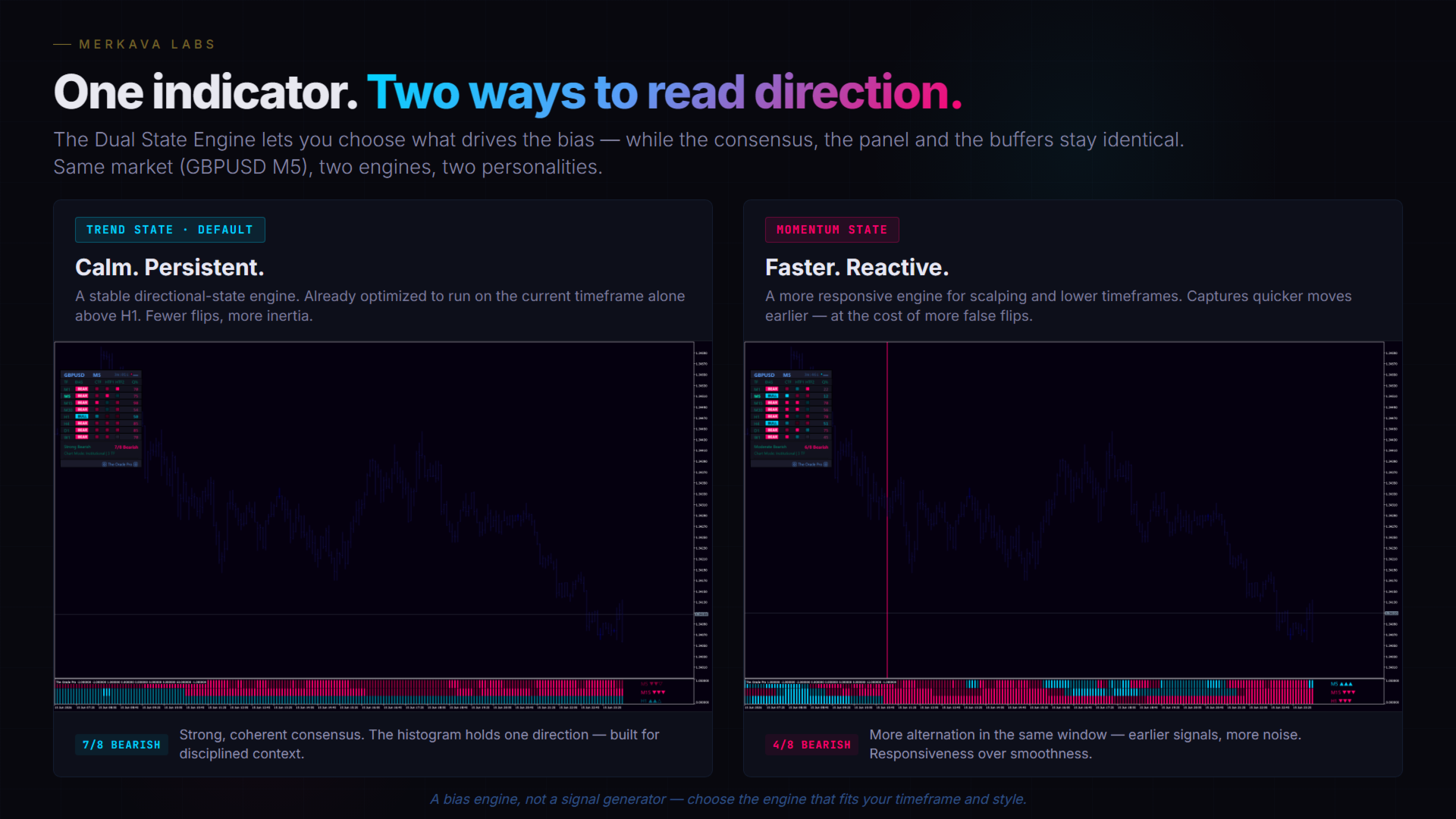
The Oracle Pro lets you select the engine that drives the directional state, while the rest of the consensus, the panel and the buffers stay identical:
- Trend State (default) - a calm, persistent directional-state engine. It is already optimized to run on the current timeframe alone on higher timeframes (above H1), where trends persist and the bias is stable. Adding higher-timeframe layers gives more structural confirmation and more safety, but it also reduces the frequency of bias changes considerably - fewer flips, more inertia.
- Momentum State - a faster, more reactive engine for scalping and lower timeframes. It captures quicker moves earlier, at the cost of more false flips. Use it when responsiveness matters more than smoothness.
Vector Consensus Divergence
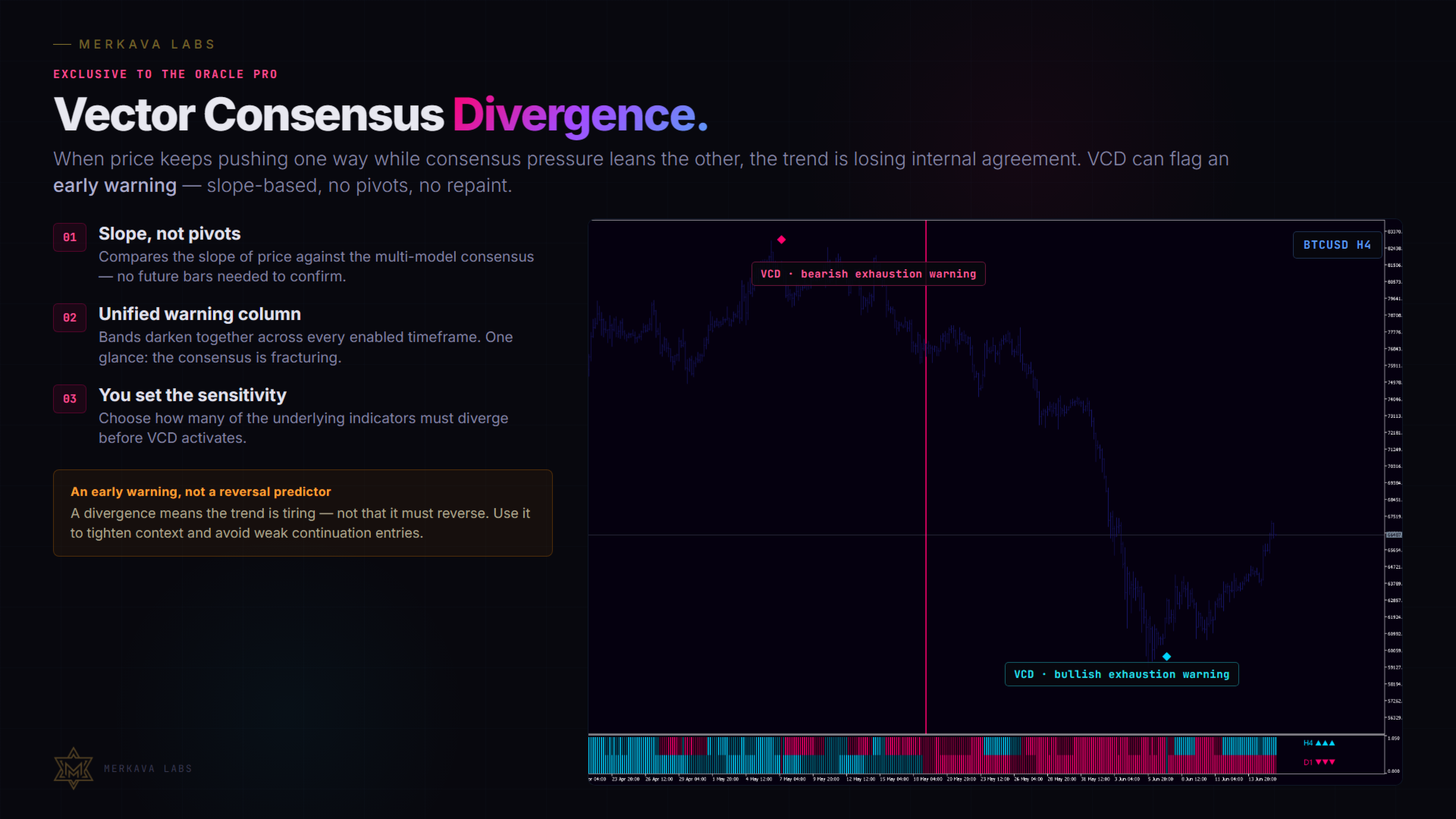
Classical divergence waits for pivot points, which structurally require future bars to confirm. VCD is different: it watches the slope relationship between price and the internal multi-model consensus across the enabled timeframes. When price keeps pushing in one direction while consensus pressure starts leaning the other way, The Oracle Pro can mark a potential trend-exhaustion warning, darken the histogram stack into a unified warning column and optionally print arrows.
VCD is an early-warning and context layer, not a reversal predictor. It is designed to help you notice when consensus is fracturing, tighten your context, avoid weak continuation entries, or prepare for a possible regime shift with more discipline. You control how many of the underlying indicators must diverge before VCD activates.
Core Workflow
- CTF layer reads the active chart timeframe.
- HTF1 layer adds the first higher-timeframe consensus context.
- HTF2 layer adds the second higher-timeframe consensus context.
- Conviction bands show bias direction and strength (strong / weak) per layer.
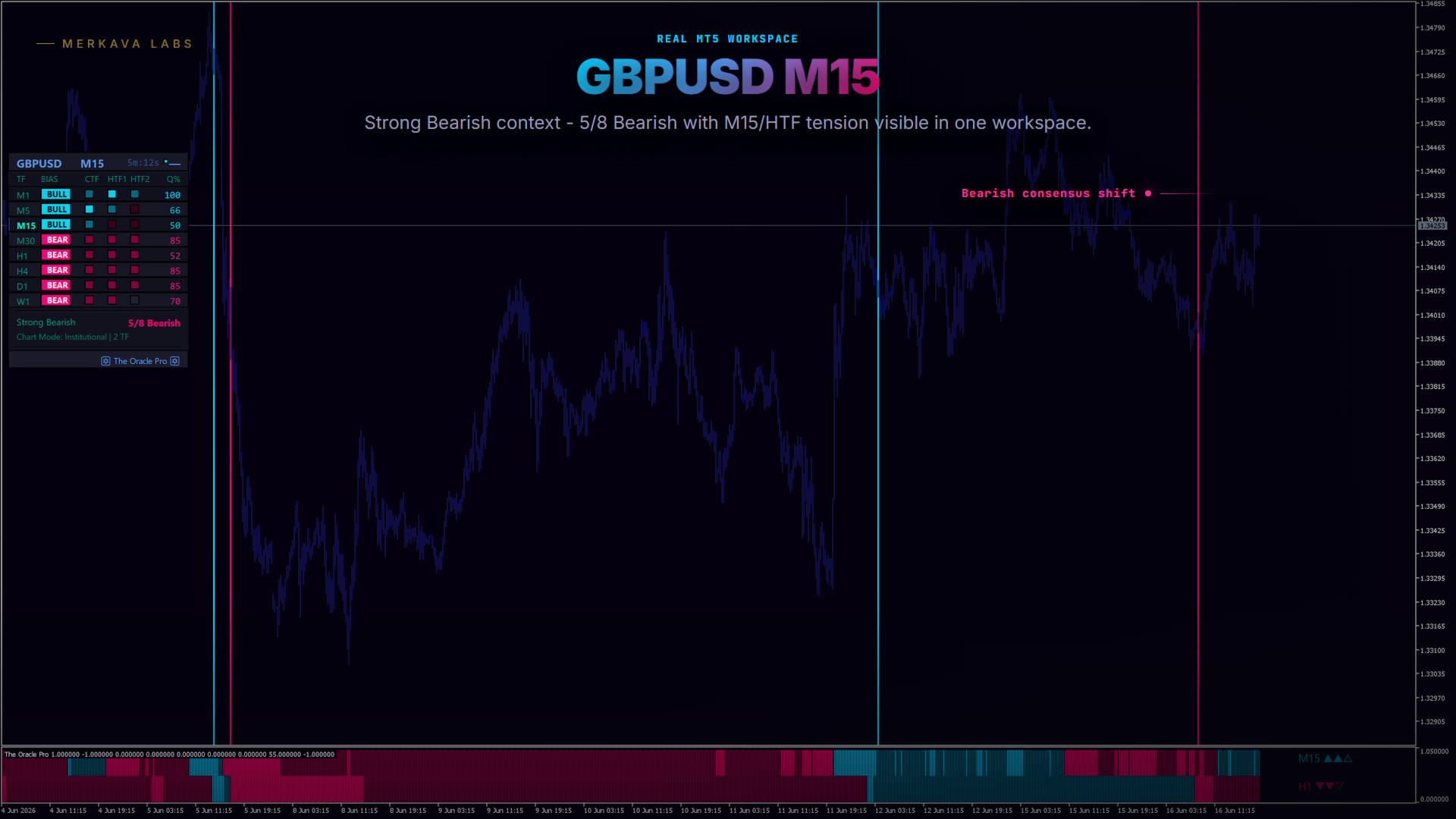
- Consensus shift markers highlight where aligned consensus changes across the enabled layers.
- VCD markers and darkened bands highlight structural price-consensus divergence.
- Optional scanner summarizes the same logic across multiple timeframe rows.
Panel, Scanner and Quality Readout
- Three-band CTF / HTF1 / HTF2 consensus display with right-side layer labels.
- Optional panel with per-layer bias state, conviction and a 0-100 quality score.
- Quality combines vote margin, bias stability and multi-timeframe alignment - a fast read of how trustworthy the current context is.
- Optional multi-timeframe scanner panel.
- 20 professional color themes, optional chart background, configurable arrow style and visual density.
Timeframe Structure and Resolution
- Structure - run 1, 2 or 3 timeframes (CTF only, CTF + one higher, or the full three-layer stack).
- HTF resolution - Institutional auto ladder, manual fixed timeframes, or a synthetic ratio preset (x2 to x6, default x3).
- HTF forming bar - optionally preview the forming higher-timeframe bar; the default favors confirmed higher-timeframe states.
EA and CopyBuffer Workflow
The Oracle Pro exposes stable public buffers: CTF / HTF1 / HTF2 consensus state, consensus shift events, VCD events, the quality score and scanner bias. Expert Advisors and dashboard tools read the state through standard MT5 CopyBuffer calls. For anti-repaint logic, always read the confirmed (closed) bar.
Recommended Use by Style
- Swing / position - bias on H4-D1, confirmation on H1; Trend State on the current timeframe alone is already a strong, stable read above H1.
- Intraday / day trading - execute on M1-M15 and take your direction from the higher-timeframe context; trade your setups in the direction of a fresh bias and stand down when the panel shows a fractured or low-quality consensus.
- Scalping - consider Momentum State for faster reaction, accepting more frequent flips, and lean on synthetic ratio chains for tight, scale-optimal higher-timeframe context.
Technical Notes
- Platform: MetaTrader 5
- Product type: custom indicator
- Markets: Forex, crypto, indices, metals, energy and stocks
- Default structure: current timeframe (add HTF1 / HTF2 as needed)
- Closed-bar logic, mandatory one-bar higher-timeframe shift, no repainting
- Strategy Tester compatible
- Multi-instance safe
- No DLL
Important: The Oracle Pro is a technical analysis and decision-support tool. It does not promise profits and does not replace risk management, position sizing or trader judgment.
User Manual: Download the full PDF manual here: https://www.mql5.com/go?link=https://merkavalabs.com/docs.html
Support: use MQL5 product comments and private messages. Product updates are included after purchase.































After several weeks of using The Oracle Pro as part of my daily trading routine, I feel I now have enough experience to give an honest opinion.
This is simply my personal experience using Oracle as part of my own trading workflow.
I mainly trade lower timeframes, especially M5, where it's very easy to become focused on what's happening on your chart and lose sight of the bigger market picture. That's where Oracle has genuinely helped me broaden the way I analyse each trade.
The biggest impact Oracle has had on my trading is the way I interpret its signals. Instead of looking at them in isolation, I now analyse them within a much broader market context. That's where I've noticed the biggest improvement in the way I approach my trading decisions.
One of the things I appreciate most is the confidence that comes from being able to verify that the idea I'm seeing on my trading timeframe is aligned with the higher-timeframe picture. It doesn't mean the trade is guaranteed to work—that's never how markets work—but it does make me feel that every decision is much better supported before I commit to it.
Before using Oracle, I tended to focus mainly on the opportunities that appeared on my trading timeframe. Now, beyond simply seeing an opportunity, I have a much clearer understanding of why it makes sense to take it—or why it's better to wait for a higher-quality setup. It may seem like a small change, but it has made me approach trading with much more confidence and discipline.
Interestingly, the biggest difference hasn't been the trades I've decided to take, but the trades I've chosen not to take after evaluating the broader market picture. In many cases, avoiding a trade has been just as valuable as finding a good one.
Over the past few weeks, Oracle and Azimuth have naturally become part of a single workflow for me. Oracle helps me understand the broader market context, while Azimuth helps me read price structure and identify trade opportunities. To me, they don't compete with each other—they complement each other because each one addresses a different part of the decision-making process.
If I could suggest one possible direction for future development, it would be the continued evolution of the Oracle + Azimuth ecosystem.
Azimuth provides a very clear view of market structure through its swing analysis. In my opinion, that information adds another valuable layer to understanding how price is developing at any given moment.
It would be very interesting to explore an optional way of incorporating that structural information as an additional layer during context validation. I believe that could further improve the synchronisation between higher-timeframe context, price structure and execution timing.
Although I notice this particularly because I do a lot of M5 scalping, I believe the idea is equally applicable to any timeframe. The relationship between context, structure and timing exists regardless of the timeframe or trading style.
I think this could become a very valuable evolution for traders who already use both tools together as part of the same analytical workflow.
Another aspect I've really appreciated is the support. Whenever I've had a question or needed clarification, the team has always been approachable, willing to help, and happy to explain things in detail. You never get the feeling that you're left on your own after purchasing the product. That level of support gives you confidence, especially when you're investing time learning a professional trading tool. On top of that, it's clear that they genuinely listen to user feedback and are committed to continuously improving the ecosystem, which, in my opinion, adds significant value beyond the products themselves.
Overall, my experience with Oracle has been genuinely positive. Oracle hasn't changed the way I find trading opportunities; it has changed the way I decide whether those opportunities are worth taking. Now I spend much more time validating whether a trade idea truly makes sense before entering the market. That has made me far more selective and, above all, has given me greater confidence that the decisions I make are built on a much stronger foundation.
Looking back, that's probably been the biggest improvement in my trading since I started using Oracle.