PulseScope Studio
- Utilities
-
Konstantin Chechnev
 💻 01 / METATRADER DEVELOPMENT
────────────────────────
I develop solutions of any complexity — from indicators, trading panels and utilities to multi-level analytical systems, Expert Advisors, optimizers and specialized market research tools. - Version: 1.0
- Activations: 5
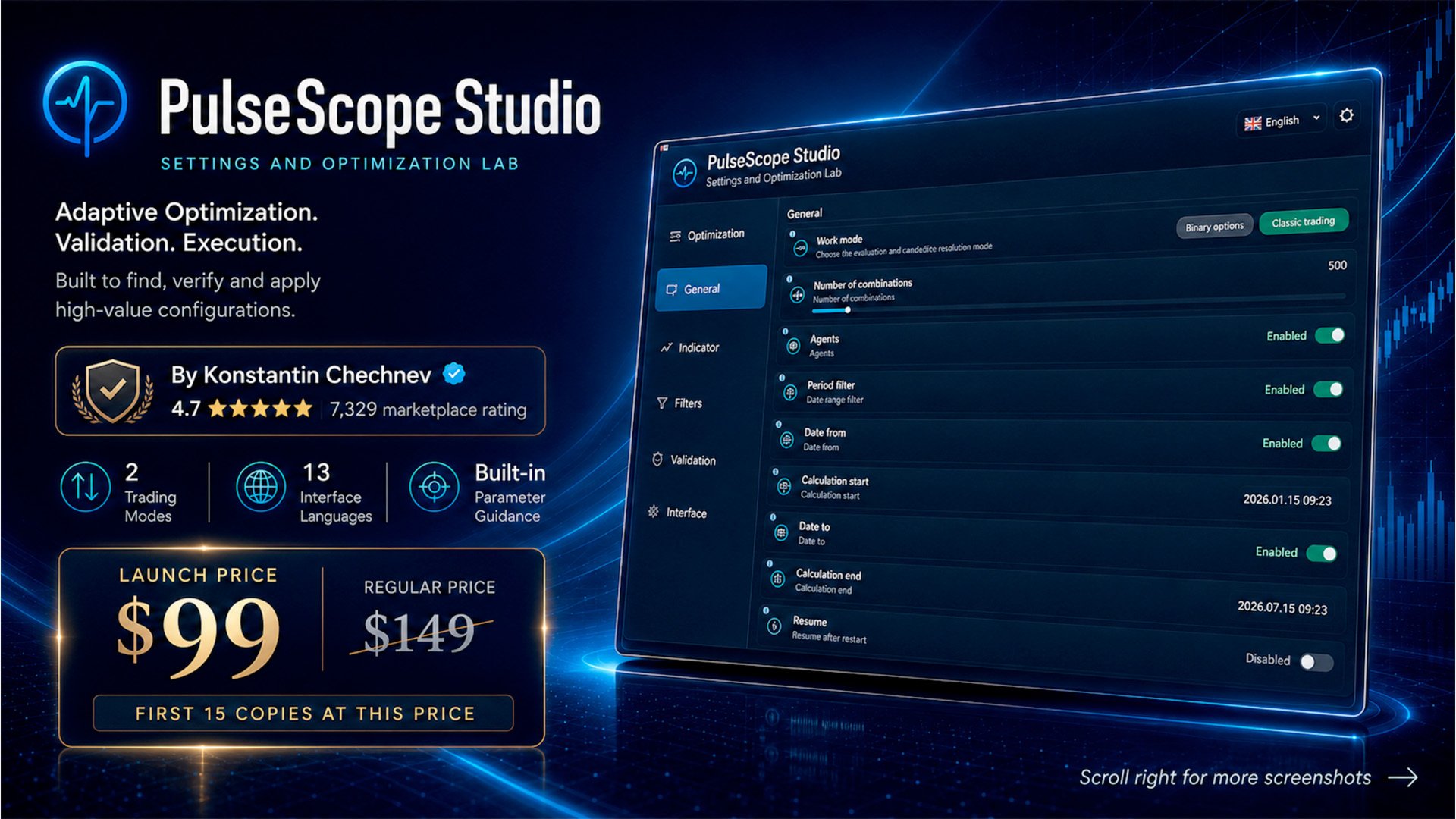
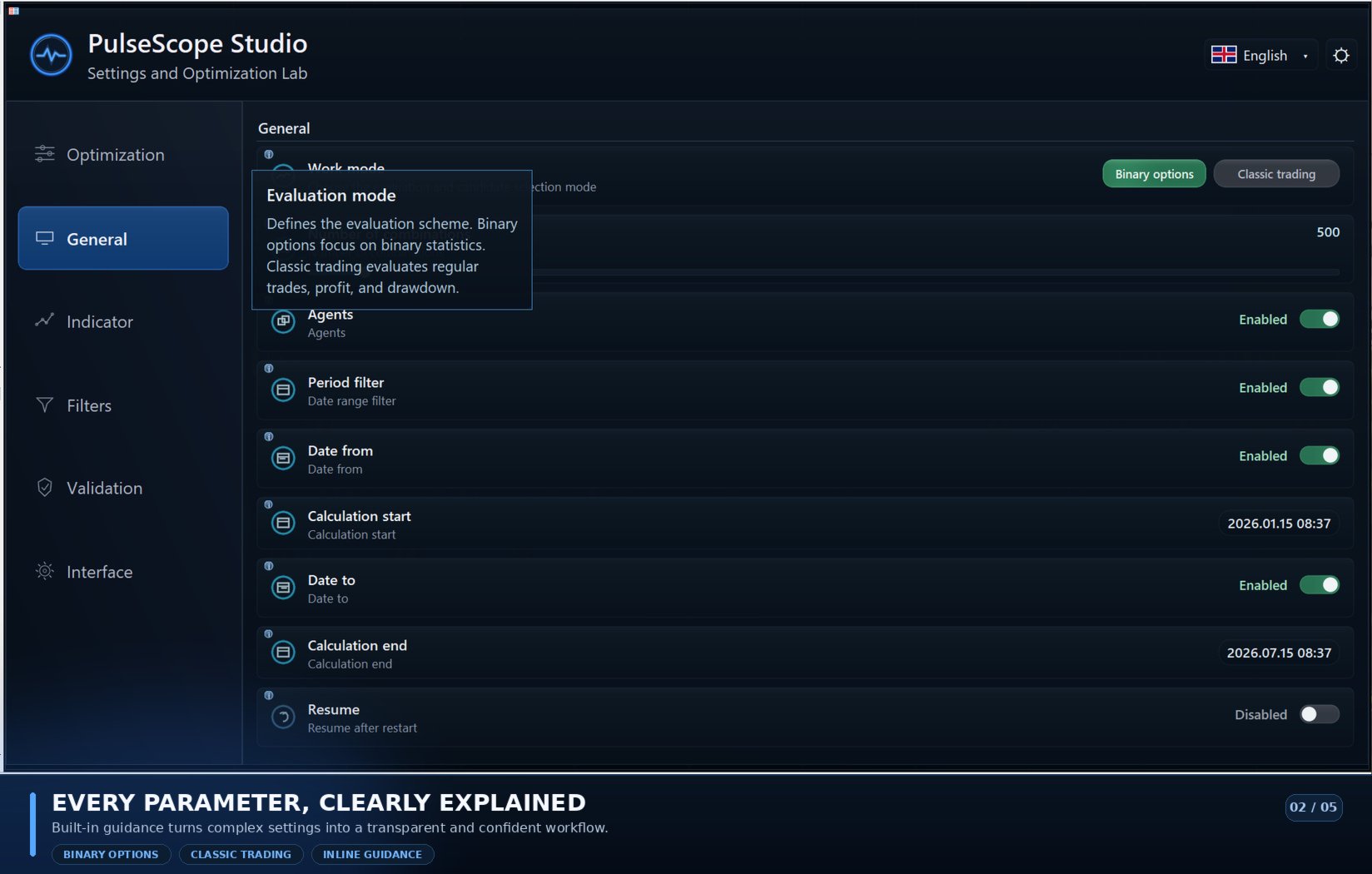
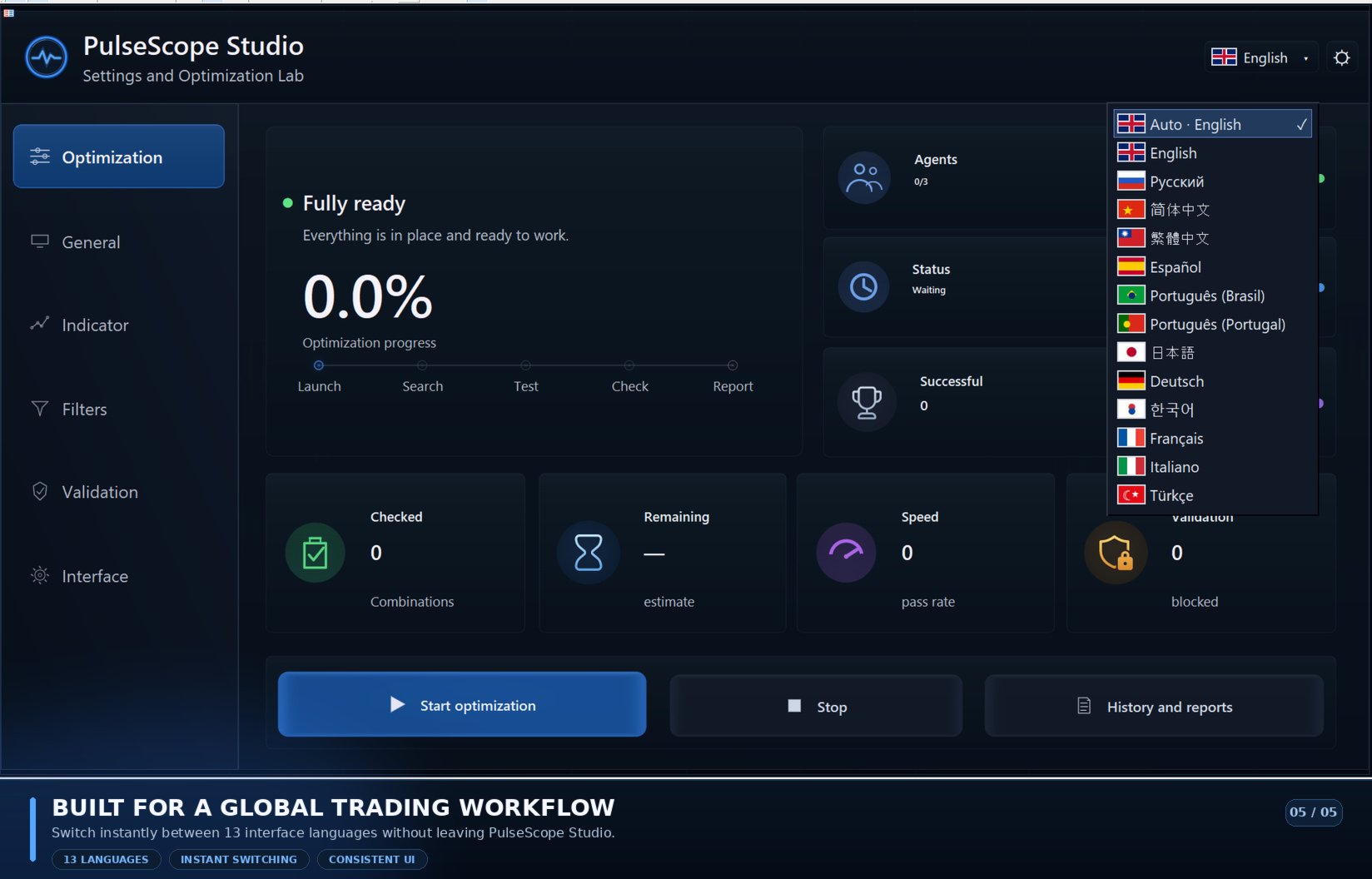
| PulseScope Studio is an automated trading indicator optimizer for MetaTrader 5. It searches for robust parameter sets, filters out random historical performance peaks, validates candidates on a separate control period, and lets you launch the selected configuration directly on the chart. The market is most deceptive precisely where a result looks especially convincing. Separating a genuine pattern from a lucky coincidence is the real challenge.
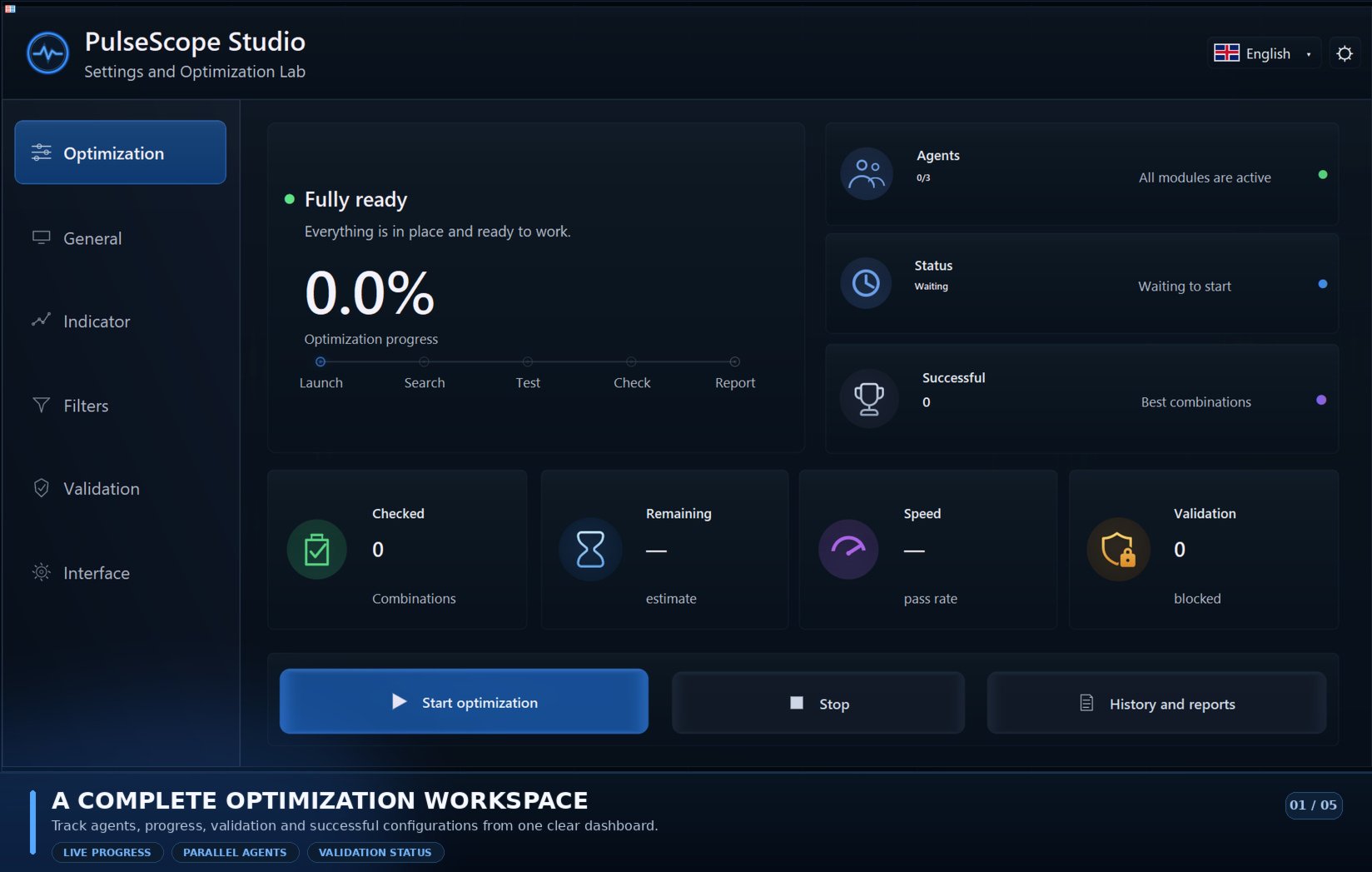
Adaptive search instead of mechanical brute force. PulseScope Studio uses adaptive genetic search and parallel computational agents running on separate charts. The algorithm does not test parameters sequentially or waste passes on mechanically scanning the entire range. Each new generation is formed with the results already obtained in mind: strong configurations are retained, their parameters are combined, and dynamic mutation control directs the search into new areas. Exact duplicates and nearly identical variants are excluded, while values that consistently lead to weak results gradually lose priority. The search does not restart from scratch with every combination — it continuously restructures itself around what has already been selected. The search does not lock onto a single discovered maximum. The algorithm combines broad exploration across different regions of the parameter space with examination of the neighborhood around promising configurations. Nearby settings are tested separately to distinguish a stable region from a single lucky pass.
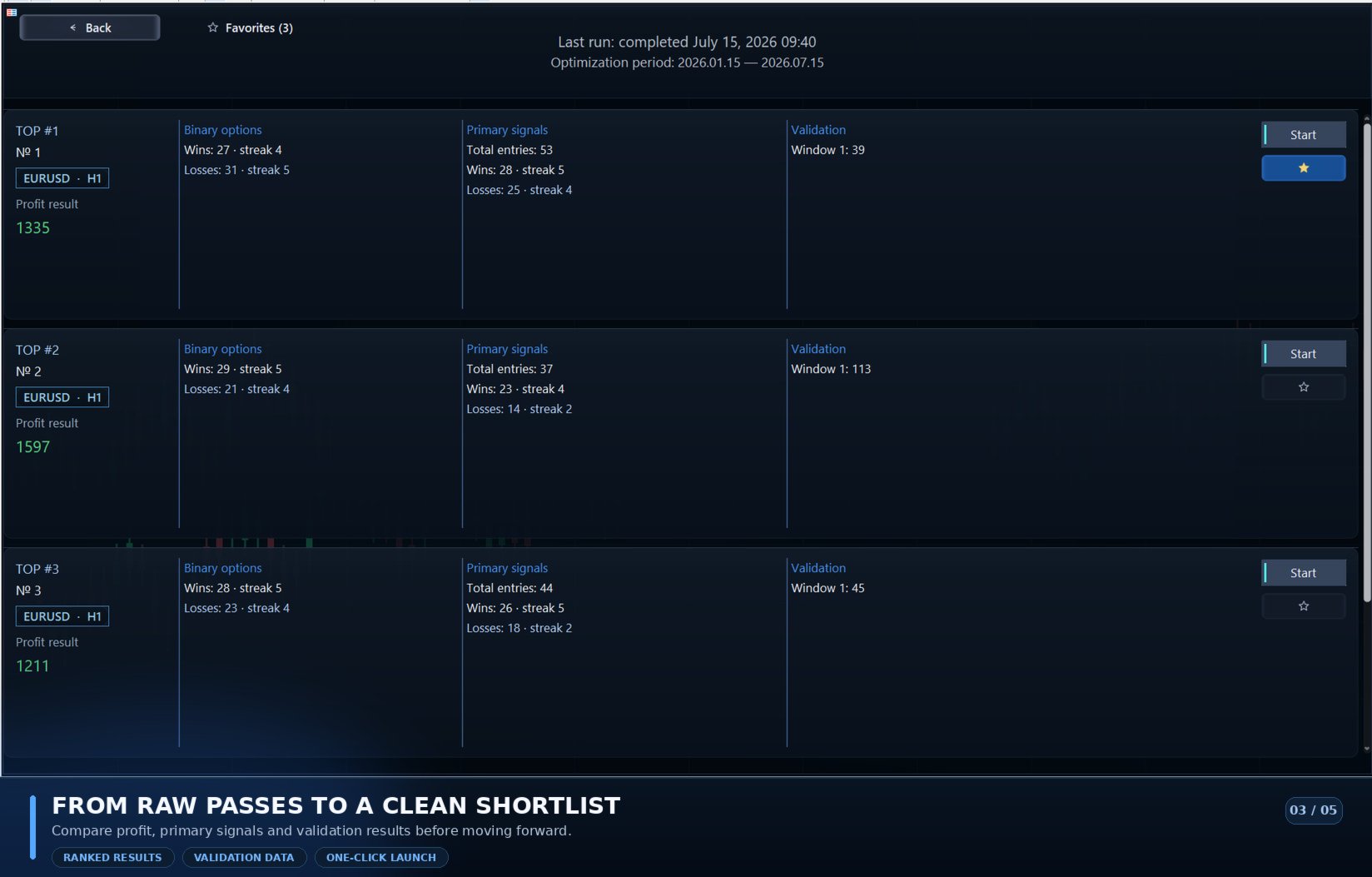
The main period is only the first stage. Even adaptive genetic search can find a configuration that happens to fit one historical segment exceptionally well. That is why promising variants do not end their journey on the main period — PulseScope Studio also evaluates them on a separate control segment that was not involved in parameter selection. Statistics are recalculated for the control segment. This shows whether the configuration preserves the character of its behavior beyond the data on which it was found, or whether its result deteriorates sharply when the segment changes. The purpose of the control check is to prevent a single lucky coincidence from appearing more convincing than it really is. It does not predict the future and does not turn a configuration into something guaranteed to remain stable. The check answers the first question: is this configuration worth saving? The next question is whether it can then be reproduced precisely without starting a new search.
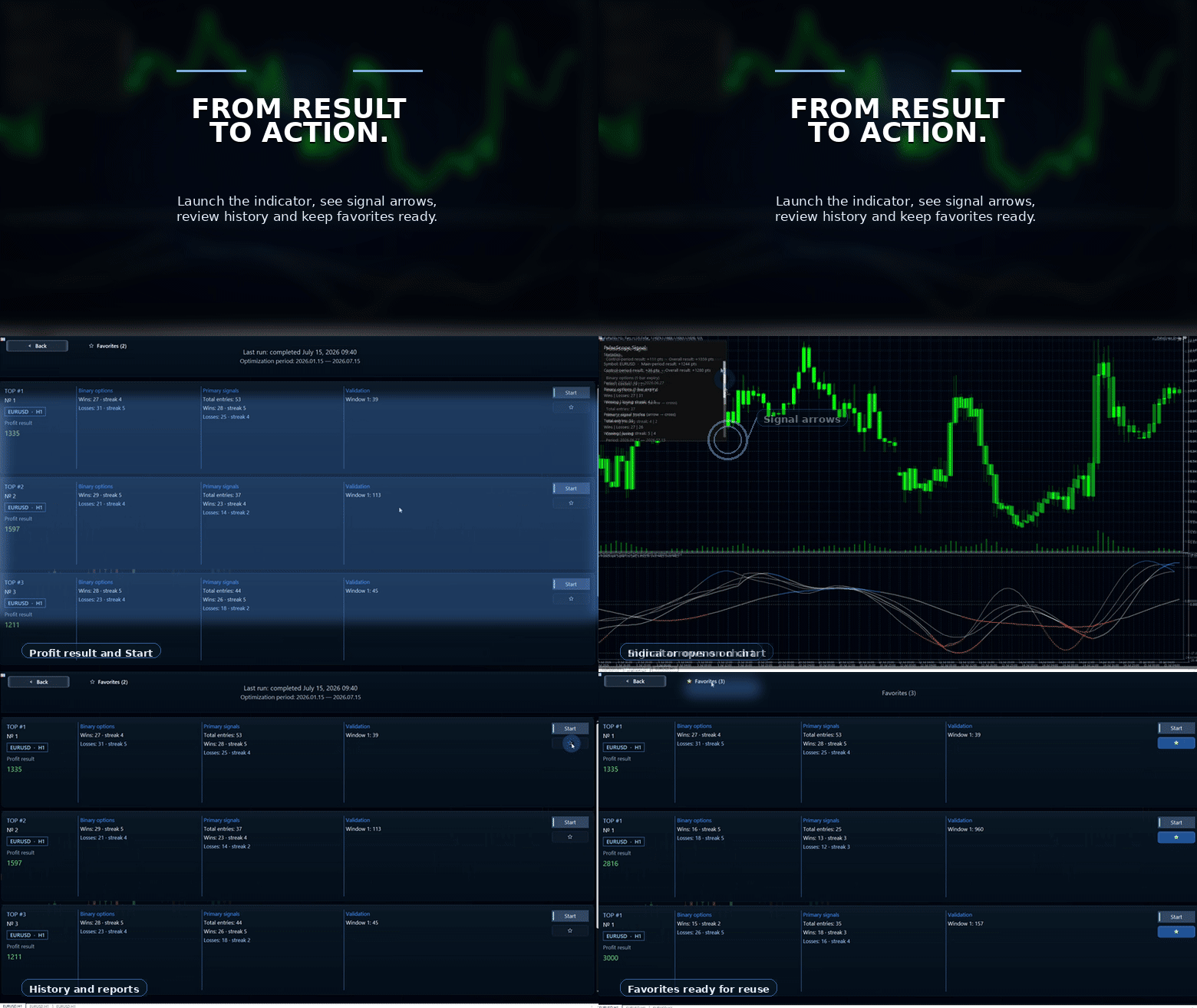
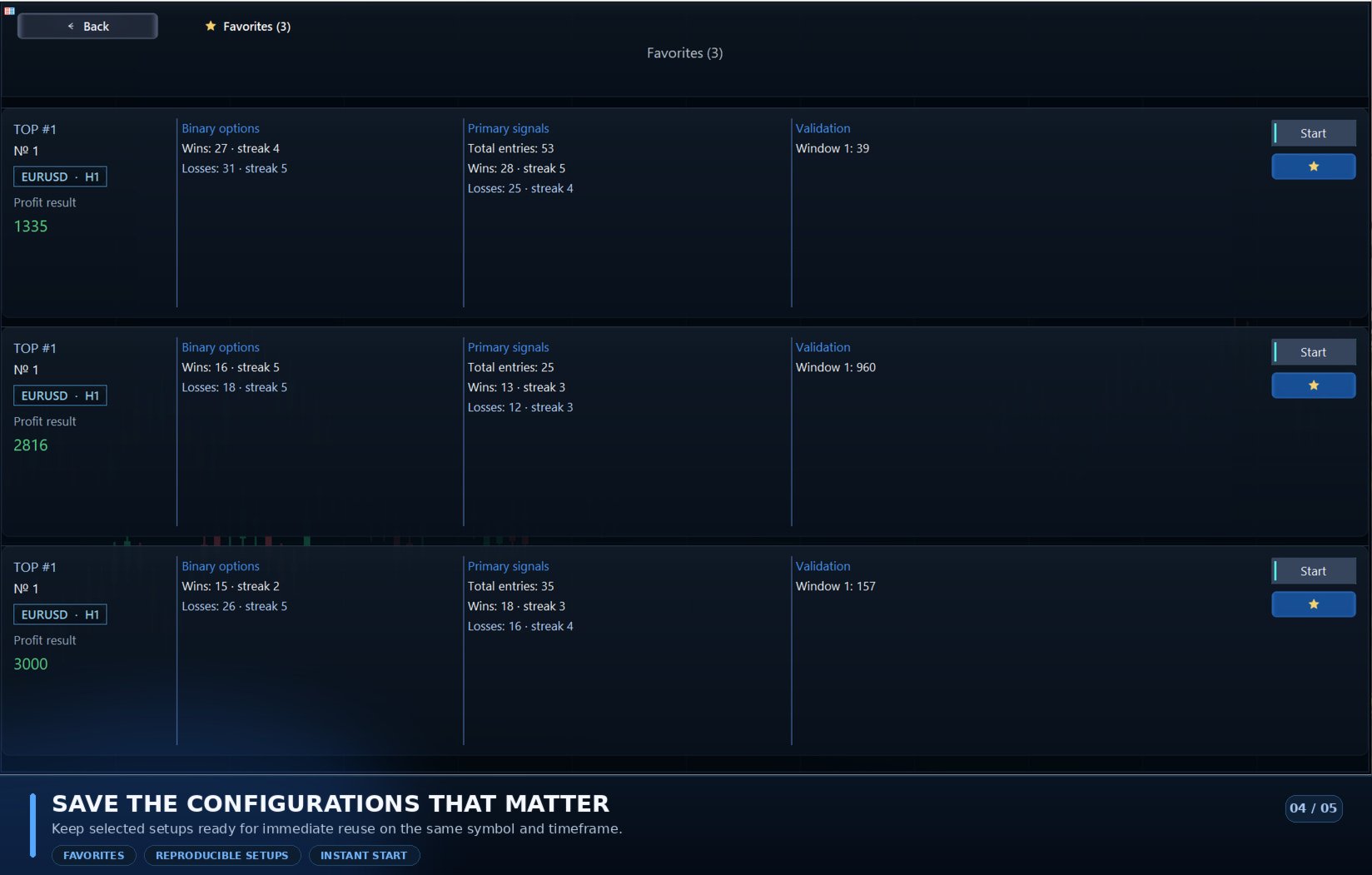
Every selected result is saved together with its parameters, instrument, and timeframe: EURUSD · M15, XAUUSD · H1, US100 · M5. Relaunch without a new optimization. A suitable configuration can be added to favorites and launched again later without repeating the optimization. Studio restores not only the numerical parameters, but also the context in which they were obtained. The selected variant does not remain just another row in a table — it becomes a reproducible configuration that can be revisited at any time.
The PulseScope Signal indicator is already built into PulseScope Studio. There is no need to install or purchase it separately: a saved configuration is launched directly from the utility interface on the corresponding instrument and timeframe. Proprietary multi-loop architecture. PulseScope Signal is built on its own multi-loop architecture, not on a standard combination of classic indicators. Three independent loops with different sensitivity levels analyze momentum across different scales of market movement and jointly track its formation, development, and weakening. A separate adaptive computational chain for each loop. Each loop uses price-data processing with outlier suppression, an assessment of the market’s fractal structure, momentum normalization relative to current volatility, and SSA analysis of price increments. The SSA module builds a Hankel trajectory matrix, extracts the dominant rank component, reconstructs the smoothed dynamics, and performs short-term extrapolation. This helps separate the structural component of the movement from random fluctuations in the price series. The entire analytical architecture is optimized. Data from the three loops are combined by a proprietary multi-stage logic of alignment, confirmation, and adaptive thresholds. As a result, Studio optimizes not a single coefficient of a standard indicator, but the parameters of the complete PulseScope Signal analytical architecture.
From a table of passes to a complete selection system. Where classic optimization leaves the user alone with a table of optimization passes and a search for the most attractive number, PulseScope Studio is only beginning the real work. The adaptive selection system forms new generations of parameters using previous results, examines the neighborhood of promising configurations, and gradually excludes directions that systematically fail the specified filters on the selected instrument and period. Computation is concentrated where potential remains. The search does not repeat itself blindly: with every generation, the algorithm focuses calculations more precisely on promising areas and stops spending resources where results remain consistently weak. This turns optimization from mechanical brute force into an engineering process of configuration selection and validation. Fast adaptation to new data. This kind of process is especially important in an environment where volatility, pace, and the structure of market movement are constantly changing. Instead of manually reviewing dozens of parameters, the user can quickly launch a new search cycle on an up-to-date data segment: parallel agents evaluate candidates, the genetic algorithm redirects the search as results accumulate, and the filters immediately exclude weak and repetitive areas. As a result, Studio quickly forms a new selected set of settings for the current instrument, timeframe, and market dynamics.
|