RSI Divergence without repaint
- Indicators
- Version: 1.1

Most “Instant RSI Divergence” Signals Are Wrong
If you have used RSI divergence indicators before, you have probably experienced this:
a divergence appears in real time, looks convincing at first,
and then disappears a few candles later.
When you look back at the chart, the historical signals no longer match what you originally saw.
This is not a user error.
It is a logical problem.
Divergence that is not based on confirmed swing highs or swing lows is inherently unstable.
If you are looking for an RSI divergence indicator that does not rewrite its own history after the fact,
this explanation is worth reading.
————————————————————
Indicator Overview
This indicator is designed to identify RSI divergence by focusing on confirmed market structure, not instant guesses.
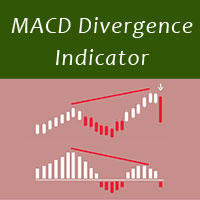
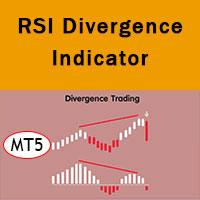
It automatically detects bullish and bearish divergence between price and RSI, and displays the divergence clearly in the RSI window.
Key characteristics:
-
Automatic identification of RSI divergence structures
-
Clear visualization of divergence segments inside the RSI window
-
No repainting and no historical signal changes
-
Designed to work alongside MACD, trendlines, moving averages, and other tools
-
Best suited for structural confirmation rather than precise top or bottom picking
————————————————————
Why Divergence Signals Appear with a Delay
This is the most important aspect of the indicator, and also the most frequently misunderstood.
Any meaningful divergence analysis requires a confirmed swing high or swing low.
To confirm a swing point, one condition cannot be avoided:
the market must show a reaction in the opposite direction.
Without a pullback, a “high” or “low” is only an assumption.
For this reason, this indicator waits for a minimum of 5 completed bars before confirming a prior swing point.
Only after that confirmation is the divergence drawn on the RSI.
As a result, every divergence displayed by the indicator is structurally validated.
Signals do not disappear, shift, or change later when the chart is reviewed.
————————————————————
Important Clarification
The presence of delay is not a weakness of this indicator.
It is a fundamental characteristic of all divergence methods that rely on confirmed swing points.
This applies equally to RSI, MACD, and other oscillators.
As long as divergence is defined using confirmed highs and lows, some degree of delay is unavoidable.
The real difference between indicators is not the logic itself,
but whether this limitation is clearly disclosed.
————————————————————
About Non-Delayed Divergence
It is possible to design predictive divergence methods, such as those based on linear regression,
that attempt to identify divergence without waiting for a pullback.
However, this always comes with a trade-off.
Reducing delay inevitably reduces reliability and increases the number of failed signals.
Zero delay and high accuracy cannot be achieved at the same time.
Future versions may include an optional non-delayed mode as an alternative,
but the current version prioritizes stability, consistency, and logical clarity.
————————————————————
How This Indicator Is Best Used
This indicator is most effective when used to:
-
Confirm structures you already observe on the chart
-
Assist in identifying trend exhaustion and corrective phases
-
Filter impulsive or emotionally driven trades
It is not designed to be used as:
-
A standalone tool for exact top or bottom prediction
Divergence is best understood as a confirmation tool, not a prediction tool.
————————————————————
Version Information
This is a free indicator with no time limitations and no symbol restrictions.
Future updates may introduce algorithm improvements or additional modes, but backward compatibility is not guaranteed.
If you understand and accept the design philosophy behind this indicator,
it can serve as a consistent, transparent, and reliable analytical tool.