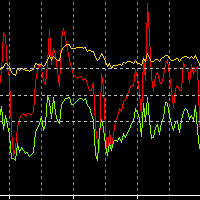
RSI divergence No delay
- Indicators
- Version: 1.0

Why Most RSI Divergence Indicators Are Either Delayed or Repainting
If you have tested enough divergence indicators, you ’ ve probably seen one of these two problems:
Either the divergence appears very late,
or the divergence suddenly disappears.
This is not because an indicator is “ poorly coded ” .
It comes from a fundamental trade-off in how divergence itself is calculated.
If you want divergence signals to appear immediately, you usually have to accept repainting.
If you want absolutely no repainting, some delay is unavoidable.
This indicator is designed to find a more reasonable balance between these two extremes.
Why Does Divergence Usually Come With Delay?
Divergence is essentially a comparison between two highs or two lows.
The key issue is that a high or a low can only be confirmed after the market produces a reversal or pullback.
Before that pullback happens, any “ high ” or “ low ” is only a temporary price point — not a confirmed extremum.
Because of this, traditional divergence algorithms usually work like this:
they wait for a pullback,
then look back to confirm a high or low,
and only after that decide whether divergence exists.
This confirmation process inevitably introduces delay.
So Where Does Repainting Come From?
Repainting typically appears in indicators that try to give earlier signals.
To detect divergence sooner, some indicators mark divergence before a high or low is fully confirmed.
But if price later continues higher or lower,
that previously assumed high or low becomes invalid,
and the divergence based on it is no longer meaningful.
As a result, the indicator has to remove or change the signal.
In other words:
repainting is not a “ bug ” — it is the consequence of making an early judgment that turns out to be wrong.
How This Indicator Handles the Trade-Off
Inspired by alternative algorithmic approaches, this indicator uses a calculation based on RSI averaging and linear regression, instead of relying entirely on confirmed swing highs and lows.
With this method, divergence can be evaluated directly at bar close, without waiting for a full pullback to confirm structure.
The result is:
No additional confirmation delay
No rewriting or removal of signals after the bar is closed
This creates a practical balance between delay and repainting.
An Important and Honest Note
This approach is not “ more advanced ” — it is simply a different trade-off.
Compared with structure-confirmation divergence algorithms:
this version produces faster signals,
but its overall accuracy is slightly lower than delayed, confirmation-based divergence.
This is not a flaw.
Speed and accuracy cannot be maximized at the same time.
About Real-Time Bar Behavior
One important detail:
While a bar is still forming, price is changing.
During this time, divergence conditions may briefly appear and then disappear.
So during an unclosed bar, you may see a divergence signal that later vanishes.
However, once the bar is closed:
any confirmed divergence signal will not repaint,
and historical signals will not be modified.
Compared to many indicators that repaint even after bar close,
this represents a clear improvement in stability.
Which Version Should You Use?
If you care more about:
faster divergence signals,
minimal delay,
and you accept some loss in accuracy,
this version is suitable:
RSI Divergence without delay
If you care more about:
confirmed structure,
higher reliability,
and trend or structural analysis,
you may prefer:
RSI Divergence without repaint
Neither version is “ better ” .
They are designed for different trading styles and use cases.
If you understand what divergence really represents,
and you accept the trade-off between speed and accuracy,
you will understand what this indicator is trying to solve.