MQL5 Programming Articles

Study the MQL5 language for programming trading strategies in numerous published articles mostly written by you - the community members. The articles are grouped into categories to help you quicker find answers to any questions related to programming: Integration, Tester, Trading Strategies, etc.
Follow our new publications and discuss them on the Forum!
Add a new article

You are missing trading opportunities:
- Free trading apps
- Over 8,000 signals for copying
- Economic news for exploring financial markets
Registration
Log in
You agree to website policy and terms of use
If you do not have an account, please register


Building a Divergence System: Creating the MPO4 Custom Indicator
We introduce MPO4, a pressure-based oscillator that emphasizes the body and direction of candles in the context of current volatility. The article details its mathematics, normalization into a bounded range, and the EMA smoothing, then builds a pivot-driven divergence module designed not to repaint. You get complete MQL5 implementation and practical guidance for interpreting signals, including a comparison with RSI as an alternative source.


MQL5 Wizard Techniques you should know (Part 54): Reinforcement Learning with hybrid SAC and Tensors
Soft Actor Critic is a Reinforcement Learning algorithm that we looked at in a previous article, where we also introduced python and ONNX to these series as efficient approaches to training networks. We revisit the algorithm with the aim of exploiting tensors, computational graphs that are often exploited in Python.


Bivariate Copulae in MQL5 (Part 1): Implementing Gaussian and Student's t-Copulae for Dependency Modeling
This is the first part of an article series presenting the implementation of bivariate copulae in MQL5. This article presents code implementing Gaussian and Student's t-copulae. It also delves into the fundamentals of statistical copulae and related topics. The code is based on the Arbitragelab Python package by Hudson and Thames.


Combining LLM, CatBoost, and Quantum Computing into a Unified Trading System
The article proposes a synthesis of new technologies to overcome the limitations of classical indicators in market data analytics. It shows how language models and quantum encoding can reveal hidden market patterns that traditional methods overlook. The experiment confirms the value of new technologies and proposes an updated analysis methodology aligned with the current state of computational innovation.


Neural Networks in Trading: Disentangling Structured Components (SCNN)
We invite you to explore the innovative SCNN framework, which takes time series analysis to a new level by clearly separating data into long-term, seasonal, short-term, and residual components. This approach significantly improves forecasting accuracy by allowing the model to adapt to complex and changing market dynamics.


Overcoming Accessibility Challenges in MQL5 Trading Tools (Part II): Enabling EA Voice Using a Python Text-to-Speech Engine
Let's discuss how we can make our Expert Advisors speech‑capable using text‑to‑speech technology, partnering Python and MQL5. After reading this article, you will walk away with a working example of an EA that speaks dynamic market information. You will master the application of TTS, the WebRequest function, and learn how Python libraries integrate with the MQL5 language to create a truly voice‑aware trading tool.


Linear Regression Prediction Channels in MQL5: Constructing Statistically Grounded Confidence and Prediction Bands
The article implements rolling OLS regression channels in MQL5 and computes confidence and prediction bands with Student's t critical values instead of a fixed standard-deviation multiplier. It explains the leverage-driven widening at window edges, contrasts the result with Bollinger and Donchian channels, and reviews OLS assumptions on price data. A five-line rendering is documented to ensure reliable display in MetaTrader 5.


Markets Positioning Codex in MQL5 (Part 2): Bitwise Learning, with Multi-Patterns for Nvidia
We continue our new series on Market-Positioning, where we study particular assets, with specific trade directions over manageable test windows. We started this by considering Nvidia Corp stock in the last article, where we covered 5 signal patterns from the complimentary pairing of the RSI and DeMarker oscillators. For this article, we cover the remaining 5 patterns and also delve into multi-pattern options that not only feature untethered combinations of all ten, but also specialized combinations of just a pair.


Overcoming The Limitation of Machine Learning (Part 4): Overcoming Irreducible Error Using Multiple Forecast Horizons
Machine learning is often viewed through statistical or linear algebraic lenses, but this article emphasizes a geometric perspective of model predictions. It demonstrates that models do not truly approximate the target but rather map it onto a new coordinate system, creating an inherent misalignment that results in irreducible error. The article proposes that multi-step predictions, comparing the model’s forecasts across different horizons, offer a more effective approach than direct comparisons with the target. By applying this method to a trading model, the article demonstrates significant improvements in profitability and accuracy without changing the underlying model.


Meta-Labeling the Classics (Part 3): Filtering and Sizing Bollinger Band Trades
Bollinger Band mean reversion degrades in trending regimes when ADX is high and bandwidth expands. We separate direction from trade selection with a two‑stage meta‑labeling pipeline: a gradient‑boosted secondary classifier trained with PurgedKFold on band‑specific features (BBP, BBB, bandwidth regime) outputs action probabilities that drive probability‑based bet sizing. The MQL5 implementation loads the ONNX model and applies position sizing within a two‑EA architecture to filter low‑quality band touches.


Role of random number generator quality in the efficiency of optimization algorithms
In this article, we will look at the Mersenne Twister random number generator and compare it with the standard one in MQL5. We will also find out the influence of the random number generator quality on the results of optimization algorithms.


Analyzing binary code of prices on the exchange (Part I): A new look at technical analysis
This article presents an innovative approach to technical analysis based on converting price movements into binary code. The author demonstrates how various aspects of market behavior — from simple price movements to complex patterns — can be encoded in a sequence of zeros and ones.


Price Action Analysis Toolkit Development (Part 76): One-Click Symbol Dashboard for Centralized Multi-Chart Management in MQL5
Learn to assemble an MT5 Expert Advisor that hosts a chart management dashboard written in MQL5. The guide walks through shared definitions, symbol acquisition and filtering, chart lifecycle functions, and a UI panel with search, scrolling, and state indicators, all driven by events and a timer. The result is a reproducible tool that reduces clicks and accelerates multi-symbol analysis.


MQL5 Wizard Techniques you should know (Part 47): Reinforcement Learning with Temporal Difference
Temporal Difference is another algorithm in reinforcement learning that updates Q-Values basing on the difference between predicted and actual rewards during agent training. It specifically dwells on updating Q-Values without minding their state-action pairing. We therefore look to see how to apply this, as we have with previous articles, in a wizard assembled Expert Advisor.


Example of Causality Network Analysis (CNA) and Vector Auto-Regression Model for Market Event Prediction
This article presents a comprehensive guide to implementing a sophisticated trading system using Causality Network Analysis (CNA) and Vector Autoregression (VAR) in MQL5. It covers the theoretical background of these methods, provides detailed explanations of key functions in the trading algorithm, and includes example code for implementation.


From Basic to Intermediate: Operator Precedence
This is definitely the most difficult question to be explained purely theoretically. That is why you need to practice everything that we're going to discuss here. While this may seem simple at first, the topic of operators can only be understood in practice combined with constant education.

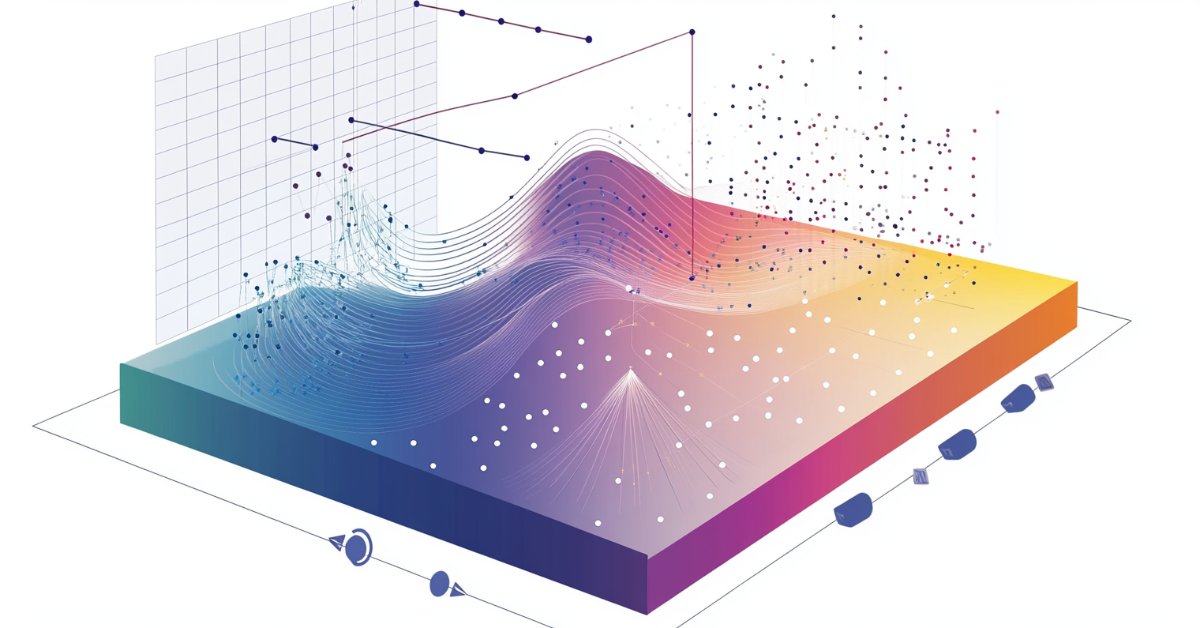
Multiple Symbol Analysis With Python And MQL5 (Part II): Principal Components Analysis For Portfolio Optimization
Managing trading account risk is a challenge for all traders. How can we develop trading applications that dynamically learn high, medium, and low-risk modes for various symbols in MetaTrader 5? By using PCA, we gain better control over portfolio variance. I’ll demonstrate how to create applications that learn these three risk modes from market data fetched from MetaTrader 5.


Building a Trade Analytics System (Part 4): Summary Metrics and Dashboard
This article extends the existing Flask backend to compute performance analytics from stored MetaTrader 5 closed trades and deliver them as both JSON and a simple web view. It calculates total trades, total profit, win rate, average profit, and trade duration metrics, returning JSON at /api/v1/analytics/summary and rendering a dashboard at /api/v1. The result provides a quick, consistent way to review trading performance from persisted SQLite records.


Neural Networks in Trading: Reducing Memory Consumption with Adam-mini Optimization
One of the directions for increasing the efficiency of the model training and convergence process is the improvement of optimization methods. Adam-mini is an adaptive optimization method designed to improve on the basic Adam algorithm.


From Basic to Intermediate: Overload
Perhaps this article will be the most confusing for novice programmers. As a matter of fact, here I will show that it is not always that all functions and procedures have unique names in the same code. Yes, we can easily use functions and procedures with the same name — and this is called overload.


From Basic to Intermediate: Arrays and Strings (I)
In today's article, we'll start exploring some special data types. To begin, we'll define what a string is and explain how to use some basic procedures. This will allow us to work with this type of data, which can be interesting, although sometimes a little confusing for beginners. The content presented here is intended solely for educational purposes. Under no circumstances should the application be viewed for any purpose other than to learn and master the concepts presented.


Two-sample Kolmogorov-Smirnov test as an indicator of time series non-stationarity
The article considers one of the most famous non-parametric homogeneity tests – the two-sample Kolmogorov-Smirnov test. Both model data and real quotes are analyzed. The article also provides an example of constructing a non-stationarity indicator (iSmirnovDistance).

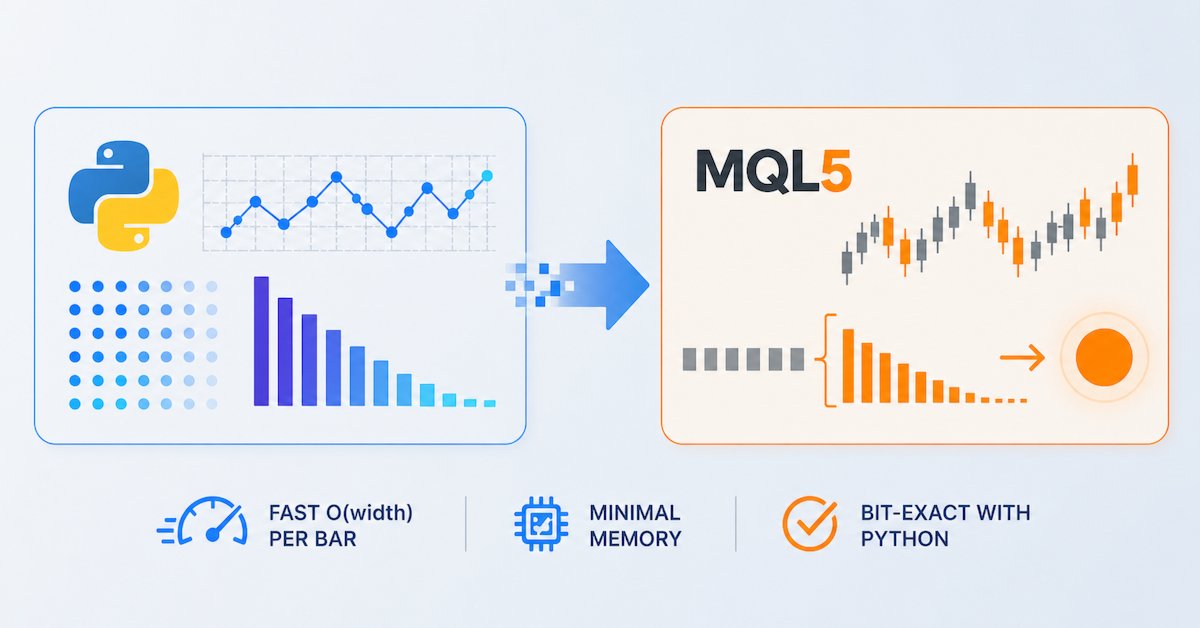
Feature Engineering for ML (Part 2): Implementing Fixed-Width Fractional Differentiation in MQL5
This article delivers a production-grade MQL5 implementation of fixed-width fractional differentiation for live MetaTrader 5 feeds. We introduce a header-only CFFDEngine that precomputes weights without a fixed cap, performs O(width) per-bar updates, and avoids per-tick allocations. The FFD.mq5 indicator supports all ENUM_APPLIED_PRICE types and prev_calculated optimization. Validation scripts confirm numerical equivalence with the standard Python frac diff_ffd pipeline.


Statistical Arbitrage Through Cointegrated Stocks (Part 10): Detecting Structural Breaks
This article presents the Chow test for detecting structural breaks in pair relationships and the application of the Cumulative Sum of Squares - CUSUM - for structural breaks monitoring and early detection. The article uses the Nvidia/Intel partnership announcement and the US Gov foreign trade tariff announcement as examples of slope inversion and intercept shift, respectively. Python scripts for all the tests are provided.


Feature Engineering for ML (Part 13): Trend-Scanning Features in Python
Trend-scanning supports both forward and backward windows, and the labeling default is unsafe for features: it looks ahead and boosts next-bar agreement well above chance on random walks. We provide a dedicated wrapper, get trend scanning features, that forces computational causal and returns only window, slope, t value, and rsquared. A second analysis quantifies errors introduced by the default log transform on signed series.


MetaTrader 5 Machine Learning Blueprint (Part 17): CPCV Backtesting — From Python Model to Tick-Level Evidence
We bridge Python-native artifacts to MQL5 for tick-accurate CPCV backtesting. The export script converts the ONNX model, calibrator, feature spec, and path masks to flat files, while the expert advisor rebuilds features, performs ONNX inference with calibration, and trades on real ticks. The Strategy Tester runs each combinatorial path, and Python aggregates per-path equities into a path Sharpe distribution to assess robustness after spread, slippage, and commission.


Population optimization algorithms: Evolution of Social Groups (ESG)
We will consider the principle of constructing multi-population algorithms. As an example of this type of algorithm, we will have a look at the new custom algorithm - Evolution of Social Groups (ESG). We will analyze the basic concepts, population interaction mechanisms and advantages of this algorithm, as well as examine its performance in optimization problems.


MQL5 Wizard Techniques you should know (14): Multi Objective Timeseries Forecasting with STF
Spatial Temporal Fusion which is using both ‘space’ and time metrics in modelling data is primarily useful in remote-sensing, and a host of other visual based activities in gaining a better understanding of our surroundings. Thanks to a published paper, we take a novel approach in using it by examining its potential to traders.


From Basic to Intermediate: Arrays and Strings (III)
This article considers two aspects. First, how the standard library can convert binary values to other representations such as octal, decimal, and hexadecimal. Second, we will talk about how we can determine the width of our password based on the secret phrase, using the knowledge we have already acquired.


Building a Correlation-Aware Portfolio Risk Monitor in MQL5
The article quantifies correlation and portfolio risk in MetaTrader 5: from time-aligned returns to a covariance matrix, true portfolio variance against the independent-sum assumption, and position-level risk attribution. A MetaTrader 5 service runs in the background, shows the metrics on a small chart panel, and pushes alerts when risk thresholds are crossed. Source code is provided for an example script, a reusable risk engine class, and the service.


Market Microstructure in MQL5 (Part 1): Robust Foundation
This article builds the foundation layer of a twelve-part MQL5 market microstructure toolkit. It implements guarded math helpers (SafeDivide, SafeLog, SafeSqrt, SafeExp, SafeTanh), robust data validation (ValidateSymbolV2, SafeCopyClose), trimmed statistical estimators (robust mean var), a linear regression slope, shared structs, and an FFT. You compile a single include file that hardens indicators and expert advisors against silent numerical failures and standardizes data flow for later parts.


MQL5 Trading Toolkit (Part 5): Expanding the History Management EX5 Library with Position Functions
Discover how to create exportable EX5 functions to efficiently query and save historical position data. In this step-by-step guide, we will expand the History Management EX5 library by developing modules that retrieve key properties of the most recently closed position. These include net profit, trade duration, pip-based stop loss, take profit, profit values, and various other important details.


Feature Engineering for ML (Part 4): Implementing Time Features in MQL5
Applying Python session boundaries to MQL5 broker timestamps misclassifies session membership by two to three hours on any non-UTC broker, corrupting session flags across the full backtest history. We implement CTimeFeatures.mqh, containing CRingBuffer and CTimeFeatures, with three EA-facing methods: Initialize (UTC offset capture and frequency gate configuration), Update (log return push to session-conditional ring buffers), and Calculate (cyclical encoding, session flags, and session volatility). The output is a flat double array drop-compatible with Python's get_time_features for sub-hourly, hourly, and daily timeframes.


MQL5 Wizard Techniques you should know (Part 20): Symbolic Regression
Symbolic Regression is a form of regression that starts with minimal to no assumptions on what the underlying model that maps the sets of data under study would look like. Even though it can be implemented by Bayesian Methods or Neural Networks, we look at how an implementation with Genetic Algorithms can help customize an expert signal class usable in the MQL5 wizard.


News Trading Made Easy (Part 4): Performance Enhancement
This article will dive into methods to improve the expert's runtime in the strategy tester, the code will be written to divide news event times into hourly categories. These news event times will be accessed within their specified hour. This ensures that the EA can efficiently manage event-driven trades in both high and low-volatility environments.


The MQL5 Standard Library Explorer (Part 12): Multi-Timeframe Composite-Score Dashboard
The article implements CMultiTimeframeMatrix, a reusable dashboard that maps symbols vs. timeframes and displays a numeric, colour‑coded score. The score combines trend, momentum, and volatility, updates by timer, and respects performance constraints. You will learn how to build the UI with CAppDialog/CLabel, compute metrics via CMatrixDouble, and embed the component into a thin EA for a consistent, real-time overview.


Detecting and Classifying Fractal Patterns Using Machine Learning
In this article, we will touch upon the intriguing topic of fractal analysis and market forecasting using machine learning. These are just the first steps towards exploring the diverse fractal structures that form on financial price charts. We will use the correlation to find patterns and the CatBoost algorithm to classify these patterns.


Automating Trading Strategies in MQL5 (Part 51): The Bread and Butter Judas Swing Model with Premium and Discount
We build a session-based reversal program in MQL5 using the Bread and Butter Judas Swing model. It derives a higher-timeframe daily bias, defines New York kill zones, maps each session's premium and discount from the live range, and requires a sweep before a market structure shift confirms entry. Readers get a ready approach to arm setups only during active sessions and execute in the bias direction with clear, testable rules.


DoEasy. Controls (Part 33): Vertical ScrollBar
In this article, we will continue the development of graphical elements of the DoEasy library and add vertical scrolling of form object controls, as well as some useful functions and methods that will be required in the future.


Neural Networks in Trading: Two-Dimensional Connection Space Models (Chimera)
In this article, we will explore the innovative Chimera framework: a two-dimensional state-space model that uses neural networks to analyze multivariate time series. This method offers high accuracy with low computational cost, outperforming traditional approaches and Transformer architectures.