MQL5 Programming Articles

Study the MQL5 language for programming trading strategies in numerous published articles mostly written by you - the community members. The articles are grouped into categories to help you quicker find answers to any questions related to programming: Integration, Tester, Trading Strategies, etc.
Follow our new publications and discuss them on the Forum!
Add a new article

You are missing trading opportunities:
- Free trading apps
- Over 8,000 signals for copying
- Economic news for exploring financial markets
Registration
Log in
You agree to website policy and terms of use
If you do not have an account, please register


An introduction to Receiver Operating Characteristic curves
ROC curves are graphical representations used to evaluate the performance of classifiers. Despite ROC graphs being relatively straightforward, there exist common misconceptions and pitfalls when using them in practice. This article aims to provide an introduction to ROC graphs as a tool for practitioners seeking to understand classifier performance evaluation.


Automating Classic Market Methods in MQL5 (Part 2): Wyckoff Cause and Effect—Point and Figure Price Targets
This article builds a self-contained MQL5 Expert Advisor that completes the Wyckoff cycle: it detects accumulation/distribution with a finite state machine, enters at the last point of support/supply, and calculates exit point-and-figure counts under Wyckoff's Cause and Effect. We detail the box size from range ATR, a 1-box reversal, target validation, and a 2R fallback. Readers get runnable code without external dependencies.


Deterministic Oscillatory Search (DOS)
Deterministic Oscillatory Search (DOS) algorithm is an innovative global optimization method that combines the advantages of gradient and swarm algorithms without the use of random numbers. The fitness oscillation and slope mechanism allows DOS to explore complex search spaces in a deterministic manner.


Neural Networks in Trading: Multi-Task Learning Based on the ResNeXt Model (Final Part)
We continue exploring a multi-task learning framework based on ResNeXt, which is characterized by modularity, high computational efficiency, and the ability to identify stable patterns in data. Using a single encoder and specialized "heads" reduces the risk of model overfitting and improves the quality of forecasts.


MetaTrader 5 Machine Learning Blueprint (Part 17): CPCV Backtesting — From Python Model to Tick-Level Evidence
We bridge Python-native artifacts to MQL5 for tick-accurate CPCV backtesting. The export script converts the ONNX model, calibrator, feature spec, and path masks to flat files, while the expert advisor rebuilds features, performs ONNX inference with calibration, and trades on real ticks. The Strategy Tester runs each combinatorial path, and Python aggregates per-path equities into a path Sharpe distribution to assess robustness after spread, slippage, and commission.


Neural Networks in Trading: Generalized 3D Referring Expression Segmentation
While analyzing the market situation, we divide it into separate segments, identifying key trends. However, traditional analysis methods often focus on one aspect and thus limit the proper perception. In this article, we will learn about a method that enables the selection of multiple objects to ensure a more comprehensive and multi-layered understanding of the situation.


Overcoming Accessibility Problems in MQL5 Trading Tools (Part III): Bidirectional Speech Communication Between a Trader and an Expert Advisor
Build a local, bidirectional voice interface for MetaTrader 5 using MQL5 WebRequest and two Python services. The article implements offline speech recognition with Vosk, wake‑word detection, an HTTP command endpoint, and a text‑to‑speech server on localhost. You will wire an Expert Advisor that fetches commands, executes trades, and returns spoken confirmations for hands‑free operation.


From Basic to Intermediate: Arrays and Strings (II)
In this article I will show that although we are still at a very basic stage of programming, we can already implement some interesting applications. In this case, we will create a fairly simple password generator. This way we will be able to apply some of the concepts that have been explained so far. In addition, we will look at how solutions can be developed for some specific problems.


From Basic to Intermediate: Array (IV)
In this article, we'll look at how you can do something very similar to what's implemented in languages like C, C++, and Java. I am talking about passing a virtually infinite number of parameters inside a function or procedure. While this may seem like a fairly advanced topic, in my opinion, what will be shown here can be easily implemented by anyone who has understood the previous concepts. Provided that they were really properly understood.


Integrating MQL5 with Data Processing Packages (Part 8): Using Graph Neural Networks for Liquidity Zone Recognition
This article shows how to represent market structure as a graph in MQL5, turning swing highs/lows into nodes with features and linking them by edges. It trains a Graph Neural Network to score potential liquidity zones, exports the model to ONNX, and runs real-time inference in an Expert Advisor. Readers learn how to build the data pipeline, integrate the model, visualize zones on the chart, and use the signals for rule-based execution.


Automating Trading Strategies in MQL5 (Part 53): Double Top and Double Bottom Reversal Model
We build an MQL5 program that detects and trades Double Top and Double Bottom patterns from confirmed swing pivots with rule-based logic. The detector matches peaks within a tolerance, derives the neckline, and applies leg-balance and spacing filters to reject weak shapes. It supports entry on a neckline break or an optional pullback, with a stop beyond the extreme and targets by measured move or reward-to-risk.


Neural networks made easy (Part 82): Ordinary Differential Equation models (NeuralODE)
In this article, we will discuss another type of models that are aimed at studying the dynamics of the environmental state.


Developing a Replay System (Part 69): Getting the Time Right (II)
Today we will look at why we need the iSpread feature. At the same time, we will understand how the system informs us about the remaining time of the bar when there is not a single tick available for it. The content presented here is intended solely for educational purposes. Under no circumstances should the application be viewed for any purpose other than to learn and master the concepts presented.


Price Action Analysis Toolkit Development (Part 76): One-Click Symbol Dashboard for Centralized Multi-Chart Management in MQL5
Learn to assemble an MT5 Expert Advisor that hosts a chart management dashboard written in MQL5. The guide walks through shared definitions, symbol acquisition and filtering, chart lifecycle functions, and a UI panel with search, scrolling, and state indicators, all driven by events and a timer. The result is a reproducible tool that reduces clicks and accelerates multi-symbol analysis.


Application of the Grey Model in Technical Analysis of Financial Time Series
This article explores the grey model, a promising tool that can expand trader's capabilities. We will look at some options for applying this model to technical analysis and building trading strategies.


Price Action Analysis Toolkit Development (Part 77): Building a Searchable Indicator Panel for MetaTrader 5
A modular indicator search system for MetaTrader 5 that replaces manual navigation through built-in indicator categories with a searchable interface. The application integrates an indicator catalog, search engine, chart launcher, and graphical panel, allowing indicators to be located, filtered, and attached to the appropriate chart window from a single interface.


MQL5 Trading Tools (Part 17): Exploring Vector-Based Rounded Rectangles and Triangles
In this article, we explore vector-based methods for drawing rounded rectangles and triangles in MQL5 using canvas, with supersampling for anti-aliased rendering. We implement scanline filling, geometric precomputations for arcs and tangents, and border drawing to create smooth, customizable shapes. This approach lays the groundwork for modern UI elements in future trading tools, supporting inputs for sizes, radii, borders, and opacities.


Implementing Practical Modules from Other Languages in MQL5 (Part 06): Python-Like File IO operations in MQL5
This article shows how to simplify complex MQL5 file operations by building a Python-style interface for effortless reading and writing. It explains how to recreate Python’s intuitive file-handling patterns through custom functions and classes. The result is a cleaner, more reliable approach to MQL5 file I/O.


Brain Storm Optimization algorithm (Part I): Clustering
In this article, we will look at an innovative optimization method called BSO (Brain Storm Optimization) inspired by a natural phenomenon called "brainstorming". We will also discuss a new approach to solving multimodal optimization problems the BSO method applies. It allows finding multiple optimal solutions without the need to pre-determine the number of subpopulations. We will also consider the K-Means and K-Means++ clustering methods.


Developing a Replay System (Part 67): Refining the Control Indicator
In this article, we'll look at what can be achieved with a little code refinement. This refinement is aimed at simplifying our code, making more use of MQL5 library calls and, above all, making it much more stable, secure and easy to use in other projects that we may develop in the future.


Creating a Probabilistic Market-Neutral Trading Robot Based on a Return Distribution
A market-neutral trading strategy based on the empirical return distribution offers an alternative to traditional technical analysis methods, replacing price direction forecasting with the statistical placement of orders at levels the price is likely to reach. This article provides a detailed analysis of the mathematical framework for calculating percentiles, algorithms for weighting position sizes based on the probability of an order being triggered, and mechanisms for adapting to changing market conditions through grid expiration. A complete implementation in MQL5 is provided.


Building a Divergence System: Creating the MPO4 Custom Indicator
We introduce MPO4, a pressure-based oscillator that emphasizes the body and direction of candles in the context of current volatility. The article details its mathematics, normalization into a bounded range, and the EMA smoothing, then builds a pivot-driven divergence module designed not to repaint. You get complete MQL5 implementation and practical guidance for interpreting signals, including a comparison with RSI as an alternative source.


Unified Multi-Timeframe Renko: Synthesizing the Market's Temporal Dimensions
The article presents an innovative concept for a multi-timeframe Renko chart that combines signals from four timeframes (M5, M15, H1, H4) into a unified synthetic instrument. The system creates a virtual symbol in MetaTrader 5 by using the EMA of each timeframe to generate a composite signal through three methods: simple average, weighted average, and consensus. The implementation includes ATR-based adaptive brick sizing, real-time operation, and full integration with MetaTrader 5.


Introduction to MQL5 (Part 43): Beginner Guide to File Handling in MQL5 (V)
The article explains how to use MQL5 structures with binary files to persist Expert Advisor parameters. It covers defining structures, accessing members, and distinguishing simple from complex layouts, then writing and reading entire records using FileWriteStruct and FileReadStruct in FILE BIN mode. You will learn safe patterns for fixed-size data and how shared storage (FILE COMMON) enables reuse across sessions and terminals.


Requesting in Connexus (Part 6): Creating an HTTP Request and Response
In this sixth article of the Connexus library series, we will focus on a complete HTTP request, covering each component that makes up a request. We will create a class that represents the request as a whole, which will help us bring together the previously created classes.


Linear Regression Prediction Channels in MQL5: Constructing Statistically Grounded Confidence and Prediction Bands
The article implements rolling OLS regression channels in MQL5 and computes confidence and prediction bands with Student's t critical values instead of a fixed standard-deviation multiplier. It explains the leverage-driven widening at window edges, contrasts the result with Bollinger and Donchian channels, and reviews OLS assumptions on price data. A five-line rendering is documented to ensure reliable display in MetaTrader 5.


Generative Adversarial Networks (GANs) for Synthetic Data in Financial Modeling (Part 2): Creating Synthetic Symbol for Testing
In this article we are creating a synthetic symbol using a Generative Adversarial Network (GAN) involves generating realistic Financial data that mimics the behavior of actual market instruments, such as EURUSD. The GAN model learns patterns and volatility from historical market data and creates synthetic price data with similar characteristics.


Neural Network in Practice: Least Squares
In this article, we'll look at a few ideas, including how mathematical formulas are more complex in appearance than when implemented in code. In addition, we will consider how to set up a chart quadrant, as well as one interesting problem that may arise in your MQL5 code. Although, to be honest, I still don't quite understand how to explain it. Anyway, I'll show you how to fix it in code.


Chemical reaction optimization (CRO) algorithm (Part I): Process chemistry in optimization
In the first part of this article, we will dive into the world of chemical reactions and discover a new approach to optimization! Chemical reaction optimization (CRO) uses principles derived from the laws of thermodynamics to achieve efficient results. We will reveal the secrets of decomposition, synthesis and other chemical processes that became the basis of this innovative method.


Market Simulation (Part 19): First Steps with SQL (II)
As we explained in the first article about SQL, there is no point in spending time programming procedures to do what is already built into SQL. However, without knowing the basics, you won’t be able to do anything with SQL or take full advantage of everything this tool offers. Therefore, in this article, we will look at how to perform basic tasks in databases.


Most notable Artificial Cooperative Search algorithm modifications (ACSm)
Here we will consider the evolution of the ACS algorithm: three modifications aimed at improving the convergence characteristics and the algorithm efficiency. Transformation of one of the leading optimization algorithms. From matrix modifications to revolutionary approaches regarding population formation.

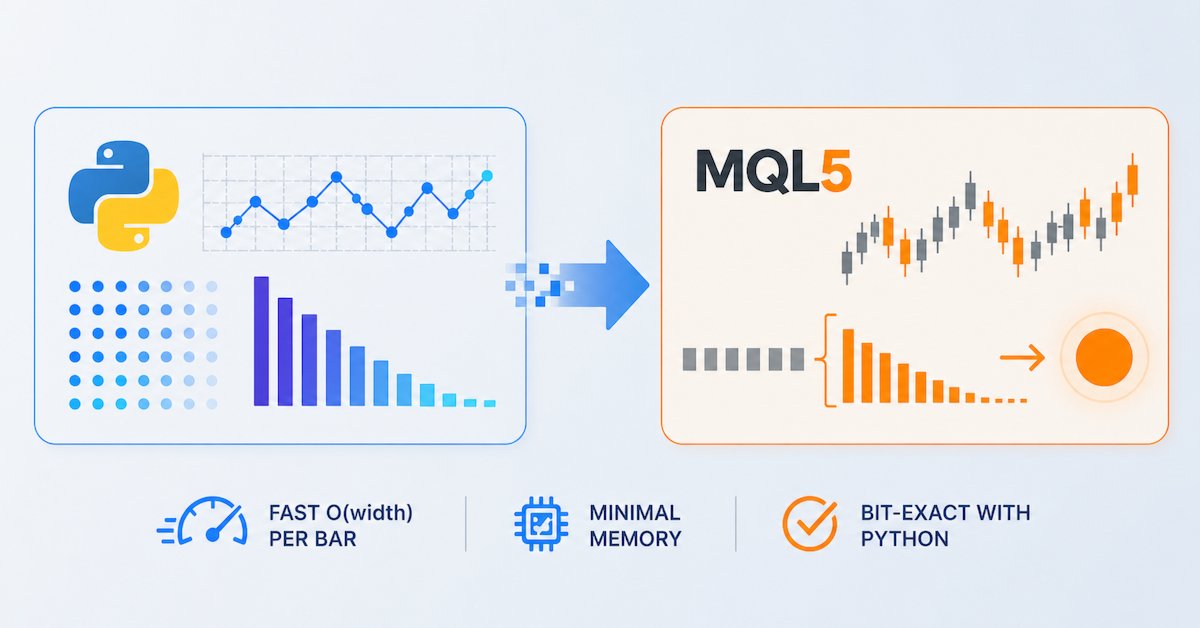
Feature Engineering for ML (Part 2): Implementing Fixed-Width Fractional Differentiation in MQL5
This article delivers a production-grade MQL5 implementation of fixed-width fractional differentiation for live MetaTrader 5 feeds. We introduce a header-only CFFDEngine that precomputes weights without a fixed cap, performs O(width) per-bar updates, and avoids per-tick allocations. The FFD.mq5 indicator supports all ENUM_APPLIED_PRICE types and prev_calculated optimization. Validation scripts confirm numerical equivalence with the standard Python frac diff_ffd pipeline.


Developing an MQTT client for MetaTrader 5: a TDD approach — Part 2
This article is part of a series describing our development steps of a native MQL5 client for the MQTT protocol. In this part we describe our code organization, the first header files and classes, and how we are writing our tests. This article also includes brief notes about the Test-Driven-Development practice and how we are applying it to this project.


Market Simulation (Part 02): Cross Orders (II)
Unlike what was done in the previous article, here we will test the selection option using an Expert Advisor. Although this is not a final solution yet, it will be enough for now. With the help of this article, you will be able to understand how to implement one of the possible solutions.


Implementing Practical Modules from Other Languages in MQL5 (Part 01): Building the SQLite3 Library, Inspired by Python
The sqlite3 module in Python offers a straightforward approach for working with SQLite databases, it is fast and convenient. In this article, we are going to build a similar module on top of built-in MQL5 functions for working with databases to make it easier to work with SQLite3 databases in MQL5 as in Python.


Market Simulation (Part 09): Sockets (III)
Today's article is a continuation of the previous one. We will look at the implementation of an Expert Advisor, focusing mainly on how the server code is executed. The code given in the previous article is not enough to make everything work as expected, so we need to dig a little deeper into it. Therefore, it is necessary to read both articles to better understand what will happen.


Category Theory in MQL5 (Part 17): Functors and Monoids
This article, the final in our series to tackle functors as a subject, revisits monoids as a category. Monoids which we have already introduced in these series are used here to aid in position sizing, together with multi-layer perceptrons.


From Basic to Intermediate: Template and Typename (III)
In this article, we will discuss the first part of the topic, which is not so easy for beginners to understand. In order not to get even more confused and to explain this topic correctly, we will divide the explanation into stages. We will devote this article to the first stage. However, although at the end of the article it may seem that we have reached the deadlock, in fact we will take a step towards another situation, which will be better understood in the next article.


Markets Positioning Codex in MQL5 (Part 2): Bitwise Learning, with Multi-Patterns for Nvidia
We continue our new series on Market-Positioning, where we study particular assets, with specific trade directions over manageable test windows. We started this by considering Nvidia Corp stock in the last article, where we covered 5 signal patterns from the complimentary pairing of the RSI and DeMarker oscillators. For this article, we cover the remaining 5 patterns and also delve into multi-pattern options that not only feature untethered combinations of all ten, but also specialized combinations of just a pair.


From Basic to Intermediate: Indicator (V)
In this article, we will look at how to handle user requests to change the chart plotting mode. This is necessary so that an indicator designed for the current chart plotting mode does not look strange or differ from what a MetaTrader 5 user expects.