MQL5 Programming Articles

Study the MQL5 language for programming trading strategies in numerous published articles mostly written by you - the community members. The articles are grouped into categories to help you quicker find answers to any questions related to programming: Integration, Tester, Trading Strategies, etc.
Follow our new publications and discuss them on the Forum!
Add a new article

You are missing trading opportunities:
- Free trading apps
- Over 8,000 signals for copying
- Economic news for exploring financial markets
Registration
Log in
You agree to website policy and terms of use
If you do not have an account, please register


Developing a multi-currency Expert Advisor (Part 7): Selecting a group based on forward period
Previously, we evaluated the selection of a group of trading strategy instances, with the aim of improving the results of their joint operation, only on the same time period, in which the optimization of individual instances was carried out. Let's see what happens in the forward period.


Artificial Cooperative Search (ACS) algorithm
Artificial Cooperative Search (ACS) is an innovative method using a binary matrix and multiple dynamic populations based on mutualistic relationships and cooperation to find optimal solutions quickly and accurately. ACS unique approach to predators and prey enables it to achieve excellent results in numerical optimization problems.


Developing a Replay System — Market simulation (Part 25): Preparing for the next phase
In this article, we complete the first phase of developing our replay and simulation system. Dear reader, with this achievement I confirm that the system has reached an advanced level, paving the way for the introduction of new functionality. The goal is to enrich the system even further, turning it into a powerful tool for research and development of market analysis.


Automating Trading Strategies in MQL5 (Part 52): The tCISD Model with SSMT and Quarterly Theory
We build a tCISD program in MQL5 that pairs Quarterly Theory cycles anchored to New York time with a correlated-symbol SSMT divergence to time reversals. The article shows how to map cycles and quarters, detect the cross-symbol sweep disagreement, and derive the tCISD level whose break confirms the change in delivery. You will get a working entry logic that arms on divergence and executes on a confirmation close or a retest.


Automatic Session Volume Profile Builder in MQL5: Rendering POC and Value Area Without Third-Party Tools
Implement a session-focused volume profile in MQL5: acquire ticks with CopyTicksRange(), bin prices, and compute POC, VAH, and VAL by the 70% approach. The indicator renders directly on the chart as native objects, supports fixed-width scaling for consistent geometry across timeframes, and refreshes on each new session. This provides objective reference levels without external dependencies.

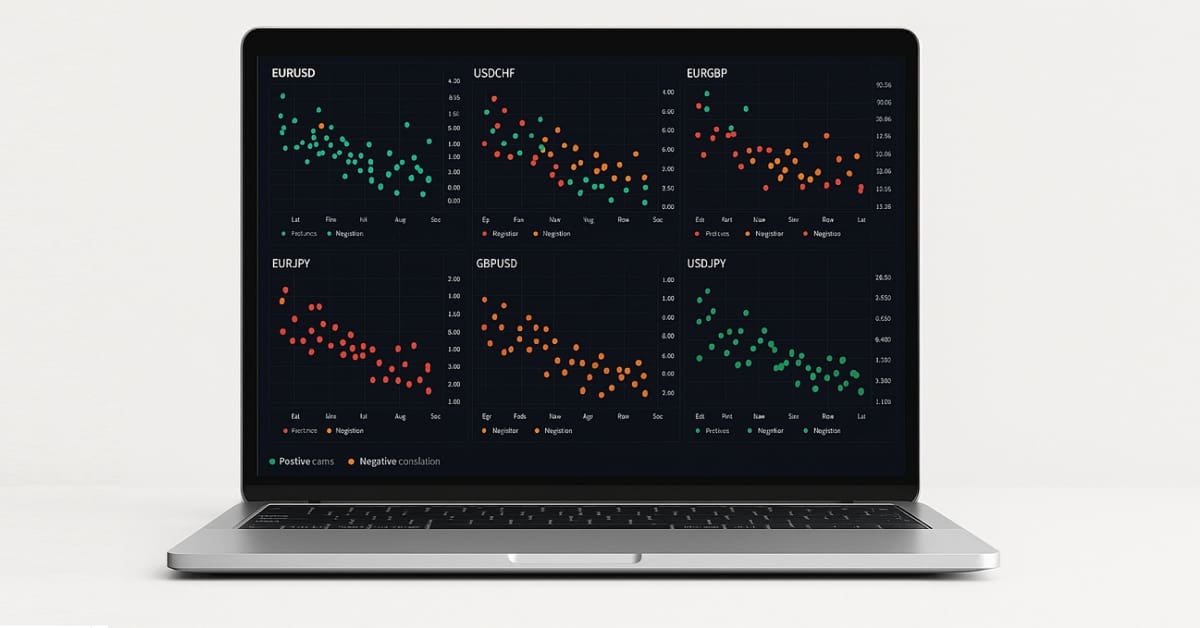
From Novice to Expert: Animated News Headline Using MQL5 (XI)—Correlation in News Trading
In this discussion, we will explore how the concept of Financial Correlation can be applied to improve decision-making efficiency when trading multiple symbols during major economic events announcement. The focus is on addressing the challenge of heightened risk exposure caused by increased volatility during news releases.


Market Simulation (Part 13): Sockets (VII)
When we develop something in xlwings or any other package that allows reading and writing directly to Excel, we must note that all programs, functions, or procedures execute and then complete their task. They do not remain in a loop, no matter how hard we try to do things differently.


Statistical Arbitrage Through Cointegrated Stocks (Final): Data Analysis with Specialized Database
The article shows how to pair SQLite (OLTP) with DuckDB (OLAP) for statistical arbitrage data processing. DuckDB’s columnar engine, ASOF JOIN, and array functions accelerate core tasks such as quote–trade alignment and RWEC, with measured speedups from 2x to 23x versus SQLite on larger inputs. You get simpler queries and faster analytics while keeping trade execution in SQLite.


Engineering a Self-Healing Expert Advisor in MQL5 (Part 1): Persistent Trade State Architecture
This article demonstrates how to build the persistence foundation of a self-healing Expert Advisor in MQL5 using SQLite. Readers will learn how to create a permanent trade-state storage layer capable of surviving terminal restarts, shutdowns, and unexpected interruptions. The article covers SQLite integration in MetaTrader 5, database lifecycle management, persistent trade-state structures, and runtime state recovery using practical MQL5 implementations.


Automating Classic Market Methods in MQL5 (Part 4): Mark Minervini's Trend Template
This article presents TrendTemplateEA, an Expert Advisor implementing Mark Minervini's eight-condition trend template for daily forex charts. It evaluates all conditions on every bar and enters only when they are simultaneously satisfied, using RSI above 50 in place of the stock market RS rating. The entry trigger is a 20-bar high breakout on expanding volume, with all rules coded and testable in MQL5.


Causal analysis of time series using transfer entropy
In this article, we discuss how statistical causality can be applied to identify predictive variables. We will explore the link between causality and transfer entropy, as well as present MQL5 code for detecting directional transfers of information between two variables.


MQL5 Wizard Techniques you should know (Part 66): Using Patterns of FrAMA and the Force Index with the Dot Product Kernel
The FrAMA Indicator and the Force Index Oscillator are trend and volume tools that could be paired when developing an Expert Advisor. We continue from our last article that introduced this pair by considering machine learning applicability to the pair. We are using a convolution neural network that uses the dot-product kernel in making forecasts with these indicators’ inputs. This is done in a custom signal class file that works with the MQL5 wizard to assemble an Expert Advisor.


From CPU to GPU in MQL5: A Practical OpenCL Framework for Accelerating Research, Optimizations, and Patterns
Find out how to build a practical CPU-to-GPU migration path in MQL5 using OpenCL. We will focus on context initialization, buffer organization, large batches, kernel startup, and minimizing data exchanges. Typical errors and ways to eliminate them will be considered as well. An example with candlestick patterns illustrates the practical benefit of the approach.


Neural Networks Made Easy (Part 81): Context-Guided Motion Analysis (CCMR)
In previous works, we always assessed the current state of the environment. At the same time, the dynamics of changes in indicators always remained "behind the scenes". In this article I want to introduce you to an algorithm that allows you to evaluate the direct change in data between 2 successive environmental states.

The View and Controller components for tables in the MQL5 MVC paradigm: Simple controls
The article covers simple controls as components of more complex graphical elements of the View component within the framework of table implementation in the MVC (Model-View-Controller) paradigm. The basic functionality of the Controller is implemented for interaction of elements with the user and with each other. This is the second article on the View component and the fourth one in a series of articles on creating tables for the MetaTrader 5 client terminal.


Risk Management (Part 4): Completing the Key Class Methods
This is Part 4 of our series on risk management in MQL5, where we continue exploring advanced methods for protecting and optimizing trading strategies. Having laid important foundations in earlier articles, we will now focus on completing all remaining methods postponed in Part 3, including functions for checking whether specific profit or loss levels have been reached. In addition, we will introduce new key events that enable more accurate and flexible risk management.


Building Volatility Models in MQL5 (Part II): Implementing GJR-GARCH and TARCH in MQL5
The article implements GJR-GARCH and TARCH in an MQL5 volatility library and explains why asymmetry improves on standard ARCH/GARCH. It covers model formulation, parameterization, and usage through derived classes and scripts. Readers get code examples for calibration and one-step-ahead forecasting on real data to support risk and diagnostics.


MQL5 Wizard Techniques you should know (Part 41): Deep-Q-Networks
The Deep-Q-Network is a reinforcement learning algorithm that engages neural networks in projecting the next Q-value and ideal action during the training process of a machine learning module. We have already considered an alternative reinforcement learning algorithm, Q-Learning. This article therefore presents another example of how an MLP trained with reinforcement learning, can be used within a custom signal class.


Permuting price bars in MQL5
In this article we present an algorithm for permuting price bars and detail how permutation tests can be used to recognize instances where strategy performance has been fabricated to deceive potential buyers of Expert Advisors.


The base class of population algorithms as the backbone of efficient optimization
The article represents a unique research attempt to combine a variety of population algorithms into a single class to simplify the application of optimization methods. This approach not only opens up opportunities for the development of new algorithms, including hybrid variants, but also creates a universal basic test stand. This stand becomes a key tool for choosing the optimal algorithm depending on a specific task.


Neural networks made easy (Part 79): Feature Aggregated Queries (FAQ) in the context of state
In the previous article, we got acquainted with one of the methods for detecting objects in an image. However, processing a static image is somewhat different from working with dynamic time series, such as the dynamics of the prices we analyze. In this article, we will consider the method of detecting objects in video, which is somewhat closer to the problem we are solving.


Neural Networks in Trading: A Hybrid Trading Framework with Predictive Coding (Final Part)
We continue our examination of the StockFormer hybrid trading system, which combines predictive coding and reinforcement learning algorithms for financial time series analysis. The system is based on three Transformer branches with a Diversified Multi-Head Attention (DMH-Attn) mechanism that enables the capturing of complex patterns and interdependencies between assets. Previously, we got acquainted with the theoretical aspects of the framework and implemented the DMH-Attn mechanisms. Today, we will talk about the model architecture and training.

Developing a Replay System (Part 36): Making Adjustments (II)
One of the things that can make our lives as programmers difficult is assumptions. In this article, I will show you how dangerous it is to make assumptions: both in MQL5 programming, where you assume that the type will have a certain value, and in MetaTrader 5, where you assume that different servers work the same.


Building a Megaphone Pattern Indicator in MQL5
Build a megaphone pattern indicator in MQL5 that detects expanding structures on the chart. The article walks through swing identification and refinement, trend line validation, breakout confirmation, and SL/TP projection, with chart objects for lines, labels, and signals. As a result, you get a rule-based implementation that automates pattern detection and produces actionable levels directly in MetaTrader 5.


Developing an MQTT client for Metatrader 5: a TDD approach — Part 4
This article is the fourth part of a series describing our development steps of a native MQL5 client for the MQTT protocol. In this part, we describe what MQTT v5.0 Properties are, their semantics, how we are reading some of them, and provide a brief example of how Properties can be used to extend the protocol.


Integrating MQL5 with data processing packages (Part 1): Advanced Data analysis and Statistical Processing
Integration enables seamless workflow where raw financial data from MQL5 can be imported into data processing packages like Jupyter Lab for advanced analysis including statistical testing.


Creating a Trading Administrator Panel in MQL5 (Part XI): Modern feature communications interface (I)
Today, we are focusing on the enhancement of the Communications Panel messaging interface to align with the standards of modern, high-performing communication applications. This improvement will be achieved by updating the CommunicationsDialog class. Join us in this article and discussion as we explore key insights and outline the next steps in advancing interface programming using MQL5.


MQL5 Trading Tools (Part 14): Pixel-Perfect Scrollable Text Canvas with Antialiasing and Rounded Scrollbar
In this article, we enhance the canvas-based price dashboard in MQL5 by adding a pixel-perfect scrollable text panel for usage guides, overcoming native scrolling limitations through custom antialiasing and a rounded scrollbar design with hover-expand functionality. The text panel supports themed backgrounds with opacity, dynamic line wrapping for content like instructions and contacts, and interactive navigation via up/down buttons, slider dragging, and mouse wheel scrolling within the body area.


MQL5 Wizard Techniques you should know (Part 85): Using Patterns of Stochastic-Oscillator and the FrAMA with Beta VAE Inference Learning
This piece follows up ‘Part-84’, where we introduced the pairing of Stochastic and the Fractal Adaptive Moving Average. We now shift focus to Inference Learning, where we look to see if laggard patterns in the last article could have their fortunes turned around. The Stochastic and FrAMA are a momentum-trend complimentary pairing. For our inference learning, we are revisiting the Beta algorithm of a Variational Auto Encoder. We also, as always, do the implementation of a custom signal class designed for integration with the MQL5 Wizard.


Engineering Trading Discipline into Code (Part 5): Account-Level Risk Enforcement in MQL5
We introduce an MQL5 discipline engine that enforces risk consistently at the account level. It continuously scans positions from any source, validates SL/TP, equity-based exposure, and target R:R, and automatically corrects deviations by setting levels or adjusting volume. The result is uniform risk structure across manual and EA trades, supported by on-chart feedback and mode-based control.


Using the MQL5 Economic Calendar for News Filter (Part 3): Surviving Terminal Restarts During News Window
The article introduces a restart-safe storage model for news-time stop removal. Suspension state and original SL/TP per position are written to terminal global variables, reconstructed on OnInit, and cleaned after restoration. This lets the EA resume an active suspension window after recompiles or restarts and restore stops only when the news window ends.


Developing a Replay System (Part 31): Expert Advisor project — C_Mouse class (V)
We need a timer that can show how much time is left till the end of the replay/simulation run. This may seem at first glance to be a simple and quick solution. Many simply try to adapt and use the same system that the trading server uses. But there's one thing that many people don't consider when thinking about this solution: with replay, and even m ore with simulation, the clock works differently. All this complicates the creation of such a system.


Neural Networks in Trading: Models Using Wavelet Transform and Multi-Task Attention
We invite you to explore a framework that combines wavelet transforms and a multi-task self-attention model, aimed at improving the responsiveness and accuracy of forecasting in volatile market conditions. The wavelet transform allows asset returns to be decomposed into high and low frequencies, carefully capturing long-term market trends and short-term fluctuations.


ALGLIB library optimization methods (Part I)
In this article, we will get acquainted with the ALGLIB library optimization methods for MQL5. The article includes simple and clear examples of using ALGLIB to solve optimization problems, which will make mastering the methods as accessible as possible. We will take a detailed look at the connection of such algorithms as BLEIC, L-BFGS and NS, and use them to solve a simple test problem.


Gain an Edge Over Any Market (Part III): Visa Spending Index
In the world of big data, there are millions of alternative datasets that hold the potential to enhance our trading strategies. In this series of articles, we will help you identify the most informative public datasets.


MQL5 Wizard Techniques you should know (Part 52): Accelerator Oscillator
The Accelerator Oscillator is another Bill Williams Indicator that tracks price momentum's acceleration and not just its pace. Although much like the Awesome oscillator we reviewed in a recent article, it seeks to avoid the lagging effects by focusing more on acceleration as opposed to just speed. We examine as always what patterns we can get from this and also what significance each could have in trading via a wizard assembled Expert Advisor.


An Introduction to the Study of Fractal Market Structures Using Machine Learning
The article attempts to examine financial time series from the perspective of self-similar fractal structures. Since we have too many analogies that confirm the possibility of considering market quotes as self-similar fractals, this allows us to think about the forecasting horizons of such structures.


Implementing Partial Position Closing in MQL5
This article develops a class for managing partial position closing in MQL5 and then integrates it into an Order Blocks Expert Advisor. It also presents test results comparing the strategy with and without partial position closing, and analyzes the conditions under which this approach can help provide and maximize profit. In conclusion, partial position closing can be highly beneficial in trading strategies, especially those focused on wider price movements.


MQL5 Wizard Techniques you should know (Part 39): Relative Strength Index
The RSI is a popular momentum oscillator that measures pace and size of a security’s recent price change to evaluate over-and-under valued situations in the security’s price. These insights in speed and magnitude are key in defining reversal points. We put this oscillator to work in another custom signal class and examine the traits of some of its signals. We start, though, by wrapping up what we started previously on Bollinger Bands.


From Basic to Intermediate: The Include Directive
In today's article, we will discuss a compilation directive that is widely used in various codes that can be found in MQL5. Although this directive will be explained rather superficially here, it is important that you begin to understand how to use it, as it will soon become indispensable as you move to higher levels of programming. The content presented here is intended solely for educational purposes. Under no circumstances should the application be viewed for any purpose other than to learn and master the concepts presented.