Polynomial Regression
- Indicators
-
Agus Santoso
 DISCLAIMER ON : The author of EA will not be held responsible for your losses or problems of any kind if the EA is directly or indirectly responsible for any losses.
Our software is provided “as is”, without any warranty or condition of any kind, express, implied or statutory. - Version: 1.0
- Activations: 5
MQL5 Blogs : https://www.mql5.com/en/blogs/post/770875
MT4 Version : https://www.mql5.com/en/market/product/179541
MT5 Version : https://www.mql5.com/en/market/product/179542
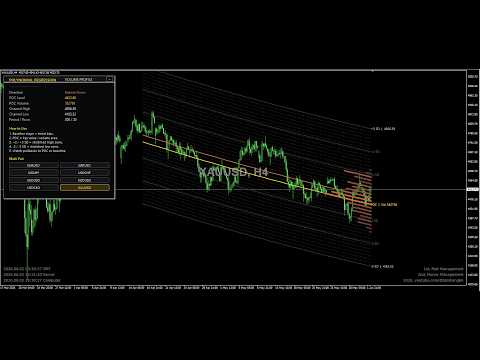
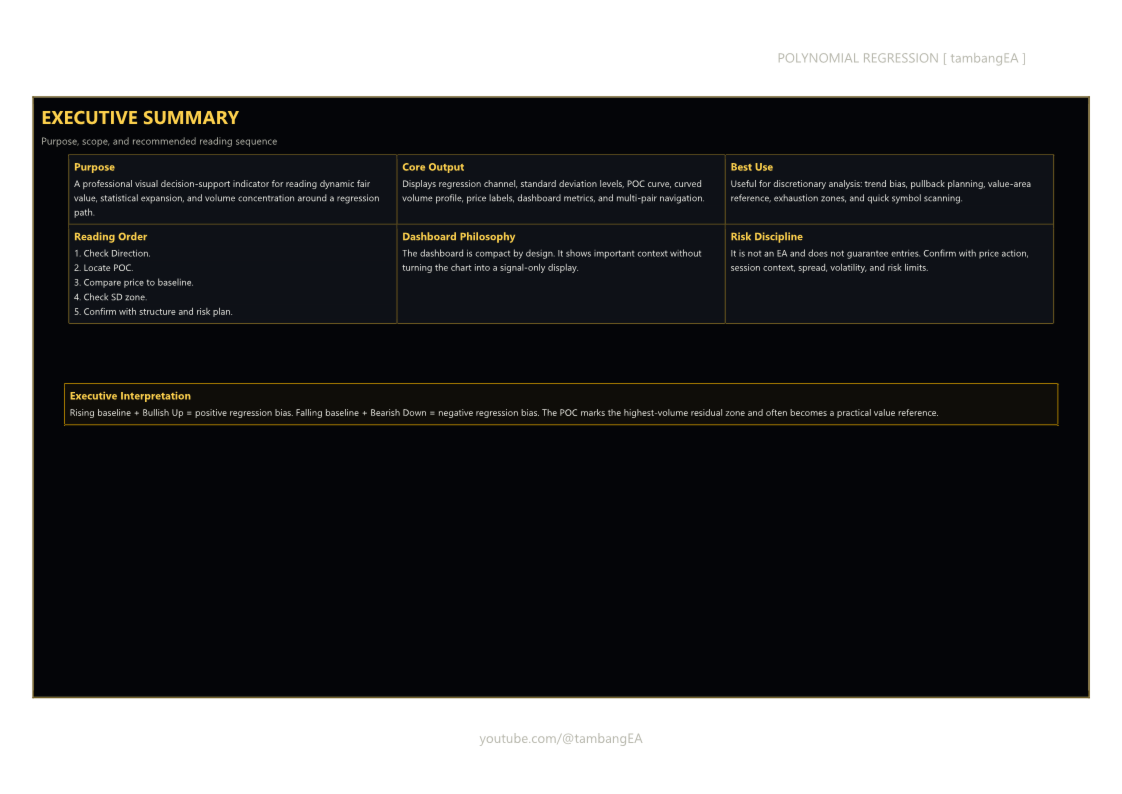
POLYNOMIAL REGRESSION [tambangEA] is designed for traders who want a clearer view of dynamic market structure, fair value movement, statistical expansion zones, and volume concentration directly on the chart.
Unlike a basic moving average or simple regression line, this indicator visualizes a complete regression matrix using a curved polynomial regression path, standard deviation zones, dynamic volume profile bars, and a Point of Control line that follows the regression structure. The result is a cleaner and more contextual way to analyze trend direction, pullback areas, stretched price zones, and high-volume reference levels.
The indicator is built as a visual decision-support tool. It does not place trades automatically and does not repaint trading signals as buy or sell arrows. Instead, it provides a professional analytical framework for discretionary traders who want to understand where price is trading relative to the regression baseline, statistical deviation bands, and volume-dominant zones.
Main Features
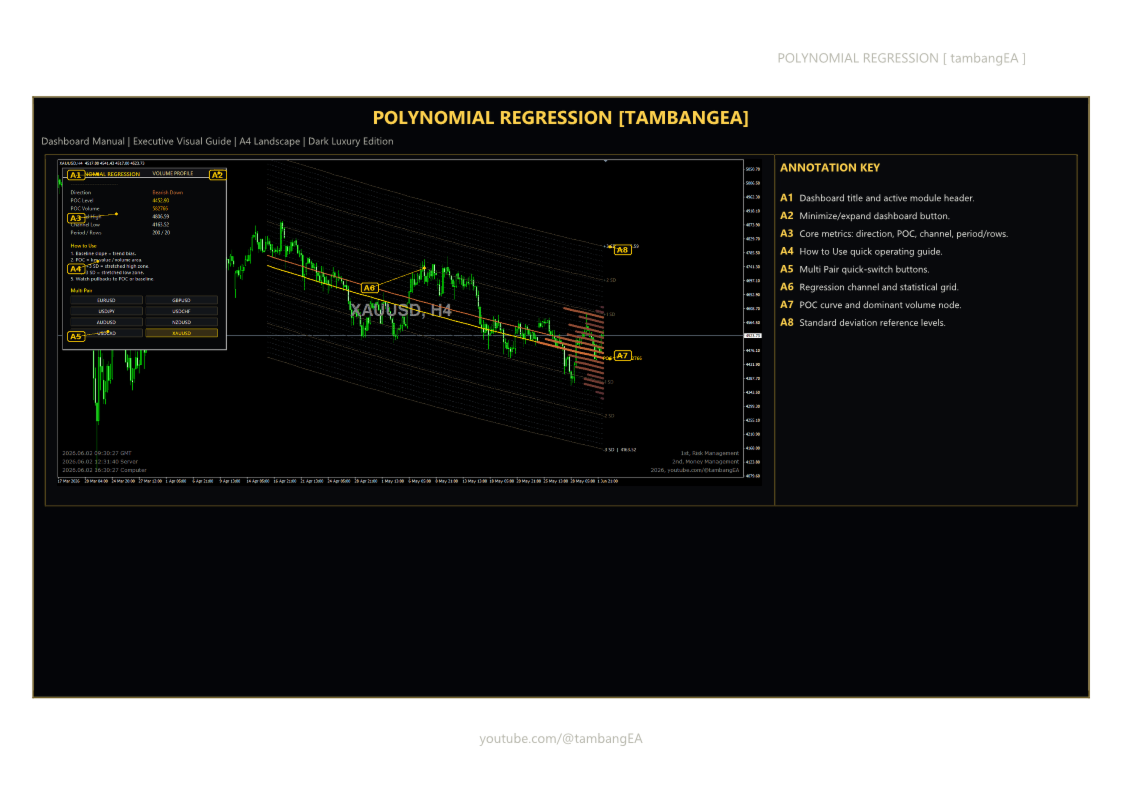
Polynomial / Linear Regression Channel
Choose between Linear Regression and Polynomial Regression mode. Polynomial mode provides a smoother curved structure that can adapt better to non-linear market movement.
Dynamic Regression Matrix
The indicator draws a full channel grid around the regression baseline, helping traders identify whether price is trading near fair value, premium zones, discount zones, or outer statistical extremes.
Standard Deviation Levels
The indicator displays deviation areas such as +1 SD, +2 SD, +3 SD and -1 SD, -2 SD, -3 SD. These zones help traders read market expansion, possible exhaustion areas, and statistical stretch.
Dynamic POC Line
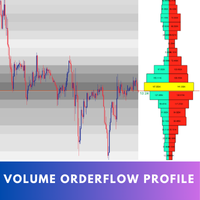
The Point of Control is calculated from the highest-volume area relative to the regression structure. This POC line follows the regression path instead of being a simple static horizontal level.
Curved Volume Profile Visualization
Volume profile bars are projected along the regression channel, allowing traders to see where volume is concentrated within the statistical structure.
Multi-Pair Quick Switch
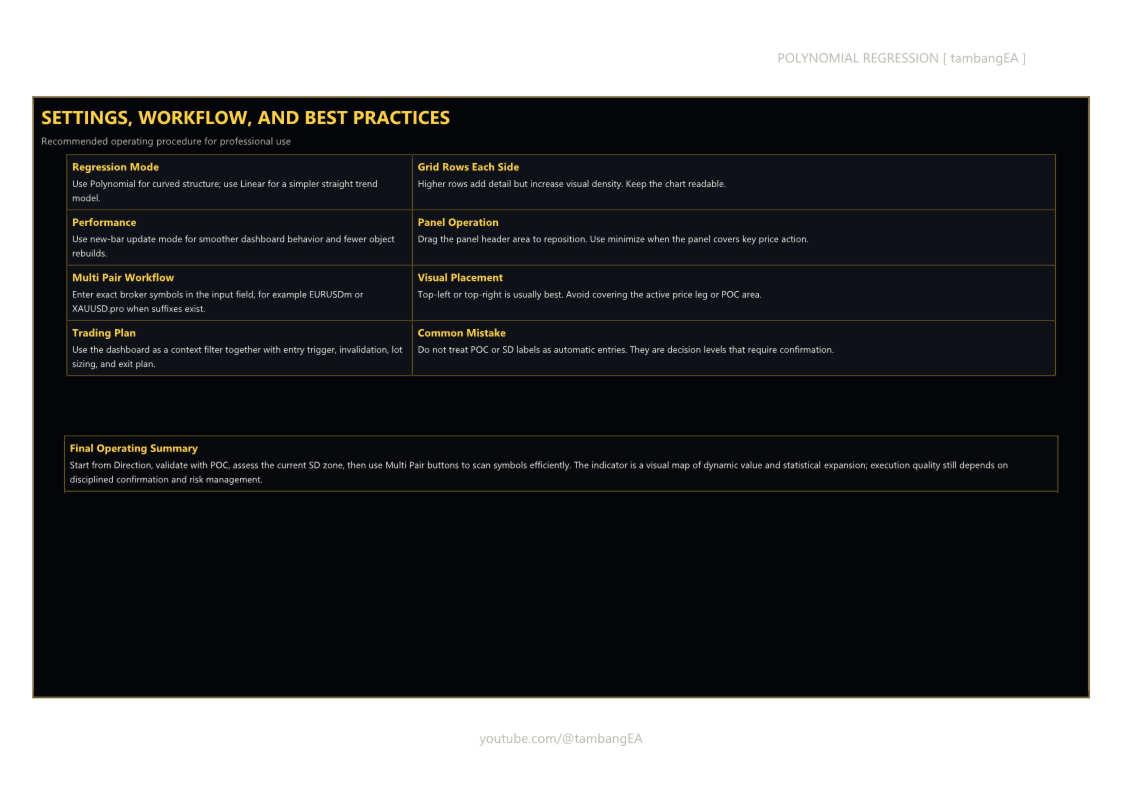
The dashboard includes clickable symbol buttons, allowing traders to switch between selected pairs directly from the chart. Broker suffixes can be customized through the input settings.
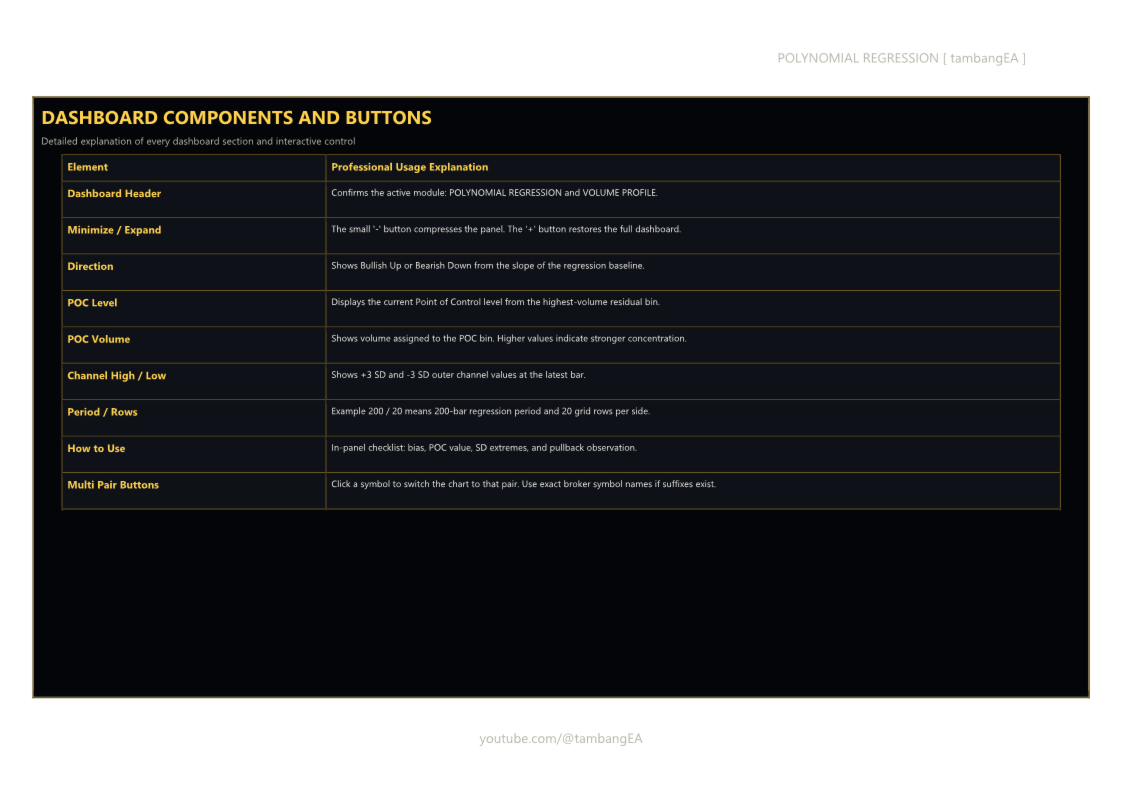
Minimize / Expand Panel
The dashboard can be minimized to save chart space and expanded again when full information is needed.
Draggable Dashboard
The dashboard can be moved on the chart for better layout control.
Performance-Oriented Object Rendering
The indicator is designed to reduce unnecessary redraws and keep the chart cleaner by updating heavy graphical objects efficiently.
How to Use
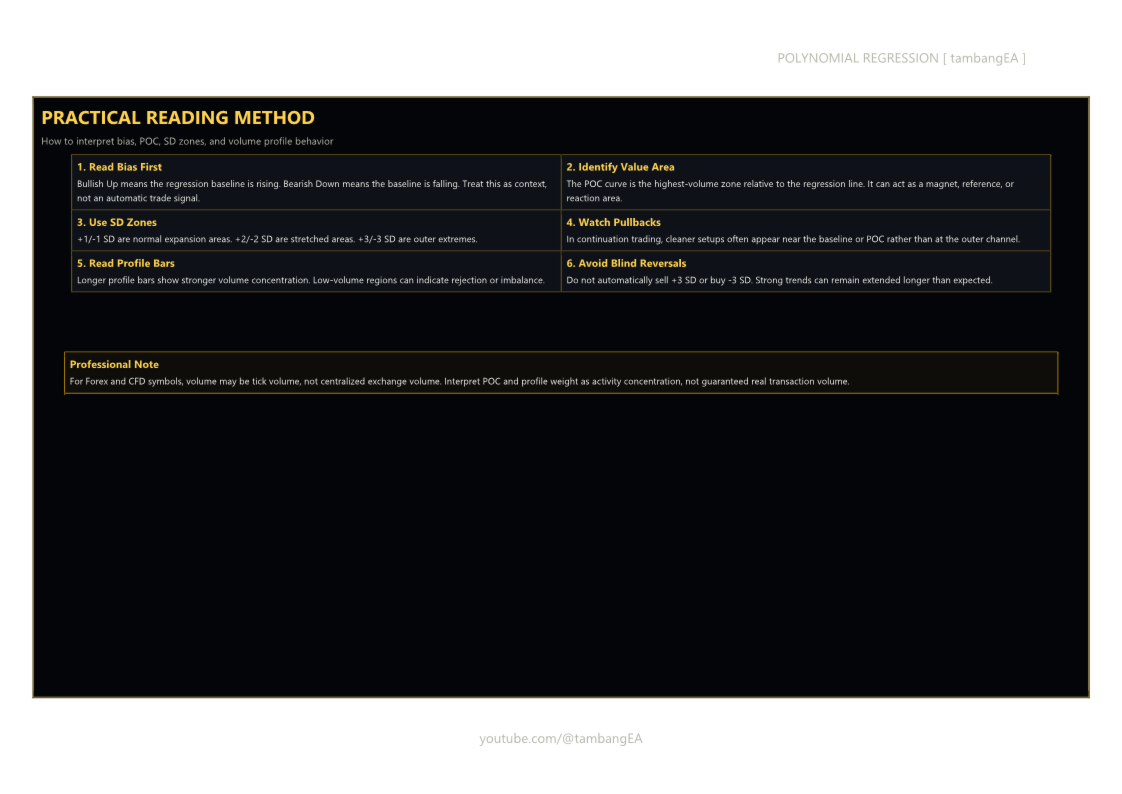
Check the dashboard direction first.
Bullish Up means the regression baseline is rising.
Bearish Down means the regression baseline is falling.
Identify the POC Level.
The POC represents the dominant volume zone relative to the regression matrix.
Price often reacts around this value area.
Observe the regression baseline.
Price near the baseline may indicate fair value.
Price far from the baseline may indicate statistical expansion.
Watch the standard deviation zones.
+2 SD and +3 SD may indicate stretched upside areas.
-2 SD and -3 SD may indicate stretched downside areas.
Use pullbacks carefully.
In trending markets, pullbacks toward the baseline or POC may offer cleaner decision areas than chasing price at the outer channel.
Use Multi-Pair buttons for faster analysis.
Add your preferred symbols in the input settings.
Use exact broker symbol names if your broker uses suffixes such as EURUSDm, XAUUSDm, or EURUSD.pro.
Recommended Usage
This indicator is suitable for:
Trend analysis
Pullback analysis
Statistical channel reading
Volume concentration analysis
Dynamic support and resistance reference
Multi-pair discretionary scanning
Market structure confirmation
It can be used on Forex, Gold, indices, commodities, and other symbols supported by your broker.
Important Notes
This indicator is not an Expert Advisor and does not execute trades automatically. It is a visual analysis tool for traders who prefer structured market reading.
The volume data used by the indicator depends on the symbol and broker. For Forex and CFD instruments, volume may represent tick volume rather than centralized exchange volume.