Articles on data analysis and statistics in MQL5

Articles on mathematical models and laws of probability are interesting for many traders. Mathematics is the basis of technical indicators, and statistics is required to analyze trading results and develop strategies.
Read about the fuzzy logic, digital filters, market profile, Kohonen maps, neural gas and many other tools that can be used for trading.
Add a new article

You are missing trading opportunities:
- Free trading apps
- Over 8,000 signals for copying
- Economic news for exploring financial markets
Registration
Log in
You agree to website policy and terms of use
If you do not have an account, please register


Developing a Replay System (Part 45): Chart Trade Project (IV)
The main purpose of this article is to introduce and explain the C_ChartFloatingRAD class. We have a Chart Trade indicator that works in a rather interesting way. As you may have noticed, we still have a fairly small number of objects on the chart, and yet we get the expected functionality. The values present in the indicator can be edited. The question is, how is this possible? This article will start to make things clearer.


Atmosphere Clouds Model Optimization (ACMO): Practice
In this article, we will continue diving into the implementation of the ACMO (Atmospheric Cloud Model Optimization) algorithm. In particular, we will discuss two key aspects: the movement of clouds into low-pressure regions and the rain simulation, including the initialization of droplets and their distribution among clouds. We will also look at other methods that play an important role in managing the state of clouds and ensuring their interaction with the environment.


A feature selection algorithm using energy based learning in pure MQL5
In this article we present the implementation of a feature selection algorithm described in an academic paper titled,"FREL: A stable feature selection algorithm", called Feature weighting as regularized energy based learning.


Overcoming Accessibility Problems in MQL5 Trading Tools (Part IV): Remote voice trading
Learn a practical way to execute MetaTrader 5 trades from Telegram voice notes using a Python middleware and an MQL5 EA acting as an HTTP client. The article covers architecture, WebRequest polling, in-memory queuing, JSON parsing with null-terminator stripping, and a constrained command grammar with a 0.001-lot default. You will configure the environment and validate round‑trip latency suitable for mobile data connections.


Feature selection and dimensionality reduction using principal components
The article delves into the implementation of a modified Forward Selection Component Analysis algorithm, drawing inspiration from the research presented in “Forward Selection Component Analysis: Algorithms and Applications” by Luca Puggini and Sean McLoone.

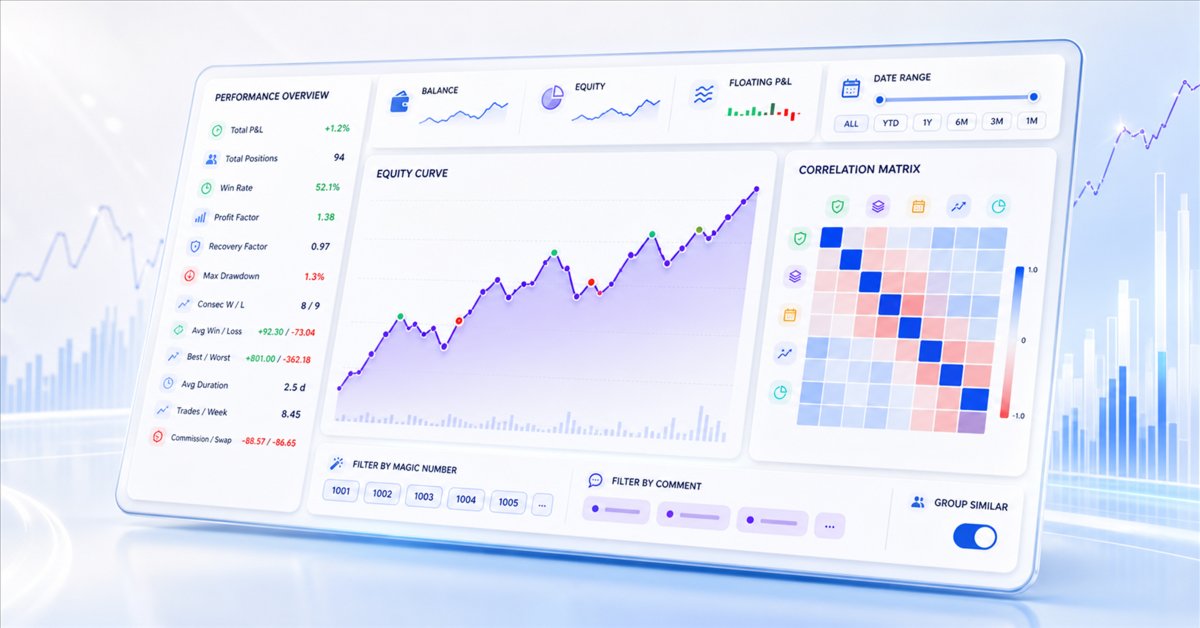
Creating an Interactive Portfolio Analyzer Dashboard with CCanvas in MQL5
This article presents a standalone Portfolio Analyzer dashboard implemented as an Expert Advisor for MetaTrader 5. It reads account deal history, reconstructs closed positions, and attributes results by magic number or normalized comment to deliver clear per-strategy metrics. The interface provides a vector equity curve, date filters, and strategy selectors, plus a Pearson correlation matrix to reveal strategy redundancy. You can attach it to a separate chart without modifying existing trading EAs.


Adaptive Social Behavior Optimization (ASBO): Two-phase evolution
We continue dwelling on the topic of social behavior of living organisms and its impact on the development of a new mathematical model - ASBO (Adaptive Social Behavior Optimization). We will dive into the two-phase evolution, test the algorithm and draw conclusions. Just as in nature a group of living organisms join their efforts to survive, ASBO uses principles of collective behavior to solve complex optimization problems.


Exploring Regression Models for Causal Inference and Trading
The article explores the possibility of using regression models in algorithmic trading. Regression models, unlike binary classification, allow for the creation of more flexible trading strategies by quantifying predicted price changes.


Kohonen Self-Organizing Maps in an MQL5 Expert Advisor
Kohonen's self-organizing maps transform the chaos of market data into an ordered two-dimensional map, where similar patterns are grouped together. The article demonstrates a complete implementation of a SOM in an MQL5 Expert Advisor with 400 neurons and continuous learning. We break down the Best Matching Unit search algorithm, weight updates using a Gaussian neighborhood function, integration with quantum effects, and the generation of trading signals. The code is open-source, the math is clear, and the results are verifiable.


Developing a Replay System (Part 35): Making Adjustments (I)
Before we can move forward, we need to fix a few things. These are not actually the necessary fixes but rather improvements to the way the class is managed and used. The reason is that failures occurred due to some interaction within the system. Despite attempts to find out the cause of such failures in order to eliminate them, all these attempts were unsuccessful. Some of these cases make no sense, for example, when we use pointers or recursion in C/C++, the program crashes.


Developing a Replay System (Part 55): Control Module
In this article, we will implement a control indicator so that it can be integrated into the message system we are developing. Although it is not very difficult, there are some details that need to be understood about the initialization of this module. The material presented here is for educational purposes only. In no way should it be considered as an application for any purpose other than learning and mastering the concepts shown.


Stepwise feature selection in MQL5
In this article, we introduce a modified version of stepwise feature selection, implemented in MQL5. This approach is based on the techniques outlined in Modern Data Mining Algorithms in C++ and CUDA C by Timothy Masters.


The case for using Hospital-Performance Data with Perceptrons, this Q4, in weighing SPDR XLV's next Performance
XLV is SPDR healthcare ETF and in an age where it is common to be bombarded by a wide array of traditional news items plus social media feeds, it can be pressing to select a data set for use with a model. We try to tackle this problem for this ETF by sizing up some of its critical data sets in MQL5.


Dingo Optimization Algorithm (DOA)
The article presents a new metaheuristic method based on the hunting strategies of Australian dingoes: group attack, chase, and scavenging. Let's see how the Dingo Optimization Algorithm (DOA) performs algorithmically.


Determining Fair Exchange Rates Using PPP and IMF Data
Building a purchasing power parity (PPP)-based exchange rate analysis system using Python. The author developed an algorithm with 5 methods for calculating fair exchange rates using IMF data. A practical guide to fundamental currency analysis, economic data processing, and integration with trading systems. Full code in open source.


Developing a Replay System (Part 39): Paving the Path (III)
Before we proceed to the second stage of development, we need to revise some ideas. Do you know how to make MQL5 do what you need? Have you ever tried to go beyond what is contained in the documentation? If not, then get ready. Because we will be doing something that most people don't normally do.


Market Simulation (Part 24): Getting Started with SQL (VII)
In the previous article, we completed the necessary introduction to SQL. And, in my opinion, we properly clarified what we wanted to show and explain about SQL. This was done so that anyone who comes to look at the market replay/simulation system being built can at least get an idea of what may be happening there. The point is that there is no sense in programming things that SQL handles perfectly.


MQL5 Wizard Techniques you should know (Part 90): Fenwick Tree Money Management with 1D CNN in MQL5
This article implements a Fenwick Tree (Binary Indexed Tree) for volume-aware money management inside an MQL5 Wizard Expert Advisor. We structure cumulative volume in O(log n) and apply four scaling modes—linear, conservative, aggressive, and mean-reversion—optionally gated by a lightweight 1D CNN. Practical tests compare the algorithm alone versus the CNN‑filtered approach to illustrate adaptive lot sizing and risk control under varying volume topologies.


Market Simulation (Part 22): Getting Started with SQL (V)
Before you give up and decide to abandon learning SQL, allow me to remind you, dear readers, that here we are still using only the most basic elements. We have not yet looked at some of SQL's capabilities. Once you understand them, you will see that SQL is far more practical than it seems. Although, most likely, we will eventually change the direction of what we are building, because the creation process is dynamic. We will show a little more about creating different things in SQL, because this is truly important and useful for you. Simply thinking that you are more capable than an entire community of programmers and developers will only lead to wasted time and opportunities. Do not worry, because what comes next will be even more interesting.


Implementation of the Quantum Reservoir Computing (QRC) circuit
A revolutionary approach to machine learning in trading through quantum computing. The article demonstrates a practical implementation of an adaptive QRC system with continuous retraining for predicting market movements in real time.


Market Microstructure in MQL5 (Part 2): Measuring long memory in MQL5 with Hurst estimators
Part 2 focuses on practical long-memory detection for intraday data. Three complementary Hurst estimators are implemented and combined into a confidence‑weighted composite, with confidence tied to valid regression scales. The final H and confidence populate the shared analysis struct, enabling indicators to act only when H departs from the neutral 0.40–0.60 band and to select trend‑following above 0.60 or mean‑reversion below 0.40.


Beyond GARCH (Part II): Measuring the Fractal Dimension of Markets
Building on the partition function analysis from Part 1, this article deepens the theoretical foundation before completing the analytical pipeline. We first give a full treatment of the Hurst exponent: what it measures, what it implies about market memory, and why it matters for the MMAR. This is followed by an intuitive exploration of multifractal spectra and what f(α) reveals about volatility heterogeneity. We then move to implementation: extracting the scaling function τ(q), estimating H via R/S analysis, and fitting the multifractal spectrum across four candidate distributions. By the end, we have the complete parameter set needed to construct the MMAR process in Part 3. Part 2 of an eight-part series.


MQL5 Trading Toolkit (Part 7): Expanding the History Management EX5 Library with the Last Canceled Pending Order Functions
Learn how to complete the creation of the final module in the History Manager EX5 library, focusing on the functions responsible for handling the most recently canceled pending order. This will provide you with the tools to efficiently retrieve and store key details related to canceled pending orders with MQL5.


Building a Future Swing Projection Indicator in MQL5
We implement a Future Swing Projection indicator in MQL5 that analyzes historical swing structure and estimates the next move from recent price behavior. It locates six alternating swing points, measures five completed legs, and uses their average distance to project a target five bars ahead. The indicator draws swing legs, a projection line, ATR‑based support and resistance zones, and a label with the projected price to keep the process rule‑based and reproducible.


Market Simulation (Part 24): Position View (II)
In this article, I will show how to use an indicator to track open positions on the trading server in the simplest and most practical way possible. I am doing this step by step to show that you do not necessarily have to move all of this into an Expert Advisor. Many of you have probably become used to doing that for one reason or another. In fact, that is not really justified, because as this implementation evolves, it will become clear that you can create or implement different types of indicators for this purpose.


Beyond GARCH (Part I): Mandelbrot's MMAR versus Engle's GARCH
This article starts the MMAR pipeline on EURUSD M5 data. We load market data via the MetaTrader5 Python API and run partition-function analysis with non-overlapping intervals to test for multifractal scaling. The result is an evidence-based decision on fractality, a prerequisite for building MMAR and for choosing whether to proceed beyond GARCH.


Building a JSON Trade Report Exporter in Pure MQL5
A refined MQL5 script exports trade history to a well‑formed JSON file in MQL5/Files/, reconstructing trades from deals by position ID and recovering stop loss and take profit via a two‑pass lookup that falls back closed to the originating order. It includes a dedicated JSON serializer and computes R‑multiple, pip profit, and duration. The result loads cleanly in Python, R, or Excel without custom parsing.


Machine Learning Without the Black Box: The Tsetlin Machine for Trading
This article builds a white-box classifier in MQL5 using the Tsetlin Machine. It learns human-readable AND-rules instead of weights, trains with integer state updates, and requires no external dependencies. You will assemble the automaton, clause, and multi-class voter, verify on XOR and other boolean tasks, booleanize indicators, label by forward ATR-scaled return, save the model to CSV, and view active rules on a live chart.


Bison Algorithm (BIA)
A new optimization method, the Bison Algorithm (BIA), uses two strategies, inspired by the behavior of bison, for solving continuous problems with a single objective function. The key features of BIA are two fundamental principles borrowed from the behavior of bison: the ability to move dynamically and a defensive strategy.


Exchange Market Algorithm (EMA)
The article presents a detailed analysis of the Exchange Market Algorithm (EMA) inspired by the behavior of stock market traders. The algorithm simulates stock trading, where market participants with varying levels of success employ different strategies to maximize profits.


Implementation of a table model in MQL5: Applying the MVC concept
In this article, we look at the process of developing a table model in MQL5 using the MVC (Model-View-Controller) architectural pattern to separate data logic, presentation, and control, enabling structured, flexible, and scalable code. We consider implementation of classes for building a table model, including the use of linked lists for storing data.


Developing a Replay System (Part 41): Starting the second phase (II)
If everything seemed right to you up to this point, it means you're not really thinking about the long term, when you start developing applications. Over time you will no longer need to program new applications, you will just have to make them work together. So let's see how to finish assembling the mouse indicator.


Population optimization algorithms: Resistance to getting stuck in local extrema (Part I)
This article presents a unique experiment that aims to examine the behavior of population optimization algorithms in the context of their ability to efficiently escape local minima when population diversity is low and reach global maxima. Working in this direction will provide further insight into which specific algorithms can successfully continue their search using coordinates set by the user as a starting point, and what factors influence their success.


MQL5 Trading Tools (Part 34): Replacing Native Chart Objects with an Interactive Canvas Drawing Layer
We replace native MetaTrader chart objects with a canvas-based drawing engine that renders tools pixel-by-pixel on a full-chart bitmap layer. The article implements persistent object storage with per-tool style memory, precise hit testing, selection, whole-object dragging, and handle manipulation. It also adds new line tools, a reorganized category system with a one-click delete action, and a rubber-band preview for multi-click placement.


Developing a Replay System (Part 34): Order System (III)
In this article, we will complete the first phase of construction. Although this part is fairly quick to complete, I will cover details that were not discussed previously. I will explain some points that many do not understand. Do you know why you have to press the Shift or Ctrl key?


MQL5 Trading Tools (Part 35): Adding Channel, Pitchfork, Gann, and Fibonacci Tools to the Canvas Drawing Layer
We extend the canvas drawing layer from the previous part with seven new categories of multi-anchor analytical drawing tools, covering three channel variants, three pitchfork variants, three Gann tools, and the six Fibonacci tools. We work through how each tool encodes its geometry on the canvas, how derived handles let users reshape compound shapes coherently, and how shared helpers handle ray clipping, scanline filling, and anti-aliased arc rendering. By the end, we will have a full set of analytical drawing tools that live on the same interactive canvas alongside the basic line tools from the previous part.


MQL5 Trading Tools (Part 29): Step-by-Step Butterfly Animation on Canvas
In this article, we expand our butterfly animation program with a four-stage animation pipeline: sequential curve drawing, smooth wing fill fading, detailed body rendering, and continuous flight. We implement a timer-driven state machine, four oscillators for wing flapping, vertical bobbing, horizontal sway, and tilt, as well as a neon glow around the wing outlines and a cyclical color change based on hue. You will learn how to structure these effects on the MetaTrader 5 canvas for clean and controlled playback.


The Avellaneda-Stoikov Model: Inventory-Aware Quoting for Two-Sided Strategies
This article builds the Avellaneda–Stoikov formulas in MQL5, feeds them with rolling estimates of mid-price volatility and a proxy for order-flow intensity, and plots the reservation price with bid and ask in real time. A bar-by-bar simulation contrasts adaptive and fixed quoting under the same fill rules. The result is a tested class, an indicator, and a backtest to improve inventory control in two‑sided strategies.


Introduction to MQL5 (Part 40): Beginner Guide to File Handling in MQL5 (II)
Create a CSV trading journal in MQL5 by reading account history over a defined period and writing structured records to file. The article explains deal counting, ticket retrieval, symbol and order type decoding, and capturing entry (lot, time, price, SL/TP) and exit (time, price, profit, result) data with dynamic arrays. The result is an organized, persistent log suitable for analysis and reporting.


MQL5 Bootstrap (II): Essential Validators for Robust Trading Systems
The article builds a reusable validation layer for Expert Advisors in MQL5. It implements lot-size rules and normalization, SL/TP and freeze-level guards, price digit normalization, margin sufficiency checks, unchanged-level filtering on modifications, account order-limit control, new-bar detection, symbol tradability checks, economic-calendar news windows, and session detectors. The result is cleaner code and fewer terminal errors in live trading.