Pressure Breakout
- Indicators
-
Agus Santoso
 DISCLAIMER ON : The author of EA will not be held responsible for your losses or problems of any kind if the EA is directly or indirectly responsible for any losses.
Our software is provided “as is”, without any warranty or condition of any kind, express, implied or statutory. - Version: 1.0
- Activations: 5
MQL5 Blogs = https://www.mql5.com/en/blogs/post/776873
MT4 Version = https://www.mql5.com/en/market/product/199357
MT5 Version = https://www.mql5.com/en/market/product/199358
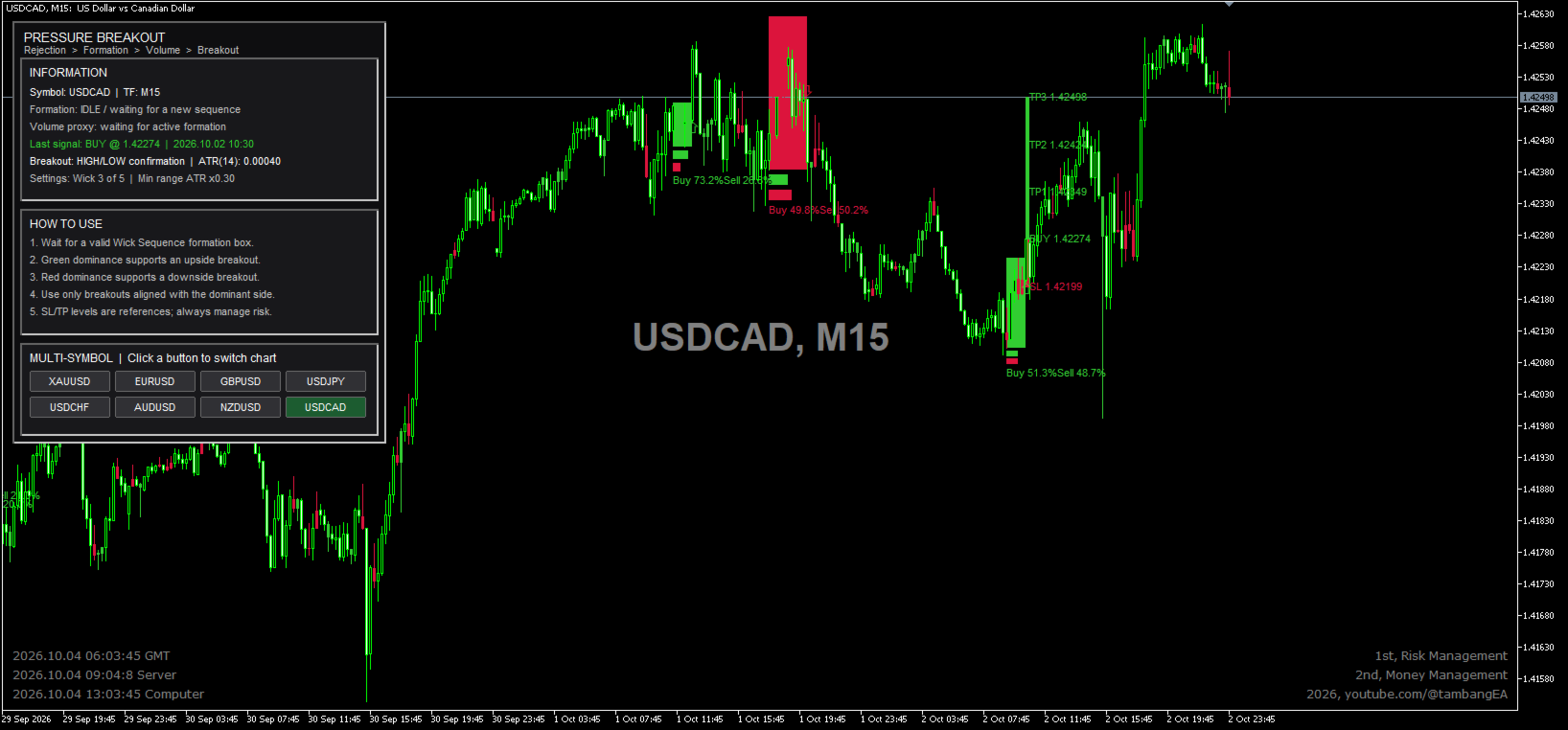
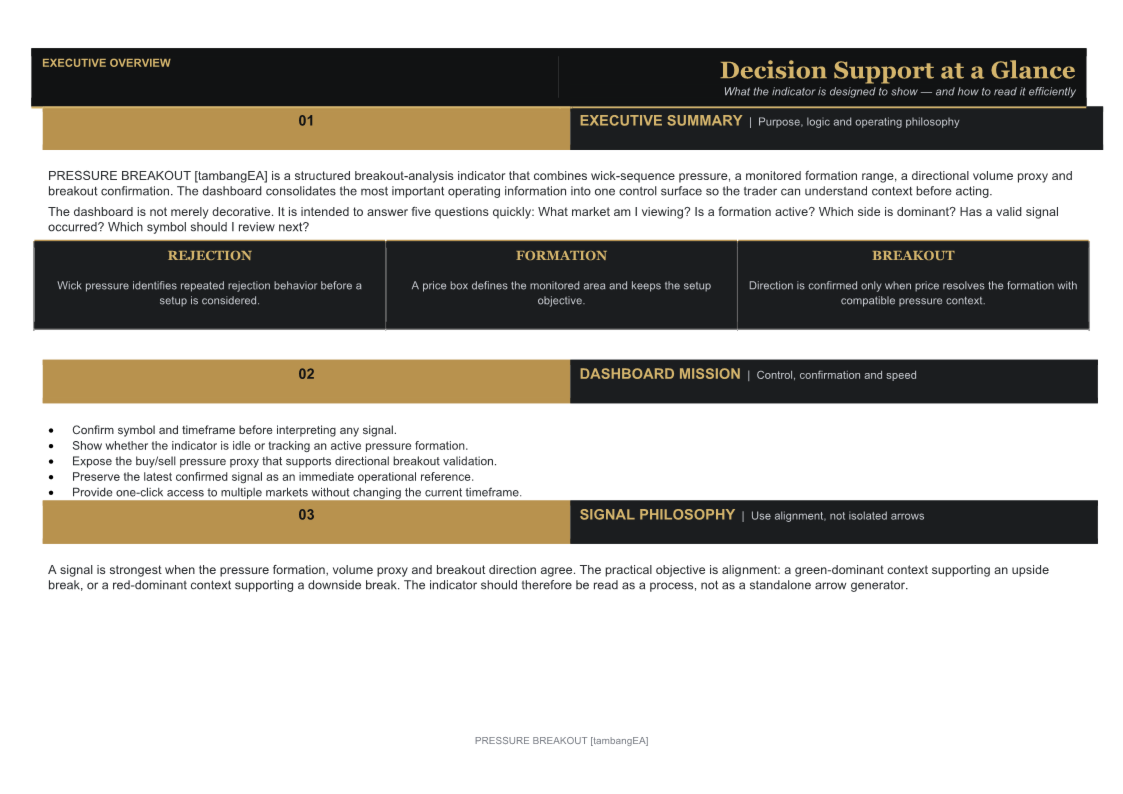
Pressure Breakout [tambangEA] is a professional MetaTrader indicator designed to identify price-pressure formations, evaluate directional dominance inside the formation, and confirm breakouts using a structured combination of wick behavior, volatility, volume proxy, and price expansion.
Instead of reacting to a single candle, the indicator looks for a sequence of qualifying wick candles within a configurable window, builds a pressure zone, monitors the development of that zone, and waits for a breakout that is aligned with the dominant pressure side.
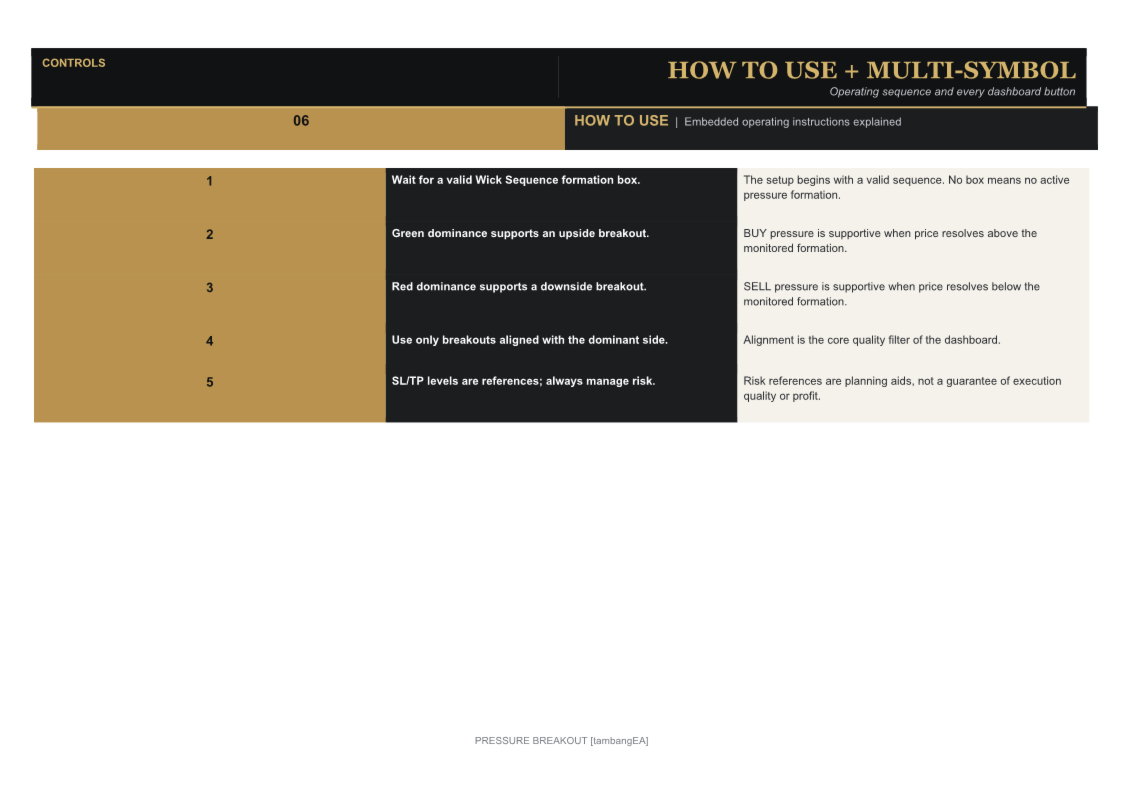
The workflow is simple:
Rejection → Formation → Volume → Breakout
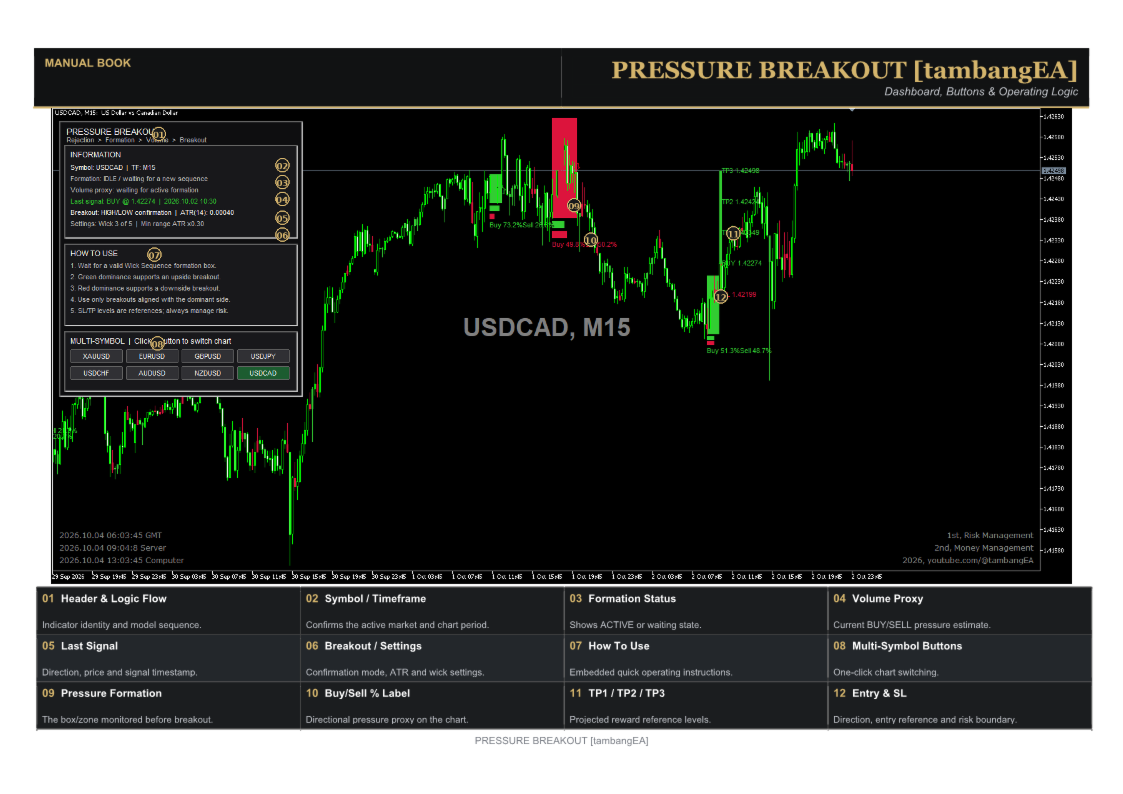
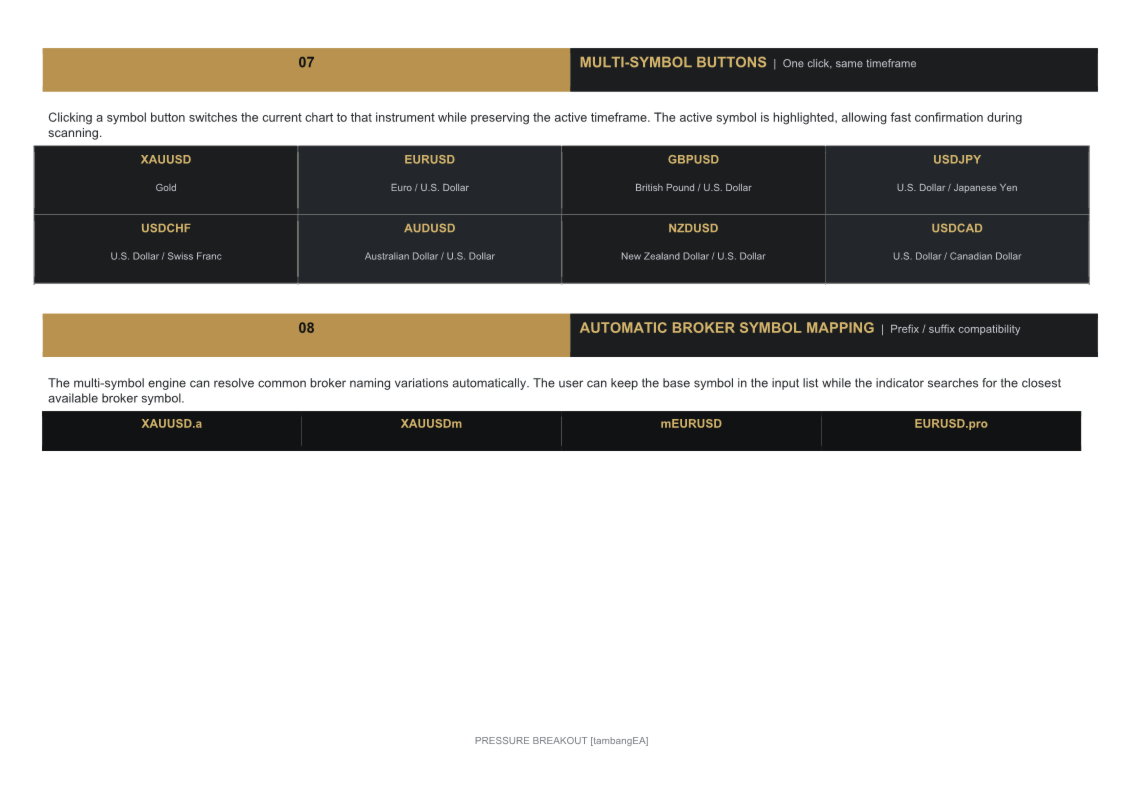
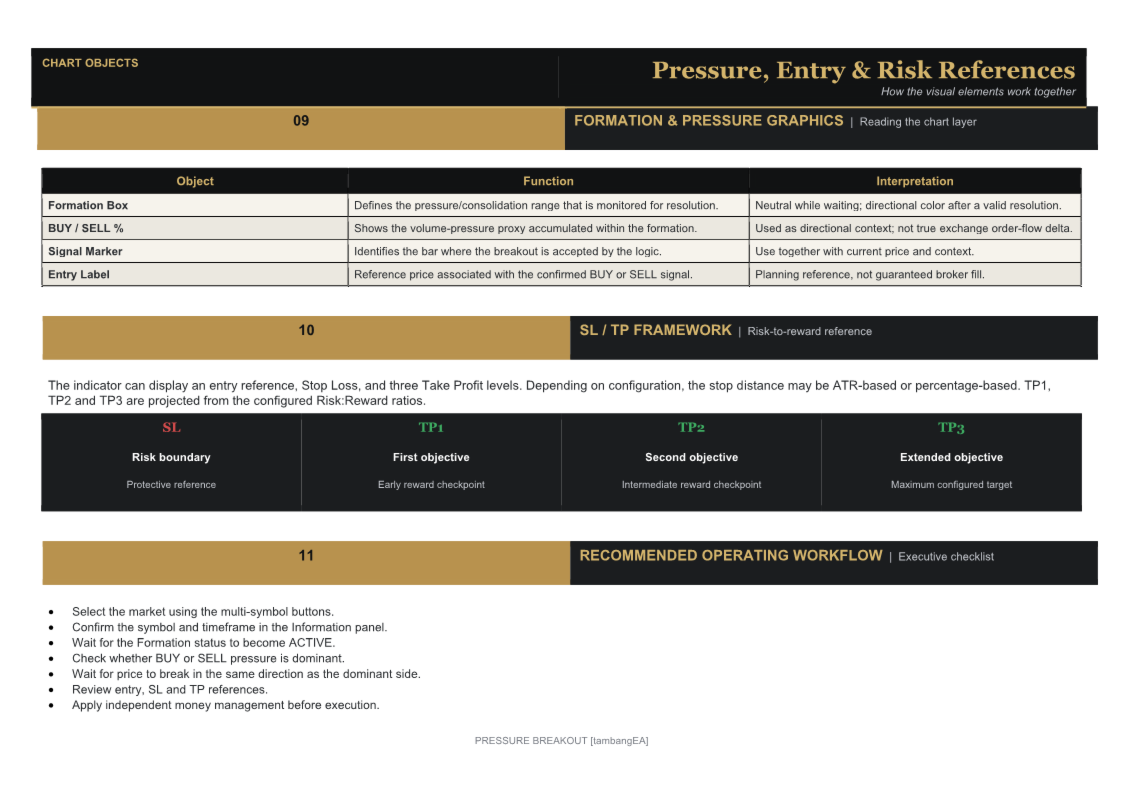
The indicator also includes an integrated dashboard, interactive multi-symbol navigation, visual entry/SL/TP references, and automatic broker symbol prefix/suffix detection.
Key Features
Wick Sequence Detection
Pressure Breakout analyzes candle geometry and identifies:
- upper-wick rejection formations;
- lower-wick rejection formations;
- multiple qualifying candles within a configurable window;
- ATR-based minimum candle-size filtering.
The candle body color is not the primary criterion. The indicator focuses on the location and proportion of the wick relative to the complete candle range.
This allows the system to recognize rejection pressure rather than relying only on bullish or bearish candle color.
N-of-M Formation Logic
The indicator does not require every wick candle to appear consecutively.
For example:
3 qualifying candles inside the latest 5 candles
can be used to create a valid pressure formation.
This provides a more flexible formation model while still requiring repeated evidence of rejection.
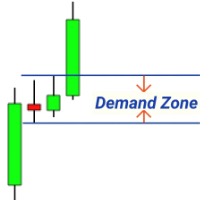
Automatic Pressure Formation Box
Once a valid Wick Sequence is detected, the indicator creates a formation box based on the recent price range.
The box represents the area where price pressure is being evaluated.
The indicator then waits for price to resolve the formation through either:
- an upside breakout, or
- a downside breakout.
The box automatically expands while the formation remains active.
Buy / Sell Pressure Proxy
Pressure Breakout estimates the directional pressure inside the formation.
The dashboard and chart can display:
Buy xx%
Sell xx%
The calculation combines candle position within its High-Low range with available volume information.
Example:
If candles repeatedly close near their highs, the system assigns more weight to buying pressure.
If candles repeatedly close near their lows, the system assigns more weight to selling pressure.
The pressure calculation is used as a directional confirmation filter.
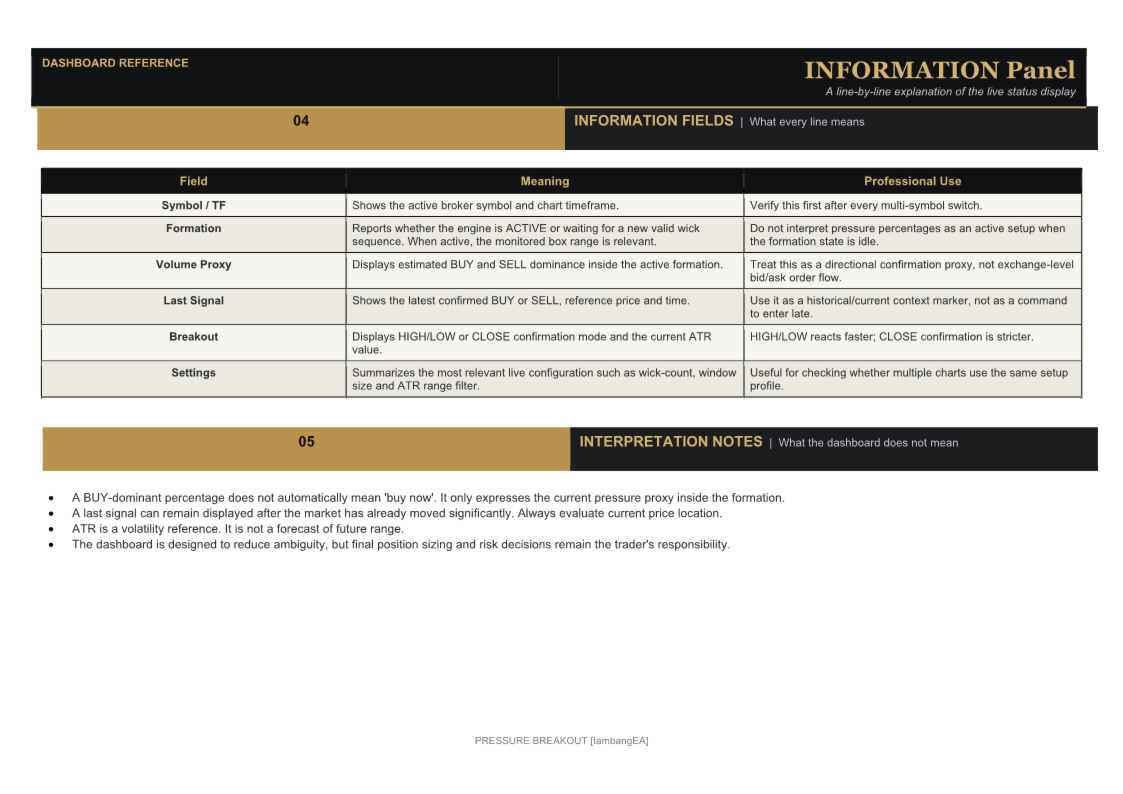
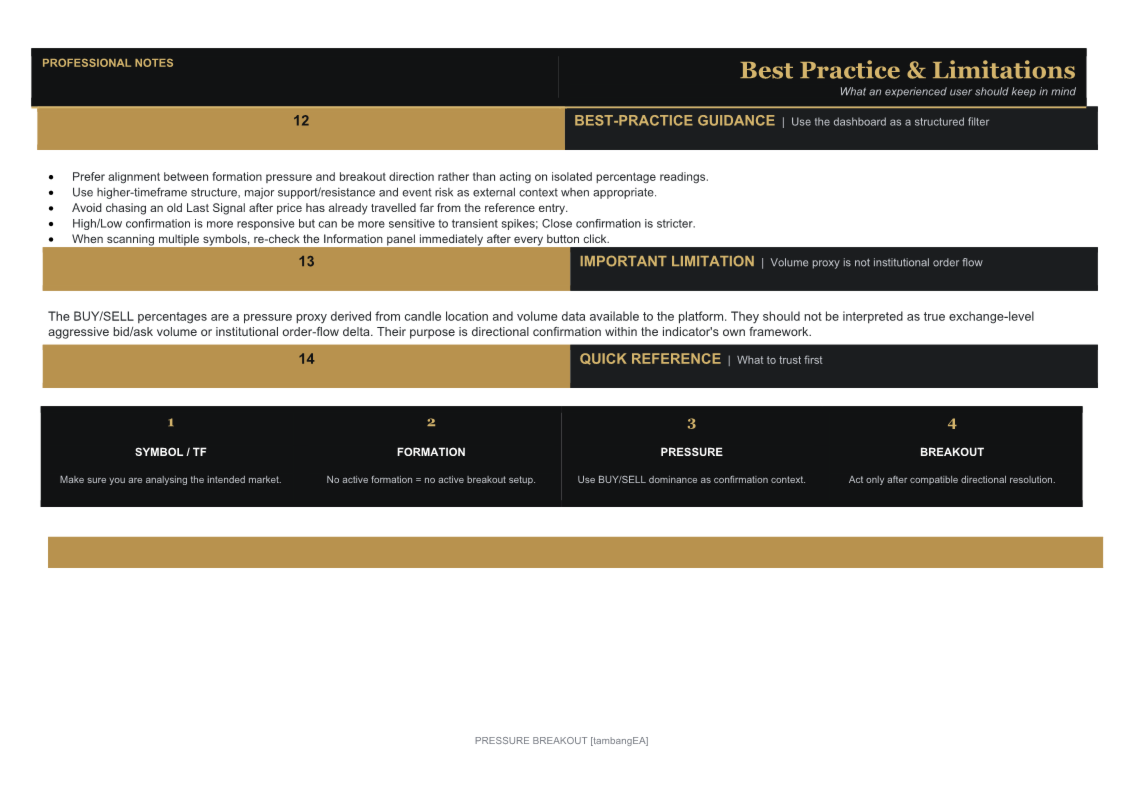
Important: Buy/Sell percentages are an analytical volume-pressure proxy. They should not be interpreted as true exchange-level bid/ask order-flow delta.
Breakout Confirmation
A breakout signal is generated when price exits the active formation and the breakout direction agrees with the dominant pressure side.
Bullish Signal
Typical sequence:
Lower-wick pressure → Formation → Buy dominance → Upward breakout → BUY signal
Bearish Signal
Typical sequence:
Upper-wick pressure → Formation → Sell dominance → Downward breakout → SELL signal
A breakout against the dominant side can be rejected by the indicator.
This helps reduce signals caused by directionally inconsistent price movement.
Two Breakout Modes
Pressure Breakout supports two breakout-confirmation methods.
High / Low Confirmation
The breakout is confirmed when:
High > Formation High
or:
Low < Formation Low
This mode is more responsive.
Close Confirmation
The breakout is confirmed only when the candle closes outside the formation.
This mode is more conservative and can help reduce sensitivity to intrabar spikes and temporary liquidity sweeps.
Breakout Candle Size Filter
An optional breakout-strength filter can require the breakout candle to be larger than the recent average candle range.
For example:
Breakout Range ≥ Average Range × 1.20
This feature can help filter weak or marginal breaks of the formation boundary.