TDI Laguerre
- Indicators
-
Andres Felipe Carvajal Rodriguez
 I do not develop indicators to follow the market. I develop algorithms to understand it.
My goal is to transform price complexity into objective, robust, and efficient tools that help traders make decisions with greater precision, consistency, and risk control. - Version: 1.0
TDI Laguerre
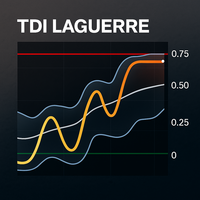
The TDI Laguerre is an evolution of the popular Traders Dynamic Index (TDI) indicator. It replaces the classic RSI with a Laguerre filter, offering a smoother, more sensitive, and precise reading of price action. This advanced version combines elements of volatility, moving averages, and visual signal detection with configurable alerts.
What Does This Indicator Do?
This indicator displays:
- A smoothed Laguerre line based on the closing price.
- A short-term EMA signal line overlaid on the Laguerre line.
- A middle band (Laguerre moving average).
- Volatility bands (based on the Laguerre standard deviation).
- Configurable upper and lower levels (e.g., overbought/oversold).
- Visual buy/sell signals based on key crossovers and reversals from extreme zones.
- Audible and visual alerts only when conditions are met at the candle close, avoiding false signals.
Key Differences:
| Aspect | Classic TDI (RSI) | TDI Laguerre |
|---|---|---|
| Core Calculation | RSI (Relative Strength Index) | Laguerre Filter (L0-L3 + CU/CD) |
| Sensitivity | Moderate, depends on RSI period | High, controlled by the gamma parameter |
| Smoothness | Requires additional smoothing | Inherently smooth |
| Reaction to Sharp Changes | Can generate noise | Attenuates noise without excessive lag |
| Adjustment Flexibility | Limited to RSI period | High: gamma, EMA, bands, levels |
Advantages of TDI Laguerre over TDI with RSI
- Increased fluidity in movements: The Laguerre line responds more clearly and with less noise than the traditional RSI.
- Lower probability of false signals: Laguerre filtering suppresses market noise, especially in lower timeframes.
- Customizable extreme level settings: You can define overbought/oversold zones outside the classic 70/30 of the RSI.
- Adaptive volatility bands: Calculated on the Laguerre line, providing dynamic context.
- Smart and visual alerts: Notifications at candle close when there are clear confirmations.
Advantages over Classic Laguerre RSI
- Complete TDI structure: This indicator not only shows the Laguerre line but also incorporates:
- EMA signal line (direction confirmation).
- Middle band and deviation bands (context analysis).
- Automatic signal detection.
- Modular and visually clear system: Allows for more complete technical analysis without requiring multiple indicators.
- Compatible with advanced trading systems: Ideal for detecting divergences, breakouts, and reversals with multiple confirmations.
- Designed for real trading decisions: Integrates practical alerts without cluttering the main chart.
Who is This Indicator For?
- Traders who already use TDI and want a smoother and more precise version.
- Users of classic Laguerre who need a more complete signal structure.
- Scalpers and intraday traders who require sensitivity without excessive noise.
- Swing traders who want solid confirmations at key levels.
Conclusion
The TDI Laguerre for MT5 offers the best of both worlds: the structural intelligence of TDI with the smoothing power of the Laguerre filter. It's a powerful tool for those seeking clarity, precision, and reliable signals in any timeframe.
One Recommended Strategy: Combination with MACD for Trend Confirmation
An appropriate combination to enhance the effectiveness of the TDI Laguerre indicator is to use the standard MACD as a macro trend filter.
Suggested Steps:
D1 (Daily) Timeframe:
- Use the standard MACD to identify the market's main trend.
- If MACD > 0, it's considered an uptrend.
- If MACD < 0, it's considered a downtrend.
H1 (One Hour) Timeframe:
- Use the TDI Laguerre indicator to find more precise entry opportunities.
- Only activate signals in favor of the trend detected on D1:
- If MACD on D1 is greater than 0, look for buy signals only.
- If MACD on D1 is less than 0, look for sell signals only.
This methodology helps reduce false signals and improve the probability of success by trading in alignment with the overall market direction.