Articles on the MQL5 programming and use of technical indicators

Technical indicators constitute an important part of trading, and every trader tries to find something new. The authors of these articles talk about econometrics and machine learning, automatic marking of Elliott Waves and digital filters - everything from the classical methods of analysis to the modern interpretation of classical ideas.
The category features articles that will teach you how to develop a custom indicator and contains unique collections of ready-to-use mathematically explained William Blau's trading ideas.
Add a new article

You are missing trading opportunities:
- Free trading apps
- Over 8,000 signals for copying
- Economic news for exploring financial markets
Registration
Log in
You agree to website policy and terms of use
If you do not have an account, please register


MQL5 Wizard Techniques you should know (Part 76): Using Patterns of Awesome Oscillator and the Envelope Channels with Supervised Learning
We follow up on our last article, where we introduced the indicator couple of the Awesome-Oscillator and the Envelope Channel, by looking at how this pairing could be enhanced with Supervised Learning. The Awesome-Oscillator and Envelope-Channel are a trend-spotting and support/resistance complimentary mix. Our supervised learning approach is a CNN that engages the Dot Product Kernel with Cross-Time-Attention to size its kernels and channels. As per usual, this is done in a custom signal class file that works with the MQL5 wizard to assemble an Expert Advisor.


MQL5 Wizard Techniques you should know (Part 52): Accelerator Oscillator
The Accelerator Oscillator is another Bill Williams Indicator that tracks price momentum's acceleration and not just its pace. Although much like the Awesome oscillator we reviewed in a recent article, it seeks to avoid the lagging effects by focusing more on acceleration as opposed to just speed. We examine as always what patterns we can get from this and also what significance each could have in trading via a wizard assembled Expert Advisor.


MQL5 Wizard Techniques you should know (Part 45): Reinforcement Learning with Monte-Carlo
Monte-Carlo is the fourth different algorithm in reinforcement learning that we are considering with the aim of exploring its implementation in wizard assembled Expert Advisors. Though anchored in random sampling, it does present vast ways of simulation which we can look to exploit.


Automatic Session Volume Profile Builder in MQL5: Rendering POC and Value Area Without Third-Party Tools
Implement a session-focused volume profile in MQL5: acquire ticks with CopyTicksRange(), bin prices, and compute POC, VAH, and VAL by the 70% approach. The indicator renders directly on the chart as native objects, supports fixed-width scaling for consistent geometry across timeframes, and refreshes on each new session. This provides objective reference levels without external dependencies.


Market Microstructure in MQL5 (Part 6): Order Flow
This article adds six order-flow functions and a new OrderFlowAnalysis struct to MicroStructure_Foundation.mqh: VPINOHLC, signed flow imbalance, trade intensity versus a 20-session baseline, a late-minus-early smart-money index, flow momentum, and a wrapper that outputs a confidence weight. Flow confidence is gated by noise and jump intensity from Parts 5 and 4. Calibrated on 602 NQ M1 NY sessions, it provides ready-to-use intraday flow signals with documented thresholds.


MQL5 Wizard Techniques you should know (Part 63): Using Patterns of DeMarker and Envelope Channels
The DeMarker Oscillator and the Envelope indicator are momentum and support/resistance tools that can be paired when developing an Expert Advisor. We therefore examine on a pattern by pattern basis what could be of use and what potentially avoid. We are using, as always, a wizard assembled Expert Advisor together with the Patterns-Usage functions that are built into the Expert Signal Class.


Introduction to MQL5 (Part 32): Mastering API and WebRequest Function in MQL5 (VI)
This article will show you how to visualize candle data obtained via the WebRequest function and API in candle format. We'll use MQL5 to read the candle data from a CSV file and display it as custom candles on the chart, since indicators cannot directly use the WebRequest function.


Defining your Edge (Part 1): Using a Discrete Fourier Transform and a Spiking Neural Network in a Trading Robot
In this article we make the case for pairing the Discrete Fourier Transform with a Spiking Neural Network in a Trading Robot. The Fourier Transform helps represent data as oscillations instead of its raw values. To govern how we interpret these cycles, we engage a Spiking Neural Network that unlike regular networks, uses time dependent electrical charges to accumulate potential and only "spike" when a target threshold is met. Combining these two engines allows us better control on the timing of discrete market movements, that in theory should give us entry signals with rigorous mathematical confirmation.


Analyzing Price Time Gaps in MQL5 (Part I): Building a Basic Indicator
Time gap analysis helps traders identify potential market reversal points. The article discusses what a time gap is, how to interpret it, and how it can be used to detect large volume influxes into the market.


Analyzing the Hourly Movement of Trading Symbols and Their Spreads in MetaTrader 5
The ProSpread seasonality index indicator with a Moving Average is a technical analysis tool that identifies seasonal patterns in price movements, analyzes price behavior during specific trading hours and is able to work with either a single instrument or a spread between two assets. It also visualizes the statistical probability of directional movements.


Account Audit System in MQL5 (Part 1): Designing the User Interface
This article builds the user interface layer of an Account Audit System in MQL5 using CChartObject classes. We construct an on-chart dashboard that displays key metrics such as start/end balance, net profit, total trades, wins/losses, win rate, withdrawals, and a star-based performance rating. A menu button lets you show or hide the panel and restores one-click trading, delivering a clean, usable foundation for the broader audit pipeline.


MQL5 Wizard Techniques you should know (Part 70): Using Patterns of SAR and the RVI with a Exponential Kernel Network
We follow up our last article, where we introduced the indicator pair of the SAR and the RVI, by considering how this indicator pairing could be extended with Machine Learning. SAR and RVI are a trend and momentum complimentary pairing. Our machine learning approach uses a convolution neural network that engages the Exponential kernel in sizing its kernels and channels, when fine-tuning the forecasts of this indicator pairing. As always, this is done in a custom signal class file that works with the MQL5 wizard to assemble an Expert Advisor.


Forecasting in Trading Using Grey Models
The article discusses the application of Grey models to forecasting financial time series. We will consider the operating principles of Grey models and the specifics of their application to financial series. We will also discuss the advantages and limitations of using these models in trading.


Application of the Grey Model in Technical Analysis of Financial Time Series
This article explores the grey model, a promising tool that can expand trader's capabilities. We will look at some options for applying this model to technical analysis and building trading strategies.


Price Action Analysis Toolkit Development (Part 77): Building a Searchable Indicator Panel for MetaTrader 5
A modular indicator search system for MetaTrader 5 that replaces manual navigation through built-in indicator categories with a searchable interface. The application integrates an indicator catalog, search engine, chart launcher, and graphical panel, allowing indicators to be located, filtered, and attached to the appropriate chart window from a single interface.


Building a Divergence System: Creating the MPO4 Custom Indicator
We introduce MPO4, a pressure-based oscillator that emphasizes the body and direction of candles in the context of current volatility. The article details its mathematics, normalization into a bounded range, and the EMA smoothing, then builds a pivot-driven divergence module designed not to repaint. You get complete MQL5 implementation and practical guidance for interpreting signals, including a comparison with RSI as an alternative source.


Developing a Replay System (Part 33): Order System (II)
Today we will continue to develop the order system. As you will see, we will be massively reusing what has already been shown in other articles. Nevertheless, you will receive a small reward in this article. First, we will develop a system that can be used with a real trading server, both from a demo account or from a real one. We will make extensive use of the MetaTrader 5 platform, which will provide us with all the necessary support from the beginning.


MQL5 Wizard Techniques you should know (Part 68): Using Patterns of TRIX and the Williams Percent Range with a Cosine Kernel Network
We follow up our last article, where we introduced the indicator pair of TRIX and Williams Percent Range, by considering how this indicator pairing could be extended with Machine Learning. TRIX and William’s Percent are a trend and support/ resistance complimentary pairing. Our machine learning approach uses a convolution neural network that engages the cosine kernel in its architecture when fine-tuning the forecasts of this indicator pairing. As always, this is done in a custom signal class file that works with the MQL5 wizard to assemble an Expert Advisor.


Linear Regression Prediction Channels in MQL5: Constructing Statistically Grounded Confidence and Prediction Bands
The article implements rolling OLS regression channels in MQL5 and computes confidence and prediction bands with Student's t critical values instead of a fixed standard-deviation multiplier. It explains the leverage-driven widening at window edges, contrasts the result with Bollinger and Donchian channels, and reviews OLS assumptions on price data. A five-line rendering is documented to ensure reliable display in MetaTrader 5.
Building a Divergence System: Creating the MPO4 Custom Indicator
We introduce MPO4, a pressure-based oscillator that emphasizes the body and direction of candles in the context of current volatility. The article details its mathematics, normalization into a bounded range, and the EMA smoothing, then builds a pivot-driven divergence module designed not to repaint. You get complete MQL5 implementation and practical guidance for interpreting signals, including a comparison with RSI as an alternative source.


Mapping Dealer Gamma Exposure (GEX) in MetaTrader 5: Walls, the Zero-Gamma Flip, and a Chart Overlay
In this article we build a dealer gamma-exposure map in MQL5. From an option chain, the tool computes per-strike GEX, finds the call and put walls, and solves for the zero-gamma flip that separates a mean-reverting regime from a trending one, then draws it all on the chart. CSV and native-symbol data paths included.


Markets Positioning Codex in MQL5 (Part 2): Bitwise Learning, with Multi-Patterns for Nvidia
We continue our new series on Market-Positioning, where we study particular assets, with specific trade directions over manageable test windows. We started this by considering Nvidia Corp stock in the last article, where we covered 5 signal patterns from the complimentary pairing of the RSI and DeMarker oscillators. For this article, we cover the remaining 5 patterns and also delve into multi-pattern options that not only feature untethered combinations of all ten, but also specialized combinations of just a pair.


Analyzing binary code of prices on the exchange (Part I): A new look at technical analysis
This article presents an innovative approach to technical analysis based on converting price movements into binary code. The author demonstrates how various aspects of market behavior — from simple price movements to complex patterns — can be encoded in a sequence of zeros and ones.


MQL5 Wizard Techniques you should know (Part 40): Parabolic SAR
The Parabolic Stop-and-Reversal (SAR) is an indicator for trend confirmation and trend termination points. Because it is a laggard in identifying trends its primary purpose has been in positioning trailing stop losses on open positions. We, however, explore if indeed it could be used as an Expert Advisor signal, thanks to custom signal classes of wizard assembled Expert Advisors.


Unified Multi-Timeframe Renko: Synthesizing the Market's Temporal Dimensions
The article presents an innovative concept for a multi-timeframe Renko chart that combines signals from four timeframes (M5, M15, H1, H4) into a unified synthetic instrument. The system creates a virtual symbol in MetaTrader 5 by using the EMA of each timeframe to generate a composite signal through three methods: simple average, weighted average, and consensus. The implementation includes ATR-based adaptive brick sizing, real-time operation, and full integration with MetaTrader 5.


Market Heat Map Indicator Based on Prime-Number Density
An innovative indicator based on prime number theory helps identify strong reversal levels that other traders overlook. Testing on 10 assets showed that reversals in mathematically significant zones occur 1.5 to 1.8 times more frequently. Five practical application scenarios with specific rules for filtering out false breakouts and making precise market entries.


Reimagining Classic Strategies (Part 22): Ensemble Mean Reverting Strategy
This article will illustrate to the reader how to implement a mean-reverting strategy for the EURUSD pair. The strategy follows contrarian trading rules. Our strategy implements a weekly moving average channel, with one moving average on the high-price feed and the latter on the low-price feed. We enter short positions when the price falls beneath the low moving average and long positions when the price rises above the high moving average. Additionally, we will export daily market data to build a simple ONNX model of the market to provide an additional filter for our entries. This provides the reader with a reproducible template for strategy development and backtesting.

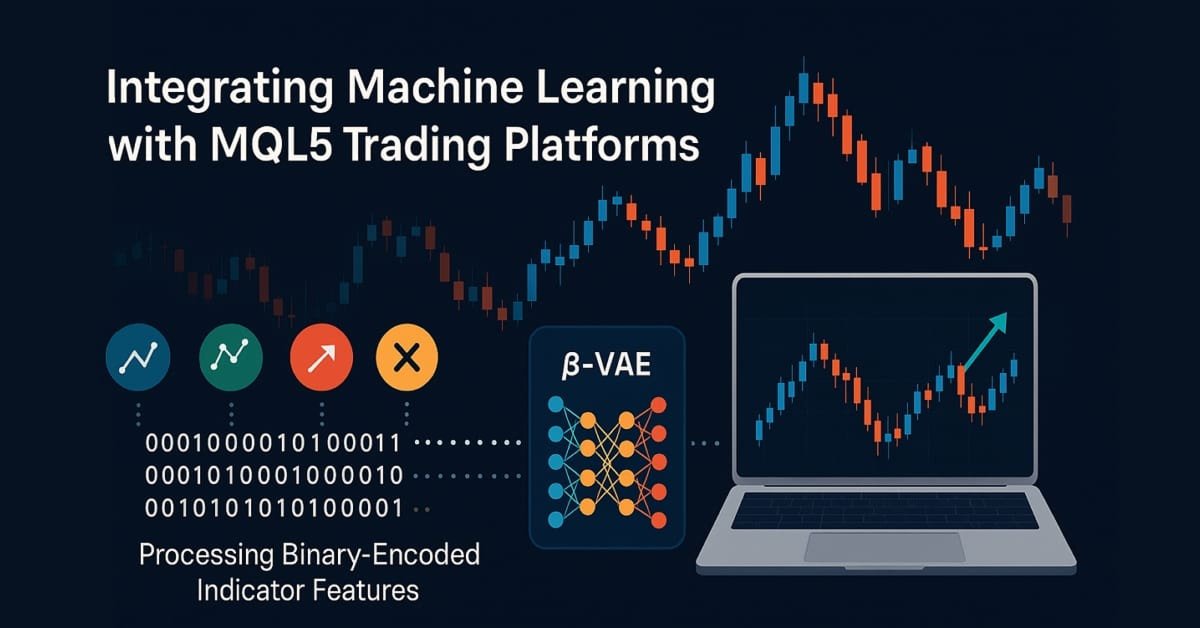
MQL5 Wizard Techniques you should know (Part 81): Using Patterns of Ichimoku and the ADX-Wilder with Beta VAE Inference Learning
This piece follows up ‘Part-80’, where we examined the pairing of Ichimoku and the ADX under a Reinforcement Learning framework. We now shift focus to Inference Learning. Ichimoku and ADX are complimentary as already covered, however we are going to revisit the conclusions of the last article related to pipeline use. For our inference learning, we are using the Beta algorithm of a Variational Auto Encoder. We also stick with the implementation of a custom signal class designed for integration with the MQL5 Wizard.


Gaussian Processes in Machine Learning (Part 2): Implementing and Testing a Classification Model in MQL5
In this section, we will look at the implementation of the key interfaces of the library of Gaussian processes in MQL5: IKernel, ILikelihood, and IInference. We will also demonstrate its operation on synthetic data and implement indicators for classification and regression, demonstrating its operation in online mode - with retraining of the model on each new bar.


A Generic Object Pool in MQL5: Eliminating Heap Fragmentation in High-Frequency Indicators
High-frequency MQL5 indicators that instantiate objects on every tick accumulate allocation overhead and timing jitter in OnCalculate(). This article constructs a generic templated object pool using a free-list index array, delivering O(1) Acquire() and Release() operations. The design includes double-release protection, strict separation of payload state from pool metadata in Reset(), and a fixed-capacity free list with no heap fallback. A dual-path custom indicator benchmark measures per-tick overhead difference using GetMicrosecondCount().


Engineering Trading Discipline into Code (Part 4): Enforcing Trading Hours and News Disabling in MQL5
An MQL5 control system that blocks orders outside scheduled trading hours and during scheduled news releases, converting time rules into executable restrictions. It combines a permissions management mechanism, a transaction-level expert advisor, and a visual dashboard for real-time status and upcoming restrictions. Configuration is accomplished using editable files, with caching and a CSV audit log for traceability.


MQL5 Wizard Techniques you should know (Part 33): Gaussian Process Kernels
Gaussian Process Kernels are the covariance function of the Normal Distribution that could play a role in forecasting. We explore this unique algorithm in a custom signal class of MQL5 to see if it could be put to use as a prime entry and exit signal.


GoertzelBrain: Adaptive Spectral Cycle Detection with Neural Network Ensemble in MQL5
GoertzelBrain combines Goertzel spectral analysis with an online‑trained neural network ensemble to convert cycle features into a directional confirmation signal. The indicator builds a compact feature vector from the dominant period, amplitude, confidence and their dynamics, plus local volatility, and outputs +1, −1 or 0. The article provides the full MQL5 implementation, explains the architecture and feature engineering, and shows how to use it as a directional filter.


Building a Hierarchical Market Structure Framework (Prototype) in MQL5 Using Modular Architecture and Event-Driven Design
This article describes a prototype reusable market structure framework for MQL5, built with a clean modular architecture and an internal event queue. It shows how to detect swing points, classify break-of-structure and change-of-character events, maintain a deterministic market state, and persist data to CSV. The focus is entirely on software engineering, component separation, and extensibility, not on trading signals. The prototype is a foundation for further development, not a production-ready library.


Evaluating the Quality of Forex Spread Trading Based on Seasonal Factors in MetaTrader 5
The article examines the quality of a seasonal trading approach on a daily timeframe, both for individual symbols and for spreads. Particular attention is paid to identifying recurring monthly cycles and the possibilities of their application in trading within the current year.


The Mathematics of Volatility: Why the GRI Indicator Deserves to Return to Your Trading Terminal
The article focuses on the Gopalakrishnan Range Index (GRI/ROCI), which quantitatively assesses the market's "degree of chaos" using the logarithm of the closing price range over a given period. The article shows how to implement GRI in MetaTrader 5, resolve the issue of negative values using a shifted logarithm, and convert the scale to convenient "points" by normalizing it by Point. Next, we examine practical scenarios for using GRI as a filter for volatility and market phases.


Market Positioning Codex for VGT with Kendall's Tau and Distance Correlation
In this article, we look to explore how a complimentary indicator pairing can be used to analyze the recent 5-year history of Vanguard Information Technology Index Fund ETF. By considering two options of algorithms, Kendall’s Tau and Distance-Correlation, we look to select not just an ideal indicator pair for trading the VGT, but also suitable signal-pattern pairings of these two indicators.


Price Action Analysis Toolkit Development (Part 71): Weekend Gap Structure Mapping in MQL5
The article delivers an object-based MQL5 implementation that detects weekend gaps from time discontinuities and renders them directly on the chart. It manages graphical objects, tracks state transitions (fresh, partial, reaction, filled), and preserves completed gaps as historical zones. The result is a reproducible framework for monitoring how price revisits and fills weekend gap structures.


Building an Object-Oriented Order Block Engine in MQL5
The article presents a production-oriented Order Block engine for MQL5 packaged as an include class, it validates zones via displacement and market structure break, maintains mitigation state only on closed bars, and avoids heavy copies by passing data by reference. A diagnostic indicator plots zones, and an EA gates logic to new bars for stable performance and reproducible tests.


A Practical Kalman Filter Price Smoother in MQL5: Adaptive Noise Estimation Without External Libraries
Fixed-weight moving averages introduce regime-insensitive lag. This work presents an adaptive scalar Kalman filter indicator in native MQL5 that estimates process noise Q from rolling return variance and measurement noise R from rolling price variance, with floor clamps for stability, and recomputes the Kalman Gain on every bar. The chart-overlay output is benchmarked against a 20-period EMA using MAE, RMSE, lag, and smoothness metrics to quantify tracking and noise suppression.