Order Gatehouse TechnoTrader
- Utilities
-
Nice Trader
 📊 Systematic & Algorithmic Trader | MT5 Expert Advisors & Tools | Live Signals | Since 2011
I build and run fully automated strategies as Expert Advisors. Disciplined risk, diversification, long-term consistency.
Trading since 2011 · Algorithmic since 2018 · Live signals on MQL5 since 2024 - Version: 1.0
Before you install: what this tool does not do. Read this first. If one of these is what you came for, this is the wrong tool, and it is better to know that before it is on your chart.
- No virtual or hidden stops, ever. Every stop is a real broker-side stop, visible to your broker and to your prop firm. Nothing is concealed from either, by design.
- One symbol per chart. The free version trades the symbol of the chart it is attached to. Its headroom projection covers this panel's own trading on this symbol. If you trade several symbols at once, the projection cannot see the whole account - that is a real capability limit of a one-chart tool, not a switched-off feature.
- No Strategy Tester trading. A click panel cannot be meaningfully clicked in the tester; the panel draws there and that is all.
- Not on the same chart as Risk Sentinel or Prop Guardian. MetaTrader 5 runs one Expert Advisor per chart. Run an account-level manager on its own chart; Order Gatehouse stays on the chart you trade.
- No promise for Mac ARM emulation or machines under 8 GB. The tool is free: attach it to your own setup and verify before you rely on it.
- On the MQL5 VPS, only the input values migrate. Panel button states, the session risk edit, and line positions do not travel to the VPS. Set anything that must survive migration in the inputs.
Order Gatehouse is a gate, not a trade manager. It stands between your click and the broker, and it only lets an order through when the order is sized, stopped, and inside your own limits. If any of that is not true, the order is not sent, and the panel tells you exactly which rule it defended.
One click, sized from risk
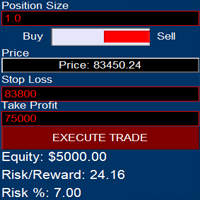
- Buy and Sell in one click on this chart's symbol. The lot is never typed. It is computed from the stop distance, your risk percent, and the symbol's real contract specification: contract size, tick size, tick value, volume step, and your deposit currency.
- There is no fixed-lot fallback and no lot input, on purpose. A typed lot is how a tight stop quietly becomes an oversized position.
- If the minimum lot would risk more than you asked for, the panel shows both numbers and asks you to confirm at the real risk. It never hides the overshoot, and if the real risk would break your daily or max drawdown headroom it still refuses.
- Optional stacking, off by default. When it is on, a new entry can be added only while every open stop on this symbol sits at breakeven or better, so a losing position can never be added to and averaging down stays impossible; every added entry passes all the refusals and the full headroom check on its own.
- Collapse the panel to a compact trading strip - the trade buttons, your live risk and today's remaining headroom stay on screen, and refusals stay visible while collapsed.
The stop is real, always
- Every order ships with a stop-loss on the broker's server at the moment of execution. There are no virtual or hidden stops, and none will be added as an option.
- If the broker refuses the stop after a fill, the position is CLOSED at market and the panel says why. Never a naked position under a drawn line.
- A watcher re-verifies the server-side stop on every pass, including after a terminal restart. If you delete the stop by hand, it is put back.
- A break-even button, free. One click moves the server-side stop of every position the panel owns on this symbol to its entry price - honest breakeven, no cushion. One-directional: a stop already at or beyond breakeven is never pulled back. If the entry sits inside the broker's minimum stop or freeze distance, the panel refuses and names the constraint and the distance.
The three refusals
- No stop, no order. Ever.
- No headroom, no order. When your daily or max-drawdown allowance is spent, the buttons lock, with the numbers on screen.
- No raising risk after a loss. A realized loss today latches your risk percent as a ceiling. It can only go down until the day resets. A token scratch does not lock the day - only a real loss does.
Every refusal names the exact rule it defended, never a bare "not allowed".
The consequence, before the click
Before you send anything, the panel shows the projection in money: this trade risks a stated amount; if the stop hits, you will have used a stated share of today's allowance and will stand a stated distance from your maximum-drawdown floor. Readable by a beginner who has never heard of R. It promises nothing; it only does the arithmetic you should be doing anyway.
Sized from what remains, not from your balance
Position-size calculators size from your balance. Funded-account rules are measured against your remaining daily and total allowance. Those are different numbers, and the gap between them is where accounts are lost. Order Gatehouse projects every trade against the allowance you have LEFT, floating losses included, the way a funded account is actually measured. Deposits and withdrawals are reconciled so a cash operation never reads as a trading loss.
Drag the stop, watch the lot
The stop and target lines are draggable on the chart. Drag the stop line and the lot recomputes live, so you SEE how a tighter stop grows the position and what that does to your headroom, before you click. The side of the stop line declares direction: stop below price arms a long, above price arms a short.
Broker constraints, named
When the broker's own rules block something, the panel names the rule: minimum stop distance, stops level, freeze level, filling mode, volume step. Not a numeric return code, and not silence.
Survives the things that kill panels
Timeframe change, profile change, template load, terminal restart: no duplicate panel, no lost state, no orphaned chart objects. The object count is kept low so the chart stays responsive, and the panel scales for high-DPI screens. If your environment reports an unusual DPI (remote desktop, VPS, display scaling) and the text renders too large, set the panel scale input to a fixed value or lower the font size input.
Scope, plainly
The tool uses its own magic number and never touches positions it did not open. It is a gate for the trades you place through it - it does not manage, close, or resize anything else on the account.
Coming later: Order Gatehouse Desk
A paid account-wide tier is planned: headroom aggregated across ALL symbols and all open positions, partial close and trailing from the same panel, and a prop-firm rulebook with the firm's own reset clock. No release date is promised. This free version is complete on its own and stays free.
How to use
- Attach to the chart of the symbol you trade. Enable Algo Trading.
- Set your risk percent and, if you use them, the daily loss and max-drawdown limits.
- Drag the stop line to your level, read the projection, click Buy or Sell.
No martingale. No grid. No averaging down. Ever.
Built by TechnoTrader. Protect the account first.