Bollinger Bands based on SAR
- Indicators
- Version: 1.0
- Activations: 5

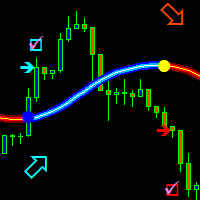
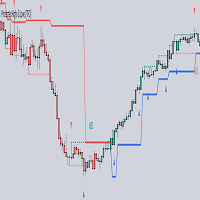
The indicator displays on the chart the moving average value of the Parabolic SAR indicator, as well as two lines of standard deviations shifted according to the settings .
The purpose of the indicator is to determine the tolerance within which price movement is possible after a reversal of the SAR indicator.
Construction principle
- The center line is a simple moving average (SMA) of the Parabolic SAR indicator.
- The upper and lower bands are the same moving average, but shifted by several standard deviations. They expand when the SAR trend changes.
Settings
- Step (step)—Set in the same way as for the Parabolic SAR indicator. Values from 0.01 to 0.2
- MaxStep (maximum) - Set the same way as for the Parabolic SAR indicator. Values from 0.1 to 0.2
- B (Period) — indicates the number of intervals used to calculate the average line. The default value is 16, but for long-term trend analysis, you can set it to 40–60.
- OTKL (Deviation Coefficient ) – this determines how wide the bands will be. The standard value is 2, but sometimes 6 is used; this allows you to identify the maximum or minimum price of a trend.
Application
- Flat - The upper and lower lines show the border of the flat .
- Uptrend - the upper line is the stop level for BUY positions.
- Downtrend - the lower line is the stop level for SELL positions.