Meravith EA
- Experts
- Version: 1.17
- Activations: 5

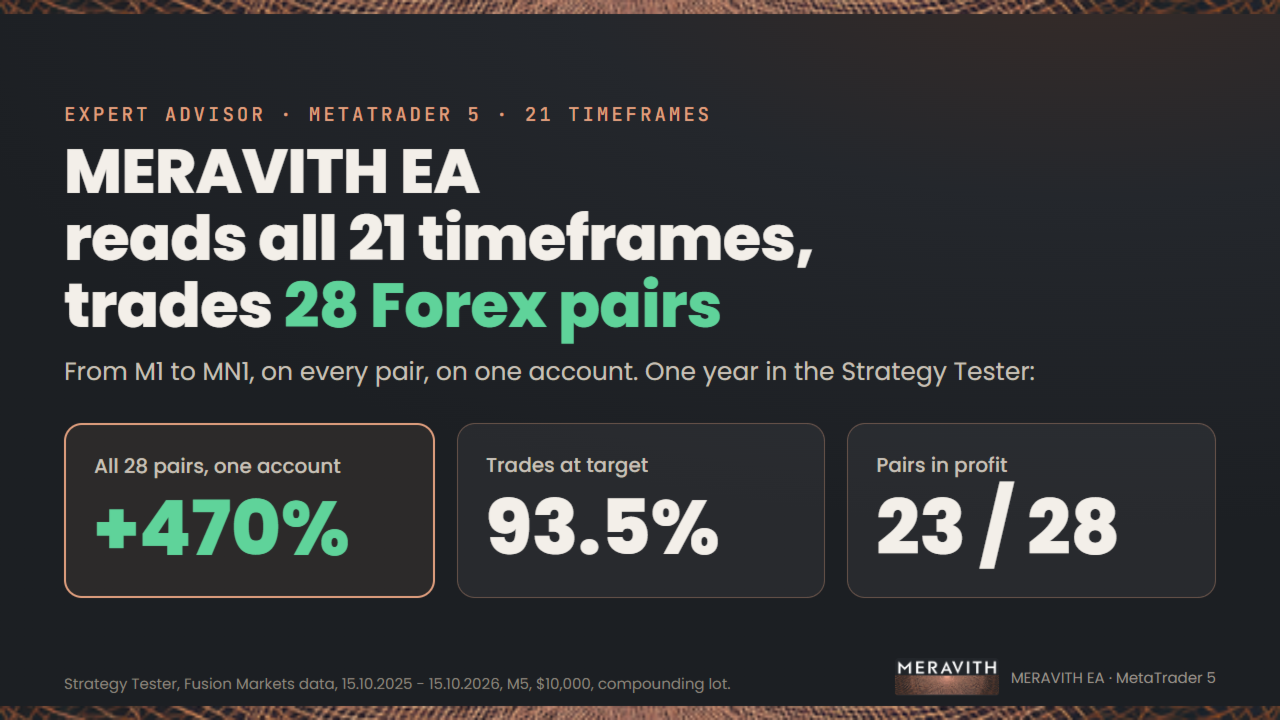
MERAVITH EA is a multi-timeframe Expert Advisor for MetaTrader 5. It reads MERAVITH on all 21 timeframes of the market it is attached to, from M1 to the monthly, and trades only when the structure across them lines up. Run on all 28 major and cross Forex pairs on one account, it made +470% in a one-year Strategy Tester test.
Strategy Tester, one year
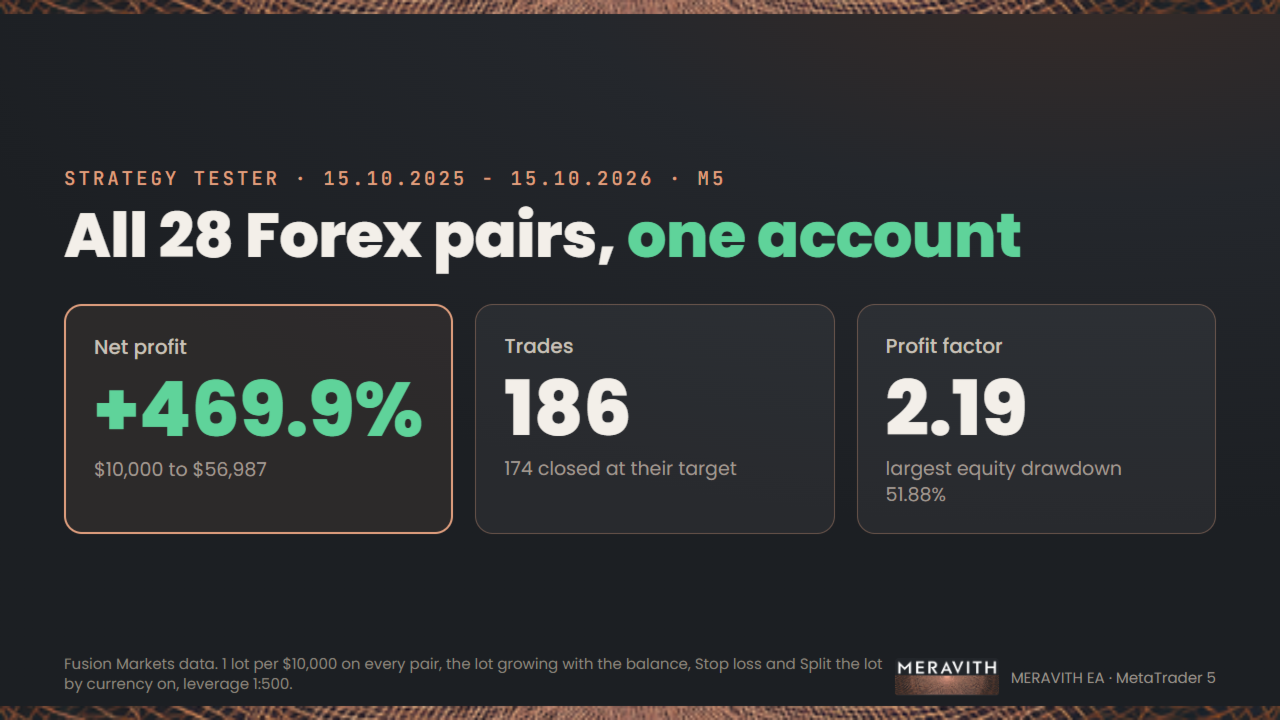
All 28 Forex pairs on one account, Fusion Markets data, 15.10.2025 - 15.10.2026, M5
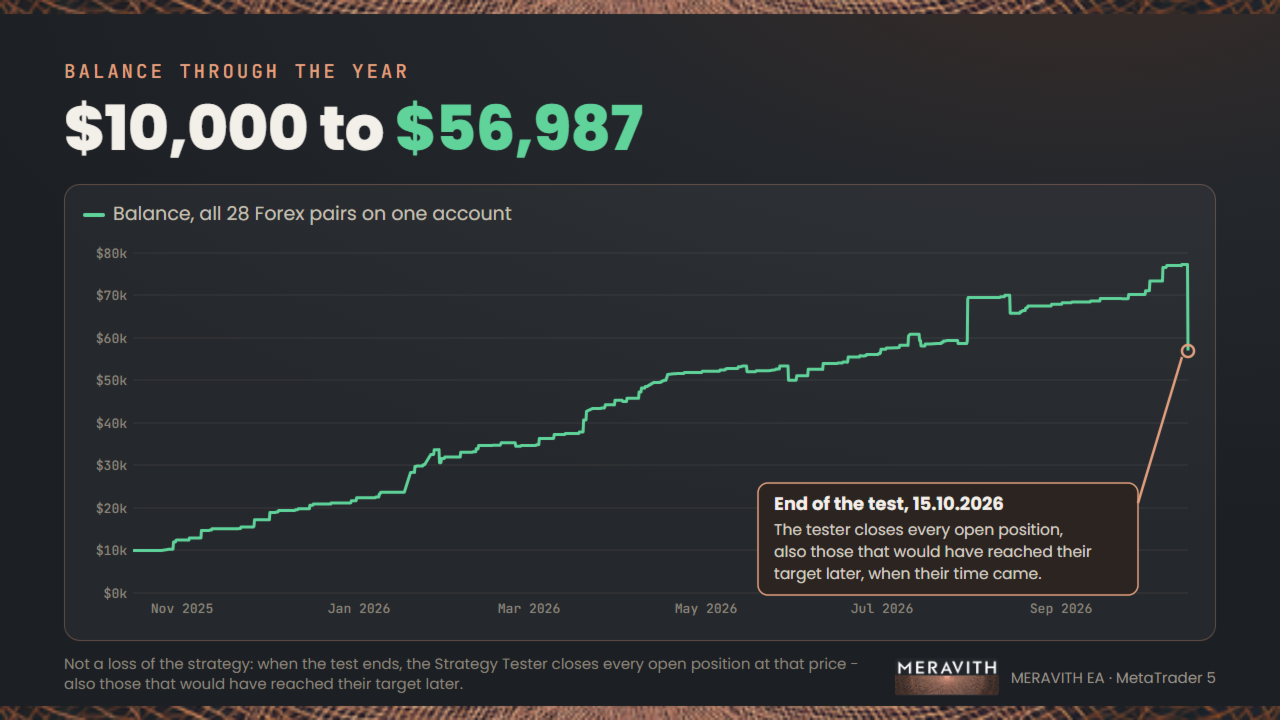
- +470% - $10,000 to $56,987 on one account, 186 trades, profit factor 2.19.
- 93.5% of the trades closed at their target - 174 of 186.
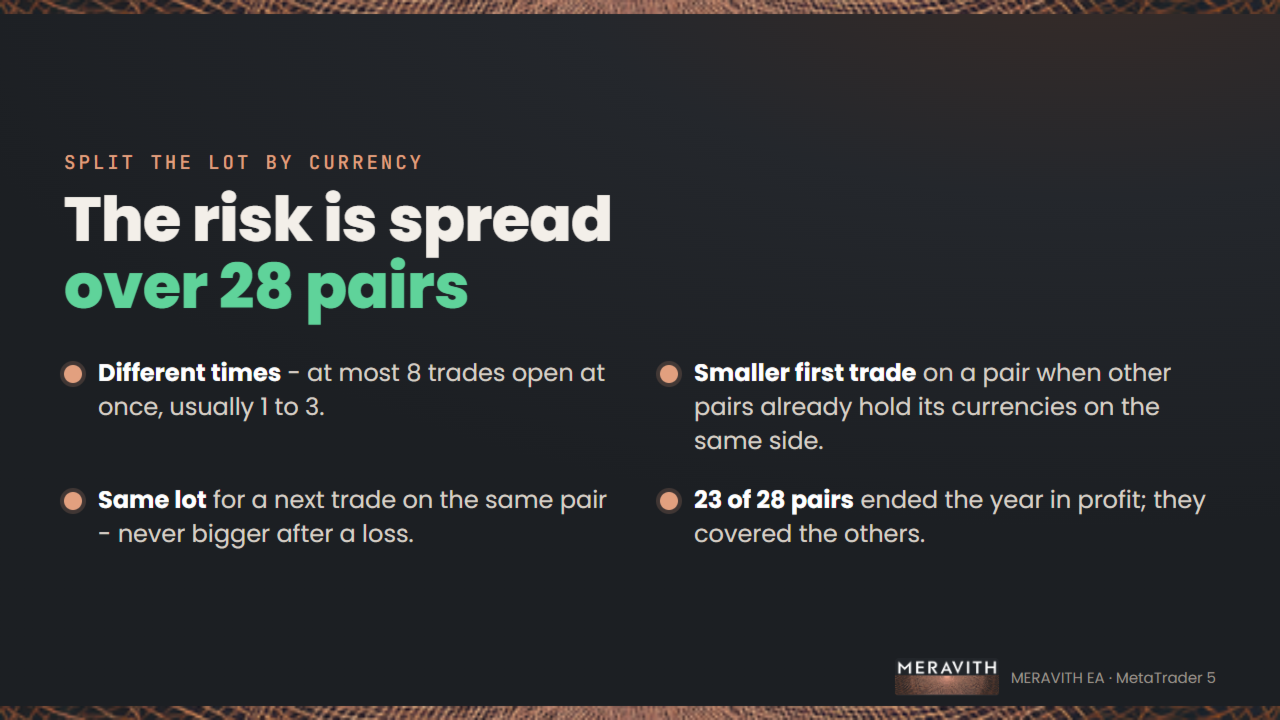
- 23 of the 28 pairs ended the year in profit.
- 1 lot per $10,000 on every pair, the lot growing with the balance, Stop loss and Split the lot by currency on (the defaults), leverage 1:500.
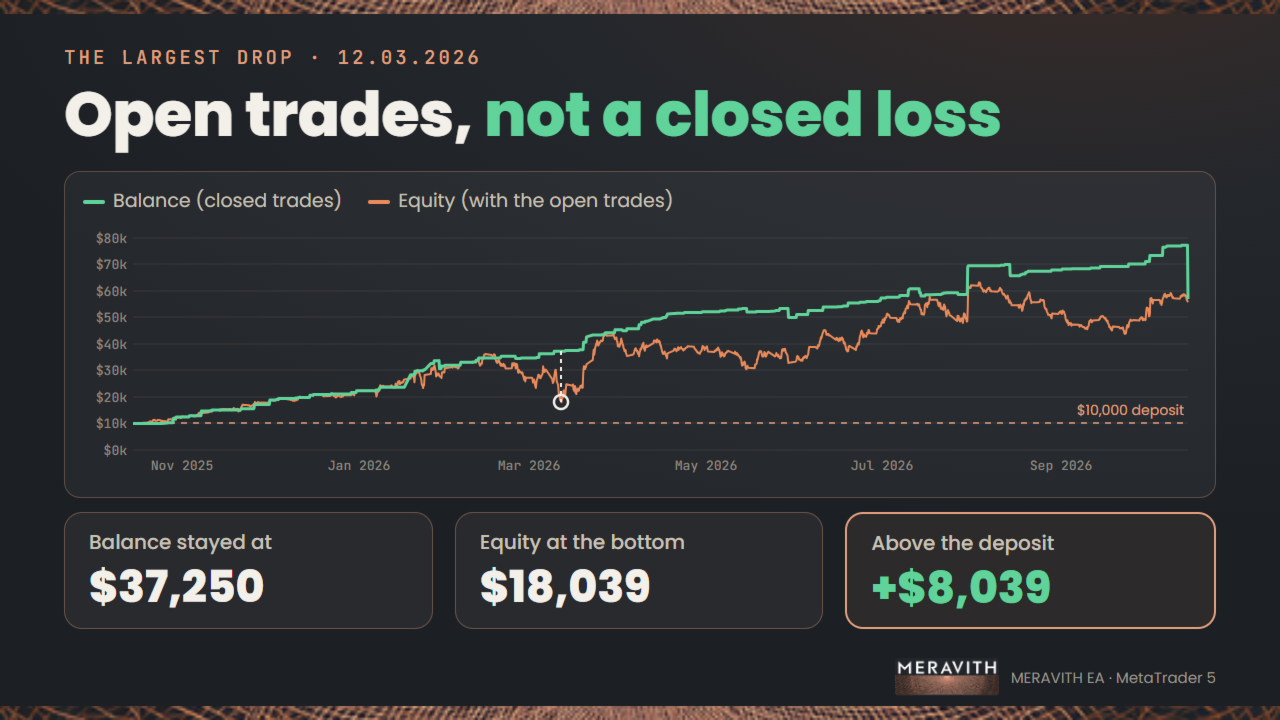
The largest drop is not a loss
The largest equity drawdown of the test was 51.9%. On 12.03.2026 the account went from $37,253 to $18,039 with trades still open, while the balance stayed at $37,250. It was the floating minus of open trades - not a realized loss and not a closed position. Even at its bottom the account stayed $8,039 above the $10,000 deposit.
The step down on the last day of the balance chart is not a loss of the strategy either: when the test ends, the Strategy Tester closes every open position at that price - also those that would have reached their target later.
The risk is your decision
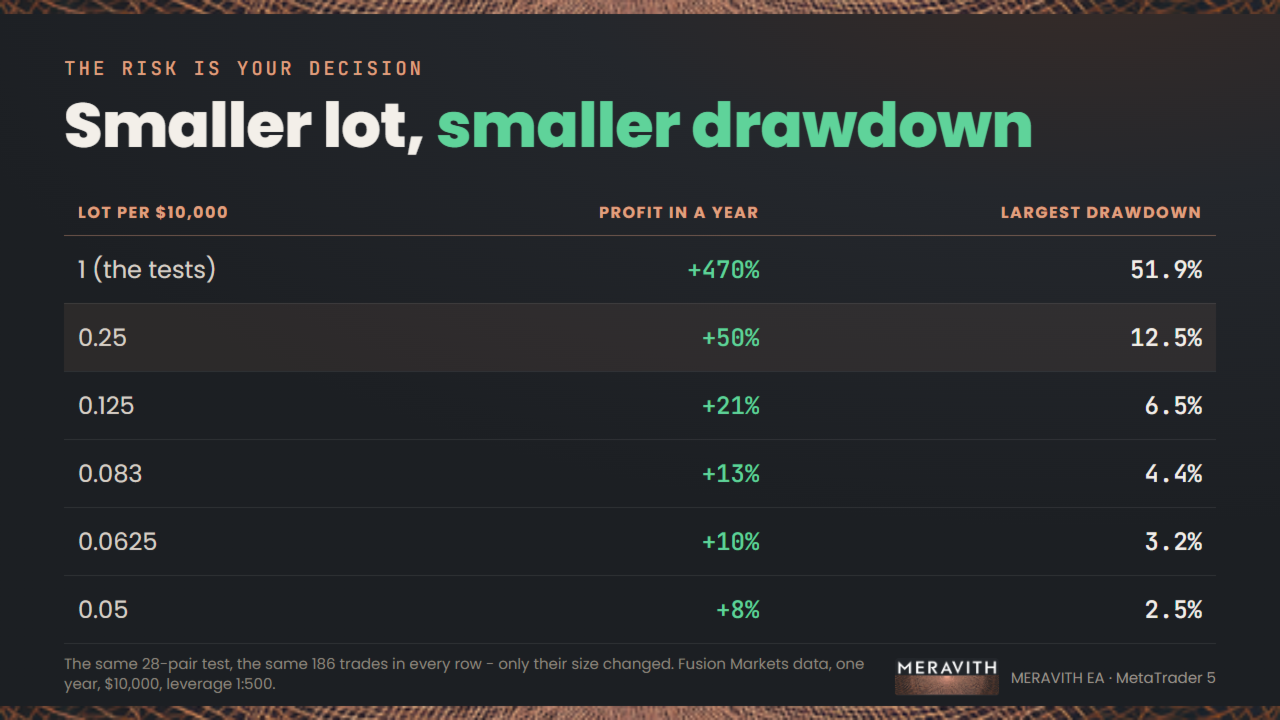
The tests use 1 lot per $10,000. MERAVITH EA trades with the lot you set: a smaller lot gives smaller profits and smaller drawdowns. The same 28-pair test, only the lot changed:
- Lot 1 per $10,000 - +470% in a year, largest drawdown 51.9%
- Lot 0.25 - +50%, largest drawdown 12.5%
- Lot 0.125 - +21%, largest drawdown 6.5%
- Lot 0.083 - +13%, largest drawdown 4.4%
- Lot 0.0625 - +10%, largest drawdown 3.2%
- Lot 0.05 - +8%, largest drawdown 2.5%
Every row has the same 186 trades; only their size is different. The default lot 0.1 lies between 0.125 and 0.083.
Why 28 pairs make +470% and one pair only +11%
It is the same EA and the same kind of trades. The difference is simple: more trades on one account.
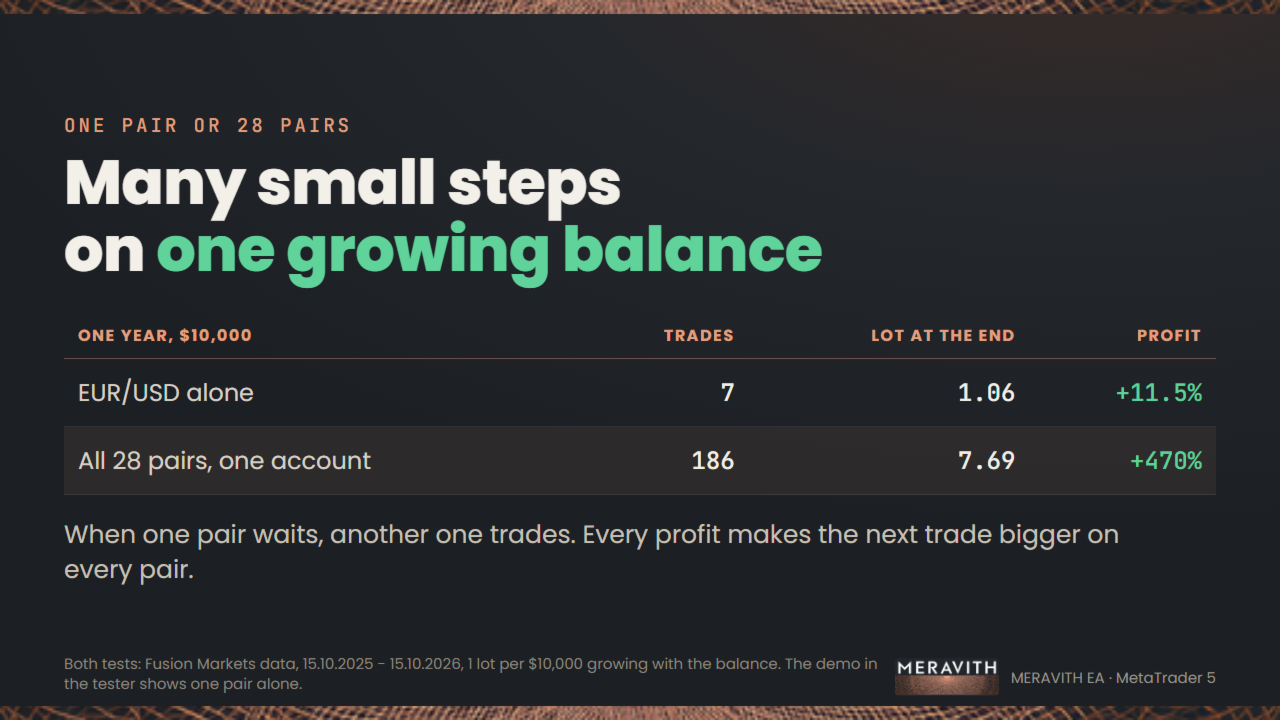
One pair gives a signal only a few times a year. In our test EUR/USD alone made 7 trades in a whole year (+11.5%, all 7 at their target). From 15 October to 31 December and from 25 May to 14 September it did not trade at all.
28 pairs gave 186 trades in the same year - every month between 4 and 23. When one pair waits, another one trades.
The lot grows with your balance, and on one account a profit on any pair makes the next trade bigger on every pair. In the 28-pair test the lot grew from 1.00 to 7.69 during the year; on EUR/USD alone from 1.00 to 1.06.
A simple example: an average trade added about 1% to the account. Do that 7 times and $10,000 becomes about $10,700. Do it 186 times, each time on the bigger balance, and $10,000 becomes about $57,000. Many small steps on one growing balance - that is the whole secret.
What makes it different
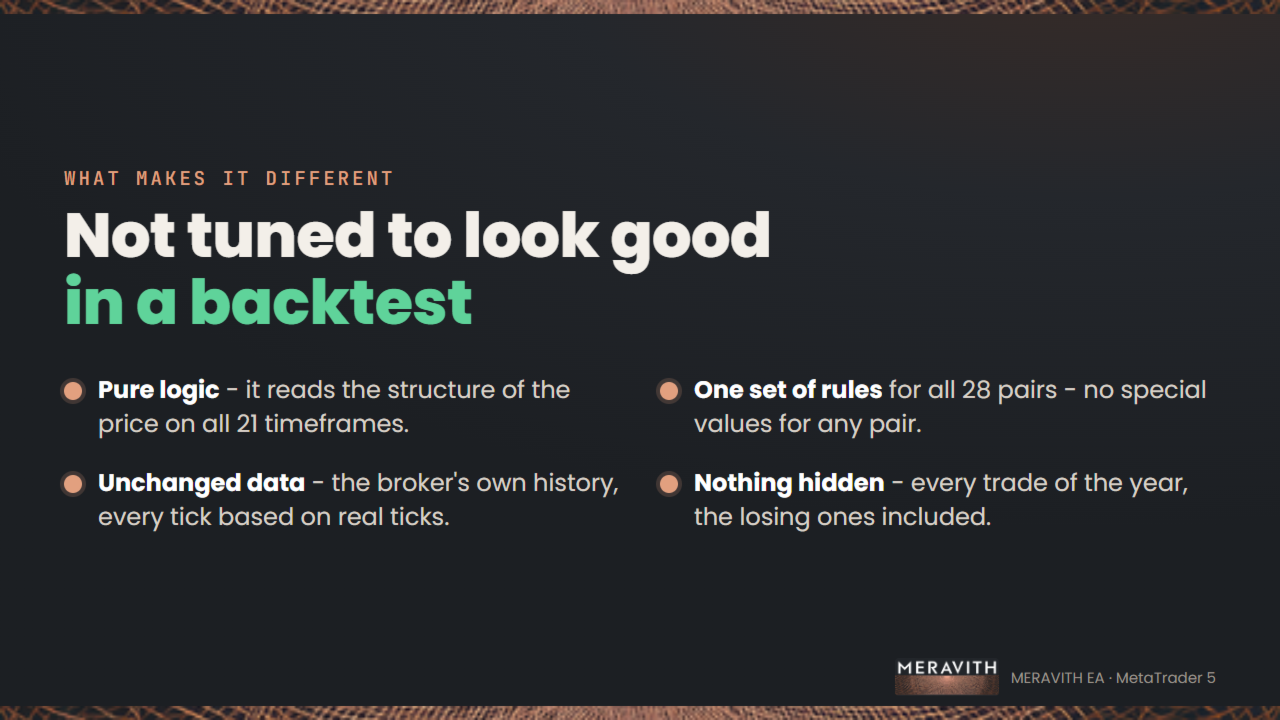
MERAVITH EA is not tuned to look good in a backtest.
- Pure logic: it reads the structure of the price on all 21 timeframes - no indicator periods to fit, nothing set by hand for one pair.
- One set of rules for all 28 pairs: the same settings on every chart, no special values for any pair.
- Unchanged data: every test ran in the standard MetaTrader 5 Strategy Tester with the broker's own price history, every tick based on real ticks - nothing edited, nothing added.
- Nothing hidden: every trade of the year is in the test report, the losing ones included, and you can run the same test yourself with the data of your own broker.
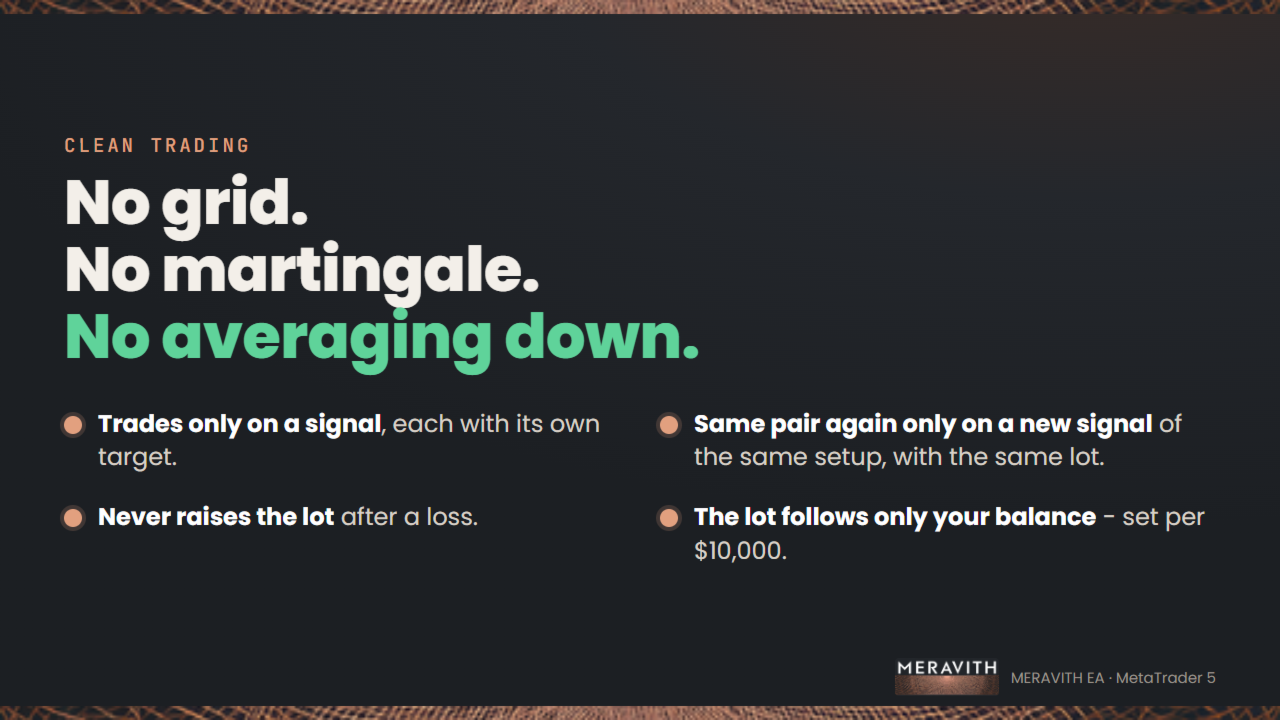
No grid. No martingale. No averaging down.
A trade opens only on a signal. A next trade on the same pair comes only from a new signal of the same setup, with the same lot as the first one - never because the price moved against a trade. The lot never grows after a loss: it follows only your balance.
The risk is spread
- Between the pairs: the 28 charts trade at different times. At most 8 trades were open at once in the test; three quarters of the time 1 to 3.
- Between the currencies: many pairs share a currency, so one strong move of that currency reaches several of them at once. With Split the lot by currency = true (the default), the first trade on a pair opens with the full lot divided by one plus the number of other pairs already in trades on the same side of either of its currencies. A next trade on the same pair and side opens with the same lot as the first one.
MERAVITH on every timeframe, traded
MERAVITH EA reads MERAVITH on all 21 timeframes of the market it is attached to, from M1 to the monthly. It waits until the reading across the timeframes gives its signal, opens the trade with its target already in the order, and lets the target close it. Between those moments it does nothing.
It needs nothing else beside it: no indicator on the chart, no connection to external servers. Everything is calculated inside your MetaTrader 5 from the history of the market.
How it trades
- Few trades on each market, chosen ones: about 6 to 9 a year on each pair; on all 28 Forex pairs together about 180 a year.
- A target in every order: each position goes in with its take profit and is closed there.
- A stop loss in every order by default (Stop loss = true); it can be switched off.
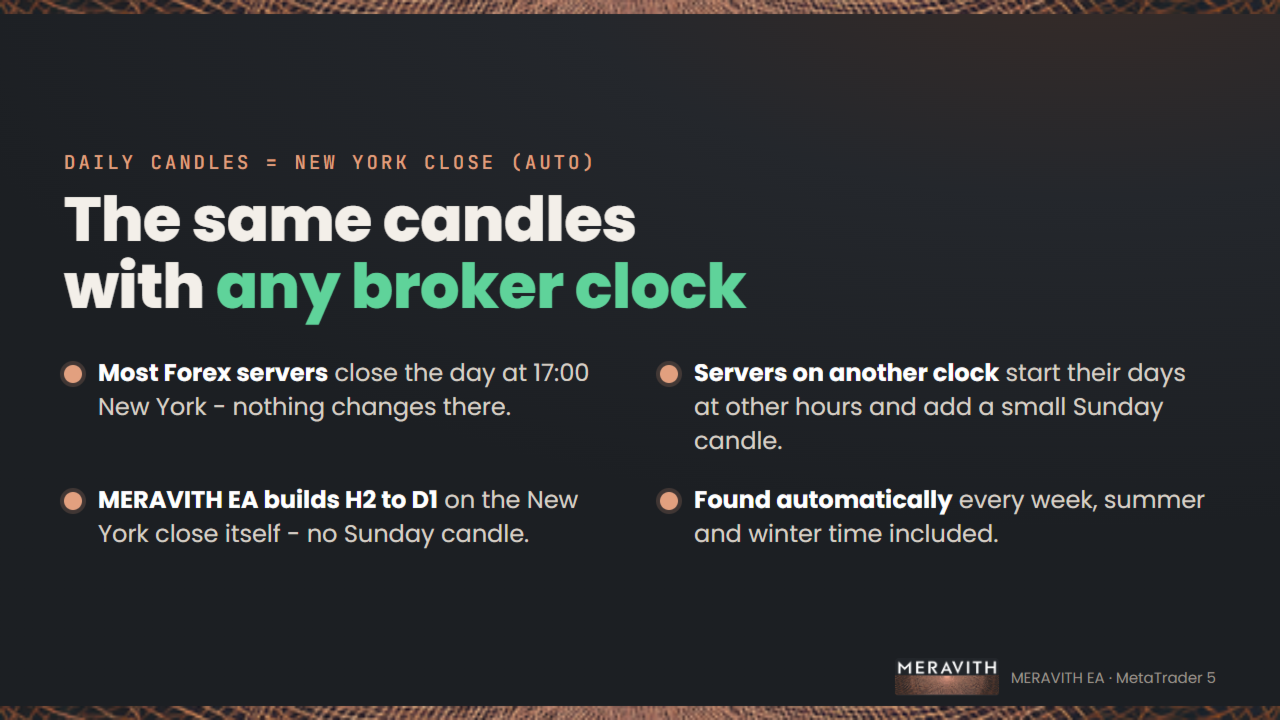
- Daily candles on the New York close: some brokers run their server clock off the New York close - their daily candles start at other hours and every week has a small Sunday candle. With Daily candles = New York close (the default) MERAVITH EA builds its H2 to D1 candles on the New York close itself, so it sees the same candles with any broker. It is found automatically every week, summer and winter time included.
- The lot follows your balance: you set the lot for every $10,000 of balance, and with Compound on it grows as the account grows.
- A panel on the chart: the market, the open trades with their price, target and profit.
The data of the broker matters
The prices of the brokers differ only a little, but MERAVITH EA reacts to those differences, so some trades differ from broker to broker. Before you trade, run MERAVITH EA in the Strategy Tester with the data of your own broker and compare it with our results.
Which lot for your leverage
The tests ran at leverage 1:500. With a lower leverage every trade needs more margin, so use a smaller lot: at 1:30, about 0.25 per $10,000 or less (see the table above). MERAVITH EA checks the free margin before every trade and skips a trade it cannot open.
How to start
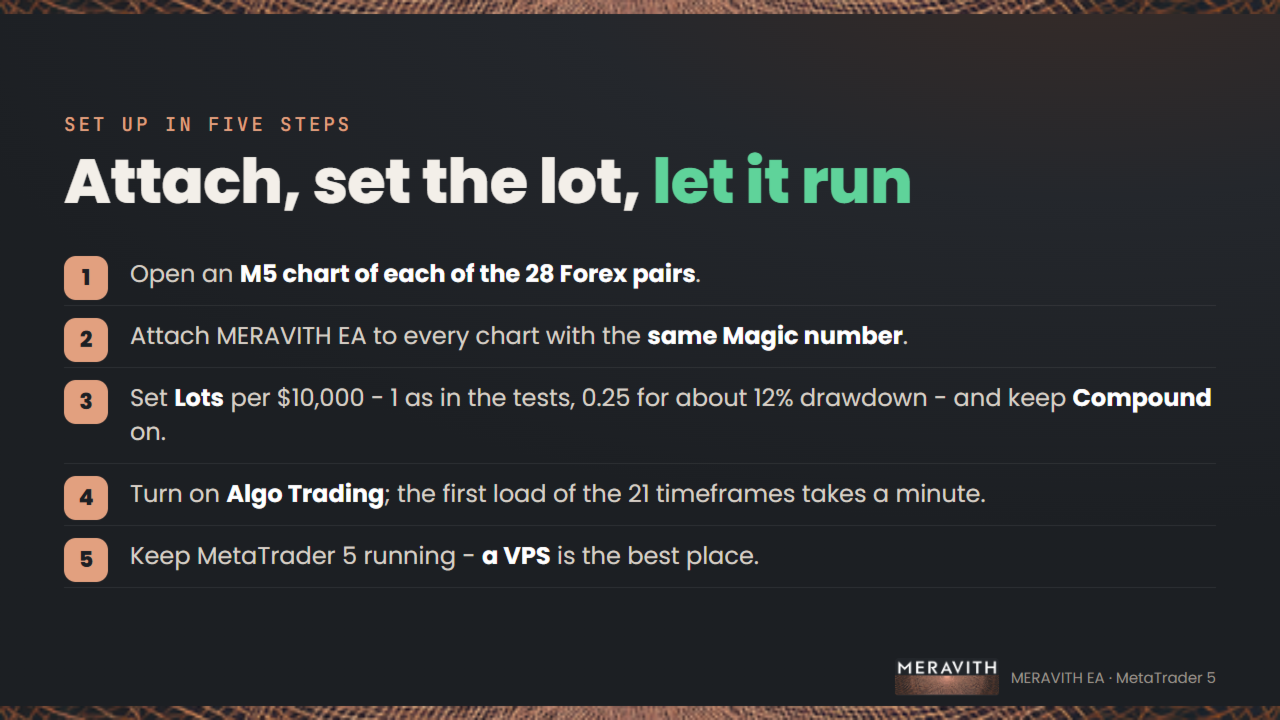
- Open an M5 chart of each of the 28 major and cross Forex pairs and attach MERAVITH EA to every one of them, all with the same Magic number - then the lot split sees the trades of all the charts.
- Set Lots, the lot for every $10,000 of balance, with the table above in mind: 1 as in the tests, 0.25 for a drawdown of about 12%, 0.25 or less at leverage 1:30. Leave Compound on to let it grow with the account.
- Turn on Algo Trading in MetaTrader 5. The first time it loads the history of the 21 timeframes, which takes a minute or two.
- Keep MetaTrader 5 running: a VPS is the best place for it.
Input parameters
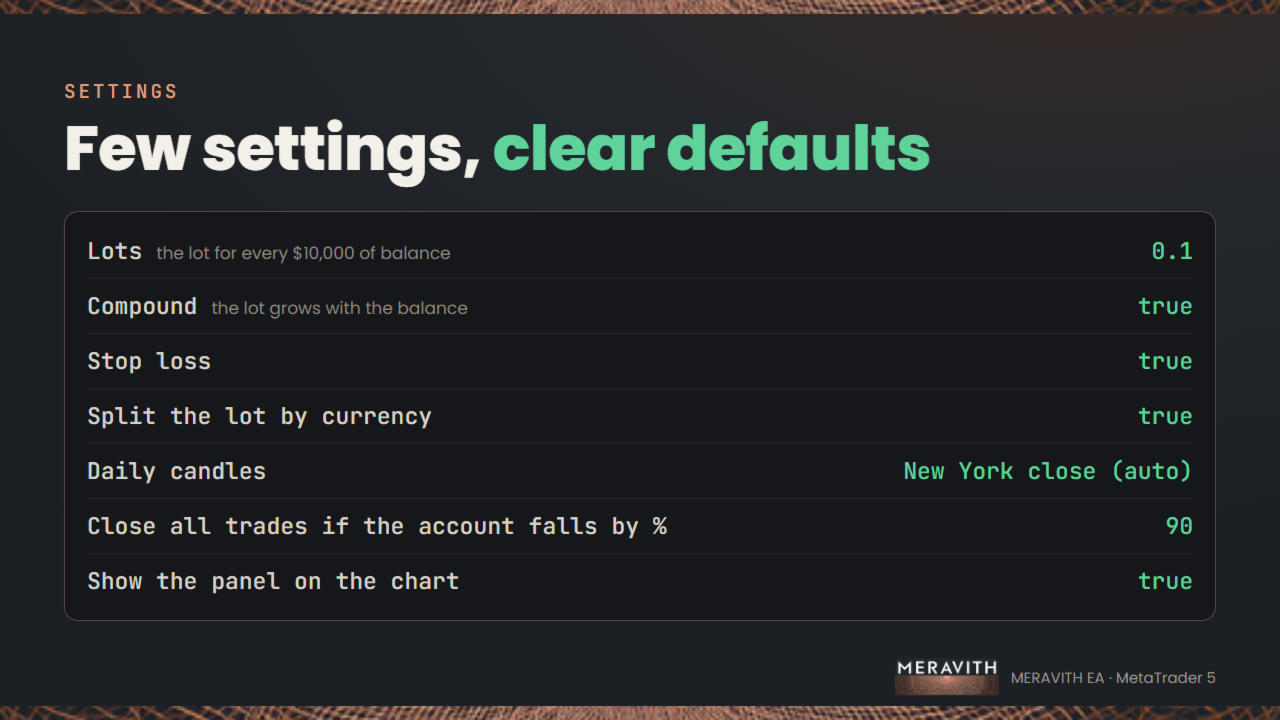
- Lots - the lot for every BaseBalance of balance (default 0.1).
- Compound - the lot grows with the balance (default true).
- BaseBalance - Lots for every this much balance (default 10000).
- Stop loss - a stop loss in every order (default true).
- Split the lot by currency - a smaller first trade on a pair when other pairs already hold its currencies on the same side; next trades on the same pair keep the size of the first (default true).
- Daily candles - New York close (auto) or as the broker's server (default New York close).
- Close all trades if the account falls by this % - account protection, 0 = off (default 90).
- Show the panel on the chart (default true).
- Magic number - the same on every chart.
Strategy Tester and the demo
The Strategy Tester runs one chart, so the demo tests one pair alone - a few trades a year, without the common balance and without the lot split between the pairs. A one-pair test shows what that pair did (for example +11.5% in a year on EUR/USD), not what the account of 28 pairs does. Short tests show even less: in one month a pair has 1 to 3 trades, and the tester closes the trades still open at the end of the test. The tester also gives the EA a shorter history of the big timeframes than it sees live. Test at least one full year.
Recommendations
- Markets: all 28 major and cross Forex pairs
- Chart timeframe: M5
- Deposit: the tests used $10,000; the lot scales with the balance, down to the broker's minimum lot
- Lot: 1 per $10,000 as in the tests, or smaller for smaller drawdowns (see the table)
- Leverage: 1:500 with Lots 1; at 1:30 Lots 0.25 or less
- Account type: hedging or netting
- Broker: test with your own broker data first; our test: Fusion Markets
Important note
By default MERAVITH EA uses a stop loss and splits the lot by currency; both can be switched off in the settings. The tests ran with both on, at leverage 1:500; with a lower leverage use a smaller lot. Results differ from broker to broker - test it with the data of your own broker first. How much risk to take is your decision: size the lot with the largest equity drawdowns of the tests in mind. MetaTrader 5 must stay connected, so a VPS is recommended.
Questions
If you have any questions about MERAVITH EA - the settings, the lot for your account, your broker or the test results - send me a private message here on MQL5. I will be glad to help.
Disclaimer
Our indicators and trading systems are advanced tools designed to assist traders in analyzing the markets and making informed decisions. These tools do not constitute financial instruments or provide direct investment recommendations. Trading in financial markets carries risks, and the value of investments can increase or decrease. Investors may not recover their initially invested capital. Past performance is not a guarantee of future results. Before using any of our trading tools, users should consult with a qualified financial advisor. This information does not constitute investment advice or an invitation to buy or sell financial instruments. Responsibility for the use of this software and the results of any trading decisions lies solely with the user.