Alpha Trend MTF
- Indicators
-
Evgenii Sutulov
 I build trading indicators, strategies, and dashboards that don't repaint.
Seven years doing this. MetaTrader 4, MetaTrader 5, TradingView.
Closed bars only. What you see is what happened.
The bar being formed never changes a published value. - Version: 1.3
A trailing stop line that asks where the money is going before it decides which side to hold. Alpha Trend MTF builds its trail from ATR and lets money flow choose the side, then takes its signals from the line crossing its own copy two bars back, which is what keeps it quiet in a chop that shakes ordinary trailing stops out. Signals from a higher timeframe can be drawn on any chart, and only closed senior bars are read. It is free: no trial, no locked features, no upgrade page.
Two trail levels are built from the low and the high at an ATR distance. Which of them holds is decided by money flow: while the money flow index is at fifty or above the market is treated as bought and the lower trail holds, and below fifty the upper one does. Without volume the same decision is made by the RSI of the close, which is the original script's own switch and is off by default here.
The line is then compared with its own copy two bars earlier. That comparison, not a comparison with price, is what produces the shading and the arrows, exactly as in the original. On MetaTrader 5 the volume behind the money flow is tick volume, which is what every volume study on this platform uses.
What is on the chart
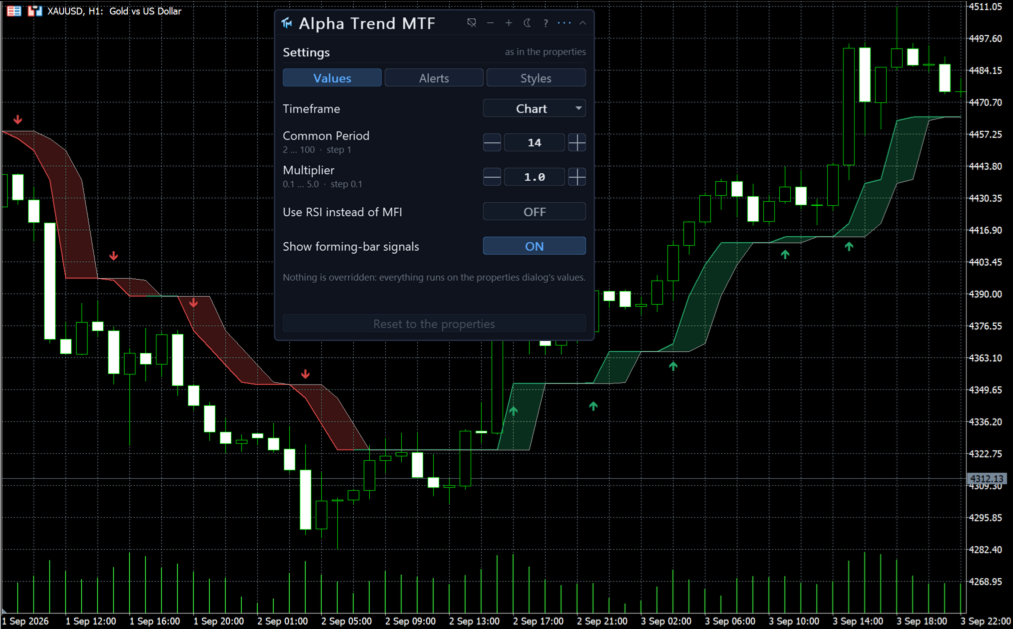
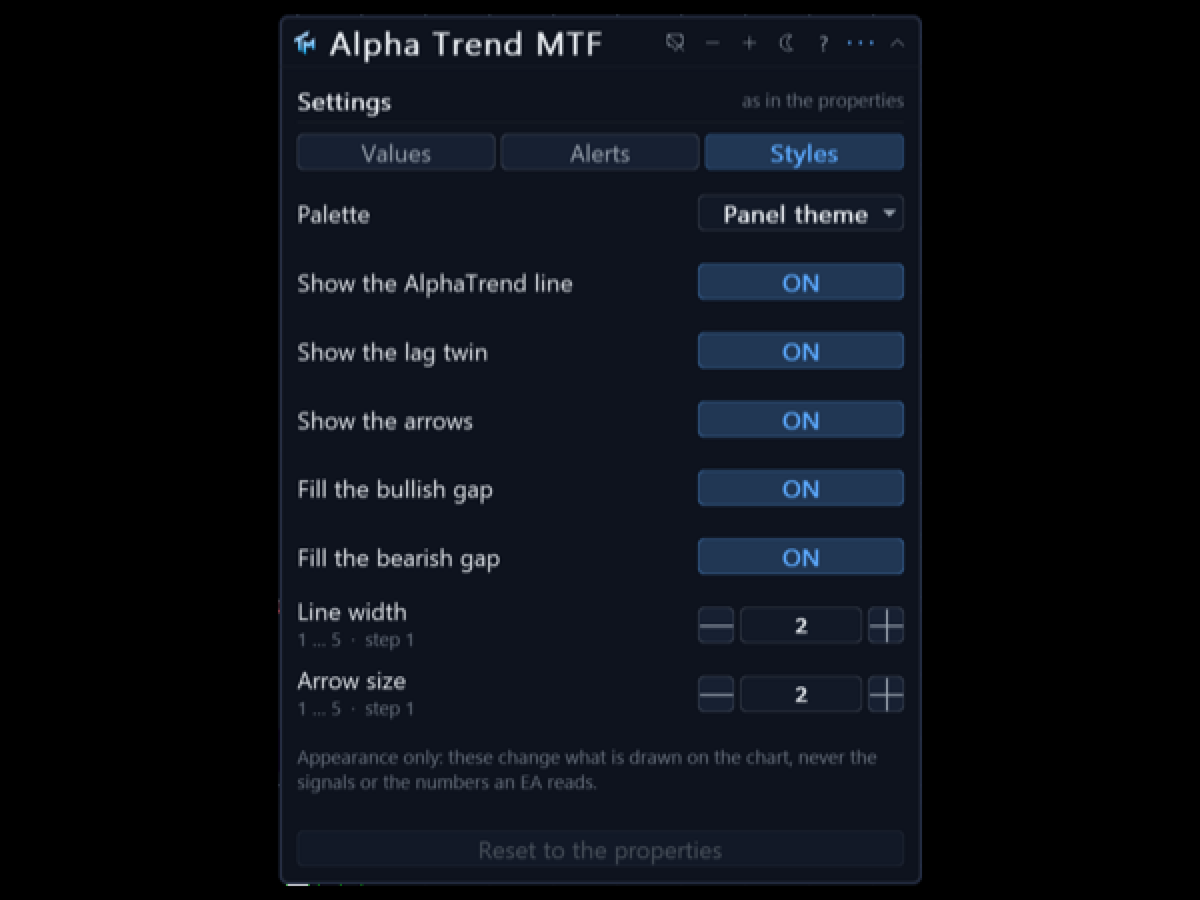
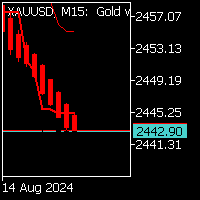
Drawn in the price window: the trail line coloured by the side it is holding and unbroken across the turn, its two bar lag twin as a thin line, two shades between the two, and BUY and SELL arrows on the bar where the line crossed its own lag. The lag twin can be hidden on its own from the Styles tab, leaving the trail alone.
The panel
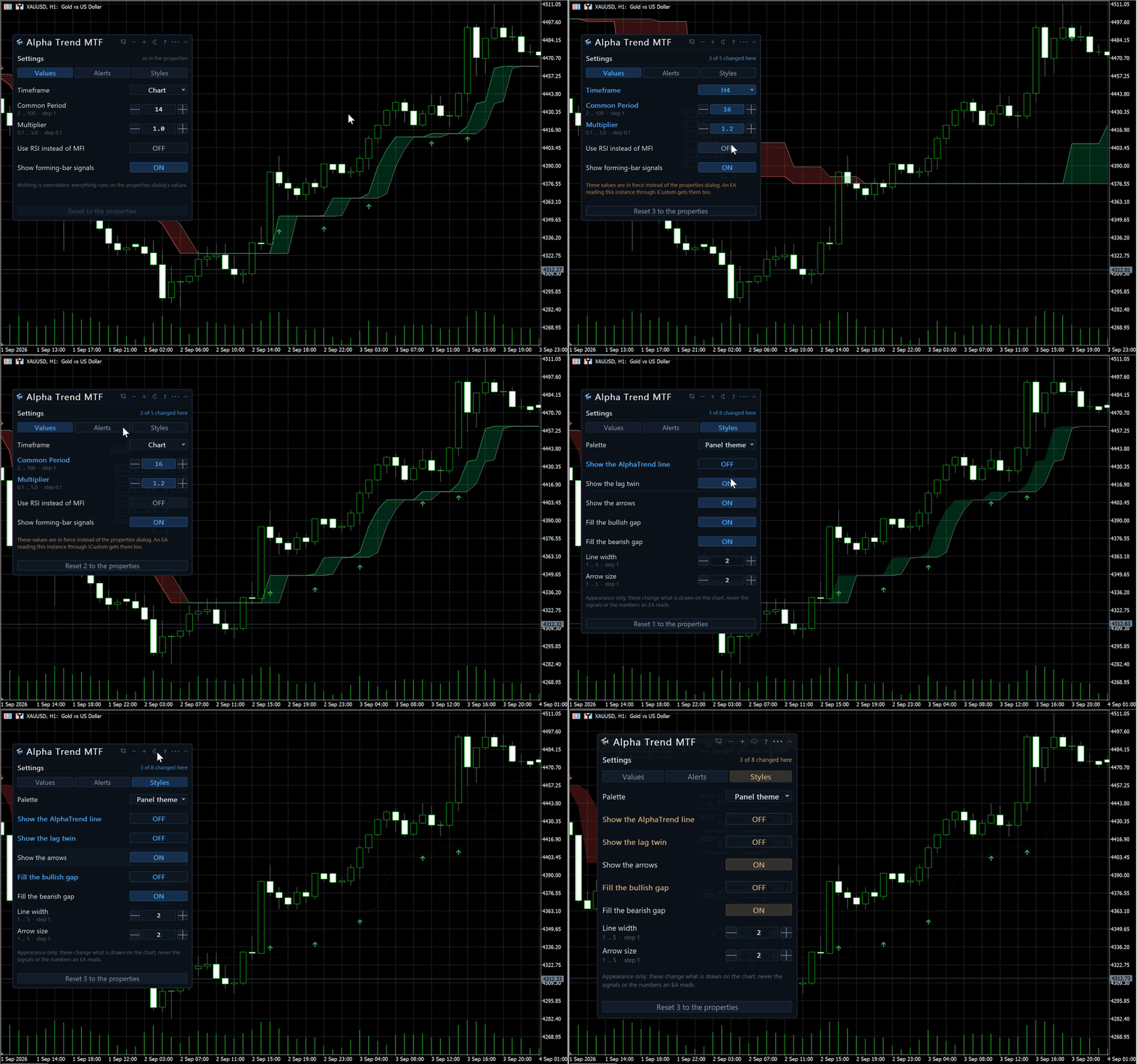
A canvas panel on the price chart, draggable, collapsible, closeable. It shows the timeframe in force and the setting values actually being used. It says what the last closed bar was: a BUY signal, a SELL signal, or neither. And it says whether the numbers on screen came from the properties dialog or from the panel, and how many of them were changed by hand.
Below that sit the settings the panel can move, with their current values. The gear opens a three-tab sheet.
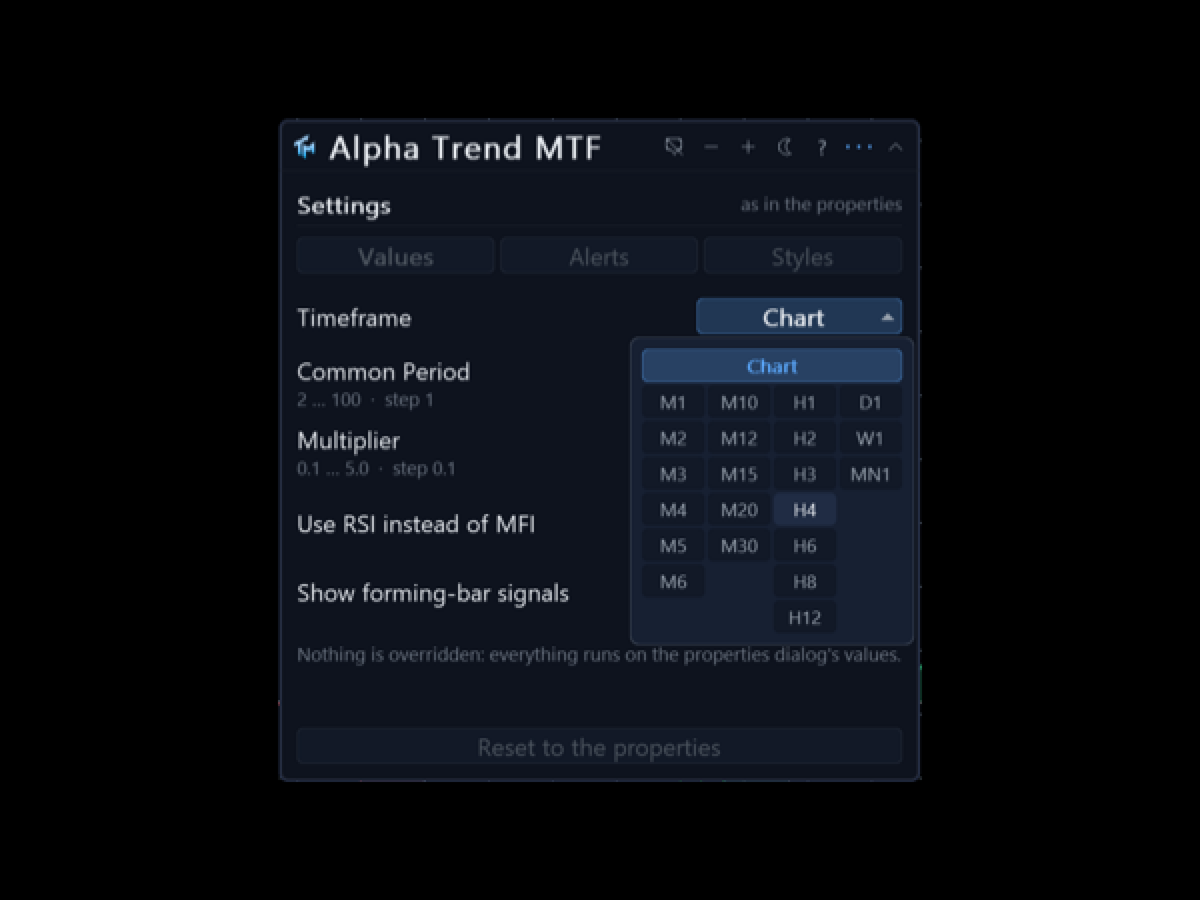
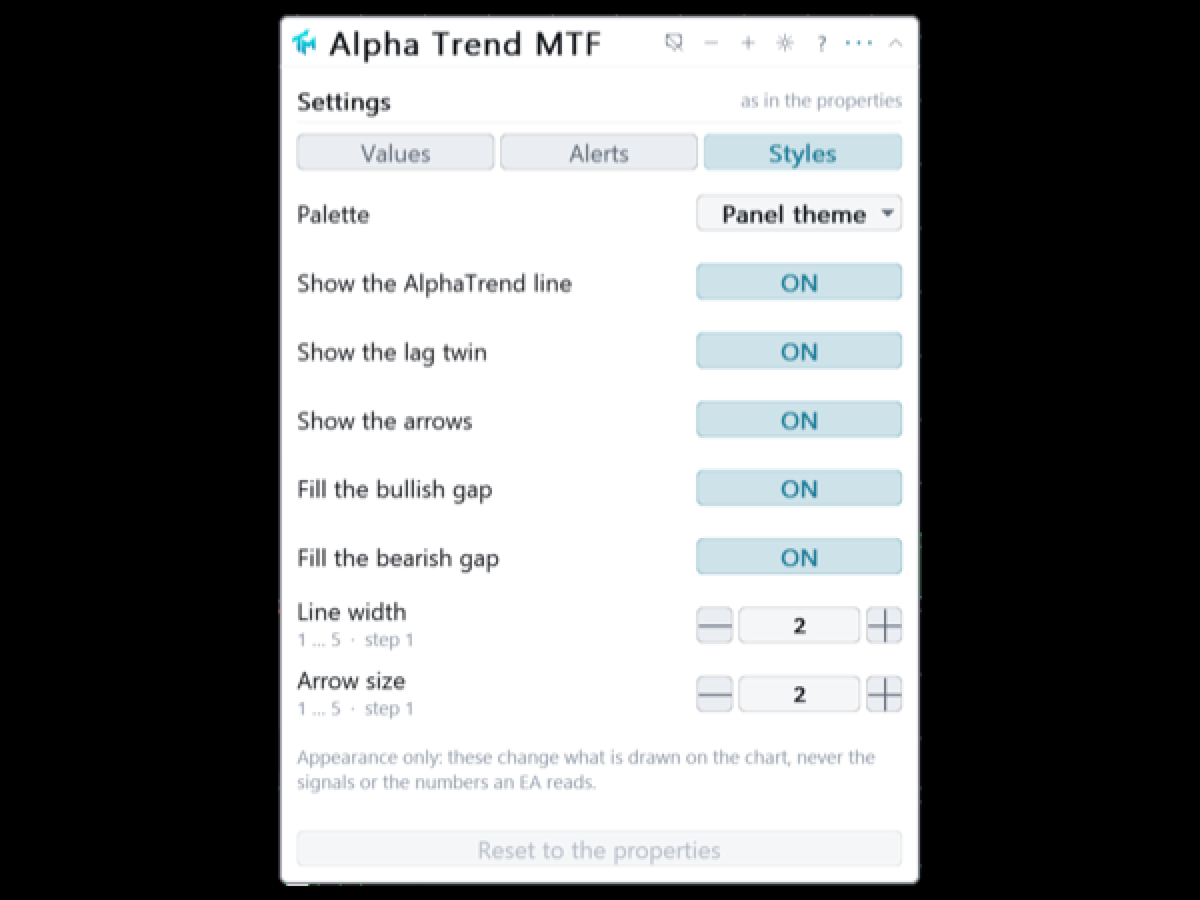
Values covers the timeframe, the common period shared by the ATR and the money flow, fourteen by default, the multiplier that sets the trail distance in ATR, and the switch that replaces money flow with the RSI of the close, which is off out of the box. Styles covers the palette, the trail line and its width, the arrow size, the lag twin and the two shades, each with a switch of its own. Every Values row has steppers, a range and a sentence of help.
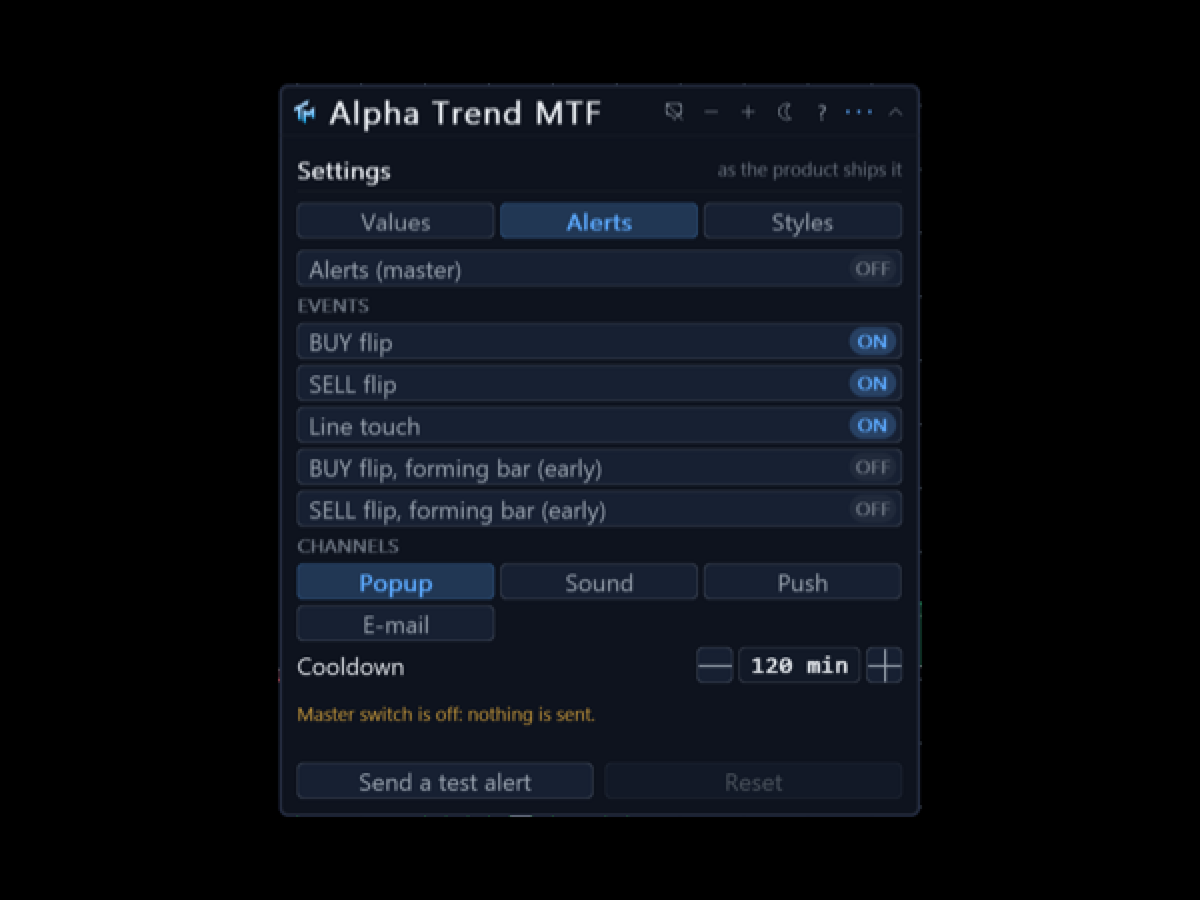
The Alerts tab covers the master switch, the per event switches, the channels, the cooldown in minutes and a test alert.
Three colour schemes: dark, light, and a colour-blind safe one that uses blue and orange rather than red and green. Everything about the panel, including every value changed on the sheet, is stored per chart and survives a timeframe change and a terminal restart. The interface is English.
Alerts
Off out of the box. Three events: a BUY signal, a SELL signal, and a touch of the trail line, which is the pull back event rather than a flip. Each has a switch of its own.
Channels: a popup window, a sound, a push to the mobile terminal and e-mail. There are per-event and per-channel switches, and a cooldown that defaults to two hours.
Alerts fire on the last closed bar. Two further alerts, off by default, speak on the forming bar within a chosen number of seconds of its close, and they are labelled early because a flip that exists mid-bar can un-happen. Telegram is not part of this product.
Signals on the forming bar
There is one switch that matters more than the others, and it is in the Values tab as well as in the inputs: whether buffers and arrows are allowed on the bar that is still forming.
With it on, which is the shipped default, you see a flip as soon as the market makes it. Sometimes that flip is undone before the bar closes and the arrow disappears. With it off, nothing is written on the forming bar at all: there is no repaint of any kind, and every signal arrives one bar late by construction.
Both behaviours are legitimate. The product does not pick for you and it does not hide which one it is doing: the panel and the setting name both say so.
Multi-timeframe
The Timeframe setting computes on a higher timeframe and draws the result here. Only closed senior bars are read: a chart bar shows the newest senior bar that had already closed by that chart bar's own close, so the flip lands on the bar that closes together with the senior bar, and nothing is drawn that could not have been known in real time.
The foreign series is built in the background. The first read of it can come back empty, the indicator retries, and the panel says whether it is waiting for a download or looking at a genuine shortage of history. It never fails initialisation over missing bars.
Reading it from an EA
Sixteen buffers, all readable through iCustom and CopyBuffer. Buffer 0, Buy, carries the arrow price on a BUY bar and EMPTY_VALUE otherwise, and is not drawn; buffer 1, Sell, is the same for a SELL. Buffers 2 to 5 belong to the two fills and are display plumbing, not for reading. Buffer 6 is the trail line while the trend is up and buffer 7 is the same line while it is down; on the turning bar both hold a value, which is what keeps the drawn line unbroken. Buffer 8 is the two bar lag twin of the trail line, which the signals cross against and buffer 9 is a service series kept for the shared buffer map. Buffers 10 and 11 are the drawn copies of buffers 0 and 1. Buffer 12, Signal, is +1 on a BUY bar, -1 on a SELL bar and 0 otherwise. Buffer 13 is Override, buffer 14 is the trail line as one unbroken series, and buffer 15 is the trend itself, 0 while up and 1 while down.
Buffers 0 and 1 are the contract: never painted, filled on every pass whatever the Styles tab says, and present in the Data Window. Hiding the arrows on the display cannot starve a strategy of the signal, because hiding is done by changing how a plot is drawn and never by emptying a buffer.
An instance created by iCustom is read only and always uses the parameters you passed. The Override buffer lets a strategy detect that a chart instance is running on numbers changed by hand from the panel.
Provenance
This is a port of "AlphaTrend" by KivancOzbilgic, an openly published TradingView script, which makes a port by formula admissible. The implementation is a reconstruction from the formulas rather than a line by line translation. One deviation is declared: the recursion is seeded with the first price instead of a zero, so the earliest bars have a value where Pine has none.
The product is called Alpha Trend MTF because that is the name of the method, not because authorship of the method is claimed here. The original work belongs to its author.
Honest limits
The trail turns late by design. In a range it will turn repeatedly, and each turn is a real crossing of the line and a poor trade.
Money flow on a forex symbol is built on tick volume, because that is the only volume the platform has. It counts price changes, not contracts, and it is not the same measure a futures chart would give.
The two bar lag is part of the method and it is what the signals are measured against. It also means the product speaks two bars after the move that caused it, and no setting removes that.
The settings move every signal the product will ever show. Two configurations produce two different sets of signals, and neither of them is the true one.
No profit figure, win rate or backtest result is claimed here.