Trixter ISO
- Experts
-
Andrei Samokhin
 Welcome to my seller page. I develop applications in the fields of AI and machine learning, and I am also passionate about trading systems. My products are based on various machine learning techniques. I research and apply state-of-the-art algorithms for time series analysis and am constantly
 - Version: 1.0
- Activations: 15
Isolation Forest is a machine learning algorithm for anomaly (outlier) detection.
How the algorithm works:
- Random partitioning: The algorithm repeatedly selects a random feature and a random threshold value to split the data, until each point ends up in its own separate "cell" (or until the maximum depth is reached).
- Isolation depth: Anomalies are "isolated" faster because they require fewer splits to be separated from the rest of the data (they are located far from dense clusters).
- Forest construction: A set of random decision trees (a forest) is built, and for each point the average isolation depth is calculated across all trees.
- Anomaly scoring: The smaller the average depth, the higher the probability that the point is an anomaly (based on this, an anomaly score from 0 to 1 is constructed).
What it is used for:
- Finding outliers in data (fraudulent transactions, equipment failures, network intrusions).
- Data cleaning before training other models (noise removal).
- Real-time system monitoring (sensor readings).
Main advantage: it works quickly and efficiently in high-dimensional spaces, does not require labeled data (unsupervised learning).
The Trixter ISO bot is built using this approach.
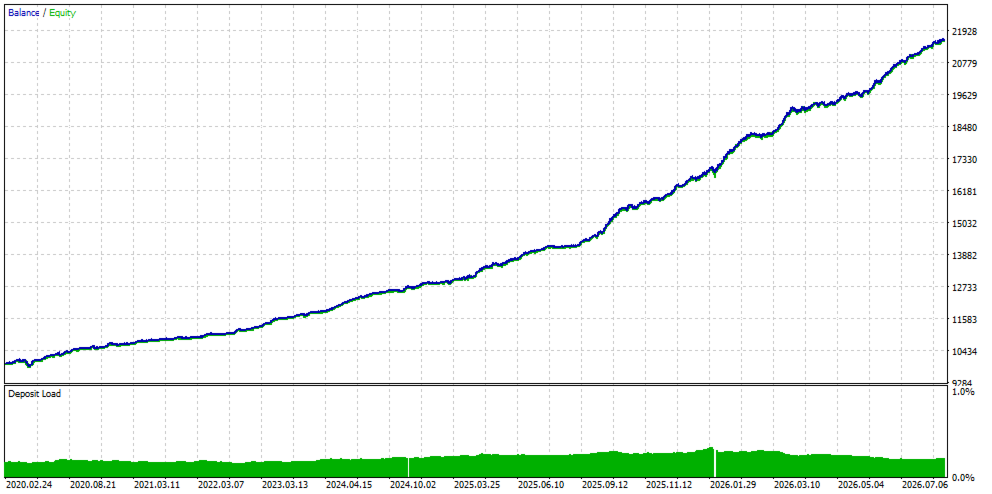
The Trixter ISO algorithm implements pattern search using isolation forest (ISO for short). We start from the assumption that the gold market is sufficiently efficient and that most price fluctuations form market noise that cannot be predicted. But we can isolate fragments of the gold chart (so-called anomalies) where it is most predictable. This way I identified 30% of chart segments that are well predictable.
Key principles
- Analysis of gold volatility across multiple timeframes and indicator periods.
- Volatility clustering to find effective patterns (from 100 to 3000).
- Statistical validation: high positive mathematical expectation and statistical significance.
- Patterns that do not pass validation are marked as noise — in such situations, trades are not opened.
- Mandatory 2-year forward test before being allowed on a live account.
Trading logic features
- Opening trades with limit orders at a selected distance from the price — minimal slippage.
- If the limit order does not trigger (price does not touch the level) and the signal disappears — the order is deleted.
- Open positions are protected with stop-loss and take-profit, and are closed at market price upon an opposing signal.
- The robot does not use martingale, arbitrage, or other high-risk strategies.
- Recommended timeframes: from M5 to H1. Optimal — H1 XAUUSD.
- Flexible configuration of trading activity is provided (parameters below).
Main settings
- Allow BUY signals, Allow SELL signals — allow or prohibit buy/sell orders when confident in the market direction.
- Signals sensitivity, Filter sensitivity — threshold for signal sensitivity and noise filtering. Default value is 0.5. Can be increased to 0.7–0.9 for cleaner signals.
- Filter by trading hours — trading time restriction. By default — 24/7.
Money management settings
- Distance in points for limit order — distance from price to limit order. Default: 250. Lower → more trades, higher → more conservative.
- Max positions + orders number — maximum number of simultaneously open positions (no averaging). Default: 3.
- Additional settings: delay between openings, maximum spread control, stop-loss and take-profit levels.
Important: Default settings are already configured. Do not change them unless absolutely necessary. Save the standard set-file to be able to revert to factory parameters.
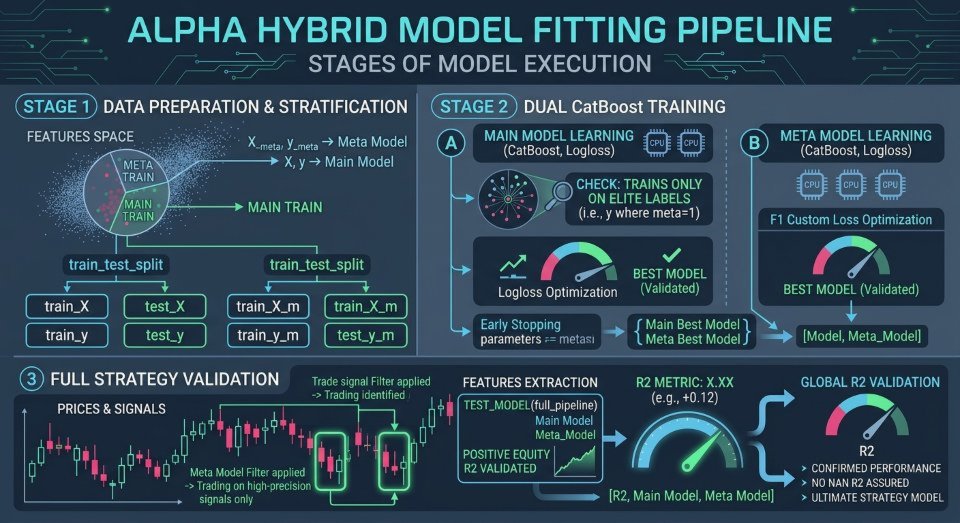
Isolation forest + two classifiers → export to ONNX | Forward period: 2 years | Recommended timeframe: H1 XAUUSD