No Chase Entry Filter
- Indicators
-
Mohamed Amr Mohamed Osama Abdelwahab
 Software Developer, Instructor, and Technical Team Leader with over 22 years of experience across desktop, web, and financial software development. Top Rated freelancer on Upwork with 200+ completed projects, $200K+ delivered, and a 100% job success record. Specialized in algorithmic trading systems
 - Version: 2.0
- Updated: 9 September 2026
- Activations: 5
No Chase Entry Filter - Entries That Are Not Late
Many losing trades are not wrong about direction. They are late. The idea was sound, the entry came after the move had already happened, and the stop was hit on an ordinary pullback that a better price would have survived.
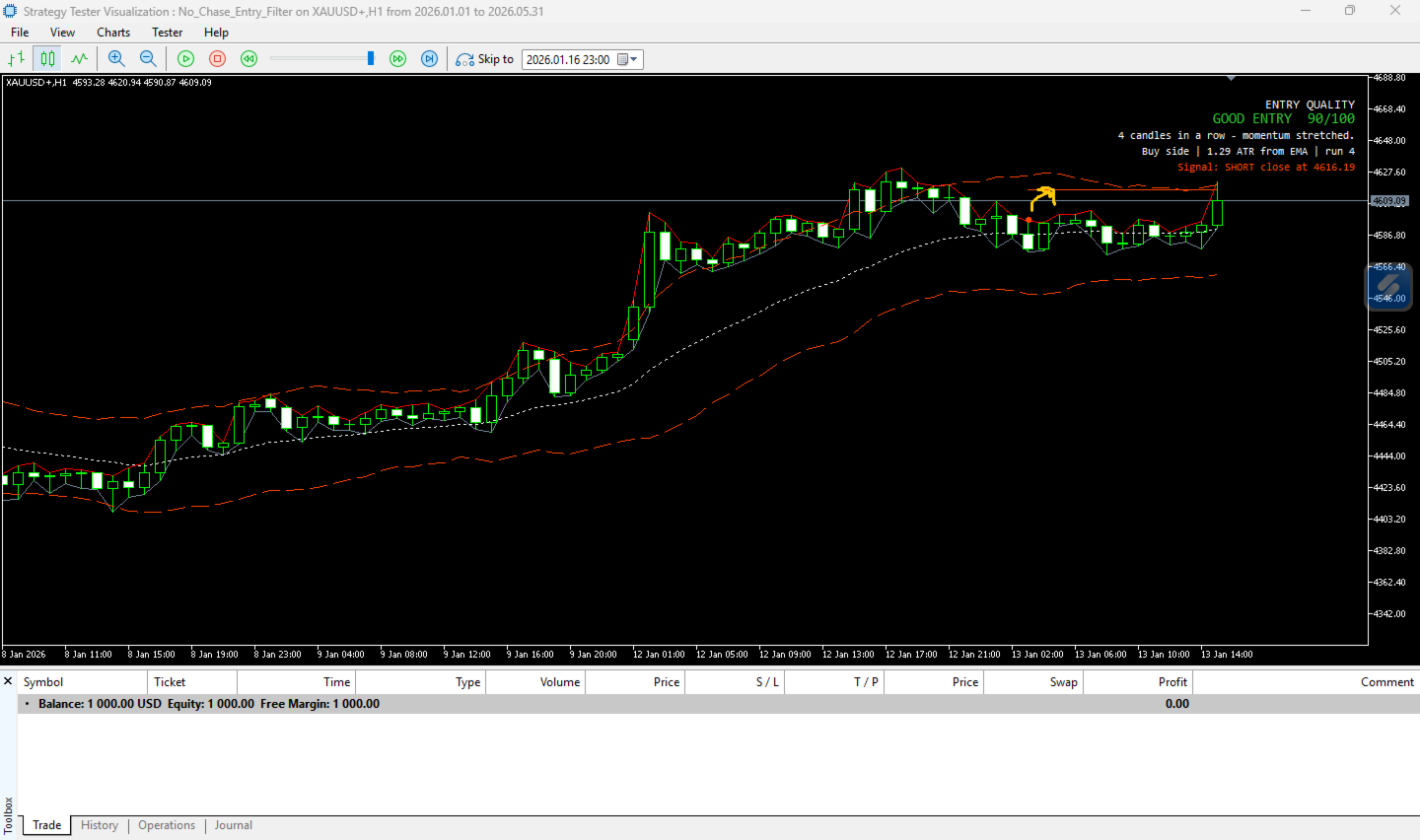
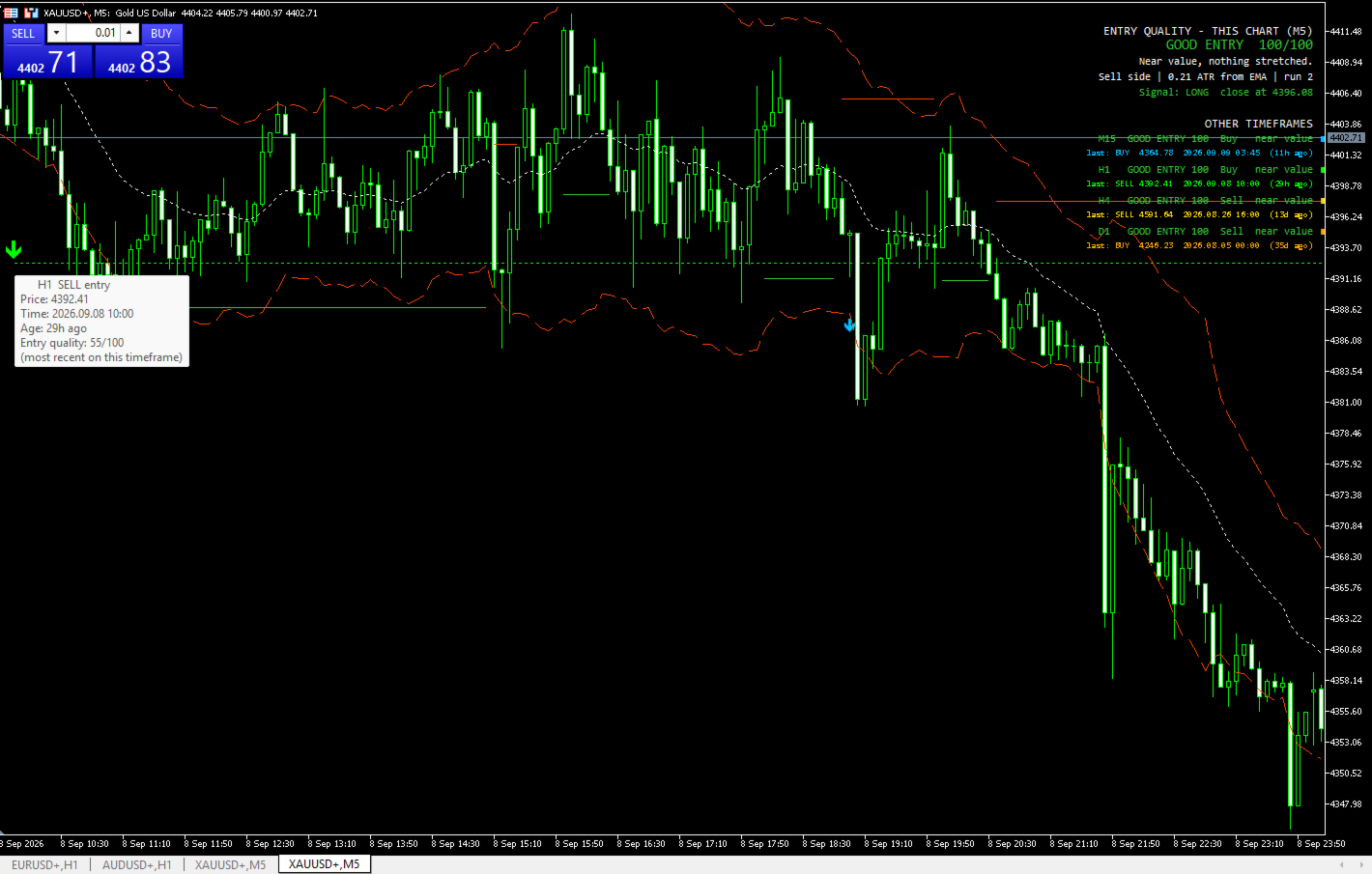
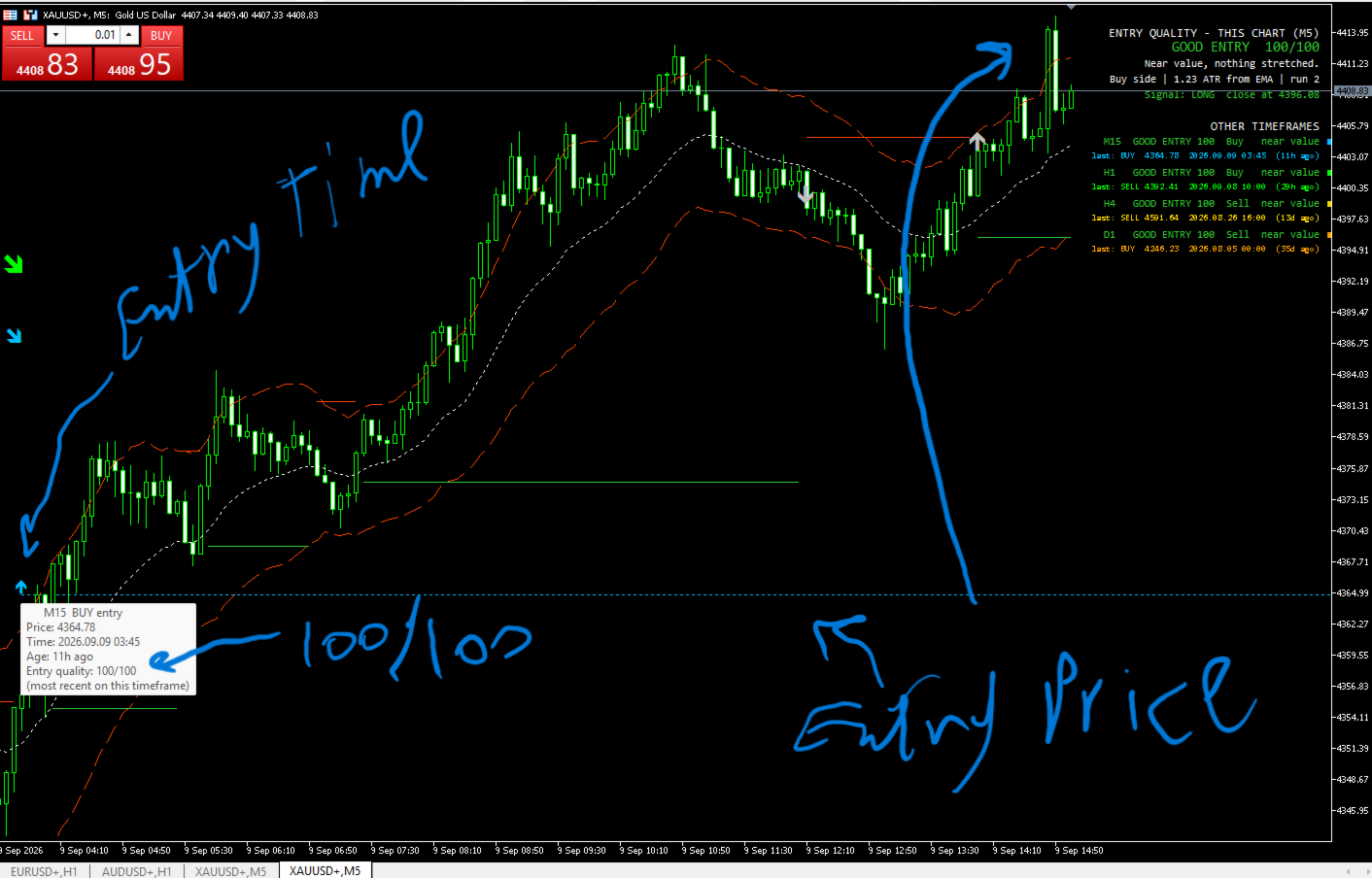
No Chase Entry Filter marks buy and sell entries from market structure, and refuses the ones taken at a bad price. A green dot means buy from here. A red dot means sell from here. A coloured level marks where the trade is closed. Behind every dot, five independent tests score the entry from 0 to 100, and a signal that arrives when price is already too extended is suppressed rather than shown.
HOW THE SIGNAL WORKS
Direction comes from market structure. A buy fires when a bar closes above the last confirmed swing high, a sell when a bar closes below the last confirmed swing low. A swing is only used once it has the required number of bars on both sides, so the structure a signal rests on was already fixed before the signal appeared.
NO REPAINTING
This matters more than any other feature, so it is stated plainly.
A swing point needs bars on both sides to exist, so it is not knowable until those bars have closed. Every signal is decided only from swings that were already final at that moment. The forming bar can never produce a dot: a signal appears at the close of the bar that created it, never during it. Recalculating, changing timeframe or reloading the chart cannot move a dot that has already printed.
The honest cost of this is that entries are not at the exact turn. A dot arrives some bars after the low or high, because that is how long it takes for the structure to be confirmed without looking into the future. An indicator that marks the exact bottom every time is reading bars that had not closed yet. This one does not.
THE FIVE TESTS
Extension. Distance between price and the reference moving average, measured in ATR so it stays comparable across instruments and volatility conditions.
Run. Consecutive candles closing in the same direction. A long unbroken run means the easy part of the move is behind you.
Impulse. The size of the current leg compared with the average size of recent legs. A leg that is much larger than usual is a sign that the entry is late rather than early.
Momentum. RSI already sitting in overbought or oversold territory for the side you are considering.
Envelope. Whether price has closed outside an ATR based envelope around the reference average, which often precedes a return toward value.
THE FILTER
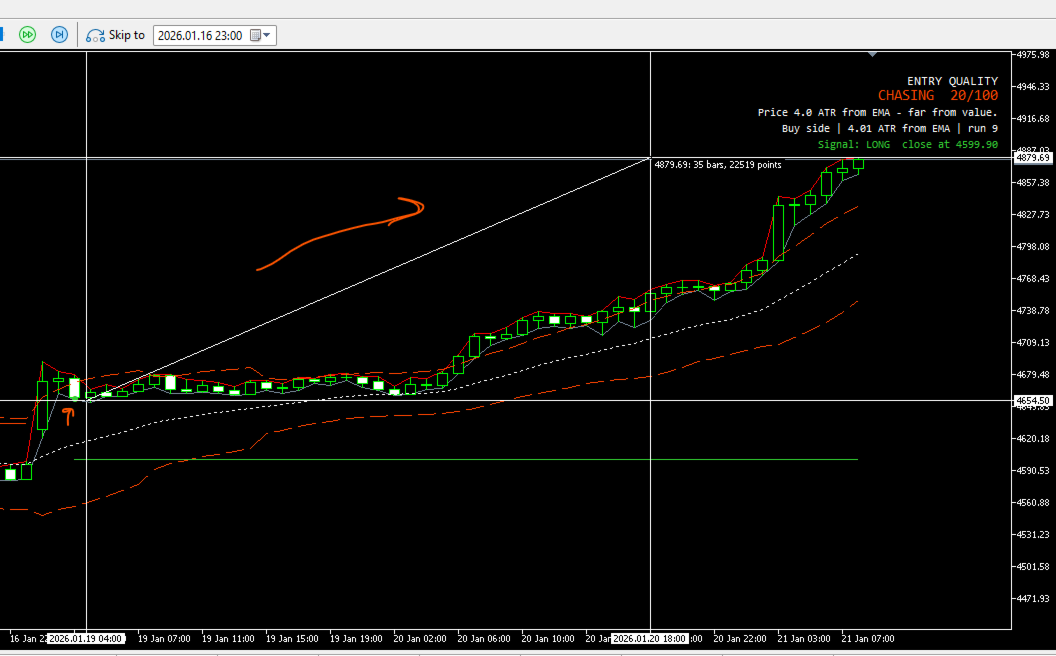
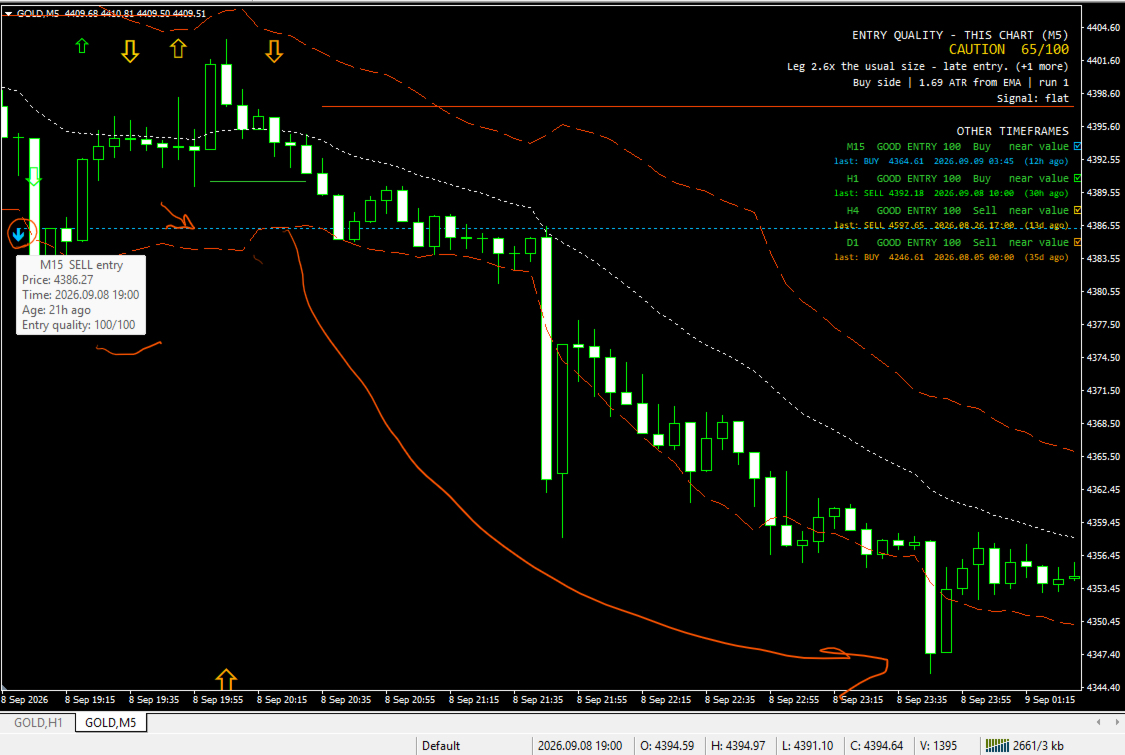
Each failed test subtracts a configurable penalty from 100. The result maps to three states. GOOD ENTRY means nothing is stretched and price is near value. CAUTION means the move is extended and a pullback would give a better price. CHASING means the move has already run.
A structure break that fires while the score says CHASING is exactly the late entry this tool exists to refuse, so no dot is printed for it. This filter can be switched off if you would rather see every break. The panel names the dominant reason in plain language, for example that price is more than two ATR from the average, or that six candles have closed in a row.
CLOSING THE TRADE
When a signal fires, a level is drawn at a configurable ATR distance from the entry: a green level to close a buy, a red level to close a sell. The level is fixed at entry and never moves. The trade ends when that level is reached or when the opposite signal appears, whichever comes first. The panel shows the open direction and the active close level at all times.
MAIN INPUTS
Bars on each side that confirm a swing. Whether the entry quality score filters the signals. Close level distance in ATR. Reference moving average period, ATR period and RSI period. Individual on and off switches for all five tests, with caution and chasing levels and an individual penalty for each. Score thresholds that define where good entry and caution begin. Optional display of the ATR envelope, the signal dots and the close levels, with adjustable size, width and distance from the bar. Panel corner, offsets, font size and colours. Alerts with popup, sound and push notification.
TRADING IDEAS
Fewer signals is the point. The filter removes breaks taken at a stretched price, so a quiet chart is the tool working, not failing.
Widen the swing confirmation on faster timeframes. Three bars on each side means something different on M5 than it does on H4.
If you want more signals, switch the score filter off before you loosen the structure setting. You will see every break and can judge for yourself which ones the filter was removing.
Compare the score shown at your own manual entries with the outcome of those trades. If poor scores cluster around your losses, that is a measurable habit rather than bad luck.
COMPATIBILITY
Works on any symbol and any timeframe. Analysis only: this indicator never sends, modifies or closes an order. The score, the verdict, the signal dots and the close levels are published to indicator buffers so an Expert Advisor or another indicator can read them.