Articles on trading system automation in MQL5

Read articles on the trading systems with a wide variety of ideas at the core. Learn how to use statistical methods and patterns on candlestick charts, how to filter signals and where to use semaphore indicators.
The MQL5 Wizard will help you create robots without programming to quickly check your trading ideas. Use the Wizard to learn about genetic algorithms.
Add a new article

You are missing trading opportunities:
- Free trading apps
- Over 8,000 signals for copying
- Economic news for exploring financial markets
Registration
Log in
You agree to website policy and terms of use
If you do not have an account, please register


Neural Networks in Trading: A Complex Trajectory Prediction Method (Traj-LLM)
In this article, I would like to introduce you to an interesting trajectory prediction method developed to solve problems in the field of autonomous vehicle movements. The authors of the method combined the best elements of various architectural solutions.


Statistical Arbitrage Through Cointegrated Stocks (Part 7): Scoring System 2
This article describes two additional scoring criteria used for selection of baskets of stocks to be traded in mean-reversion strategies, more specifically, in cointegration based statistical arbitrage. It complements a previous article where liquidity and strength of the cointegration vectors were presented, along with the strategic criteria of timeframe and lookback period, by including the stability of the cointegration vectors and the time to mean reversion (half-time). The article includes the commented results of a backtest with the new filters applied and the files required for its reproduction are also provided.


Optimizing Liquidity Raids: Mastering the Difference Between Liquidity Raids and Market Structure Shifts
This is an article about a specialized trend-following EA that aims to clearly elaborate how to utilize trading setups after liquidity raids. This article will explore in detail an EA that is specifically designed for traders who are keen on optimizing and utilizing liquidity raids and purges as entry criteria for their trades and trading decisions. It will also explore how to correctly differentiate between liquidity raids and market structure shifts and how to validate and utilize each of them when they occur, thus trying to mitigate losses that occur from traders confusing the two.


Ten "Errors" of a Newcomer in Trading?
The article substantiates approach to building a trading system as a sequence of opening and closing the interrelated orders regarding the existing conditions - prices and the current values of each order's profit/loss, not only and not so much the conventional "alerts". We are giving an exemplary realization of such an elementary trading system.


Developing a Replay System (Part 42): Chart Trade Project (I)
Let's create something more interesting. I don't want to spoil the surprise, so follow the article for a better understanding. From the very beginning of this series on developing the replay/simulator system, I was saying that the idea is to use the MetaTrader 5 platform in the same way both in the system we are developing and in the real market. It is important that this is done properly. No one wants to train and learn to fight using one tool while having to use another one during the fight.


Walsh Functions in Modern Trading
The article discusses the application of Walsh functions in trading. We will explore the basic principles of using these functions to analyze financial markets, forecast prices, and make trading decisions. We will also discuss the advantages and disadvantages of these functions, as well as the prospects for their application in trading and technical analysis.


Neural Networks in Trading: Effective Feature Extraction for Accurate Classification (Mantis)
Meet Mantis — a lightweight foundation model for time series classification based on a Transformer architecture, featuring contrastive pre-training and hybrid attention that deliver record-breaking accuracy and scalability.


Neural Networks Made Easy (Part 95): Reducing Memory Consumption in Transformer Models
Transformer architecture-based models demonstrate high efficiency, but their use is complicated by high resource costs both at the training stage and during operation. In this article, I propose to get acquainted with algorithms that allow to reduce memory usage of such models.


Data Science and ML (Part 47): Forecasting the Market Using the DeepAR model in Python
In this article, we will attempt to predict the market with a decent model for time series forecasting named DeepAR. A model that is a combination of deep neural networks and autoregressive properties found in models like ARIMA and Vector Autoregressive (VAR).

Neural networks made easy (Part 42): Model procrastination, reasons and solutions
In the context of reinforcement learning, model procrastination can be caused by several reasons. The article considers some of the possible causes of model procrastination and methods for overcoming them.


Neural Networks in Trading: Directional Diffusion Models (DDM)
In this article, we discuss Directional Diffusion Models that exploit data-dependent anisotropic and directed noise in a forward diffusion process to capture meaningful graph representations.


MQL5 Wizard Techniques you should know (Part 79): Using Gator Oscillator and Accumulation/Distribution Oscillator with Supervised Learning
In the last piece, we concluded our look at the pairing of the gator oscillator and the accumulation/distribution oscillator when used in their typical setting of the raw signals they generate. These two indicators are complimentary as trend and volume indicators, respectively. We now follow up that piece, by examining the effect that supervised learning can have on enhancing some of the feature patterns we had reviewed. Our supervised learning approach is a CNN that engages with kernel regression and dot product similarity to size its kernels and channels. As always, we do this in a custom signal class file that works with the MQL5 wizard to assemble an Expert Advisor.


Neural Networks in Trading: Adaptive Detection of Market Anomalies (Final Part)
We continue to build the algorithms that form the basis of the DADA framework, which is an advanced tool for detecting anomalies in time series. This approach enables effective distinguishing random fluctuations from significant deviations. Unlike classical methods, DADA dynamically adapts to different data types, choosing the optimal compression level in each specific case.


Neural networks made easy (Part 57): Stochastic Marginal Actor-Critic (SMAC)
Here I will consider the fairly new Stochastic Marginal Actor-Critic (SMAC) algorithm, which allows building latent variable policies within the framework of entropy maximization.


Creating Custom Indicators in MQL5 (Part 7): Hybrid Time Price Opportunity (TPO) Market Profiles for Session Analysis
In this article, we develop a custom indicator in MQL5 for hybrid Time Price Opportunity (TPO) market profiles, supporting multiple session timeframes such as intraday, daily, weekly, monthly, and fixed periods with timezone adjustments. The indicator quantizes prices into a grid, tracks session data including highs, lows, opens, and closes, and calculates key elements like the point of control and value area based on TPO counts. It renders profiles visually on the chart with customizable colors for TPO letters, single prints, value areas, POC, and close markers, enabling detailed session analysis

MQL5 Wizard Techniques you should know (Part 50): Awesome Oscillator
The Awesome Oscillator is another Bill Williams Indicator that is used to measure momentum. It can generate multiple signals, and therefore we review these on a pattern basis, as in prior articles, by capitalizing on the MQL5 wizard classes and assembly.


Mathematical Models in Grid Strategies
In this article, we will examine the application of mathematics to grid strategies. We will consider the basic principles of the strategy, as well as its advantages and disadvantages. You will learn how to build a trading grid, set optimal parameters, and manage risks effectively.


Neural Networks in Trading: Adaptive Detection of Market Anomalies (DADA)
We invite you to get acquainted with the DADA framework, which is an innovative method for detecting anomalies in time series. It helps distinguish random fluctuations from suspicious deviations. Unlike traditional methods, DADA is flexible and adapts to different data. Instead of a fixed compression level, it uses several options and chooses the most appropriate one for each case.


MQL5 Wizard Techniques you should know (Part 28): GANs Revisited with a Primer on Learning Rates
The Learning Rate, is a step size towards a training target in many machine learning algorithms’ training processes. We examine the impact its many schedules and formats can have on the performance of a Generative Adversarial Network, a type of neural network that we had examined in an earlier article.


MQL5 Wizard Techniques you should know (Part 21): Testing with Economic Calendar Data
Economic Calendar Data is not available for testing with Expert Advisors within Strategy Tester, by default. We look at how Databases could help in providing a work around this limitation. So, for this article we explore how SQLite databases can be used to archive Economic Calendar news such that wizard assembled Expert Advisors can use this to generate trade signals.


Neural Networks Made Easy (Part 97): Training Models With MSFformer
When exploring various model architecture designs, we often devote insufficient attention to the process of model training. In this article, I aim to address this gap.


Market Simulation (Part 01): Cross Orders (I)
Today we will begin the second stage, where we will look at the market replay/simulation system. First, we will show a possible solution for cross orders. I will show you the solution, but it is not final yet. It will be a possible solution to a problem that we will need to solve in the near future.


Neural Networks in Trading: Controlled Segmentation
In this article. we will discuss a method of complex multimodal interaction analysis and feature understanding.


Developing a Replay System — Market simulation (Part 23): FOREX (IV)
Now the creation occurs at the same point where we converted ticks into bars. This way, if something goes wrong during the conversion process, we will immediately notice the error. This is because the same code that places 1-minute bars on the chart during fast forwarding is also used for the positioning system to place bars during normal performance. In other words, the code that is responsible for this task is not duplicated anywhere else. This way we get a much better system for both maintenance and improvement.


Neural Networks in Trading: Integrating Chaos Theory into Time Series Forecasting (Final Part)
We continue to integrate methods proposed by the authors of the Attraos framework into trading models. Let me remind you that this framework uses concepts of chaos theory to solve time series forecasting problems, interpreting them as projections of multidimensional chaotic dynamic systems.


Price Action Analysis Toolkit Development (Part 9): External Flow
This article explores a new dimension of analysis using external libraries specifically designed for advanced analytics. These libraries, like pandas, provide powerful tools for processing and interpreting complex data, enabling traders to gain more profound insights into market dynamics. By integrating such technologies, we can bridge the gap between raw data and actionable strategies. Join us as we lay the foundation for this innovative approach and unlock the potential of combining technology with trading expertise.


Three MACD Filters on US_TECH100: Five Years of Broker Data
This article tests three common filters on a standard MACD crossover for US_TECH100 H1 using five years of broker-native data. Filters are layered incrementally: regime, higher timeframe (HTF) alignment, and US session timing, to isolate each one's marginal impact. Results show session timing contributes far more than indicator refinements, while regime and HTF add little on their own. Includes a reproducible MQL5 regime classifier.


Developing a Replay System — Market simulation (Part 22): FOREX (III)
Although this is the third article on this topic, I must explain for those who have not yet understood the difference between the stock market and the foreign exchange market: the big difference is that in the Forex there is no, or rather, we are not given information about some points that actually occurred during the course of trading.


Building A Candlestick Trend Constraint Model (Part 5): Notification System (Part II)
Today, we are discussing a working Telegram integration for MetaTrader 5 Indicator notifications using the power of MQL5, in partnership with Python and the Telegram Bot API. We will explain everything in detail so that no one misses any point. By the end of this project, you will have gained valuable insights to apply in your projects.


Developing a multi-currency Expert Advisor (Part 11): Automating the optimization (first steps)
To get a good EA, we need to select multiple good sets of parameters of trading strategy instances for it. This can be done manually by running optimization on different symbols and then selecting the best results. But it is better to delegate this work to the program and engage in more productive activities.


News Filtering with MetaTrader 5 Economic Calendar and CSV Fallback
This article presents a self-contained news filter module for MetaTrader 5 built on the platform's economic calendar API. It implements symbol-to-currency mapping, pre- and post-event trading pauses, and optional position size reduction on high-impact days, with a CSV-based fallback for the Strategy Tester. A demo EA and live chart dashboard show integration and verification in both live and backtest environments.


Neural Networks in Trading: Spatio-Temporal Neural Network (STNN)
In this article we will talk about using space-time transformations to effectively predict upcoming price movement. To improve the numerical prediction accuracy in STNN, a continuous attention mechanism is proposed that allows the model to better consider important aspects of the data.


Neural networks made easy (Part 89): Frequency Enhanced Decomposition Transformer (FEDformer)
All the models we have considered so far analyze the state of the environment as a time sequence. However, the time series can also be represented in the form of frequency features. In this article, I introduce you to an algorithm that uses frequency components of a time sequence to predict future states.


Formulating Dynamic Multi-Pair EA (Part 7): Cross-Pair Correlation Mapping for Real-Time Trade Filtering
In this part, we will integrate a real-time correlation matrix into a multi-symbol Expert Advisor to prevent redundant or risk-stacked trades. By dynamically measuring cross-pair relationships, the EA will filter entries that conflict with existing exposure, improving portfolio balance, reducing systemic risk, and enhancing overall trade quality.


Developing a multi-currency Expert Advisor (Part 10): Creating objects from a string
The EA development plan includes several stages with intermediate results being saved in the database. They can only be retrieved from there again as strings or numbers, not objects. So we need a way to recreate the desired objects in the EA from the strings read from the database.


Neural networks made easy (Part 72): Trajectory prediction in noisy environments
The quality of future state predictions plays an important role in the Goal-Conditioned Predictive Coding method, which we discussed in the previous article. In this article I want to introduce you to an algorithm that can significantly improve the prediction quality in stochastic environments, such as financial markets.


Statistical Arbitrage Through Cointegrated Stocks (Part 5): Screening
This article proposes an asset screening process for a statistical arbitrage trading strategy through cointegrated stocks. The system starts with the regular filtering by economic factors, like asset sector and industry, and finishes with a list of criteria for a scoring system. For each statistical test used in the screening, a respective Python class was developed: Pearson correlation, Engle-Granger cointegration, Johansen cointegration, and ADF/KPSS stationarity. These Python classes are provided along with a personal note from the author about the use of AI assistants for software development.

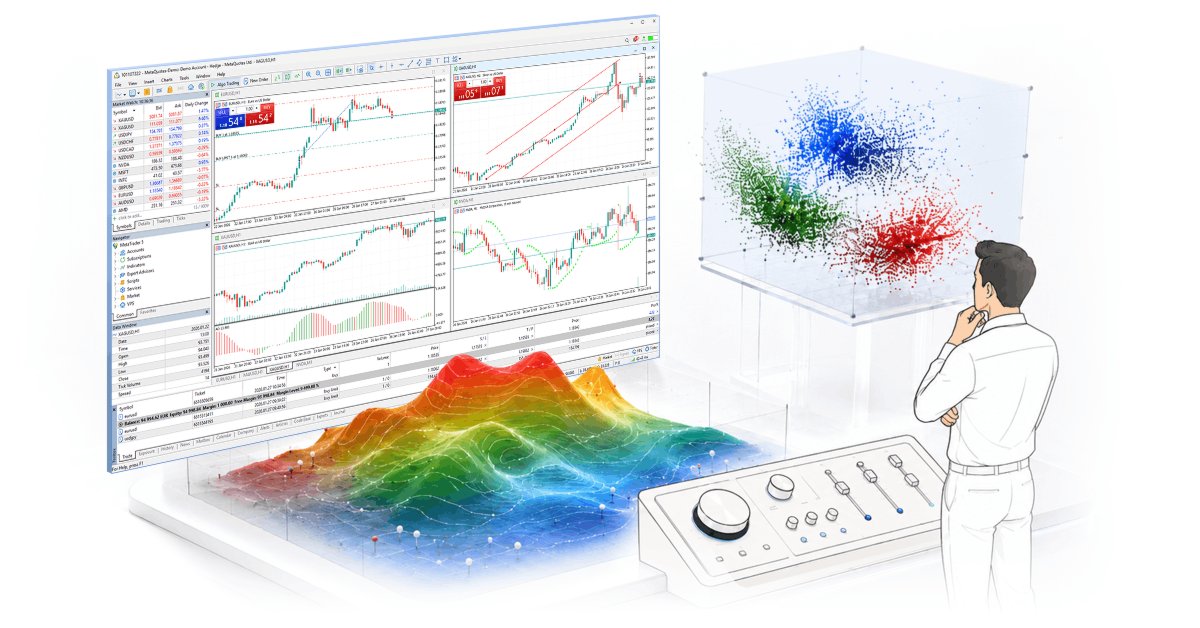
3D Visualization Without External Libraries: How MetaTrader 5 Reveals Optimization Results via MQL5 + DX11
The article describes the practical application of DirectX 11 and built-in MQL5 tools for creating 3D visualizations and interactive interfaces in MetaTrader 5. The focus is on cognitive efficiency - the ability of 3D charts and guided scenes to help in understanding optimization data, liquidity clusters, and multi-dimensional trading scenarios. The basics of the DX pipeline, working with shaders, binding mouse and keyboard events, and objective technological limitations are discussed in detail. The article is intended for MQL5 developers and algorithmic traders who are ready to transform strategy metrics into understandable 3D analytical landscapes, where the visual layer accelerates decision-making.


Developing a Replay System (Part 37): Paving the Path (I)
In this article, we will finally begin to do what we wanted to do much earlier. However, due to the lack of "solid ground", I did not feel confident to present this part publicly. Now I have the basis to do this. I suggest that you focus as much as possible on understanding the content of this article. I mean not simply reading it. I want to emphasize that if you do not understand this article, you can completely give up hope of understanding the content of the following ones.


Big Bang - Big Crunch (BBBC) algorithm
The article presents the Big Bang - Big Crunch method, which has two key phases: cyclic generation of random points and their compression to the optimal solution. This approach combines exploration and refinement, allowing us to gradually find better solutions and open up new optimization opportunities.