

Тестер стратегий для Python и MetaTrader 5 (Часть 02): Работа с барами, тиками и реализация встроенных функций в симуляторе
 415
415
 0
0

Оглавление
- Введение
- Обработка исторических тиков MetaTrader 5
- Обработка исторических баров MetaTrader 5
- Перегрузка функций MetaTrader 5
- symbol_info_tick
- symbol_info
- copy_rates_from
- copy_rates_from_pos
- copy_rates_range
- copy_ticks_from
- copy_ticks_range
- orders_total
- orders_get
- positions_total
- positions_get
- history_orders_total
- history_orders_get
- deals_total
- history_deals_get
- account_info
- order_calc_profit
- order_calc_margin
- Заключительные мысли
Введение
В предыдущей статье мы обсудили и создали в Python класс симулятора под названием TradeSimulator, который в значительной степени опирался на информацию из MetaTrader 5, такую как тики, данные баров, информация о символах и многое другое.
Первая статья заложила основу того, что необходимо для имитации клиента MetaTrader 5 и его тестера стратегий, то есть симулятора. В этой статье мы добавим данные тиков и баров, а также функции, аналогичные тем, которые предоставляет модуль Python–MetaTrader 5, в симулятор. Это приблизит нас ещё на один шаг к воспроизведению всего, что делает и предоставляет MetaTrader 5.
Обработка исторических тиков MetaTrader 5
Тики — это наиболее детализированные ценовые обновления финансового инструмента в реальном времени, отражающие каждое отдельное изменение цены, движение bid/ask и торговый объём.
В отличие от OHLC-баров — Open, High, Low, Close — тики предоставляют данные с точностью до миллисекунд.
Возможно, вы знакомы с функцией OnTick из языка программирования MQL5. Это основная функция MQL5-ботов, которая вызывается при поступлении нового тика.
Терминал MetaTrader 5 в значительной степени опирается на тиковые данные при открытии, сопровождении и закрытии сделок. Без тиков на этой платформе невозможны никакие торговые операции.
С учётом этого нам нужно уметь получать и обрабатывать тики так же, как это делает терминал.
Модуль Python–MetaTrader 5 предоставляет различные способы получения тиков. Один из них — использование функции copy_ticks_range:
copy_ticks_range(
   symbol,       // symbol name
   date_from,    // date the ticks are requested from
   date_to,      // date, up to which the ticks are requested
   flags         // combination of flags defining the type of requested ticks
   )
Попробуем собрать тиковые данные из MetaTrader 5.
def fetch_ticks(start_datetime: datetime, end_datetime: datetime, symbol: str):

    ticks = mt5.copy_ticks_range(symbol, start_datetime, end_datetime, mt5.COPY_TICKS_ALL)

    print(f"Fetched {len(ticks)} ticks for {symbol} from {start_datetime} to {end_datetime}")
    print(ticks[:5])  # Print first 5 ticks for inspection

    return ticks
Пример.
import MetaTrader5 as mt5
from datetime import datetime, timezone

if __name__ == "__main__":
    if not mt5.initialize():
        print(f"Failed to Initialize MetaTrader5. Error = {mt5.last_error()}")
        mt5.shutdown()
        quit()

    symbol = "EURUSD"
    start_dt = datetime(2025, 1, 1, 0, 0, tzinfo=timezone.utc)
    end_dt = datetime(2025, 12, 1, 1, 0, tzinfo=timezone.utc)

    fetch_ticks(start_dt, end_dt, symbol)
Вывод.
Fetched 2814462 ticks for EURUSD from 2025-01-01 00:00:00+00:00 to 2025-12-01 01:00:00+00:00
[(1758499200, 1.17403, 1.17603, 0., 0, 1758499200161, 134, 0.)
 (1758499247, 1.17405, 1.17605, 0., 0, 1758499247468, 134, 0.)
 (1758499500, 1.17346, 1.17546, 0., 0, 1758499500116, 134, 0.)
 (1758499505, 1.173  , 1.175  , 0., 0, 1758499505869, 134, 0.)
 (1758499510, 1.17307, 1.17487, 0., 0, 1758499510079, 134, 0.)]
Как видно, всего за 11 месяцев нам удалось получить 2,8 миллиона тиковых записей. Мы также можем проверить их размер в мегабайтах. Это даст приблизительную оценку того, сколько памяти RAM потребляет один такой запрос тиков.
    # calculate tick array size in megabytes
    size_in_bytes = ticks.nbytes
    size_in_mb = size_in_bytes / (1024 * 1024)
    print(f"Tick array size: {size_in_mb:.2f} MB")
Вывод.
Tick array size: 161.04 MB Как видно, данные всего за 11 месяцев занимают около 0,1 ГБ. Теперь представьте, что в нашем симуляторе, то есть тестере стратегий, пользователь решит протестировать мультивалютного бота по 12 символам за 20 лет. Насколько это нагрузит память и общую производительность?
Нам необходимо найти оптимальный подход к обработке такого объёма данных без чрезмерного потребления памяти и при приемлемой общей производительности.
Polars DataFrames — одно из лучших решений для подобных ситуаций.
Polars прост в использовании и очень быстр; его streaming API позволяет разработчикам эффективно обрабатывать большие наборы данных, включая наборы данных, превышающие объём доступной памяти, например 100 ГБ и больше.
Поскольку мы больше не будем использовать массивы NumPy для хранения всего объёма данных, нам также необходимо разделить процесс сбора данных на более мелкие и менее затратные по памяти фрагменты тиковых данных.
def ticks_to_polars(ticks):
    return pl.DataFrame({
        "time": ticks["time"],
        "bid": ticks["bid"],
        "ask": ticks["ask"],
        "last": ticks["last"],
        "volume": ticks["volume"],
        "time_msc": ticks["time_msc"],
        "flags": ticks["flags"],
        "volume_real": ticks["volume_real"],
    })

def fetch_historical_ticks(start_datetime: datetime,
                           end_datetime: datetime,
                           symbol: str):

    # first of all, we have to ensure the symbol is valid and can be used for requesting data
    if not utils.ensure_symbol(symbol=symbol):
        print(f"Symbol {symbol} not available")
        return

    current = start_datetime.replace(day=1, hour=0, minute=0, second=0)

    while True:
        month_start, month_end = utils.month_bounds(current)

        # Cap last month to end_date
        if (
            month_start.year == end_datetime.year and
            month_start.month == end_datetime.month
        ):
            month_end = end_datetime

        # Stop condition
        if month_start > end_datetime:
            break

        print(f"Processing ticks {month_start:%Y-%m-%d} -> {month_end:%Y-%m-%d}")

        # --- fetch data here ---
        ticks = mt5.copy_ticks_range(
            symbol,
            month_start,
            month_end,
            mt5.COPY_TICKS_ALL
        )

        if ticks is None or len(ticks) == 0:

            config.simulator_logger.critical(f"Failed to Get ticks. Error = {mt5.last_error()}")
            current = (month_start + timedelta(days=32)).replace(day=1) # Advance to next month safely

            continue

        df = ticks_to_polars(ticks)

        df = df.with_columns([
            pl.from_epoch("time", time_unit="s").dt.replace_time_zone("utc").alias("time")
        ])

        df = df.with_columns([
            pl.col("time").dt.year().alias("year"),
            pl.col("time").dt.month().alias("month"),
        ])

        df.write_parquet(
            os.path.join(config.TICKS_HISTORY_DIR, symbol),
            partition_by=["year", "month"],
            mkdir=True
        )

        if config.debug:
           print(df.head(-10))

        # Advance to next month safely
        current = (month_start + timedelta(days=32)).replace(day=1)
Таким образом, вместо того чтобы собирать все тики сразу с помощью copy_ticks_range, мы итеративно собираем тики за каждый месяц и сохраняем информацию в отдельные файлы.
      df.write_parquet(
            os.path.join(config.TICKS_HISTORY_DIR, symbol),
            partition_by=["year", "month"],
            mkdir=True
        )
Выведем данные, чтобы посмотреть, что содержит объект DataFrame.
print(df.head(-10)) # optional, see what data looks like
Вывод.
2025-12-24 16:41:44,138 | CRITICAL | simulator.log20251224 | fetch_historical_ticks 52 --> Failed to Get ticks. Error = (1, 'Success')
Processing ticks 2025-07-01 -> 2025-07-31
2025-12-24 16:41:44,139 | CRITICAL | simulator.log20251224 | fetch_historical_ticks 52 --> Failed to Get ticks. Error = (1, 'Success')
Processing ticks 2025-08-01 -> 2025-08-31
2025-12-24 16:41:44,140 | CRITICAL | simulator.log20251224 | fetch_historical_ticks 52 --> Failed to Get ticks. Error = (1, 'Success')
Processing ticks 2025-09-01 -> 2025-09-30
shape: (434_916, 10)
┌─────────────────────────┬─────────┬─────────┬──────┬───┬───────┬─────────────┬──────┬───────┐
│ time                    ┆ bid     ┆ ask     ┆ last ┆ … ┆ flags ┆ volume_real ┆ year ┆ month │
│ ---                     ┆ ---     ┆ ---     ┆ ---  ┆   ┆ ---   ┆ ---         ┆ ---  ┆ ---   │
│ datetime[μs, UTC]       ┆ f64     ┆ f64     ┆ f64  ┆   ┆ u32   ┆ f64         ┆ i32  ┆ i8    │
╞═════════════════════════╪═════════╪═════════╪══════╪═══╪═══════╪═════════════╪══════╪═══════╡
│ 2025-09-22 00:00:00 UTC ┆ 1.17403 ┆ 1.17603 ┆ 0.0  ┆ … ┆ 134   ┆ 0.0         ┆ 2025 ┆ 9     │
│ 2025-09-22 00:00:47 UTC ┆ 1.17405 ┆ 1.17605 ┆ 0.0  ┆ … ┆ 134   ┆ 0.0         ┆ 2025 ┆ 9     │
│ 2025-09-22 00:05:00 UTC ┆ 1.17346 ┆ 1.17546 ┆ 0.0  ┆ … ┆ 134   ┆ 0.0         ┆ 2025 ┆ 9     │
│ 2025-09-22 00:05:05 UTC ┆ 1.173   ┆ 1.175   ┆ 0.0  ┆ … ┆ 134   ┆ 0.0         ┆ 2025 ┆ 9     │
│ 2025-09-22 00:05:10 UTC ┆ 1.17307 ┆ 1.17487 ┆ 0.0  ┆ … ┆ 134   ┆ 0.0         ┆ 2025 ┆ 9     │
│ …                       ┆ …       ┆ …       ┆ …    ┆ … ┆ …     ┆ …           ┆ …    ┆ …     │
│ 2025-09-30 23:58:44 UTC ┆ 1.17335 ┆ 1.17343 ┆ 0.0  ┆ … ┆ 4     ┆ 0.0         ┆ 2025 ┆ 9     │
│ 2025-09-30 23:58:45 UTC ┆ 1.17335 ┆ 1.17342 ┆ 0.0  ┆ … ┆ 4     ┆ 0.0         ┆ 2025 ┆ 9     │
│ 2025-09-30 23:58:46 UTC ┆ 1.17335 ┆ 1.17343 ┆ 0.0  ┆ … ┆ 4     ┆ 0.0         ┆ 2025 ┆ 9     │
│ 2025-09-30 23:58:47 UTC ┆ 1.17335 ┆ 1.17342 ┆ 0.0  ┆ … ┆ 4     ┆ 0.0         ┆ 2025 ┆ 9     │
│ 2025-09-30 23:58:50 UTC ┆ 1.17334 ┆ 1.1734  ┆ 0.0  ┆ … ┆ 134   ┆ 0.0         ┆ 2025 ┆ 9     │
└─────────────────────────┴─────────┴─────────┴──────┴───┴───────┴─────────────┴──────┴───────┘
Processing ticks 2025-10-01 -> 2025-10-31
shape: (1_401_674, 10)
┌─────────────────────────┬─────────┬─────────┬──────┬───┬───────┬─────────────┬──────┬───────┐
│ time                    ┆ bid     ┆ ask     ┆ last ┆ … ┆ flags ┆ volume_real ┆ year ┆ month │
│ 2025-10-01 00:00:01 UTC ┆ 1.17337 ┆ 1.17506 ┆ 0.0  ┆ … ┆ 134   ┆ 0.0         ┆ 2025 ┆ 10    │
│ 2025-10-01 00:00:02 UTC ┆ 1.17337 ┆ 1.17402 ┆ 0.0  ┆ … ┆ 4     ┆ 0.0         ┆ 2025 ┆ 10    │
│ 2025-10-01 00:00:02 UTC ┆ 1.17337 ┆ 1.17389 ┆ 0.0  ┆ … ┆ 4     ┆ 0.0         ┆ 2025 ┆ 10    │
│ …                       ┆ …       ┆ …       ┆ …    ┆ … ┆ …     ┆ …           ┆ …    ┆ …     │
│ 2025-10-31 23:56:43 UTC ┆ 1.15368 ┆ 1.15368 ┆ 0.0  ┆ … ┆ 134   ┆ 0.0         ┆ 2025 ┆ 10    │
│ 2025-10-31 23:56:52 UTC ┆ 1.15369 ┆ 1.15369 ┆ 0.0  ┆ … ┆ 134   ┆ 0.0         ┆ 2025 ┆ 10    │
│ 2025-10-31 23:56:52 UTC ┆ 1.15371 ┆ 1.15371 ┆ 0.0  ┆ … ┆ 134   ┆ 0.0         ┆ 2025 ┆ 10    │
│ 2025-10-31 23:56:53 UTC ┆ 1.1537  ┆ 1.1537  ┆ 0.0  ┆ … ┆ 134   ┆ 0.0         ┆ 2025 ┆ 10    │
│ 2025-10-31 23:56:53 UTC ┆ 1.15371 ┆ 1.15371 ┆ 0.0  ┆ … ┆ 134   ┆ 0.0         ┆ 2025 ┆ 10    │
└─────────────────────────┴─────────┴─────────┴──────┴───┴───────┴─────────────┴──────┴───────┘
Processing ticks 2025-11-01 -> 2025-11-30
shape: (976_714, 10)
┌─────────────────────────┬─────────┬─────────┬──────┬───┬───────┬─────────────┬──────┬───────┐
│ time                    ┆ bid     ┆ ask     ┆ last ┆ … ┆ flags ┆ volume_real ┆ year ┆ month │
│ ---                     ┆ ---     ┆ ---     ┆ ---  ┆   ┆ ---   ┆ ---         ┆ ---  ┆ ---   │
│ datetime[μs, UTC]       ┆ f64     ┆ f64     ┆ f64  ┆   ┆ u32   ┆ f64         ┆ i32  ┆ i8    │
╞═════════════════════════╪═════════╪═════════╪══════╪═══╪═══════╪═════════════╪══════╪═══════╡
│ 2025-11-03 00:00:00 UTC ┆ 1.1528  ┆ 1.15365 ┆ 0.0  ┆ … ┆ 134   ┆ 0.0         ┆ 2025 ┆ 11    │
│ 2025-11-03 00:01:00 UTC ┆ 1.1528  ┆ 1.15365 ┆ 0.0  ┆ … ┆ 130   ┆ 0.0         ┆ 2025 ┆ 11    │
│ 2025-11-03 00:01:00 UTC ┆ 1.1528  ┆ 1.15365 ┆ 0.0  ┆ … ┆ 4     ┆ 0.0         ┆ 2025 ┆ 11    │
│ 2025-11-03 00:01:21 UTC ┆ 1.15295 ┆ 1.15365 ┆ 0.0  ┆ … ┆ 130   ┆ 0.0         ┆ 2025 ┆ 11    │
│ 2025-11-03 00:01:25 UTC ┆ 1.15282 ┆ 1.15365 ┆ 0.0  ┆ … ┆ 130   ┆ 0.0         ┆ 2025 ┆ 11    │
│ …                       ┆ …       ┆ …       ┆ …    ┆ … ┆ …     ┆ …           ┆ …    ┆ …     │
│ 2025-11-28 23:55:12 UTC ┆ 1.15948 ┆ 1.16018 ┆ 0.0  ┆ … ┆ 134   ┆ 0.0         ┆ 2025 ┆ 11    │
│ 2025-11-28 23:55:13 UTC ┆ 1.15955 ┆ 1.16017 ┆ 0.0  ┆ … ┆ 134   ┆ 0.0         ┆ 2025 ┆ 11    │
│ 2025-11-28 23:55:36 UTC ┆ 1.15948 ┆ 1.16018 ┆ 0.0  ┆ … ┆ 134   ┆ 0.0         ┆ 2025 ┆ 11    │
│ 2025-11-28 23:55:37 UTC ┆ 1.15953 ┆ 1.16017 ┆ 0.0  ┆ … ┆ 134   ┆ 0.0         ┆ 2025 ┆ 11    │
│ 2025-11-28 23:55:54 UTC ┆ 1.15954 ┆ 1.16024 ┆ 0.0  ┆ … ┆ 134   ┆ 0.0         ┆ 2025 ┆ 11    │
│ time                    ┆ bid     ┆ ask     ┆ last ┆ … ┆ flags ┆ volume_real ┆ year ┆ month │
│ ---                     ┆ ---     ┆ ---     ┆ ---  ┆   ┆ ---   ┆ ---         ┆ ---  ┆ ---   │
│ datetime[μs, UTC]       ┆ f64     ┆ f64     ┆ f64  ┆   ┆ u32   ┆ f64         ┆ i32  ┆ i8    │
╞═════════════════════════╪═════════╪═════════╪══════╪═══╪═══════╪═════════════╪══════╪═══════╡
│ 2025-12-01 00:00:00 UTC ┆ 1.15936 ┆ 1.15969 ┆ 0.0  ┆ … ┆ 134   ┆ 0.0         ┆ 2025 ┆ 12    │
│ 2025-12-01 00:00:06 UTC ┆ 1.15934 ┆ 1.15962 ┆ 0.0  ┆ … ┆ 134   ┆ 0.0         ┆ 2025 ┆ 12    │
│ 2025-12-01 00:00:11 UTC ┆ 1.15935 ┆ 1.15997 ┆ 0.0  ┆ … ┆ 134   ┆ 0.0         ┆ 2025 ┆ 12    │
│ 2025-12-01 00:00:15 UTC ┆ 1.15936 ┆ 1.15979 ┆ 0.0  ┆ … ┆ 134   ┆ 0.0         ┆ 2025 ┆ 12    │
│ 2025-12-01 00:00:21 UTC ┆ 1.15936 ┆ 1.15964 ┆ 0.0  ┆ … ┆ 4     ┆ 0.0         ┆ 2025 ┆ 12    │
│ …                       ┆ …       ┆ …       ┆ …    ┆ … ┆ …     ┆ …           ┆ …    ┆ …     │
│ 2025-12-01 00:59:57 UTC ┆ 1.15964 ┆ 1.16005 ┆ 0.0  ┆ … ┆ 4     ┆ 0.0         ┆ 2025 ┆ 12    │
│ 2025-12-01 00:59:57 UTC ┆ 1.15972 ┆ 1.16012 ┆ 0.0  ┆ … ┆ 134   ┆ 0.0         ┆ 2025 ┆ 12    │
│ 2025-12-01 00:59:57 UTC ┆ 1.15967 ┆ 1.16005 ┆ 0.0  ┆ … ┆ 134   ┆ 0.0         ┆ 2025 ┆ 12    │
│ 2025-12-01 00:59:57 UTC ┆ 1.15971 ┆ 1.16009 ┆ 0.0  ┆ … ┆ 134   ┆ 0.0         ┆ 2025 ┆ 12    │
│ 2025-12-01 00:59:57 UTC ┆ 1.15965 ┆ 1.16005 ┆ 0.0  ┆ … ┆ 134   ┆ 0.0         ┆ 2025 ┆ 12    │
└─────────────────────────┴─────────┴─────────┴──────┴───┴───────┴─────────────┴──────┴───────┘
January 2024:
 shape: (0, 10)
┌───────────────────┬─────┬─────┬──────┬───┬───────┬─────────────┬──────┬───────┐
│ time              ┆ bid ┆ ask ┆ last ┆ … ┆ flags ┆ volume_real ┆ year ┆ month │
│ ---               ┆ --- ┆ --- ┆ ---  ┆   ┆ ---   ┆ ---         ┆ ---  ┆ ---   │
│ datetime[μs, UTC] ┆ f64 ┆ f64 ┆ f64  ┆   ┆ u32   ┆ f64         ┆ i32  ┆ i8    │
╞═══════════════════╪═════╪═════╪══════╪═══╪═══════╪═════════════╪══════╪═══════╡
└───────────────────┴─────┴─────┴──────┴───┴───────┴─────────────┴──────┴───────┘
shape: (1, 2)
┌───────────────────┬───────────────────┐
│ time_min          ┆ time_max          │
│ ---               ┆ ---               │
│ datetime[μs, UTC] ┆ datetime[μs, UTC] │
╞═══════════════════╪═══════════════════╡
│ null              ┆ null              │
└───────────────────┴───────────────────┘
Одна из самых удобных особенностей метода Polars под названием write_parquet заключается в том, что при передаче значения в аргумент partition_by он использует полученные столбцы как группы и сохраняет данные в отдельные подпапки.
После сбора тиков по двум инструментам.
if __name__ == "__main__":

    if not mt5.initialize():
        print(f"Failed to Initialize MetaTrader5. Error = {mt5.last_error()}")
        mt5.shutdown()
        quit()

    symbol = "EURUSD"
    start_dt = datetime(2025, 1, 1, 0, 0, tzinfo=timezone.utc)
    end_dt = datetime(2025, 12, 1, 1, 0, tzinfo=timezone.utc)

    fetch_historical_ticks(start_datetime=start_dt, end_datetime=end_dt, symbol=symbol)
    fetch_historical_ticks(start_datetime=start_dt, end_datetime=end_dt, symbol= "GBPUSD")

    path = os.path.join(config.TICKS_HISTORY_DIR, symbol)
    lf = pl.scan_parquet(path)

    jan_2024 = (
        lf
        .filter(
            (pl.col("year") == 2024) &
            (pl.col("month") == 1)
        )
        .collect(engine="streaming")
    )

    print("January 2024:\n", jan_2024.head(-10))
    print(
        jan_2024.select([
            pl.col("time").min().alias("time_min"),
            pl.col("time").max().alias("time_max")
        ])
    )

    mt5.shutdown()
Ниже показано, как выглядят выходные папки.
(venv) c:\Users\Omega Joctan\OneDrive\Documents\PyMetaTester>tree History
Folder PATH listing
Volume serial number is 2CFE-3A78
C:\USERS\OMEGA JOCTAN\ONEDRIVE\DOCUMENTS\PYMETATESTER\HISTORY
├───Bars
│   ├───EURUSD
│   │   └───M5
└───Ticks
    ├───EURUSD
    │   └───year=2025
    │       ├───month=10
    │       ├───month=11
    │       ├───month=12
    │       └───month=9
    └───GBPUSD
        └───year=2025
            ├───month=10
            ├───month=11
            ├───month=12
            └───month=9
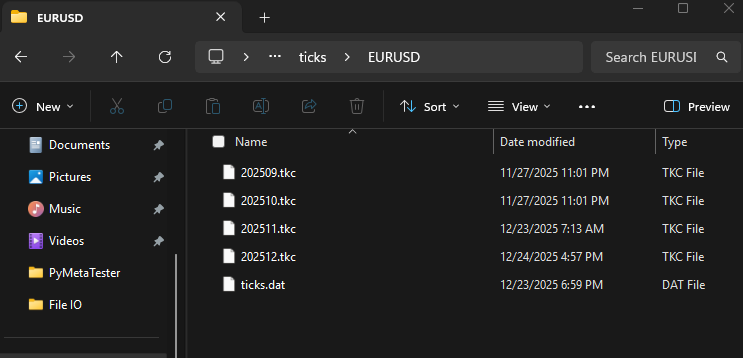
К сожалению, мне не удалось получить все тиковые данные, которые я запрашивал, то есть с 1 января по 1 декабря 2025 года. Похоже, что нельзя получить больше тиков, чем доступно в вашем терминале MetaTrader 5. В данном случае у моего брокера было лишь несколько месяцев тиковых данных, и именно их я постоянно получал.
From: C:\Users\Omega\AppData\Roaming\MetaQuotes\Terminal\010E047102812FC0C18890992854220E\bases\<broker name>\ticks\EURUSD
Обработка исторических баров MetaTrader 5
В отличие от тиков, бары основаны на таймфреймах. С барами работать проще, чем с тиками. Аналогично тому, как мы собирали тики, нам нужно похожим образом собрать данные баров.
Сначала необходимо убедиться, что символ доступен, и выбрать его в MarketWatch перед запросом его баров.
Внутри utils.py:
def ensure_symbol(symbol: str) -> bool:
    info = mt5.symbol_info(symbol)
    if info is None:
        print(f"Symbol {symbol} not found")
        return False

    if not info.visible:
        if not mt5.symbol_select(symbol, True):
            print(f"Failed to select symbol {symbol}")
            return False
    return True
Затем мы собираем данные, начиная с первого и заканчивая последним днём месяца.
def fetch_historical_bars(symbol: str,
                          timeframe: int,
                          start_datetime: datetime,
                          end_datetime: datetime):
    """
    Fetch historical bar data for a given symbol and timeframe, forward in time.
    Saves data to a single Parquet file in append mode.
    """

    if not utils.ensure_symbol(symbol=symbol):
        print(f"Symbol {symbol} not available")
        return

    current = start_datetime.replace(day=1, hour=0, minute=0, second=0)

    while True:
        month_start, month_end = utils.month_bounds(current)

        # Cap last month to end_date
        if (
            month_start.year == end_datetime.year and
            month_start.month == end_datetime.month
        ):
            month_end = end_datetime

        # Stop condition
        if month_start > end_datetime:
            break

        print(f"Processing {month_start:%Y-%m-%d} -> {month_end:%Y-%m-%d}")

        # --- fetch data here ---
        rates = mt5.copy_rates_range(
            symbol,
            timeframe,
            month_start,
            month_end
        )

        if rates is None and len(rates)==0:
            config.simulator_logger.warning(f"Failed to Get bars from MetaTrader5")
            current = (month_start + timedelta(days=32)).replace(day=1) # Advance to next month safely
            continue

        df = bars_to_polars(rates)
Мы сохраняем данные баров в соответствующие Parquet-файлы, разделённые по месяцам и годам в виде подпапок.
df = df.with_columns([
    pl.from_epoch("time", time_unit="s").dt.replace_time_zone("utc").alias("time")
])

df = df.with_columns([
    pl.col("time").dt.year().alias("year"),
    pl.col("time").dt.month().alias("month"),
])

tf_name = utils.TIMEFRAMES_REV[timeframe]
df.write_parquet(
    os.path.join(config.BARS_HISTORY_DIR, symbol, tf_name),
    partition_by=["year", "month"],
    mkdir=True
)

if config.is_debug:
    print(df.head(-10))

# Advance to next month safely
current = (month_start + timedelta(days=32)).replace(day=1)
Например, бары, собранные по трём символам за 10 месяцев.
if __name__ == "__main__":

    if not mt5.initialize():
        print(f"Failed to Initialize MetaTrader5. Error = {mt5.last_error()}")
        mt5.shutdown()
        quit()

    start_date = datetime(2022, 1, 1, tzinfo=timezone.utc)
    end_date = datetime(2025, 1, 10, tzinfo=timezone.utc)

    fetch_historical_bars("XAUUSD", mt5.TIMEFRAME_M1, start_date, end_date)
    fetch_historical_bars("EURUSD", mt5.TIMEFRAME_H1, start_date, end_date)
    fetch_historical_bars("GBPUSD", mt5.TIMEFRAME_M5, start_date, end_date)

    # read polaris dataframe and print the head for both symbols

    symbol = "GBPUSD"
    timeframe = utils.TIMEFRAMES_REV[mt5.TIMEFRAME_M5]

    path = os.path.join(config.BARS_HISTORY_DIR, symbol, timeframe)

    lf = pl.scan_parquet(path)

    jan_2024 = (
        lf
        .filter(
            (pl.col("year") == 2024) &
            (pl.col("month") == 1)
        )
        .collect(engine="streaming")
    )

    print("January 2024:\n", jan_2024.head(-10))
    print(
        jan_2024.select([
            pl.col("time").min().alias("time_min"),
            pl.col("time").max().alias("time_max")
        ])
    )

    mt5.shutdown()
Вывод.
(venv) c:\Users\Omega Joctan\OneDrive\Documents\PyMetaTester>tree History
Folder PATH listing
Volume serial number is 2CFE-3A78
C:\USERS\OMEGA JOCTAN\ONEDRIVE\DOCUMENTS\PYMETATESTER\HISTORY
├───Bars
│   ├───EURUSD
│   │   ├───H1
│   │   │   ├───year=2022
│   │   │   │   ├───month=1
│   │   │   │   ├───month=10
│   │   │   │   ├───month=11
│   │   │   │   ├───month=12
│   │   │   │   ├───month=2
│   │   │   │   ├───month=3
│   │   │   │   ├───month=4
│   │   │   │   ├───month=5
│   │   │   │   ├───month=6
│   │   │   │   ├───month=7
│   │   │   │   ├───month=8
│   │   │   │   └───month=9
│   │   │   ├───year=2023
│   │   │   │   ├───month=1
│   │   │   │   ├───month=10
│   │   │   │   ├───month=11
│   │   │   │   ├───month=12
│   │   │   │   ├───month=2
│   │   │   │   ├───month=3
│   │   │   │   ├───month=4
│   │   │   │   ├───month=5
│   │   │   │   ├───month=6
│   │   │   │   ├───month=7
│   │   │   │   ├───month=8
│   │   │   │   └───month=9
│   │   │   ├───year=2024
│   │   │   │   ├───month=1
│   │   │   │   ├───month=10
│   │   │   │   ├───month=11
│   │   │   │   ├───month=12
│   │   │   │   ├───month=2
│   │   │   │   ├───month=3
│   │   │   │   ├───month=4
│   │   │   │   ├───month=5
│   │   │   │   ├───month=6
│   │   │   │   ├───month=7
│   │   │   │   ├───month=8
│   │   │   │   └───month=9
│   │   │   └───year=2025
│   │   │       └───month=1
│   │   └───M5
│   │       ├───year=2022
│   │       │   ├───month=1
│   │       │   ├───month=10
│   │       │   ├───month=11
│   │       │   ├───month=12
│   │       │   ├───month=2
│   │       │   ├───month=3
│   │       │   ├───month=4
│   │       │   ├───month=5
│   │       │   ├───month=6
│   │       │   ├───month=7
│   │       │   ├───month=8
│   │       │   └───month=9
│   │       ├───year=2023
│   │       │   ├───month=1
│   │       │   ├───month=10
│   │       │   ├───month=11
│   │       │   ├───month=12
│   │       │   ├───month=2
│   │       │   ├───month=3
│   │       │   ├───month=4
│   │       │   ├───month=5
│   │       │   ├───month=6
│   │       │   ├───month=7
│   │       │   ├───month=8
│   │       │   └───month=9
│   │       ├───year=2024
│   │       │   ├───month=1
│   │       │   ├───month=10
│   │       │   ├───month=11
│   │       │   ├───month=12
│   │       │   ├───month=2
│   │       │   ├───month=3
│   │       │   ├───month=4
│   │       │   ├───month=5
│   │       │   ├───month=6
│   │       │   ├───month=7
│   │       │   ├───month=8
│   │       │   └───month=9
│   │       └───year=2025
│   │           └───month=1
└───Ticks
    ├───EURUSD
    │   └───year=2025
    │       ├───month=10
    │       ├───month=11
    │       ├───month=12
    │       └───month=9
    └───GBPUSD
        └───year=2025
            ├───month=10
            ├───month=11
            ├───month=12
            └───month=9
Перегрузка функций MetaTrader 5
И снова: в предыдущей статье мы смогли смоделировать некоторые торговые операции, хотя слишком сильно полагались на MetaTrader 5 для получения тиков, котировок и части критически важной информации. На этот раз мы хотим получить полностью или почти полностью изолированный пользовательский симулятор.
Сначала мы добавим экземпляр тестера. Это означает, что если пользователь запускает симулятор с аргументом IS_TESTER, установленным в True, то есть в режиме тестера стратегий, вместо извлечения критически важной информации, такой как котировки и тики, напрямую из MetaTrader 5, мы будем получать такую информацию из пользовательских путей, созданных в предыдущих разделах.
Когда IS_TESTER установлен в False, мы делаем обратное — извлекаем такие данные напрямую из MetaTrader 5.
class Simulator:
    def __init__(self, simulator_name: str, mt5_instance: mt5, deposit: float, leverage: str="1:100"):

        #... other variables

        self.IS_RUNNING = True # is the simulator running or stopped
        self.IS_TESTER = True # are we on the strategy tester mode or live trading

        self.symbol_info_cache: dict[str, namedtuple] = {}

    def Start(self, IS_TESTER: bool) -> bool: # simulator start

        self.IS_TESTER = IS_TESTER

    def Stop(self): # simulator stopped
        self.IS_RUNNING = False
        pass
symbol_info_tick
Теперь, когда у нас есть собственный способ хранения и чтения тиковых данных из локального пути, нам нужен способ возвращать такую информацию пользователю так же, как это делает клиент MetaTrader 5.
symbol_info_tick(
   symbol      // financial instrument name
)
Нам нужна аналогичная функция внутри класса Simulator. Функция должна решать, возвращать тики из MetaTrader 5 или тики внутри симулятора.
    def symbol_info_tick(self, symbol: str) -> namedtuple:

        if self.IS_TESTER:
            return self.tick_cache[symbol]

        try:
            tick = self.mt5_instance.symbol_info_tick(symbol)
        except Exception as e:
            self.__GetLogger().warning(f"Failed. MT5 Error = {self.mt5_instance.last_error()}")

        return tick
Внутри класса симулятора у нас есть массив для отслеживания последних тиков.
В конструкторе класса:
self.tick_cache: dict[str, namedtuple] = {}
Однако этот симулятор должен получать эту тиковую информацию. Для такой задачи нам нужна функция.
def TickUpdate(self, symbol: str, tick: namedtuple):
    self.tick_cache[symbol] = tick
symbol_info
Эта функция получает с платформы MetaTrader 5 данные по указанному финансовому инструменту.
symbol_info(
   symbol      // financial instrument name
)
Нам нужна аналогичная функция в нашем классе симулятора, но она не должна запрашивать эти данные из MetaTrader 5 более одного раза за время жизни симулятора.
После извлечения данных символа из MetaTrader 5 они должны сохраняться в массиве для последующего использования. Это снижает зависимость от MetaTrader 5 и улучшает общую производительность.
def symbol_info(self, symbol: str) -> namedtuple:

    """Gets data on the specified financial instrument."""

    if symbol not in self.symbol_info_cache:
        info = self.mt5_instance.symbol_info(symbol)
        if info is None:
           return None

       self.symbol_info_cache[symbol] = info

   return self.symbol_info_cache[symbol]
Массив для временного хранения данных символов определяется аналогично массиву для хранения тиков, рассмотренному выше.
self.symbol_info_cache: dict[str, namedtuple] = {}
copy_rates_from
Эта функция получает бары из терминала MetaTrader 5, начиная с указанной даты, и возвращает заданное количество предыдущих баров.
copy_rates_from(
   symbol,       // symbol name
   timeframe,    // timeframe
   date_from,    // initial bar open date
   count         // number of bars
   )
В аналогичной функции нашего класса мы начинаем с того, что убеждаемся, что заданная начальная дата находится в формате UTC.
def copy_rates_from(self, symbol: str, timeframe: int, date_from: datetime, count: int) -> np.array:

    date_from = utils.ensure_utc(date_from)
Если пользователь выбрал режим тестера стратегий (IS_TESTER=True), мы получаем данные баров, сохранённые в Parquet-файлах.
if self.IS_TESTER:

    # instead of getting data from MetaTrader 5, get data stored in our custom directories

    path = os.path.join(config.BARS_HISTORY_DIR, symbol, utils.TIMEFRAMES_REV[timeframe])
    lf = pl.scan_parquet(path)

    try:
        rates = (
            lf
            .filter(pl.col("time") <= date_from) # get data starting at the given date
            .sort("time", descending=True)
            .limit(count) # limit the request to some bars
            .select([
                pl.col("time").dt.epoch("s").cast(pl.Int64).alias("time"),

                pl.col("open"),
                pl.col("high"),
                pl.col("low"),
                pl.col("close"),
                pl.col("tick_volume"),
                pl.col("spread"),
                pl.col("real_volume"),
            ]) # return only what's required
            .collect(engine="streaming") # the streming engine, doesn't store data in memory
        ).to_dicts()

        rates = np.array(rates)[::-1] # reverse an array so it becomes oldest -> newest

    except Exception as e:
        config.tester_logger.warn(f"Failed to copy rates {e}")
        return np.array(dict())
else:

    rates = self.mt5_instance.copy_rates_from(symbol, timeframe, date_from, count)
    rates = np.array(self.__mt5_rates_to_dicts(rates))

    if rates is None:
        config.simulator_logger.warn(f"Failed to copy rates. MetaTrader 5 error = {self.mt5_instance.last_error()}")
        return np.array(dict())

return rates
Если переменная класса IS_TESTER установлена в False, мы получаем данные баров напрямую из MetaTrader 5.
Поскольку MetaTrader 5 возвращает структурированный массив NumPy, преобразуем его в массив NumPy со словарями данных для каждого элемента массива. Это делает формат согласованным с форматом, полученным после преобразования объекта Polars DataFrame.
def __mt5_rates_to_dicts(self, rates) -> list[dict]:

    if rates is None or len(rates) == 0:
        return []

    # structured numpy array from MT5
    if rates.dtype.names is not None:
        return [
            {name: r[name].item() if hasattr(r[name], "item") else r[name]
            for name in rates.dtype.names}
            for r in rates
        ]
Пример использования:
sim = Simulator(simulator_name="MySimulator", mt5_instance=mt5, deposit=1078.30, leverage="1:500")

start = datetime(2025, 1, 1)
bars = 10

sim.Start(IS_TESTER=True) # start the simulator in the strategy tester mode
rates = sim.copy_rates_from(symbol="EURUSD", timeframe=mt5.TIMEFRAME_H1, date_from=start, count=bars)
print("is_tester=true\n", rates)

sim.Start(IS_TESTER=False) # start the simulator in real-time trading
rates = sim.copy_rates_from(symbol="EURUSD", timeframe=mt5.TIMEFRAME_H1, date_from=start, count=bars)

print("is_tester=false\n",rates)
Вывод.
is_tester=true
 [{'time': 1735653600, 'open': 1.04104, 'high': 1.04145, 'low': 1.03913, 'close': 1.03928, 'tick_volume': 2543, 'spread': 0, 'real_volume': 0}
 {'time': 1735657200, 'open': 1.03929, 'high': 1.03973, 'low': 1.03836, 'close': 1.0393, 'tick_volume': 3171, 'spread': 0, 'real_volume': 0}
 {'time': 1735660800, 'open': 1.03931, 'high': 1.03943, 'low': 1.03748, 'close': 1.03759, 'tick_volume': 4073, 'spread': 0, 'real_volume': 0}
 {'time': 1735664400, 'open': 1.03759, 'high': 1.03893, 'low': 1.03527, 'close': 1.03548, 'tick_volume': 5531, 'spread': 0, 'real_volume': 0}
 {'time': 1735668000, 'open': 1.03548, 'high': 1.03614, 'low': 1.0346899999999999, 'close': 1.03504, 'tick_volume': 3918, 'spread': 0, 'real_volume': 0}
 {'time': 1735671600, 'open': 1.03504, 'high': 1.03551, 'low': 1.03442, 'close': 1.03493, 'tick_volume': 3279, 'spread': 0, 'real_volume': 0}
 {'time': 1735675200, 'open': 1.0348600000000001, 'high': 1.03569, 'low': 1.03455, 'close': 1.0352999999999999, 'tick_volume': 2693, 'spread': 0, 'real_volume': 0}
 {'time': 1735678800, 'open': 1.0352999999999999, 'high': 1.03647, 'low': 1.03516, 'close': 1.03548, 'tick_volume': 1840, 'spread': 0, 'real_volume': 0}
 {'time': 1735682400, 'open': 1.03549, 'high': 1.03633, 'low': 1.03546, 'close': 1.03586, 'tick_volume': 1192, 'spread': 0, 'real_volume': 0}
 {'time': 1735686000, 'open': 1.03586, 'high': 1.0361, 'low': 1.03527, 'close': 1.03527, 'tick_volume': 975, 'spread': 0, 'real_volume': 0}]
is_tester=false
 [{'time': 1735653600, 'open': 1.04104, 'high': 1.04145, 'low': 1.03913, 'close': 1.03928, 'tick_volume': 2543, 'spread': 0, 'real_volume': 0}
 {'time': 1735657200, 'open': 1.03929, 'high': 1.03973, 'low': 1.03836, 'close': 1.0393, 'tick_volume': 3171, 'spread': 0, 'real_volume': 0}
 {'time': 1735660800, 'open': 1.03931, 'high': 1.03943, 'low': 1.03748, 'close': 1.03759, 'tick_volume': 4073, 'spread': 0, 'real_volume': 0}
 {'time': 1735664400, 'open': 1.03759, 'high': 1.03893, 'low': 1.03527, 'close': 1.03548, 'tick_volume': 5531, 'spread': 0, 'real_volume': 0}
 {'time': 1735668000, 'open': 1.03548, 'high': 1.03614, 'low': 1.0346899999999999, 'close': 1.03504, 'tick_volume': 3918, 'spread': 0, 'real_volume': 0}
 {'time': 1735671600, 'open': 1.03504, 'high': 1.03551, 'low': 1.03442, 'close': 1.03493, 'tick_volume': 3279, 'spread': 0, 'real_volume': 0}
 {'time': 1735675200, 'open': 1.0348600000000001, 'high': 1.03569, 'low': 1.03455, 'close': 1.0352999999999999, 'tick_volume': 2693, 'spread': 0, 'real_volume': 0}
 {'time': 1735678800, 'open': 1.0352999999999999, 'high': 1.03647, 'low': 1.03516, 'close': 1.03548, 'tick_volume': 1840, 'spread': 0, 'real_volume': 0}
 {'time': 1735682400, 'open': 1.03549, 'high': 1.03633, 'low': 1.03546, 'close': 1.03586, 'tick_volume': 1192, 'spread': 0, 'real_volume': 0}
 {'time': 1735686000, 'open': 1.03586, 'high': 1.0361, 'low': 1.03527, 'close': 1.03527, 'tick_volume': 975, 'spread': 0, 'real_volume': 0}]
copy_rates_from_pos
Согласно документации, эта функция получает бары из терминала MetaTrader 5, начиная с указанного индекса.
В индексе 0 находится текущий бар, а бар с наибольшим индексом является самым старым баром в терминале.
Это самая сложная из всех функций, копирующих информацию о барах из MetaTrader 5, просто потому что она зависит от времени.
Поскольку бар с индексом 0 всегда является текущим баром, это означает, что текущая функция должна знать время текущего тика. При запуске симулятора в так называемом тестере стратегий мы наследуем функцию copy_rates_from, которая принимает время начальной даты.
Мы передаём ей начальную дату:
текущее время + текущий таймфрейм в секундах * количество баров, запрошенное пользователем.
    def copy_rates_from_pos(self, symbol: str, timeframe: int, start_pos: int, count: int) -> np.array:

        if self.tick is None or self.tick.time is None:
            self.__GetLogger().critical("Time information not found in the ticker, call the function 'TickUpdate' giving it the latest tick information")
            now = datetime.now(tz=timezone.utc)
        else:
            now = self.tick.time

        if self.IS_TESTER:
            rates = self.copy_rates_from(symbol=symbol,
                                        timeframe=timeframe,
                                        date_from=now+timedelta(seconds=utils.PeriodSeconds(timeframe)*start_pos),
                                        count=count)

        else:

            rates = self.mt5_instance.copy_rates_from_pos(symbol, timeframe, start_pos, count)
            rates = np.array(self.__mt5_rates_to_dicts(rates))

            if rates is None:
                self.__GetLogger().warning(f"Failed to copy rates. MetaTrader 5 error = {self.mt5_instance.last_error()}")
                return np.array(dict())

        return rates
Когда IS_TESTER=False, то есть система работает в реальном времени, симулятор получает бары напрямую из терминала MetaTrader 5.
Пример использования:
sim = Simulator(simulator_name="MySimulator", mt5_instance=mt5, deposit=1078.30, leverage="1:500")

start = datetime(2025, 1, 1)
bars = 10
symbol = "EURUSD"
timeframe = mt5.TIMEFRAME_H1

sim.Start(IS_TESTER=True)
rates = sim.copy_rates_from_pos(symbol=symbol, timeframe=timeframe, start_pos=0, count=bars)

print("is_tester=true\n", rates)

sim.Start(IS_TESTER=False) # start the simulator in real-time trading
rates = sim.copy_rates_from_pos(symbol=symbol, timeframe=timeframe, start_pos=0, count=bars)

print("is_tester=false\n",rates)
Вывод.
(venv) C:\Users\Omega Joctan\OneDrive\Documents\PyMetaTester>python test.py
2025-12-25 12:42:33,366 | CRITICAL | tester |  copy_rates_from_pos 221 --> Time information not found in the ticker, call the function 'TickUpdate' giving it the latest tick information
is_tester=true
 [{'time': 1766584800, 'open': 1.17927, 'high': 1.17932, 'low': 1.1784, 'close': 1.17843, 'tick_volume': 1983, 'spread': 0, 'real_volume': 0}
 {'time': 1766588400, 'open': 1.17843, 'high': 1.17909, 'low': 1.17838, 'close': 1.17853, 'tick_volume': 2783, 'spread': 0, 'real_volume': 0}
 {'time': 1766592000, 'open': 1.17849, 'high': 1.17869, 'low': 1.17773, 'close': 1.17807, 'tick_volume': 2690, 'spread': 0, 'real_volume': 0}
 {'time': 1766595600, 'open': 1.17804, 'high': 1.17825, 'low': 1.17754, 'close': 1.17781, 'tick_volume': 2834, 'spread': 0, 'real_volume': 0}
 {'time': 1766599200, 'open': 1.17781, 'high': 1.1781, 'low': 1.17732, 'close': 1.17795, 'tick_volume': 2354, 'spread': 0, 'real_volume': 0}
 {'time': 1766602800, 'open': 1.17794, 'high': 1.17832, 'low': 1.17726, 'close': 1.17766, 'tick_volume': 1424, 'spread': 0, 'real_volume': 0}
 {'time': 1766606400, 'open': 1.17764, 'high': 1.17798, 'low': 1.17744, 'close': 1.17788, 'tick_volume': 1105, 'spread': 0, 'real_volume': 0}
 {'time': 1766610000, 'open': 1.17788, 'high': 1.1782, 'low': 1.17787, 'close': 1.17817, 'tick_volume': 654, 'spread': 0, 'real_volume': 0}
 {'time': 1766613600, 'open': 1.17817, 'high': 1.17819, 'low': 1.1779, 'close': 1.1779600000000001, 'tick_volume': 608, 'spread': 0, 'real_volume': 0}
 {'time': 1766617200, 'open': 1.1779600000000001, 'high': 1.17797, 'low': 1.17761, 'close': 1.17768, 'tick_volume': 1165, 'spread': 0, 'real_volume': 0}]
2025-12-25 12:42:33,394 | CRITICAL | simulator |  copy_rates_from_pos 221 --> Time information not found in the ticker, call the function 'TickUpdate' giving it the latest tick information
is_tester=false
 [{'time': 1766584800, 'open': 1.17927, 'high': 1.17932, 'low': 1.1784, 'close': 1.17843, 'tick_volume': 1983, 'spread': 0, 'real_volume': 0}
 {'time': 1766588400, 'open': 1.17843, 'high': 1.17909, 'low': 1.17838, 'close': 1.17853, 'tick_volume': 2783, 'spread': 0, 'real_volume': 0}
 {'time': 1766592000, 'open': 1.17849, 'high': 1.17869, 'low': 1.17773, 'close': 1.17807, 'tick_volume': 2690, 'spread': 0, 'real_volume': 0}
 {'time': 1766595600, 'open': 1.17804, 'high': 1.17825, 'low': 1.17754, 'close': 1.17781, 'tick_volume': 2834, 'spread': 0, 'real_volume': 0}
 {'time': 1766599200, 'open': 1.17781, 'high': 1.1781, 'low': 1.17732, 'close': 1.17795, 'tick_volume': 2354, 'spread': 0, 'real_volume': 0}
 {'time': 1766602800, 'open': 1.17794, 'high': 1.17832, 'low': 1.17726, 'close': 1.17766, 'tick_volume': 1424, 'spread': 0, 'real_volume': 0}
 {'time': 1766606400, 'open': 1.17764, 'high': 1.17798, 'low': 1.17744, 'close': 1.17788, 'tick_volume': 1105, 'spread': 0, 'real_volume': 0}
 {'time': 1766610000, 'open': 1.17788, 'high': 1.1782, 'low': 1.17787, 'close': 1.17817, 'tick_volume': 654, 'spread': 0, 'real_volume': 0}
 {'time': 1766613600, 'open': 1.17817, 'high': 1.17819, 'low': 1.1779, 'close': 1.1779600000000001, 'tick_volume': 608, 'spread': 0, 'real_volume': 0}
 {'time': 1766617200, 'open': 1.1779600000000001, 'high': 1.17797, 'low': 1.17761, 'close': 1.17768, 'tick_volume': 1165, 'spread': 0, 'real_volume': 0}]
copy_rates_range
Эта функция получает бары из терминала MetaTrader 5 в указанном диапазоне дат.
copy_rates_range(
   symbol,       // symbol name
   timeframe,    // timeframe
   date_from,    // date the bars are requested from
   date_to       // date, up to which the bars are requested
   )
В отличие от двух предыдущих, эта функция возвращает бары между двумя датами: date_from, то есть начальной датой, и date_to, то есть конечной датой.
    def copy_rates_range(self, symbol: str, timeframe: int, date_from: datetime, date_to: datetime):

        date_from = utils.ensure_utc(date_from)
        date_to = utils.ensure_utc(date_to)

        if self.IS_TESTER:

            # instead of getting data from MetaTrader 5, get data stored in our custom directories

            path = os.path.join(config.BARS_HISTORY_DIR, symbol, utils.TIMEFRAMES_REV[timeframe])
            lf = pl.scan_parquet(path)

            try:
                rates = (
                    lf
                    .filter(
                            (pl.col("time") >= pl.lit(date_from)) &
                            (pl.col("time") <= pl.lit(date_to))
                        ) # get bars between date_from and date_to
                    .sort("time", descending=True)
                    .select([
                        pl.col("time").dt.epoch("s").cast(pl.Int64).alias("time"),

                        pl.col("open"),
                        pl.col("high"),
                        pl.col("low"),
                        pl.col("close"),
                        pl.col("tick_volume"),
                        pl.col("spread"),
                        pl.col("real_volume"),
                    ]) # return only what's required
                    .collect(engine="streaming") # the streming engine, doesn't store data in memory
                ).to_dicts()

                rates = np.array(rates)[::-1] # reverse an array so it becomes oldest -> newest

            except Exception as e:
                self.__GetLogger().warning(f"Failed to copy rates {e}")
                return np.array(dict())
        else:

            rates = self.mt5_instance.copy_rates_range(symbol, timeframe, date_from, date_to)
            rates = np.array(self.__mt5_rates_to_dicts(rates))

            if rates is None:
                self.__GetLogger().warning(f"Failed to copy rates. MetaTrader 5 error = {self.mt5_instance.last_error()}")
                return np.array(dict())

        return rates
copy_ticks_from
Согласно документации, эта функция получает тики из терминала MetaTrader 5, начиная с указанной даты.
copy_ticks_from(
   symbol,       // symbol name
   date_from,    // date the ticks are requested from
   count,        // number of requested ticks
   flags         // combination of flags defining the type of requested ticks
   )
В аналогичной функции внутри нашего класса симулятора мы читаем тики из нашей базы данных, когда пользователь выбрал режим тестера стратегий (IS_TESTER=True), а в противоположном случае читаем их напрямую из MetaTrader 5.
    def copy_ticks_from(self, symbol: str, date_from: datetime, count: int, flags: int=mt5.COPY_TICKS_ALL) -> np.array:

        date_from = utils.ensure_utc(date_from)
        flag_mask = self.__tick_flag_mask(flags)

        if self.IS_TESTER:

            path = os.path.join(config.TICKS_HISTORY_DIR, symbol)
            lf = pl.scan_parquet(path)

            try:
                ticks = (
                    lf
                    .filter(pl.col("time") >= pl.lit(date_from)) # get data starting at the given date
                    .filter((pl.col("flags") & flag_mask) != 0)
                    .sort(
                        ["time", "time_msc"],
                        descending=[False, False]
                    )
                    .limit(count) # limit the request to a specified number of ticks
                    .select([
                        pl.col("time").dt.epoch("s").cast(pl.Int64).alias("time"),

                        pl.col("bid"),
                        pl.col("ask"),
                        pl.col("last"),
                        pl.col("volume"),
                        pl.col("time_msc"),
                        pl.col("flags"),
                        pl.col("volume_real"),
                    ])
                    .collect(engine="streaming") # the streming engine, doesn't store data in memory
                ).to_dicts()

                ticks = np.array(ticks)

            except Exception as e:
                self.__GetLogger().warning(f"Failed to copy ticks {e}")
                return np.array(dict())
        else:

            ticks = self.mt5_instance.copy_ticks_from(symbol, date_from, count, flags)
            ticks = np.array(self.__mt5_data_to_dicts(ticks))

            if ticks is None:
                self.__GetLogger().warning(f"Failed to copy ticks. MetaTrader 5 error = {self.mt5_instance.last_error()}")
                return np.array(dict())

        return ticks
Поскольку запрос тиков включает параметр flags, позволяющий пользователям выбирать, какие именно тики они хотят получить, нам нужен способ создать маску флагов, полезную для фильтрации тиков в зависимости от потребностей пользователя.
Согласно документации:
Флаг определяет тип запрашиваемых тиков.
Значения флагов описаны в перечислении COPY_TICKS .
| ID | Описание |
|---|---|
| COPY_TICKS_ALL | все тики |
| COPY_TICKS_INFO | тики, содержащие изменения цены Bid и/или Ask |
| COPY_TICKS_TRADE | тики, содержащие изменения Last и/или Volume |
TICK_FLAG определяет возможные флаги для тиков. Эти флаги используются для описания тиков, полученных функциями copy_ticks_from() и copy_ticks_range().
| ID | Описание |
|---|---|
| TICK_FLAG_BID | цена Bid изменилась |
| TICK_FLAG_ASK | цена Ask изменилась |
| TICK_FLAG_LAST | цена Last изменилась |
| TICK_FLAG_VOLUME | объём изменился |
| TICK_FLAG_BUY | последняя цена Buy изменилась |
| TICK_FLAG_SELL | последняя цена Sell изменилась |
    def __tick_flag_mask(self, flags: int) -> int:
        if flags == mt5.COPY_TICKS_ALL:
            return (
                mt5.TICK_FLAG_BID
                | mt5.TICK_FLAG_ASK
                | mt5.TICK_FLAG_LAST
                | mt5.TICK_FLAG_VOLUME
                | mt5.TICK_FLAG_BUY
                | mt5.TICK_FLAG_SELL
            )

        mask = 0
        if flags & mt5.COPY_TICKS_INFO:
            mask |= mt5.TICK_FLAG_BID | mt5.TICK_FLAG_ASK
        if flags & mt5.COPY_TICKS_TRADE:
            mask |= mt5.TICK_FLAG_LAST | mt5.TICK_FLAG_VOLUME

        return mask
Пример использования:
sim = Simulator(simulator_name="MySimulator", mt5_instance=mt5, deposit=1078.30, leverage="1:500")

start = datetime(2025, 1, 1)
end = datetime(2025, 1, 5)

bars = 10
symbol = "EURUSD"
timeframe = mt5.TIMEFRAME_H1

sim.Start(IS_TESTER=True) # start simulation in the strategy tester

ticks = sim.copy_ticks_from(symbol=symbol, date_from=start.replace(month=12, hour=0, minute=0), count=bars)

print("is_tester=true\n", ticks)

sim.Start(IS_TESTER=False) # start the simulator in real-time trading

ticks = sim.copy_ticks_from(symbol=symbol, date_from=start.replace(month=12, hour=0, minute=0), count=bars)

print("is_tester=false\n", ticks)
Вывод.
is_tester=true
 [{'time': 1764547200, 'bid': 1.15936, 'ask': 1.1596899999999999, 'last': 0.0, 'volume': 0, 'time_msc': 1764547200174, 'flags': 134, 'volume_real': 0.0}
 {'time': 1764547206, 'bid': 1.15934, 'ask': 1.15962, 'last': 0.0, 'volume': 0, 'time_msc': 1764547206476, 'flags': 134, 'volume_real': 0.0}
 {'time': 1764547211, 'bid': 1.1593499999999999, 'ask': 1.15997, 'last': 0.0, 'volume': 0, 'time_msc': 1764547211273, 'flags': 134, 'volume_real': 0.0}
 {'time': 1764547215, 'bid': 1.15936, 'ask': 1.15979, 'last': 0.0, 'volume': 0, 'time_msc': 1764547215872, 'flags': 134, 'volume_real': 0.0}
 {'time': 1764547221, 'bid': 1.15936, 'ask': 1.15964, 'last': 0.0, 'volume': 0, 'time_msc': 1764547221475, 'flags': 4, 'volume_real': 0.0}
 {'time': 1764547231, 'bid': 1.1593499999999999, 'ask': 1.15997, 'last': 0.0, 'volume': 0, 'time_msc': 1764547231674, 'flags': 134, 'volume_real': 0.0}
 {'time': 1764547260, 'bid': 1.1593499999999999, 'ask': 1.15997, 'last': 0.0, 'volume': 0, 'time_msc': 1764547260073, 'flags': 130, 'volume_real': 0.0}
 {'time': 1764547265, 'bid': 1.15892, 'ask': 1.15998, 'last': 0.0, 'volume': 0, 'time_msc': 1764547265485, 'flags': 134, 'volume_real': 0.0}
 {'time': 1764547320, 'bid': 1.15892, 'ask': 1.15998, 'last': 0.0, 'volume': 0, 'time_msc': 1764547320074, 'flags': 130, 'volume_real': 0.0}
 {'time': 1764547345, 'bid': 1.15894, 'ask': 1.15998, 'last': 0.0, 'volume': 0, 'time_msc': 1764547345872, 'flags': 134, 'volume_real': 0.0}]
is_tester=false
 [{'time': 1764547200, 'bid': 1.15936, 'ask': 1.1596899999999999, 'last': 0.0, 'volume': 0, 'time_msc': 1764547200174, 'flags': 134, 'volume_real': 0.0}
 {'time': 1764547206, 'bid': 1.15934, 'ask': 1.15962, 'last': 0.0, 'volume': 0, 'time_msc': 1764547206476, 'flags': 134, 'volume_real': 0.0}
 {'time': 1764547211, 'bid': 1.1593499999999999, 'ask': 1.15997, 'last': 0.0, 'volume': 0, 'time_msc': 1764547211273, 'flags': 134, 'volume_real': 0.0}
 {'time': 1764547215, 'bid': 1.15936, 'ask': 1.15979, 'last': 0.0, 'volume': 0, 'time_msc': 1764547215872, 'flags': 134, 'volume_real': 0.0}
 {'time': 1764547221, 'bid': 1.15936, 'ask': 1.15964, 'last': 0.0, 'volume': 0, 'time_msc': 1764547221475, 'flags': 4, 'volume_real': 0.0}
 {'time': 1764547231, 'bid': 1.1593499999999999, 'ask': 1.15997, 'last': 0.0, 'volume': 0, 'time_msc': 1764547231674, 'flags': 134, 'volume_real': 0.0}
 {'time': 1764547260, 'bid': 1.1593499999999999, 'ask': 1.15997, 'last': 0.0, 'volume': 0, 'time_msc': 1764547260073, 'flags': 130, 'volume_real': 0.0}
 {'time': 1764547265, 'bid': 1.15892, 'ask': 1.15998, 'last': 0.0, 'volume': 0, 'time_msc': 1764547265485, 'flags': 134, 'volume_real': 0.0}
 {'time': 1764547320, 'bid': 1.15892, 'ask': 1.15998, 'last': 0.0, 'volume': 0, 'time_msc': 1764547320074, 'flags': 130, 'volume_real': 0.0}
 {'time': 1764547345, 'bid': 1.15894, 'ask': 1.15998, 'last': 0.0, 'volume': 0, 'time_msc': 1764547345872, 'flags': 134, 'volume_real': 0.0}]
copy_ticks_range
Согласно документации, эта функция получает тики из терминала MetaTrader 5 за указанный диапазон дат.
Сигнатура функции:
copy_ticks_range(
   symbol,       // symbol name
   date_from,    // date the ticks are requested from
   date_to,      // date, up to which the ticks are requested
   flags         // combination of flags defining the type of requested ticks
   )
Ниже приведена аналогичная реализация функции внутри класса Simulator.
     def copy_ticks_range(self, symbol: str, date_from: datetime, date_to: datetime, flags: int=mt5.COPY_TICKS_ALL) -> np.array:

        date_from = utils.ensure_utc(date_from)
        date_to = utils.ensure_utc(date_to)

        flag_mask = self.__tick_flag_mask(flags)

        if self.IS_TESTER:

            path = os.path.join(config.TICKS_HISTORY_DIR, symbol)
            lf = pl.scan_parquet(path)

            try:
                ticks = (
                    lf
                    .filter(
                            (pl.col("time") >= pl.lit(date_from)) &
                            (pl.col("time") <= pl.lit(date_to))
                        ) # get ticks between date_from and date_to
                    .filter((pl.col("flags") & flag_mask) != 0)
                    .sort(
                        ["time", "time_msc"],
                        descending=[False, False]
                    )
                    .select([
                        pl.col("time").dt.epoch("s").cast(pl.Int64).alias("time"),

                        pl.col("bid"),
                        pl.col("ask"),
                        pl.col("last"),
                        pl.col("volume"),
                        pl.col("time_msc"),
                        pl.col("flags"),
                        pl.col("volume_real"),
                    ])
                    .collect(engine="streaming") # the streaming engine, doesn't store data in memory
                ).to_dicts()

                ticks = np.array(ticks)

            except Exception as e:
                self.__GetLogger().warning(f"Failed to copy ticks {e}")
                return np.array(dict())
        else:

            ticks = self.mt5_instance.copy_ticks_range(symbol, date_from, date_to, flags)
            ticks = np.array(self.__mt5_data_to_dicts(ticks))

            if ticks is None:
                self.__GetLogger().warning(f"Failed to copy ticks. MetaTrader 5 error = {self.mt5_instance.last_error()}")
                return np.array(dict())

        return ticks
Пример использования:
sim = Simulator(simulator_name="MySimulator", mt5_instance=mt5, deposit=1078.30, leverage="1:500")

sim.Start(IS_TESTER=True) # start simulation in the strategy tester

ticks = sim.copy_ticks_range(symbol=symbol,
                             date_from=start.replace(month=12, hour=0, minute=0),
                             date_to=end.replace(month=12, hour=0, minute=5))

print("is_tester=true\n", ticks)

sim.Start(IS_TESTER=False) # start the simulator in real-time trading

ticks = sim.copy_ticks_range(symbol=symbol,
                             date_from=start.replace(month=12, hour=0, minute=0),
                             date_to=end.replace(month=12, hour=0, minute=5))

print("is_tester=false\n", ticks)
Вывод.
is_tester=true
 [{'time': 1764547200, 'bid': 1.15936, 'ask': 1.1596899999999999, 'last': 0.0, 'volume': 0, 'time_msc': 1764547200174, 'flags': 134, 'volume_real': 0.0}
 {'time': 1764547206, 'bid': 1.15934, 'ask': 1.15962, 'last': 0.0, 'volume': 0, 'time_msc': 1764547206476, 'flags': 134, 'volume_real': 0.0}
 {'time': 1764547211, 'bid': 1.1593499999999999, 'ask': 1.15997, 'last': 0.0, 'volume': 0, 'time_msc': 1764547211273, 'flags': 134, 'volume_real': 0.0}
 ...
 {'time': 1764550799, 'bid': 1.15965, 'ask': 1.16006, 'last': 0.0, 'volume': 0, 'time_msc': 1764550799475, 'flags': 134, 'volume_real': 0.0}
 {'time': 1764550799, 'bid': 1.15971, 'ask': 1.16011, 'last': 0.0, 'volume': 0, 'time_msc': 1764550799669, 'flags': 134, 'volume_real': 0.0}
 {'time': 1764550799, 'bid': 1.15965, 'ask': 1.16006, 'last': 0.0, 'volume': 0, 'time_msc': 1764550799877, 'flags': 134, 'volume_real': 0.0}]
is_tester=false
 [{'time': 1764547200, 'bid': 1.15936, 'ask': 1.1596899999999999, 'last': 0.0, 'volume': 0, 'time_msc': 1764547200174, 'flags': 134, 'volume_real': 0.0}
 {'time': 1764547206, 'bid': 1.15934, 'ask': 1.15962, 'last': 0.0, 'volume': 0, 'time_msc': 1764547206476, 'flags': 134, 'volume_real': 0.0}
 {'time': 1764547211, 'bid': 1.1593499999999999, 'ask': 1.15997, 'last': 0.0, 'volume': 0, 'time_msc': 1764547211273, 'flags': 134, 'volume_real': 0.0}
 ...
 {'time': 1764893040, 'bid': 1.16424, 'ask': 1.16479, 'last': 0.0, 'volume': 0, 'time_msc': 1764893040071, 'flags': 130, 'volume_real': 0.0}
 {'time': 1764893061, 'bid': 1.16424, 'ask': 1.16479, 'last': 0.0, 'volume': 0, 'time_msc': 1764893061887, 'flags': 4, 'volume_real': 0.0}
 {'time': 1764893096, 'bid': 1.16424, 'ask': 1.16482, 'last': 0.0, 'volume': 0, 'time_msc': 1764893096077, 'flags': 4, 'volume_real': 0.0}]
В предыдущей статье у нас были пользовательские функции для получения информации об открытых позициях, ордерах, сделках и так далее. На этот раз мы перегрузим все эти функции с использованием синтаксиса модуля Python–MetaTrader5.
orders_total
Согласно документации, эта функция получает количество активных ордеров из терминала MetaTrader 5
orders_total()
Она возвращает целочисленное значение.
Если симулятор работает в режиме тестера стратегий, функция возвращает количество ордеров, хранящихся в контейнере симулированных ордеров; в противном случае она возвращает ордера из клиента MetaTrader 5.
def orders_total(self) -> int:

    """Get the number of active orders.

    Returns (int): The number of active orders in either a simulator or MetaTrader 5
        """

    return len(self.orders_container) if self.IS_TESTER else self.mt5_instance.orders_total()
orders_get
Согласно документации,эта функция получает активные ордера с возможностью фильтрации по символу или тикету. Есть три варианта вызова.
orders_get()
Вызов с указанием символа, по которому нужно получить активные ордера.
orders_get(
   symbol="SYMBOL"      // symbol name
)
Вызов с указанием группы символов, по которым нужно получить активные ордера.
orders_get(
   group="GROUP"        // filter for selecting orders for symbols
)
Вызов с указанием тикета ордера.
orders_get(
   ticket=TICKET        // ticket
)
Эта функция возвращает информацию в виде структуры именованного кортежа (namedtuple). В случае ошибки возвращает None. Информацию об ошибке можно получить с помощью last_error().
Чтобы наш симулятор был максимально похож на терминал MetaTrader 5, мы должны возвращать похожий тип данных (namedtuple).
from collections import namedtuple
Мы можем определить эквивалентную функцию в нашем симуляторе следующим образом:
def orders_get(self, symbol: Optional[str] = None, group: Optional[str] = None, ticket: Optional[int] = None) -> namedtuple:
    """G et active orders with the ability to filter by symbol or ticket. Есть три варианта вызова.

    Returns:

        list: Returns info in the form of a named tuple structure (namedtuple). В случае ошибки возвращает None. Информацию об ошибке можно получить с помощью last_error().
    """
Нам нужно не только вернуть так называемый namedtuple, но и обеспечить похожее содержимое этого типа данных.
    def __init__(self, simulator_name: str, mt5_instance: mt5, deposit: float, leverage: str="1:100"):

        # ----------------- TradeOrder --------------------------

        self.TradeOrder = namedtuple(
            "TradeOrder",
            [
                "ticket",
                "time_setup",
                "time_setup_msc",
                "time_done",
                "time_done_msc",
                "time_expiration",
                "type",
                "type_time",
                "type_filling",
                "state",
                "magic",
                "position_id",
                "position_by_id",
                "reason",
                "volume_initial",
                "volume_current",
                "price_open",
                "sl",
                "tp",
                "price_current",
                "price_stoplimit",
                "symbol",
                "comment",
                "external_id",
            ]
        )
Ниже приведена аналогичная функция в нашем классе Simulator.
    def orders_get(self, symbol: Optional[str] = None, group: Optional[str] = None, ticket: Optional[int] = None) -> namedtuple:

        self.__orders_container__.extend([order1, order2])

        if self.IS_TESTER:

            orders = self.__orders_container__

            # no filters → return all orders
            if symbol is None and group is None and ticket is None:
                return tuple(orders)

            # symbol filter (highest priority)
            if symbol is not None:
                return tuple(o for o in orders if o.symbol == symbol)

            # group filter
            if group is not None:
                return tuple(o for o in orders if fnmatch.fnmatch(o.symbol, group))

            # ticket filter
            if ticket is not None:
                return tuple(o for o in orders if o.ticket == ticket)

            return tuple()

        try:
            if symbol is not None:
                return self.mt5_instance.orders_get(symbol=symbol)

            if group is not None:
                return self.mt5_instance.orders_get(group=group)

            if ticket is not None:
                return self.mt5_instance.orders_get(ticket=ticket)

            return self.mt5_instance.orders_get()

        except Exception:
            return None
Если пользователь выбирает режим тестера стратегий (IS_TESTER=True), мы получаем ордера и информацию о них изнутри симулятора; в противном случае извлекаем их из терминала MetaTrader 5.
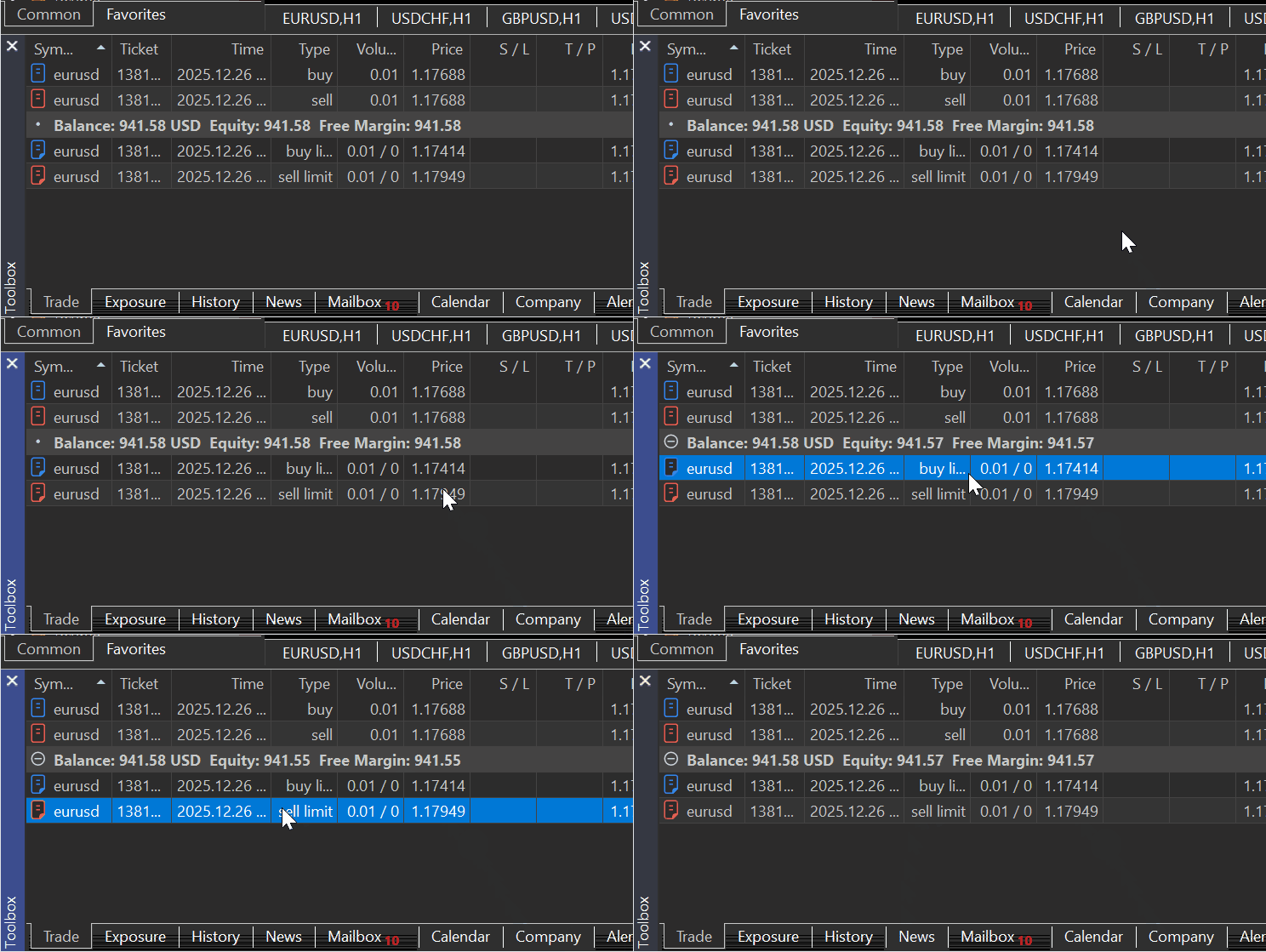
С двумя отложенными ордерами в моём терминале MetaTrader 5:
И две симулированные сделки:
        order1 = self.TradeOrder(
            ticket=123456,
            time_setup=int(datetime.now().timestamp()),
            time_setup_msc=int(datetime.now().timestamp() * 1000),
            time_done=0,
            time_done_msc=0,
            time_expiration=0,
            type=mt5.ORDER_TYPE_BUY_LIMIT,
            type_time=0,
            type_filling=mt5.ORDER_FILLING_RETURN,
            state=mt5.ORDER_STATE_PLACED,
            magic=0,
            position_id=0,
            position_by_id=0,
            reason=0,
            volume_initial=0.01,
            volume_current=0.01,
            price_open=1.1750,
            sl=1.1700,
            tp=1.1800,
            price_current=1.1750,
            price_stoplimit=0.0,
            symbol="GBPUSD",
            comment="",
            external_id="",
        )

        order2 = self.TradeOrder(
            ticket=123457,
            time_setup=int(datetime.now().timestamp()),
            time_setup_msc=int(datetime.now().timestamp() * 1000),
            time_done=0,
            time_done_msc=0,
            time_expiration=0,
            type=mt5.ORDER_TYPE_SELL_LIMIT,
            type_time=0,
            type_filling=mt5.ORDER_FILLING_RETURN,
            state=mt5.ORDER_STATE_PLACED,
            magic=0,
            position_id=0,
            position_by_id=0,
            reason=0,
            volume_initial=0.01,
            volume_current=0.01,
            price_open=1.1800,
            sl=1.1850,
            tp=1.1700,
            price_current=1.1800,
            price_stoplimit=0.0,
            symbol="EURUSD",
            comment="",
            external_id="",
        )

        self.__orders_container__.extend([order1, order2])
Затем мы проверяем наличие ордеров как в MetaTrader 5, так и в симуляторе.
sim = Simulator(simulator_name="MySimulator", mt5_instance=mt5, deposit=1078.30, leverage="1:500")

sim.Start(IS_TESTER=True) # start simulation in the strategy tester
print("Orders in the simulator:\n", sim.orders_get())


sim.Start(IS_TESTER=False) # start the simulator in real-time trading
print("Orders in MetaTrader 5:\n", sim.orders_get())
Вывод:
Ордера в симуляторе:
 (TradeOrder(ticket=123456, time_setup=1766749779, time_setup_msc=1766749779726, time_done=0, time_done_msc=0, time_expiration=0, type=2, type_time=0, type_filling=2, state=1, magic=0, position_id=0, position_by_id=0, reason=0, volume_initial=0.01, volume_current=0.01, price_open=1.175, sl=1.17, tp=1.18, price_current=1.175, price_stoplimit=0.0, symbol='GBPUSD', comment='', external_id=''),
 TradeOrder(ticket=123457, time_setup=1766749779, time_setup_msc=1766749779726, time_done=0, time_done_msc=0, time_expiration=0, type=3, type_time=0, type_filling=2, state=1, magic=0, position_id=0, position_by_id=0, reason=0, volume_initial=0.01, volume_current=0.01, price_open=1.18, sl=1.185, tp=1.17, price_current=1.18, price_stoplimit=0.0, symbol='EURUSD', comment='', external_id=''))
Orders in MetaTrader 5:
 (TradeOrder(ticket=1381968725, time_setup=1766748043, time_setup_msc=1766748043247, time_done=0, time_done_msc=0, time_expiration=0, type=2, type_time=0, type_filling=2, state=1, magic=0, position_id=0, position_by_id=0, reason=0, volume_initial=0.01, volume_current=0.01, price_open=1.17414, sl=0.0, tp=0.0, price_current=1.17769, price_stoplimit=0.0, symbol='EURUSD', comment='', external_id=''),
TradeOrder(ticket=1381968767, time_setup=1766748049, time_setup_msc=1766748049051, time_done=0, time_done_msc=0, time_expiration=0, type=3, type_time=0, type_filling=2, state=1, magic=0, position_id=0, position_by_id=0, reason=0, volume_initial=0.01, volume_current=0.01, price_open=1.17949, sl=0.0, tp=0.0, price_current=1.17769, price_stoplimit=0.0, symbol='EURUSD', comment='', external_id=''))
positions_total
Согласно документации, эта функция возвращает количество открытых позиций в клиенте MetaTrader 5.
positions_total()
Ниже приведён аналогичный метод в симуляторе.
    def positions_total(self) -> int:
        """Get the number of open positions in MetaTrader 5 client.

        Returns:
            int: number of positions
        """

        if self.IS_TESTER:
            return len(self.__positions_container__)
        try:
            total = self.mt5_instance.positions_total()
        except Exception as e:
            self.__GetLogger().error(f"MetaTrader5 error = {e}")
            return -1

        return total
positions_get
Этот метод выглядит и работает аналогично методу orders_get, который мы только что рассмотрели выше.
Функция получает открытые позиции с возможностью фильтрации по символу или тикету. У неё есть три варианта вызова.
Вызов без параметров возвращает открытые позиции по всем символам.
positions_get()
Вызов с указанием символа возвращает открытые позиции по указанному инструменту.
positions_get(
   symbol="SYMBOL"      // symbol name
)
Вызов с указанием группы символов, по которым должны быть получены открытые позиции.
positions_get(
   group="GROUP"        // filter for selecting positions by symbols
)
Вызов с указанием тикета позиции.
positions_get(
   ticket=TICKET        // ticket
)
Подобно методу orders_get, этот метод возвращает данные в виде структуры именованного кортежа namedtuple. В случае ошибки возвращает None. Информацию об ошибке можно получить с помощью last_error().
С учётом этого нам нужна аналогичная структура для хранения информации о позициях в нашем симуляторе — похожая на ту, которую возвращает модуль MetaTrader 5-Python.
    def positions_get(self, symbol: Optional[str] = None, group: Optional[str] = None, ticket: Optional[int] = None) -> namedtuple:

        if self.IS_TESTER:

            positions = self.__positions_container__

            # no filters → return all positions
            if symbol is None and group is None and ticket is None:
                return tuple(positions)

            # symbol filter (highest priority)
            if symbol is not None:
                return tuple(o for o in positions if o.symbol == symbol)

            # group filter
            if group is not None:
                return tuple(o for o in positions if fnmatch.fnmatch(o.symbol, group))

            # ticket filter
            if ticket is not None:
                return tuple(o for o in positions if o.ticket == ticket)

            return tuple()

        try:
            if symbol is not None:
                return self.mt5_instance.positions_get(symbol=symbol)

            if group is not None:
                return self.mt5_instance.positions_get(group=group)

            if ticket is not None:
                return self.mt5_instance.positions_get(ticket=ticket)

            return self.mt5_instance.positions_get()

        except Exception:
            return None
Пример использования:
sim = Simulator(simulator_name="MySimulator", mt5_instance=mt5, deposit=1078.30, leverage="1:500")

sim.Start(IS_TESTER=True) # start simulation in the strategy tester
print("positions total in the Simulator: ",sim.positions_total())
print("positions in the Simulator:\n",sim.positions_get())

sim.Start(IS_TESTER=False) # start the simulator in real-time trading
print("positions total in MetaTrader5: ",sim.positions_total())
print("positions in MetaTraer5:\n",sim.positions_get())
Вывод.
(venv) C:\Users\Omega Joctan\OneDrive\Documents\PyMetaTester>python test.py
positions total in the Simulator:  0
positions in the Simulator:
 ()
positions total in MetaTrader5:  2
positions in MetaTraer5:
 (TradePosition(ticket=1381981938, time=1766748992, time_msc=1766748992425, time_update=1766748992, time_update_msc=1766748992425, type=0, magic=0, identifier=1381981938, reason=0, volume=0.01, price_open=1.17688, sl=0.0, tp=0.0, price_current=1.17755, swap=0.0, profit=0.67, symbol='EURUSD', comment='', external_id=''),
TradePosition(ticket=1381981988, time=1766748994, time_msc=1766748994018, time_update=1766748994, time_update_msc=1766748994018, type=1, magic=0, identifier=1381981988, reason=0, volume=0.01, price_open=1.17688, sl=0.0, tp=0.0, price_current=1.17755, swap=0.0, profit=-0.67, symbol='EURUSD', comment='', external_id=''))
history_orders_total
Согласно документации, этот метод получает количество ордеров в торговой истории за определённый временной интервал.
history_orders_total(
   date_from,    // date the orders are requested from
   date_to       // date, up to which the orders are requested
   )
Параметры:
- date_from: дата, начиная с которой запрашиваются ордера. Задаётся объектом datetime или количеством секунд, прошедших с 1970.01.01.
- date_to: дата, до которой запрашиваются ордера. Задаётся объектом datetime или количеством секунд, прошедших с 1970.01.01.
Аналогичная функция в симуляторе может быть реализована следующим образом:
    def history_orders_total(self, date_from: datetime, date_to: datetime) -> int:

        # date range is a requirement

        if date_from is None or date_to is None:
            self.__GetLogger().error("date_from and date_to must be specified")
            return None

        date_from = utils.ensure_utc(date_from)
        date_to = utils.ensure_utc(date_to)

        if self.IS_TESTER:

            date_from_ts = int(date_from.timestamp())
            date_to_ts   = int(date_to.timestamp())

            return sum(
                        1
                        for o in self.__orders_history_container__
                        if date_from_ts <= o.time_setup <= date_to_ts
                    )

        try:
            total = self.mt5_instance.history_orders_total(date_from, date_to)
        except Exception as e:
            self.__GetLogger().error(f"MetaTrader5 error = {e}")
            return -1

        return total
Пример использования:
sim.Start(IS_TESTER=True) # start simulation in the strategy tester

date_to = datetime.now()
date_from = date_to - timedelta(days=1)

print(sim.history_orders_total(date_from=date_from,date_to=date_to))

sim.Start(IS_TESTER=False) # start the simulator in real-time trading

print(sim.history_orders_total(date_from=date_from,date_to=date_to))
Вывод.
(venv) C:\Users\Omega Joctan\OneDrive\Documents\PyMetaTester>python test.py
orders in the last 24 hours in the Simulator: 0
orders in the last 24 hours in MetaTrader5: 3
history_orders_get
Согласно документации, этот метод получает ордера из торговой истории с возможностью фильтрации по тикету или позиции.
Он возвращает все ордера, попадающие в указанный интервал.
У неё есть три варианта вызова.
history_orders_get(
   date_from,                // date the orders are requested from
   date_to,                  // date, up to which the orders are requested
   group="GROUP"        // filter for selecting orders by symbols
   )
Вызов с указанием тикета ордера. Возвращает ордер с указанным тикетом.
history_orders_get(
   ticket=TICKET        // order ticket
)
Вызов с указанием тикета позиции. Возвращает все ордера с тикетом позиции, указанным в свойстве ORDER_POSITION_ID .
history_orders_get(
   position=POSITION    // position ticket
)
Как и внутри функции history_orders_total, мы читаем всю информацию из массива с именем __orders_history_container__ с дополнительными фильтрами по тикету (ticket, тикет ордера), позиции (position, тикет сохранённой позиции) и группе (group, фильтр для выбора нужной группы символов).
    def history_orders_get(self,
                           date_from: datetime,
                           date_to: datetime,
                           group: Optional[str] = None,
                           ticket: Optional[int] = None,
                           position: Optional[int] = None
                           ) -> namedtuple:

        if self.IS_TESTER:

            orders = self.__orders_history_container__

            # ticket filter (highest priority)
            if ticket is not None:
                return tuple(o for o in orders if o.ticket == ticket)

            # position filter
            if position is not None:
                return tuple(o for o in orders if o.position_id == position)

            # date range is a requirement
            if date_from is None or date_to is None:
                self.__GetLogger().error("date_from and date_to must be specified")
                return None

            date_from_ts = int(utils.ensure_utc(date_from).timestamp())
            date_to_ts   = int(utils.ensure_utc(date_to).timestamp())

            filtered = (
                o for o in orders
                if date_from_ts <= o.time_setup <= date_to_ts
            ) # obtain orders that fall within this time range

            # optional group filter
            if group is not None:
                filtered = (
                    o for o in filtered
                    if fnmatch.fnmatch(o.symbol, group)
                )

            return tuple(filtered)

        try: # we are not on the strategy tester simulation

            if ticket is not None:
                return self.mt5_instance.history_orders_get(date_from, date_to, ticket=ticket)

            if position is not None:
                return self.mt5_instance.history_orders_get(date_from, date_to, position=position)

            if date_from is None or date_to is None:
                raise ValueError("date_from and date_to are required")

            date_from = utils.ensure_utc(date_from)
            date_to   = utils.ensure_utc(date_to)

            if group is not None:
                return self.mt5_instance.history_orders_get(
                    date_from, date_to, group=group
                )

            return self.mt5_instance.history_orders_get(date_from, date_to)

        except Exception as e:
            self.__GetLogger().error(f"MetaTrader5 error = {e}")
            return None
history_deals_total
Согласно документации, эта функция получает количество сделок в торговой истории за указанный интервал.
history_deals_total(
   date_from,    // date the deals are requested from
   date_to       // date, up to which the deals are requested
   )
Параметры:
- date_from: Дата, начиная с которой запрашиваются сделки. Задаётся объектом datetime или количеством секунд, прошедших с 1970.01.01.
- date_to: Дата, до которой запрашиваются сделки. Задаётся объектом datetime или количеством секунд, прошедших с 1970.01.01.
    def history_deals_total(self, date_from: datetime, date_to: datetime) -> int:
        """
        Get the number of deals in history within the specified date range.

        Args:
            date_from (datetime): Date the orders are requested from. Задаётся объектом datetime или количеством секунд, прошедших с 1970.01.01.

            date_to (datetime, required): Date, up to which the orders are requested. Задаётся объектом datetime или количеством секунд, прошедших с 1970.01.01.

        Returns:
            An integer value.
        """

        if date_from is None or date_to is None:
            self.__GetLogger().error("date_from and date_to must be specified")
            return -1

        date_from = utils.ensure_utc(date_from)
        date_to   = utils.ensure_utc(date_to)

        if self.IS_TESTER:

            date_from_ts = int(date_from.timestamp())
            date_to_ts   = int(date_to.timestamp())

            return sum(
                1
                for d in self.__deals_history_container__
                if date_from_ts <= d.time <= date_to_ts
            )

        try:
            return self.mt5_instance.history_deals_total(date_from, date_to)

        except Exception as e:
            self.__GetLogger().error(f"MetaTrader5 error = {e}")
            return -1
Пример использования:
sim = Simulator(simulator_name="MySimulator", mt5_instance=mt5, deposit=1078.30, leverage="1:500")

date_to = datetime.now()
date_from = date_to - timedelta(days=1)

print("Total deals in the last 24 hours in MetaTrader5:", sim.history_deals_total(date_from=date_from,date_to=date_to))

sim.Start(IS_TESTER=False) # start the simulator in real-time trading

print("Total deals in the last 24 hours in MetaTrader5:", sim.history_deals_total(date_from=date_from,date_to=date_to))
Вывод.
Total deals in the last 24 hours in MetaTrader5: 0
Total deals in the last 24 hours in MetaTrader5: 3
history_deals_get
Согласно документации, этот метод получает сделки из торговой истории за указанный временной интервал с возможностью фильтрации по тикету или позиции.
Функция имеет три варианта вызова.
history_deals_get(
   date_from,                // date the deals are requested from
   date_to,                  // date, up to which the deals are requested
   group="GROUP"             // filter for selecting deals for symbols
   )
Вызов с указанием тикета ордера. Возвращает все сделки, у которых указанный тикет ордера находится в свойстве DEAL_ORDER .
history_deals_get(
   ticket=TICKET        // order ticket
)
Вызов с указанием тикета позиции. Возвращает все сделки, у которых указанный тикет позиции находится в свойстве DEAL_POSITION_ID .
history_deals_get(
   position=POSITION    // position ticket
)
В классе Simulator мы создадим метод с таким же именем. Когда пользователь выбирает режим тестера стратегий (IS_TESTER=True), история сделок извлекается из массива внутри симулятора; в противном случае такая информация извлекается напрямую из клиента MetaTrader 5.
    def history_deals_get(self,
                          date_from: datetime,
                          date_to: datetime,
                          group: Optional[str] = None,
                          ticket: Optional[int] = None,
                          position: Optional[int] = None
                        ) -> namedtuple:

        if self.IS_TESTER:

            deals = self.__deals_history_container__

            # ticket filter (highest priority)
            if ticket is not None:
                return tuple(d for d in deals if d.ticket == ticket)

            # position filter
            if position is not None:
                return tuple(d for d in deals if d.position_id == position)

            # date range is a requirement
            if date_from is None or date_to is None:
                self.__GetLogger().error("date_from and date_to must be specified")
                return None

            date_from_ts = int(utils.ensure_utc(date_from).timestamp())
            date_to_ts   = int(utils.ensure_utc(date_to).timestamp())

            filtered = (
                d for d in deals
                if date_from_ts <= d.time <= date_to_ts
            ) # obtain orders that fall within this time range

            # optional group filter
            if group is not None:
                filtered = (
                    d for d in filtered
                    if fnmatch.fnmatch(d.symbol, group)
                )

            return tuple(filtered)

        try: # we are not on the strategy tester simulation

            if ticket is not None:
                return self.mt5_instance.history_deals_get(date_from, date_to, ticket=ticket)

            if position is not None:
                return self.mt5_instance.history_deals_get(date_from, date_to, position=position)

            if date_from is None or date_to is None:
                raise ValueError("date_from and date_to are required")

            date_from = utils.ensure_utc(date_from)
            date_to   = utils.ensure_utc(date_to)

            if group is not None:
                return self.mt5_instance.history_deals_get(
                    date_from, date_to, group=group
                )

            return self.mt5_instance.history_deals_get(date_from, date_to)

        except Exception as e:
            self.__GetLogger().error(f"MetaTrader5 error = {e}")
            return None
Пример использования:
sim = Simulator(simulator_name="MySimulator", mt5_instance=mt5, deposit=1078.30, leverage="1:500")

sim.Start(IS_TESTER=True) # start simulation in the strategy tester

date_to = datetime.now()
date_from = date_to - timedelta(days=1)

print("deals in the last 24 hours in the Simulator:\n", sim.history_deals_get(date_from=date_from,date_to=date_to))

sim.Start(IS_TESTER=False) # start the simulator in real-time trading

print("Deals in the last 24 hours in MetaTrader5:\n", sim.history_deals_get(date_from=date_from,date_to=date_to))
Вывод.
(venv) C:\Users\Omega Joctan\OneDrive\Documents\PyMetaTester>python test.py
deals in the last 24 hours in the Simulator:
 ()
Deals in the last 24 hours in MetaTrader5:
 (TradeDeal(ticket=1134768493, order=1381981938, time=1766748992, time_msc=1766748992425, type=0, entry=0, magic=0, position_id=1381981938, reason=0, volume=0.01, price=1.17688, commission=-0.04, swap=0.0, profit=0.0, fee=0.0, symbol='EURUSD', comment='', external_id=''),
TradeDeal(ticket=1134768532, order=1381981988, time=1766748994, time_msc=1766748994018, type=1, entry=0, magic=0, position_id=1381981988, reason=0, volume=0.01, price=1.17688, commission=-0.04, swap=0.0, profit=0.0, fee=0.0, symbol='EURUSD', comment='', external_id=''),
TradeDeal(ticket=1135016562, order=1381968767, time=1766763381, time_msc=1766763381530, type=1, entry=0, magic=0, position_id=1381968767, reason=0, volume=0.01, price=1.17953, commission=-0.04, swap=0.0, profit=0.0, fee=0.0, symbol='EURUSD', comment='', external_id=''))
account_info
Необходимо иметь способ получать информацию о счёте как из терминала MetaTrader 5, так и из симулятора. Чтобы реализовать это в нашем классе, нам нужен похожий на способ хранения и доступа к параметрам счёта.
Если вы запросите информацию о счёте из MetaTrader 5 с помощью метода account_info(), вы увидите кортеж, который выглядит так:
AccountInfo(login=52557820, trade_mode=0, leverage=500, limit_orders=200, margin_so_mode=0, trade_allowed=True, trade_expert=True, margin_mode=2, currency_digits=2, fifo_close=False, balance=941.54, credit=0.0, profit=2.37, equity=943.91, margin=2.36, margin_free=941.55, margin_level=39996.18644067797, margin_so_call=100.0, margin_so_so=0.0, margin_initial=0.0, margin_maintenance=0.0, assets=0.0, liabilities=0.0, commission_blocked=0.0, name='OMEGA MSIGWA', server='ICMarketsSC-Demo', currency='USD', company='Raw Trading Ltd')
В документации сказано, что функция возвращает информацию в виде структуры именованного кортежа (namedtuple). В случае ошибки возвращает None. Информацию об ошибке можно получить с помощью last_error().
Мы определяем аналогичную структуру внутри класса Simulator.
        self.AccountInfo = namedtuple(
            "AccountInfo",
            [
                "login",
                "trade_mode",
                "leverage",
                "limit_orders",
                "margin_so_mode",
                "trade_allowed",
                "trade_expert",
                "margin_mode",
                "currency_digits",
                "fifo_close",
                "balance",
                "credit",
                "profit",
                "equity",
                "margin",
                "margin_free",
                "margin_level",
                "margin_so_call",
                "margin_so_so",
                "margin_initial",
                "margin_maintenance",
                "assets",
                "liabilities",
                "commission_blocked",
                "name",
                "server",
                "currency",
                "company",
            ]
        )
Поскольку мы стремимся имитировать MetaTrader 5 с помощью этого класса симулятора, нам нужно перенять часть параметров счёта MetaTrader 5 в симулируемый счёт.
        mt5_acc_info = mt5_instance.account_info()

        if mt5_acc_info is None:
            raise RuntimeError("Failed to obtain MT5 account info")

        self.__account_state_update(
            account_info=self.AccountInfo(
                # ---- identity / broker-controlled ----
                login=11223344,
                trade_mode=mt5_acc_info.trade_mode,
                leverage=int(leverage.split(":")[1]),
                limit_orders=mt5_acc_info.limit_orders,
                margin_so_mode=mt5_acc_info.margin_so_mode,
                trade_allowed=mt5_acc_info.trade_allowed,
                trade_expert=mt5_acc_info.trade_expert,
                margin_mode=mt5_acc_info.margin_mode,
                currency_digits=mt5_acc_info.currency_digits,
                fifo_close=mt5_acc_info.fifo_close,

                # ---- simulator-controlled financials ----
                balance=deposit,                # simulator starting balance
                credit=mt5_acc_info.credit,
                profit=0.0,
                equity=deposit,
                margin=0.0,
                margin_free=deposit,
                margin_level=0.0,

                # ---- risk thresholds (copied from broker) ----
                margin_so_call=mt5_acc_info.margin_so_call,
                margin_so_so=mt5_acc_info.margin_so_so,
                margin_initial=mt5_acc_info.margin_initial,
                margin_maintenance=mt5_acc_info.margin_maintenance,

                # ---- rarely used but keep parity ----
                assets=mt5_acc_info.assets,
                liabilities=mt5_acc_info.liabilities,
                commission_blocked=mt5_acc_info.commission_blocked,

                # ---- descriptive ----
                name="John Doe",
                server="MetaTrader5-Simulator",
                currency=mt5_acc_info.currency,
                company=mt5_acc_info.company,
            )
        )
Мы заполняем все данные, кроме финансовых показателей, которые можем рассчитать сами: баланс счёта, equity, margin, free margin и margin level.
Внутри функции account_info мы проверяем, выбрал ли пользователь режим тестера стратегий (IS_TESTER=True): в таком случае возвращаем информацию о счёте симулятора; в противном случае возвращаем информацию о счёте из MetaTrader 5.
    def account_info(self) -> namedtuple:

        """Gets info on the current trading account."""

        if self.IS_TESTER:
            return self.AccountInfo

        mt5_ac_info = self.mt5_instance.account_info()
        if  mt5_ac_info is None:
            self.__GetLogger().warning(f"Failed to obtain MT5 account info, MT5 Error = {self.mt5_instance.last_error()}")
            return

        return mt5_ac_info
Пример использования:
sim = Simulator(simulator_name="MySimulator", mt5_instance=mt5, deposit=1078.30, leverage="1:200")

sim.Start(IS_TESTER=True) # start simulation in the strategy tester
print("simulator's account info: ", sim.account_info())

sim.Start(IS_TESTER=False) # start the simulator in real-time trading
print("MetaTrader5's account info: ", sim.account_info())
Вывод.
(venv) C:\Users\Omega Joctan\OneDrive\Documents\PyMetaTester>python test.py
simulator's account info:  AccountInfo(login=11223344, trade_mode=0, leverage=200, limit_orders=200, margin_so_mode=0, trade_allowed=True, trade_expert=True, margin_mode=2, currency_digits=2, fifo_close=False, balance=1078.3, credit=0.0, profit=0.0, equity=1078.3, margin=0.0, margin_free=1078.3, margin_level=0.0, margin_so_call=100.0, margin_so_so=0.0, margin_initial=0.0, margin_maintenance=0.0, assets=0.0, liabilities=0.0, commission_blocked=0.0, name='John Doe', server='MetaTrader5-Simulator', currency='USD', company='Raw Trading Ltd')
MetaTrader5's account info:  AccountInfo(login=52557820, trade_mode=0, leverage=500, limit_orders=200, margin_so_mode=0, trade_allowed=True, trade_expert=True, margin_mode=2, currency_digits=2, fifo_close=False, balance=941.54, credit=0.0, profit=2.37, equity=943.91, margin=2.36, margin_free=941.55, margin_level=39996.18644067797, margin_so_call=100.0, margin_so_so=0.0, margin_initial=0.0, margin_maintenance=0.0, assets=0.0, liabilities=0.0, commission_blocked=0.0, name='OMEGA MSIGWA', server='ICMarketsSC-Demo', currency='USD', company='Raw Trading Ltd')
order_calc_profit
Это одна из полезных функций в нашем симуляторе, поскольку она помогает оценить, сколько средств подвергается риску или какую прибыль планируется получить по конкретной позиции или ордеру.
Согласно документации:
Эта функция возвращает прибыль в валюте счёта для указанной торговой операции.
order_calc_profit(
   action,          // order type (ORDER_TYPE_BUY or ORDER_TYPE_SELL)
   symbol,          // symbol name
   volume,          // volume
   price_open,      // open price
   price_close      // close price
   );
Чтобы создать аналогичную функцию в MQL5, нужно понять внутреннюю работу этой функции MetaTrader 5.
Подробное описание можно найти здесь: https://www.mql5.com/ru/book/automation/experts/experts_ordercalcprofit
Ниже приведена таблица с формулами для оценки прибыли ордера в MetaTrader 5.
| Идентификатор | Формула |
|---|---|
| SYMBOL_CALC_MODE_FOREX | (ClosePrice - OpenPrice) * ContractSize * Lots |
| SYMBOL_CALC_MODE_FOREX_NO_LEVERAGE | (ClosePrice - OpenPrice) * ContractSize * Lots |
| SYMBOL_CALC_MODE_CFD | (ClosePrice - OpenPrice) * ContractSize * Lots |
| SYMBOL_CALC_MODE_CFDINDEX | (ClosePrice - OpenPrice) * ContractSize * Lots |
| SYMBOL_CALC_MODE_CFDLEVERAGE | (ClosePrice - OpenPrice) * ContractSize * Lots |
| SYMBOL_CALC_MODE_EXCH_STOCKS | (ClosePrice - OpenPrice) * ContractSize * Lots |
| SYMBOL_CALC_MODE_EXCH_STOCKS_MOEX | (ClosePrice - OpenPrice) * ContractSize * Lots |
| SYMBOL_CALC_MODE_FUTURES | (ClosePrice - OpenPrice) * Lots * TickPrice / TickSize |
| SYMBOL_CALC_MODE_EXCH_FUTURES | (ClosePrice - OpenPrice) * Lots * TickPrice / TickSize |
| SYMBOL_CALC_MODE_EXCH_FUTURES_FORTS | (ClosePrice - OpenPrice) * Lots * TickPrice / TickSize |
| SYMBOL_CALC_MODE_EXCH_BONDS | Lots * ContractSize * (ClosePrice * FaceValue + AccruedInterest) |
| SYMBOL_CALC_MODE_EXCH_BONDS_MOEX | Lots * ContractSize * (ClosePrice * FaceValue + AccruedInterest) |
| SYMBOL_CALC_MODE_SERV_COLLATERAL | Lots * ContractSize * MarketPrice * LiqudityRate |
Мы вводим те же формулы в одноимённую функцию внутри нашего симулятора.
    def order_calc_profit(self,
                        action: int,
                        symbol: str,
                        volume: float,
                        price_open: float,
                        price_close: float) -> float:
        """
        Return profit in the account currency for a specified trading operation.

        Args:
            action (int): The type of position taken, either 0 (buy) or 1 (sell).
            symbol (str): Financial instrument name.
            volume (float):   Trading operation volume.
            price_open (float): Open Price.
            price_close (float): Close Price.
        """


        sym = self.symbol_info(symbol)

        if self.IS_TESTER:

            contract_size = sym.trade_contract_size

            # --- Determine direction ---
            if action == mt5.ORDER_TYPE_BUY:
                direction = 1
            elif action == mt5.ORDER_TYPE_SELL:
                direction = -1
            else:
                self.__GetLogger().critical("order_calc_profit failed: invalid order type")
                return 0.0

            # --- Core profit calculation ---

            calc_mode = sym.trade_calc_mode
            price_delta = (price_close - price_open) * direction

            try:
                # ------------------ FOREX / CFD / STOCKS -----------------------
                if calc_mode in (
                    mt5.SYMBOL_CALC_MODE_FOREX,
                    mt5.SYMBOL_CALC_MODE_FOREX_NO_LEVERAGE,
                    mt5.SYMBOL_CALC_MODE_CFD,
                    mt5.SYMBOL_CALC_MODE_CFDINDEX,
                    mt5.SYMBOL_CALC_MODE_CFDLEVERAGE,
                    mt5.SYMBOL_CALC_MODE_EXCH_STOCKS,
                    mt5.SYMBOL_CALC_MODE_EXCH_STOCKS_MOEX,
                ):
                    profit = price_delta * contract_size * volume

                # ---------------- FUTURES --------------------
                elif calc_mode in (
                    mt5.SYMBOL_CALC_MODE_FUTURES,
                    mt5.SYMBOL_CALC_MODE_EXCH_FUTURES,
                    # mt5.SYMBOL_CALC_MODE_EXCH_FUTURES_FORTS,
                ):
                    tick_value = sym.trade_tick_value
                    tick_size = sym.trade_tick_size

                    if tick_size <= 0:
                        self.__GetLogger().critical("Invalid tick size")
                        return 0.0

                    profit = price_delta * volume * (tick_value / tick_size)

                # ---------- BONDS -------------------

                elif calc_mode in (
                    mt5.SYMBOL_CALC_MODE_EXCH_BONDS,
                    mt5.SYMBOL_CALC_MODE_EXCH_BONDS_MOEX,
                ):
                    face_value = sym.trade_face_value
                    accrued_interest = sym.trade_accrued_interest

                    profit = (
                        volume
                        * contract_size
                        * (price_close * face_value + accrued_interest)
                        - volume
                        * contract_size
                        * (price_open * face_value)
                    )

                # ------ COLLATERAL -------
                elif calc_mode == mt5.SYMBOL_CALC_MODE_SERV_COLLATERAL:
                    liquidity_rate = sym.trade_liquidity_rate
                    market_price = (
                        self.tick.ask if action == mt5.ORDER_TYPE_BUY else self.tick.bid
                    )

                    profit = (
                        volume
                        * contract_size
                        * market_price
                        * liquidity_rate
                    )

                else:
                    self.__GetLogger().critical(
                        f"Unsupported trade calc mode: {calc_mode}"
                    )
                    return 0.0

                return round(profit, 2)

            except Exception as e:
                self.__GetLogger().critical(f"Failed: {e}")
                return 0.0

        # if we are not on the strategy tester

        try:
            profit = self.mt5_instance.order_calc_profit(
                action,
                symbol,
                volume,
                price_open,
                price_close
            )

        except Exception as e:
            self.__GetLogger().critical(f"Failed to calculate profit of a position, MT5 error = {self.mt5_instance.last_error()}")
            return np.nan

        return profit
Пример использования:
sim = Simulator(simulator_name="MySimulator", mt5_instance=mt5, deposit=1078.30, leverage="1:500")

sim.Start(IS_TESTER=True) # start simulation in the strategy tester

profit = sim.order_calc_profit(action=mt5.POSITION_TYPE_SELL, symbol=symbol, volume=0.01, price_open=entry, price_close=tp)
print("Simulator profit caclulate: ", profit)

sim.Start(IS_TESTER=False) # start the simulator in real-time trading

profit = sim.order_calc_profit(action=mt5.POSITION_TYPE_SELL, symbol=symbol, volume=0.01, price_open=entry, price_close=tp)
print("MT5 profit caclulate: ", round(profit, 2))
Вывод.
Simulator profit caclulate:  1.68
MT5 profit caclulate:  1.68
order_calc_margin
Это ещё одна полезная функция в API MetaTrader 5, несмотря на то, что её работа менее известна.
Согласно документации, эта функция рассчитывает маржу в валюте счёта, необходимую для выполнения указанной торговой операции.
Следующая таблица представляет формулы, используемые для реализации функции order_calc_margin.
| Идентификатор | Формула |
|---|---|
| SYMBOL_CALC_MODE_FOREX Forex | Lots * ContractSize * MarginRate / Leverage |
| SYMBOL_CALC_MODE_FOREX_NO_LEVERAGE Forex without leverage | Lots * ContractSize * MarginRate |
| SYMBOL_CALC_MODE_CFD CFD | Lots * ContractSize * MarketPrice * MarginRate |
| SYMBOL_CALC_MODE_CFDLEVERAGE CFD with leverage | Lots * ContractSize * MarketPrice * MarginRate / Leverage |
| SYMBOL_CALC_MODE_CFDINDEX CFDs on indices | Lots * ContractSize * MarketPrice * TickPrice / TickSize * MarginRate |
| SYMBOL_CALC_MODE_EXCH_STOCKS Securities on the stock exchange | Lots * ContractSize * LastPrice * MarginRate |
| SYMBOL_CALC_MODE_EXCH_STOCKS_MOEX Securities on MOEX | Lots * ContractSize * LastPrice * MarginRate |
| SYMBOL_CALC_MODE_FUTURES Futures | Lots * InitialMargin * MarginRate |
| SYMBOL_CALC_MODE_EXCH_FUTURES Futures on the stock exchange | Lots * InitialMargin * MarginRate or |
| SYMBOL_CALC_MODE_EXCH_FUTURES_FORTS Futures on FORTS | Lots * InitialMargin * MarginRate or |
| SYMBOL_CALC_MODE_EXCH_BONDS Bonds on the stock exchange | Lots * ContractSize * FaceValue * OpenPrice / 100 |
| SYMBOL_CALC_MODE_EXCH_BONDS_MOEX Bonds on MOEX | Lots * ContractSize * FaceValue * OpenPrice / 100 |
| SYMBOL_CALC_MODE_SERV_COLLATERAL | Non-tradable asset (margin not applicable) |
Мы используем те же формулы для оценки маржи ордера в нашем классе Simulator.
    def order_calc_margin(self, action: int, symbol: str, volume: float, price: float) -> float:
        """
        Return margin in the account currency to perform a specified trading operation.

        """

        if volume <= 0 or price <= 0:
            self.__GetLogger().error("order_calc_margin failed: invalid volume or price")
            return 0.0

        if not self.IS_TESTER:
            try:
                return round(self.mt5_instance.order_calc_margin(action, symbol, volume, price), 2)
            except Exception:
                self.__GetLogger().warning(f"Failed: MT5 Error = {self.mt5_instance.last_error()}")
                return 0.0

        # IS_TESTER = True
        sym = self.symbol_info(symbol)

        contract_size = sym.trade_contract_size
        leverage = max(self.AccountInfo.leverage, 1)

        margin_rate = (
            sym.margin_initial
            if sym.margin_initial > 0
            else sym.margin_maintenance
        )

        if margin_rate <= 0: # if margin rate is zero set it to 1
            margin_rate = 1.0

        mode = sym.trade_calc_mode

        if mode == self.mt5_instance.SYMBOL_CALC_MODE_FOREX:
            margin = (volume * contract_size * price) / leverage

        elif mode == self.mt5_instance.SYMBOL_CALC_MODE_FOREX_NO_LEVERAGE:
            margin = volume * contract_size * price

        elif mode in (
            self.mt5_instance.SYMBOL_CALC_MODE_CFD,
            self.mt5_instance.SYMBOL_CALC_MODE_CFDINDEX,
            self.mt5_instance.SYMBOL_CALC_MODE_EXCH_STOCKS,
            self.mt5_instance.SYMBOL_CALC_MODE_EXCH_STOCKS_MOEX,
        ):
            margin = volume * contract_size * price * margin_rate

        elif mode == self.mt5_instance.SYMBOL_CALC_MODE_CFDLEVERAGE:
            margin = (volume * contract_size * price * margin_rate) / leverage

        elif mode in (
            self.mt5_instance.SYMBOL_CALC_MODE_FUTURES,
            self.mt5_instance.SYMBOL_CALC_MODE_EXCH_FUTURES,
            # self.mt5_instance.SYMBOL_CALC_MODE_EXCH_FUTURES_FORTS,
        ):
            margin = volume * sym.margin_initial

        elif mode in (
            self.mt5_instance.SYMBOL_CALC_MODE_EXCH_BONDS,
            self.mt5_instance.SYMBOL_CALC_MODE_EXCH_BONDS_MOEX,
        ):
            margin = (
                volume
                * contract_size
                * sym.trade_face_value
                * price
                / 100
            )

        elif mode == self.mt5_instance.SYMBOL_CALC_MODE_SERV_COLLATERAL:
            margin = 0.0

        else:
            self.__GetLogger().warning(f"Unknown calc mode {mode}, fallback margin formula used")
            margin = (volume * contract_size * price) / leverage

        return round(margin, 2)
Часть с margin_rate является самой сложной, поскольку нам нужно убедиться, что значения существуют, прежде чем выбирать подходящее значение ставки.
Заключительные мысли
В этой статье мы представили способ передачи тиковых данных в наш симулятор и реализовали почти все необходимые функции, предоставляемые Python API для MetaTrader 5. Это приближает нас к изолированной среде для симуляции работы MetaTrader 5 и, тем самым, к созданию пользовательского тестера стратегий для наших торговых ботов на Python.
В следующей статье мы реализуем торговые функции и смоделируем торговую активность на некоторых тиках из прошлого. Впереди ещё больше интересного, так что следите за продолжением!
До связи.
Поделитесь своими мыслями и помогите улучшить этот проект на GitHub: https://github.com/MegaJoctan/PyMetaTester
Вкладка вложений
| Название файла | Описание и использование |
|---|---|
| bars.py | Содержит функции для сбора баров из клиента MetaTrader 5 в пользовательский файл и путь. |
| ticks.py | Содержит функции для сбора тиков из клиента MetaTrader 5 в пользовательский файл и путь. |
| config.py | Python-файл конфигурации, где определены наиболее полезные переменные для повторного использования по всему проекту. |
| utils.py | Утилитный Python-файл, содержащий простые функции для помощи в различных задачах, то есть вспомогательные функции (helpers). |
| simulator.py | Содержит класс с именем Simulator. Основная логика нашего симулятора находится в одном месте. |
| test.py | Файл, используемый для тестирования всего кода и функций, рассмотренных в этой статье. |
| error_description.py | Содержит функции для преобразования всех кодов ошибок MetaTrader 5 в понятные человеку сообщения. |
| requirements.txt | Содержит все Python-зависимости и их версии, используемые в этом проекте. |
Перевод с английского произведен MetaQuotes Ltd.
Оригинальная статья: https://www.mql5.com/en/articles/20455
Предупреждение: все права на данные материалы принадлежат MetaQuotes Ltd. Полная или частичная перепечатка запрещена.
Данная статья написана пользователем сайта и отражает его личную точку зрения. Компания MetaQuotes Ltd не несет ответственности за достоверность представленной информации, а также за возможные последствия использования описанных решений, стратегий или рекомендаций.

 Построение моделей волатильности в MQL5 (Часть I): Первичная реализация
 Разработка инструментария для анализа Price Action (Часть 43): Вероятностный анализ свечных паттернов и пробоев
 Автоматизация торговых стратегий в MQL5 (Часть 26): Создание системы усреднения на основе пин-баров для многопозиционной торговли
 Разработка инструментария для анализа Price Action (Часть 42): Интерактивное тестирование на графике с кнопочной логикой и статистическими уровнями

- Бесплатные приложения для трейдинга
- 8 000+ сигналов для копирования
- Экономические новости для анализа финансовых рынков
Вы принимаете политику сайта и условия использования