Market Shift Levels MT5 Scanner
- Indicators
-
Duc Hoan Nguyen
 I develop practical trading tools for MetaTrader 4/5, with a focus on indicator integration, Multi-Timeframe analysis, market scanning, and automated trading solutions.
My work mainly includes:
• Indicator-to-EA Solutions - Version: 1.0
- Activations: 10
New tools will be $30 for the first week or the first 3 purchases!
Trading Tools Channel on MQL5: Join my MQL5 channel to update the latest news from me
See more MT5 version at: Market Shift Levels MT5 Scanner
See more MT4 version at: Market Shift Levels MT4 Scanner
See more products at: All Products
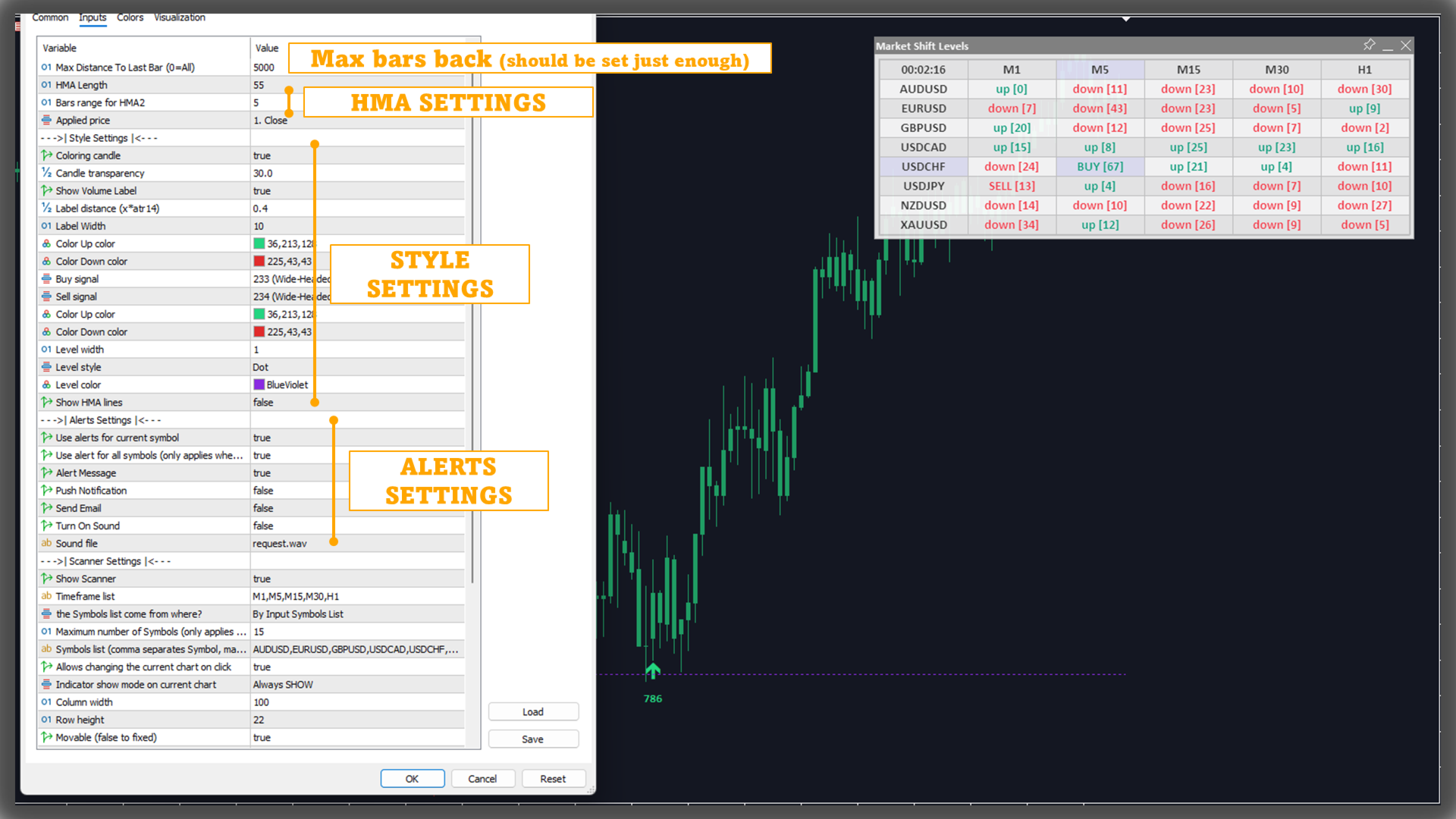
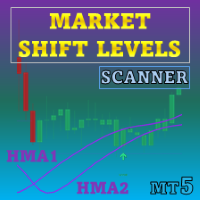
Market Shift Levels are horizontal zones that mark a directional change in market behavior. The shifts are derived from crossovers between two smoothed HMAs, which are designed to reduce lag while indicating potential reversals.
Once a shift is detected:
-
A dashed horizontal Market Shift Level is plotted at the low (for a bullish shift) or at the high (for a bearish shift) of the candle.
-
These levels may act as reaction points during pullbacks and trend retests.
-
Volume labels are added when price wicks into these levels to help gauge the strength of rejection or acceptance.
-
Uses HMA-based logic to detect when price momentum shifts.
-
Plots clean Market Shift Levels (MSLs) that can act as dynamic support and resistance.
-
Automatically colors bars and candles based on price and HMAs positioning.
-
Labels wick-based retests with Volume data of the 3-bar cluster.
-
Look for trend shifts where the HMA crossover triggers a new level; this indicates a possible structural pivot.
-
Treat the horizontal level as a potential support or resistance zone, especially when price returns with wick rejections.
-
Observe volume labels near the level; higher values may suggest stronger rejection and potential continuation.
-
Combine with confluence tools for additional context.
-
After a bullish shift, wait for price to return and wick into the level; if volume increases and the candle closes firmly, this can be used as a retest-confirmation entry.
-
After a bearish shift, bearish wick rejections accompanied by volume may indicate short re-entry zones.
Conclusion
The Market Shift Levels indicator provides a visual approach—with volume/price labels—for identifying trend reversals and critical retest zones in real time. It helps structure analysis around defined, repeatable conditions.