Articles on MetaTrader 5 integration using MQL5

Traders meet interesting challenges which often require an innovative approach. This category features articles that offer the most unexpected solutions for evaluating, analyzing and processing price data and trading results. The articles describe various integration solutions, including connection of databases and ICQ, use of OpenCL and social networks, use of Delphi and C#.
Read on to learn how to use specialized mathematical and neural packages, and much more. Become an author and share unique ideas with the MQL5.community members.
Add a new article

You are missing trading opportunities:
- Free trading apps
- Over 8,000 signals for copying
- Economic news for exploring financial markets
Registration
Log in
You agree to website policy and terms of use
If you do not have an account, please register


Overcoming Accessibility Problems in MQL5 Trading Tools (Part III): Bidirectional Speech Communication Between a Trader and an Expert Advisor
Build a local, bidirectional voice interface for MetaTrader 5 using MQL5 WebRequest and two Python services. The article implements offline speech recognition with Vosk, wake‑word detection, an HTTP command endpoint, and a text‑to‑speech server on localhost. You will wire an Expert Advisor that fetches commands, executes trades, and returns spoken confirmations for hands‑free operation.


MQL5 Wizard Techniques you should know (Part 68): Using Patterns of TRIX and the Williams Percent Range with a Cosine Kernel Network
We follow up our last article, where we introduced the indicator pair of TRIX and Williams Percent Range, by considering how this indicator pairing could be extended with Machine Learning. TRIX and William’s Percent are a trend and support/ resistance complimentary pairing. Our machine learning approach uses a convolution neural network that engages the cosine kernel in its architecture when fine-tuning the forecasts of this indicator pairing. As always, this is done in a custom signal class file that works with the MQL5 wizard to assemble an Expert Advisor.


Market Simulation (Part 17): Sockets (XI)
The implementation of the part of the code that will run in MetaTrader 5 does not present any difficulty. However, there are several points that need to be taken into account. This is necessary so that you can make the system work. Remember one important thing: not just one program will be running. In reality, we will have to run three programs simultaneously. It is important to implement and structure each of them in such a way that they can interact and communicate with one another, and that each of them understands what the others are trying or intending to do.


Central Force Optimization (CFO) algorithm
The article presents the Central Force Optimization (CFO) algorithm inspired by the laws of gravity. It explores how principles of physical attraction can solve optimization problems where "heavier" solutions attract less successful counterparts.


Applying Localized Feature Selection in Python and MQL5
This article explores a feature selection algorithm introduced in the paper 'Local Feature Selection for Data Classification' by Narges Armanfard et al. The algorithm is implemented in Python to build binary classifier models that can be integrated with MetaTrader 5 applications for inference.


Implementing Practical Modules from Other Languages in MQL5 (Part 01): Building the SQLite3 Library, Inspired by Python
The sqlite3 module in Python offers a straightforward approach for working with SQLite databases, it is fast and convenient. In this article, we are going to build a similar module on top of built-in MQL5 functions for working with databases to make it easier to work with SQLite3 databases in MQL5 as in Python.


Analyzing weather impact on currencies of agricultural countries using Python
What is the relationship between weather and Forex? Classical economic theory has long ignored the influence of such factors as weather on market behavior. But everything has changed. Let's try to find connections between the weather conditions and the position of agricultural currencies on the market.


Building a Divergence System: Creating the MPO4 Custom Indicator
We introduce MPO4, a pressure-based oscillator that emphasizes the body and direction of candles in the context of current volatility. The article details its mathematics, normalization into a bounded range, and the EMA smoothing, then builds a pivot-driven divergence module designed not to repaint. You get complete MQL5 implementation and practical guidance for interpreting signals, including a comparison with RSI as an alternative source.


Can DOOM Run in MetaTrader 5: DLLs, Rendering, and MQL5 Input?
This article demonstrates how to run DOOM inside MetaTrader 5 by integrating a native Windows DLL with an MQL5 Expert Advisor. We cover building the DLL, real-time framebuffer rendering via ResourceCreate, keyboard input with a key-up workaround using GetAsyncKeyState, and running the game loop on a background thread. The techniques are directly applicable to custom visualization, external data bridges, and robust MQL5–native code integration.


Overcoming Accessibility Challenges in MQL5 Trading Tools (Part II): Enabling EA Voice Using a Python Text-to-Speech Engine
Let's discuss how we can make our Expert Advisors speech‑capable using text‑to‑speech technology, partnering Python and MQL5. After reading this article, you will walk away with a working example of an EA that speaks dynamic market information. You will master the application of TTS, the WebRequest function, and learn how Python libraries integrate with the MQL5 language to create a truly voice‑aware trading tool.


MQL5 Wizard Techniques you should know (Part 54): Reinforcement Learning with hybrid SAC and Tensors
Soft Actor Critic is a Reinforcement Learning algorithm that we looked at in a previous article, where we also introduced python and ONNX to these series as efficient approaches to training networks. We revisit the algorithm with the aim of exploiting tensors, computational graphs that are often exploited in Python.


Role of random number generator quality in the efficiency of optimization algorithms
In this article, we will look at the Mersenne Twister random number generator and compare it with the standard one in MQL5. We will also find out the influence of the random number generator quality on the results of optimization algorithms.


MetaTrader 5 Machine Learning Blueprint (Part 17): CPCV Backtesting — From Python Model to Tick-Level Evidence
We bridge Python-native artifacts to MQL5 for tick-accurate CPCV backtesting. The export script converts the ONNX model, calibrator, feature spec, and path masks to flat files, while the expert advisor rebuilds features, performs ONNX inference with calibration, and trades on real ticks. The Strategy Tester runs each combinatorial path, and Python aggregates per-path equities into a path Sharpe distribution to assess robustness after spread, slippage, and commission.


Population optimization algorithms: Evolution of Social Groups (ESG)
We will consider the principle of constructing multi-population algorithms. As an example of this type of algorithm, we will have a look at the new custom algorithm - Evolution of Social Groups (ESG). We will analyze the basic concepts, population interaction mechanisms and advantages of this algorithm, as well as examine its performance in optimization problems.


Detecting and Classifying Fractal Patterns Using Machine Learning
In this article, we will touch upon the intriguing topic of fractal analysis and market forecasting using machine learning. These are just the first steps towards exploring the diverse fractal structures that form on financial price charts. We will use the correlation to find patterns and the CatBoost algorithm to classify these patterns.


MQL5 Trading Toolkit (Part 5): Expanding the History Management EX5 Library with Position Functions
Discover how to create exportable EX5 functions to efficiently query and save historical position data. In this step-by-step guide, we will expand the History Management EX5 library by developing modules that retrieve key properties of the most recently closed position. These include net profit, trade duration, pip-based stop loss, take profit, profit values, and various other important details.


Database Is Easy (Part 1): A Lightweight ORM Framework for MQL5 Using SQLite
This article presents a structured way to manage SQLite data in MQL5 through an ORM layer for MetaTrader 5. It introduces core classes for entity modeling and database access, a fluent CRUD API, reflection hooks for OnGet/OnSet, and macros to define models quickly. Practical code shows creating tables, binding fields, inserting, updating, querying, and deleting records. Developers gain reusable, type-safe components that minimize repetitive SQL.


Population optimization algorithms: Charged System Search (CSS) algorithm
In this article, we will consider another optimization algorithm inspired by inanimate nature - Charged System Search (CSS) algorithm. The purpose of this article is to present a new optimization algorithm based on the principles of physics and mechanics.


CRUD Operations in Firebase using MQL
This article offers a step-by-step guide to mastering CRUD (Create, Read, Update, Delete) operations in Firebase, focusing on its Realtime Database and Firestore. Discover how to use Firebase SDK methods to efficiently manage data in web and mobile apps, from adding new records to querying, modifying, and deleting entries. Explore practical code examples and best practices for structuring and handling data in real-time, empowering developers to build dynamic, scalable applications with Firebase’s flexible NoSQL architecture.

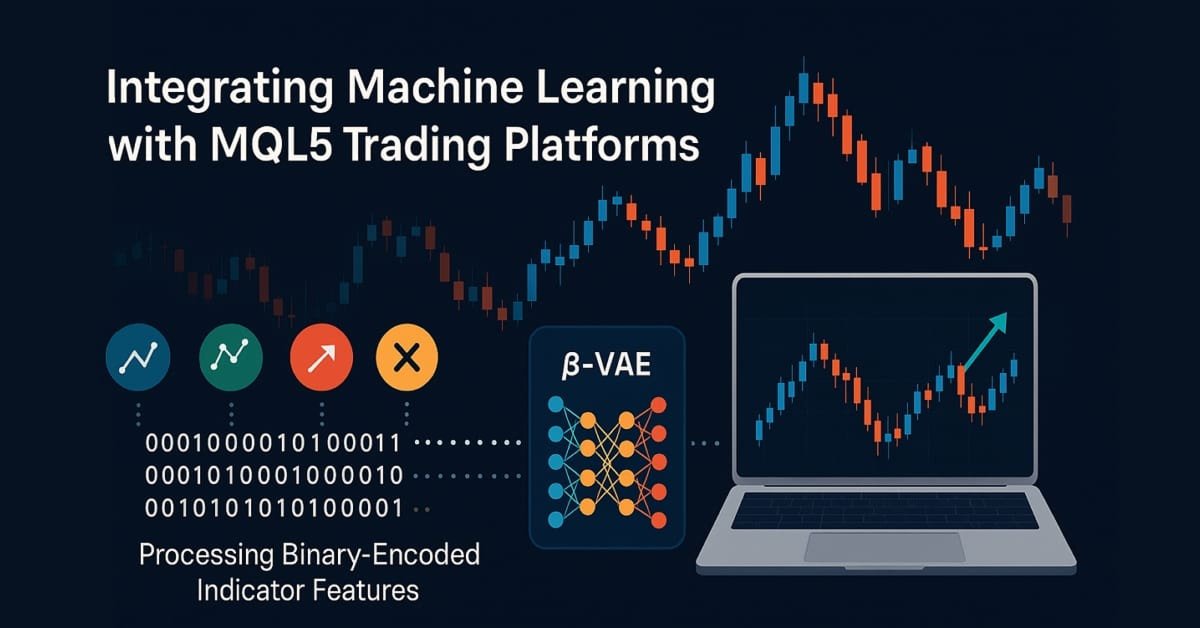
MQL5 Wizard Techniques you should know (Part 81): Using Patterns of Ichimoku and the ADX-Wilder with Beta VAE Inference Learning
This piece follows up ‘Part-80’, where we examined the pairing of Ichimoku and the ADX under a Reinforcement Learning framework. We now shift focus to Inference Learning. Ichimoku and ADX are complimentary as already covered, however we are going to revisit the conclusions of the last article related to pipeline use. For our inference learning, we are using the Beta algorithm of a Variational Auto Encoder. We also stick with the implementation of a custom signal class designed for integration with the MQL5 Wizard.


Interactive Supply and Demand Zone Manager in MQL5 (Part II): Event-Driven Architecture and Persistent Lifecycle Logging
This article advances the stateful supply and demand zone framework for MetaTrader 5 by replacing polling with an event-driven model based on OnChartEvent(). We split synchronization into dedicated handlers for creation, modification, and deletion, and separate market logic in OnTick() from user interactions in OnChartEvent(). A persistent, append-only CSV logger records all lifecycle events, improving responsiveness, state consistency, and recoverable history for downstream analysis.


Creating a Trading Administrator Panel in MQL5 (Part VII): Trusted User, Recovery and Cryptography
Security prompts, such as those triggered every time you refresh the chart, add a new pair to the chat with the Admin Panel EA, or restart the terminal, can become tedious. In this discussion, we will explore and implement a feature that tracks the number of login attempts to identify a trusted user. After a set number of failed attempts, the application will transition to an advanced login procedure, which also facilitates passcode recovery for users who may have forgotten it. Additionally, we will cover how cryptography can be effectively integrated into the Admin Panel to enhance security.


MQL5 Trading Tools (Part 33): Building a Rich Content Markup Documentation System for MQL5 Programs
We extend the Part 9 setup wizard to build a canvas-based, in-chart documentation system for MetaTrader 5. The panel is tabbed and scrollable, supports inline styling, images, and interactive controls, and renders with supersampled anti-aliasing. The result is a reusable engine that any MQL5 program can embed to deliver self-contained documentation directly on the chart.


Developing a Terminal Manager (Part 2): Running Multiple Terminal Instances
Let's move on to using multiple terminal instances on the server by setting up a simple control panel for starting and stopping them. Now it is time to expand the functionality and move on to the next stages — implementing more complex features, such as managing multiple terminal instances, state persistence, integration with the MetaTrader 5 API, and a web interface with comprehensive information about the terminals.

MQL5 Wizard Techniques you should know (Part 60): Inference Learning (Wasserstein-VAE) with Moving Average and Stochastic Oscillator Patterns
We wrap our look into the complementary pairing of the MA & Stochastic oscillator by examining what role inference-learning can play in a post supervised-learning & reinforcement-learning situation. There are clearly a multitude of ways one can choose to go about inference learning in this case, our approach, however, is to use variational auto encoders. We explore this in python before exporting our trained model by ONNX for use in a wizard assembled Expert Advisor in MetaTrader.


Implementing a Breakeven Mechanism in MQL5 (Part 2): ATR- and RRR-Based Breakeven
This article completes the implementation of ATR- and RRRR-based breakeven mechanisms in MQL5 and develops, from scratch, a class that makes it easy to switch breakeven modes without having to enter the parameters again. To evaluate the effectiveness of each breakeven type, several backtests are run, analyzing their advantages and disadvantages in the context of algorithmic trading.


The Group Method of Data Handling: Implementing the Multilayered Iterative Algorithm in MQL5
In this article we describe the implementation of the Multilayered Iterative Algorithm of the Group Method of Data Handling in MQL5.


Introduction to MQL5 (Part 36): Mastering API and WebRequest Function in MQL5 (X)
This article introduces the basic concepts behind HMAC-SHA256 and API signatures in MQL5, explaining how messages and secret keys are combined to securely authenticate requests. It lays the foundation for signing API calls without exposing sensitive data.


Engineering Trading Discipline into Code (Part 6): Building a Unified Discipline Framework in MQL5
The article introduces a unified MQL5 discipline framework that consolidates the symbol whitelist, trading‑hours and news filters, and daily trade‑limit modules under CDisciplineEngine.mqh. It explains centralized trade validation and state synchronization shared by a chart dashboard and an enforcement Expert Advisor. Readers learn how to authorize orders through a single gate, monitor permissions in real time, and automatically enforce rules across the terminal.


Developing an MQL5 RL agent with RestAPI integration (Part 4): Organizing functions in classes in MQL5
This article discusses the transition from procedural coding to object-oriented programming (OOP) in MQL5 with an emphasis on integration with the REST API. Today we will discuss how to organize HTTP request functions (GET and POST) into classes. We will take a closer look at code refactoring and show how to replace isolated functions with class methods. The article contains practical examples and tests.


Population optimization algorithms: Artificial Multi-Social Search Objects (MSO)
This is a continuation of the previous article considering the idea of social groups. The article explores the evolution of social groups using movement and memory algorithms. The results will help to understand the evolution of social systems and apply them in optimization and search for solutions.


Introduction to MQL5 (Part 35): Mastering API and WebRequest Function in MQL5 (IX)
Discover how to detect user actions in MetaTrader 5, send requests to an AI API, extract responses, and implement scrolling text in your panel.


Arithmetic Optimization Algorithm (AOA): From AOA to SOA (Simple Optimization Algorithm)
In this article, we present the Arithmetic Optimization Algorithm (AOA) based on simple arithmetic operations: addition, subtraction, multiplication and division. These basic mathematical operations serve as the foundation for finding optimal solutions to various problems.


Backtracking Search Algorithm (BSA)
What if an optimization algorithm could remember its past journeys and use that memory to find better solutions? BSA does just that – balancing exploration with revisiting the tried and true. In this article, we reveal the secrets of the algorithm. A simple idea, minimum parameters and a stable result.


Covariance Matrix Adaptation Evolution Strategy (CMA-ES)
The article explores one of the most interesting non-gradient optimization algorithms, which learns to understand the geometry of the objective function. We will focus on the classical implementation of CMA-ES with a slight modification - replacing the normal distribution with the power one. We will thoroughly examine the math behind the algorithm, as well as practical implementation, and check where CMA-ES is unbeatable and where it should be avoided.


Encoding Candlestick Patterns (Part 3): Frequency Analysis for Single Candlestick Type Structure
This article introduces a frequency-analysis framework for encoded candlestick patterns in MQL5. By transforming candlesticks into alphabetic symbols, historical price action can be analyzed as a statistical sequence rather than a visual chart. Using GBPUSD and Gold across multiple timeframes, the study examines the occurrence frequency of individual candlestick types, identifies dominant market structures, and reveals the symmetry between bullish and bearish price movements. The results establish a quantitative foundation for pattern discovery and prepare the way for analyzing multi-candlestick sequences and their predictive potential in algorithmic trading systems.


Graph Theory: Network Flow of Commodities (Ford-Fulkerson Algorithm), Used as a Liquidity-Capacity Engine
The article presents an MQL5 Expert Advisor that adapts the Ford–Fulkerson max-flow method into a liquidity-capacity filter. Market structures—Swing Highs/Lows, Fair Value Gaps, Order Blocks, and Liquidity Pools—form a directed graph with edge capacities from volume, price reaction, distance, and structure quality. Maximum flow qualifies ICT setups, filters weak paths, and drives dynamic position sizing for a consistent, two-stage decision process.


Meta-Labeling the Classics (Part 2): Filtering and Sizing ADX Trades
The DI crossover often triggers in ranges where +DI and -DI oscillate without persistence. We build a two-layer hybrid: Optuna's TPE optimizes a regime gate over ADXR threshold, DI lookback, and minimum DI separation to maximize signal precision on a held-out window, then a Random Forest uses eleven ADX-derived features to accept or scale entries via afml.bet_sizing. The result filters ranging-market bursts and calibrates position size on EURUSD H1.


Market Positioning Codex for VGT with Kendall's Tau and Distance Correlation
In this article, we look to explore how a complimentary indicator pairing can be used to analyze the recent 5-year history of Vanguard Information Technology Index Fund ETF. By considering two options of algorithms, Kendall’s Tau and Distance-Correlation, we look to select not just an ideal indicator pair for trading the VGT, but also suitable signal-pattern pairings of these two indicators.


MetaTrader 5 Machine Learning Blueprint (Part 16): Nested CV for Unbiased Evaluation
The article presents a V-in-V nested cross-validation pipeline for financial data that breaks leakage at three decision points: hyperparameter search, calibration, and final evaluation. A temporal three‑zone split isolates an inner walk‑forward search with the 1‑SE rule from an outer walk‑forward or CPCV evaluation, while OOF isotonic calibration is fitted independently. The resulting UnifiedValidationCalibrator delivers unbiased out‑of‑sample scores and well‑calibrated probabilities for deployment.