DailyEndPotential for mt4
- Indicators
- Version: 1.0
- Activations: 5

Daily End Potential (DEP) v1.26 is a technical indicator for MetaTrader 4 that analyzes the price range in a specified time window and calculates the probability of price movement up or down until the end of the trading day.
INDICATOR PURPOSE
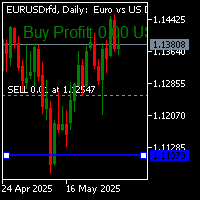
The indicator helps traders determine the most likely direction of intraday movement after the formation of a key price range. If the price is closer to the upper boundary of the range, the downward movement potential is greater, and vice versa. The indicator calculates this potential as a percentage and issues a signal when the probability exceeds a specified threshold. The signal is displayed as an arrow on the chart accompanied by a text label showing the probability percentage.
HOW IT WORKS
The trader sets a time interval in local PC time (for example, from 10:00 to 11:00) during which the price range is formed. The indicator automatically synchronizes local time with the broker's server time. After the analysis window closes, the indicator determines where the closing price is relative to the range boundaries. If the probability of movement in one direction exceeds the threshold value (default 75%), the indicator displays an arrow on the bar corresponding to the analysis window closing time and issues a notification indicating the target level. The signal remains on the chart until the beginning of the next trading day.
APPLICABLE MARKETS AND INSTRUMENTS
The indicator is suitable for the Forex currency market, stock market, commodity market, cryptocurrency market, and stock indices. Recommended currency pairs: EUR/USD, GBP/USD, USD/JPY, AUD/USD, as well as cross rates EUR/GBP, EUR/JPY, GBP/JPY. It shows good results on gold (XAU/USD), oil (BRENT, WTI), and cryptocurrencies (BTC/USD, ETH/USD). Optimal timeframes: M30 and H1 for intraday trading, M15 for aggressive trading with short targets, H4 for determining the overall daily direction. On minute timeframes (M1-M5), the indicator can work but requires a wider analysis window and a lower probability threshold due to narrow price ranges.
ADVANTAGES
Automatic synchronization of local PC time with the broker's server time allows the indicator to work correctly on any broker servers regardless of time zone. All time settings are specified in the user's local time. The indicator is universal and works on all timeframes (M1-MN) with any trading instruments. Built-in reliable protection against critical errors: division by zero, array out of bounds, buffer overflow, incorrect parameters, and missing bars. The signal arrow remains on the chart and does not disappear during updates. Flexible settings allow adjusting the analysis window, probability threshold, arrow size and color, and disabling notifications. A debug mode (DebugMode) is available for checking correct operation. The indicator displays colored arrows on the chart, text labels with probability percentages, and an informative comment in the upper left corner. When a signal appears, a pop-up Alert notification is issued indicating the symbol, probability, and target level. The indicator is easy to use and does not require deep knowledge of technical analysis.
DISADVANTAGES AND LIMITATIONS
The signal appears only after the analysis window closes, so in a fast-moving market, part of the potential may already be realized. In low-volatility periods with a narrow range, signals are less reliable, and during consolidation, frequent false signals are possible. On minute timeframes (M1-M5), the range is often too narrow to form a reliable signal (less than 10 points is filtered out). The indicator does not take into account fundamental factors such as news and economic data. An incorrectly chosen analysis window time may give incorrect signals, requiring optimization for a specific instrument. There are no built-in filters for trend, volatility, or volumes. The indicator issues only one signal per day and does not track changes in the situation after the first signal appears.
RECOMMENDATIONS FOR USE
It is recommended to optimize the analysis window for a specific instrument and trading session: for the European session from 9:00 to 10:00 or from 10:00 to 11:00 CET, for the American session from 16:00 to 17:00 CET, for the Asian session from 2:00 to 3:00 CET. For minute timeframes, it is recommended to expand the analysis window to 2-3 hours and lower the probability threshold to 60-65%. It is advisable to use additional filters: consider the overall daily trend, pay attention to support and resistance levels, and check the economic calendar before entering a trade. For risk management, it is recommended to place a stop loss behind the opposite boundary of the range, set a take profit at the target level, or partially fix profits. Do not risk more than 1-2% of capital per trade. Optimal probability thresholds: 75-80% for a conservative approach with fewer signals but higher accuracy; 65-70% for a moderate approach; 50-60% for an aggressive approach with maximum signals but requiring additional filtering. The DebugMode parameter is recommended to be enabled only for checking the correct operation of the indicator.
CONCLUSION
Daily End Potential is a useful tool for intraday traders, helping to formalize market entry based on the price range. The indicator is particularly effective on liquid instruments during periods of normal market activity but requires competent risk management and additional confirmation of signals by other methods of analysis. Version 1.26 for MT4 includes improved error protection and automatic time synchronization with the user's local PC.