Spring Break
- Experts
-
Darren Mark Scott
 Trade Dispensary is an organization dedicated to innovative financial products and cutting-edge algorithmic trading tools. Developer of Trade Dispensary trade copier and Spring Break expert advisor for Metatrader 5.
- Version: 1.0
- Activations: 5
Spring Break
An automated imbalance strategy for the Nasdaq 100 index, designed to run on the 1 minute chart.
Spring Break began as a discretionary method I traded by hand. Over three years it has been developed, refined and retested into the automated version offered here.
How it trades
The strategy works from areas of imbalance. When price leaves a level quickly it can leave an unbalanced area behind it, and those areas often matter again when price returns to them. Spring Break measures these areas across a fixed set of higher timeframes while running on the 1 minute chart, then takes two separate trade types around them, named Bar and Beach.
Each trade type has its own entry, stop loss, take profit, trailing and sizing settings. The two can be tuned independently, or either one can be switched off and the other run on its own.
Every position is sent with a stop loss and a take profit attached. The strategy does not use grid, martingale or averaging techniques, and it never adds to a losing position.
Risk and account controls
The account protection settings were written with funded account rules in mind.
-
Maximum total drawdown and maximum daily loss, each as a percentage of the starting balance.
-
An optional daily profit target that stops trading once it is reached.
-
Consecutive loss and daily trade count limits.
-
A choice of what happens when a limit is reached, from closing all positions to only stopping new entries.
-
A maximum spread filter and a cap on the number of open positions.
-
Up to three trading session windows and an optional daily flat time, all read in New York time.
-
An optional filter that pauses entries around high impact news.
Position sizing is set per trade type. Bar and Beach can each use a fixed lot, or risk a percentage of equity measured against that trade's own stop distance. A lot cap is available if you want a hard ceiling on size.
Settings
The defaults are the values this version was tested with. Most users will only need to set the broker time offset and the position size.
-
Broker to New York offset. The number of hours between your broker's clock and New York. Session times and the daily flat time are all read in New York time, so this is the one input that must match your broker.
-
Vibe. How much relative strength an area must show before it is considered. Higher values ask for stronger areas and give fewer trades.
-
Minimum Shot and Maximum Shot. The smallest and the largest imbalance sizes to accept, as a percentage of price. The two together form a band, which leaves out both very small areas and unusually large one off moves.
-
Ride. A confirmation level that price must reach before a Bar trade is armed, set as a percentage of the area's own size. The further the value sits from zero, the more confirmation is asked for and the fewer trades you will see.
-
Wave. The same idea for the Beach trade: a confirmation level that must be reached before a Beach entry becomes valid. The Ride and Wave defaults carry opposite signs, and that is deliberate, because the sign is what places the level. Adjust the size of the number if you want more or less confirmation, but do not flip the sign unless you have tested it.
-
Entry, stop loss and take profit levels. These are set as a percentage of the area's own size rather than as a fixed number of points, so each trade scales with the area it is taken from.
-
Trail start and trail distance. Also a percentage of the area. Trailing is optional for each trade type.
-
Stamina. A measure of how much net ground the market has covered compared with the distance it travelled to get there. Entries are taken only at or below the Stamina figure, which keeps the strategy out of strong one directional runs.
Other instruments
Spring Break was designed, tested and tuned on the Nasdaq 100, and that is the market the supplied defaults belong to. Nothing in the logic is specific to an index, so it can be run on other instruments, but the defaults should not be expected to carry over and would need to be retested on whatever you choose.
Set files and updates for Gold and Bitcoin may follow in the near future. Anything of that kind will arrive as a free update to this product rather than as a separate listing.
Requirements
-
A Nasdaq 100 instrument for the settings supplied. Brokers name it differently, including NAS100, US100, USTEC and NDX100. The strategy reads whichever symbol the chart is on.
-
The 1 minute chart. The higher timeframes it uses are fixed internally.
-
A hedging or a netting account. On a netting account there is a setting that prevents opposite direction trades being open at the same time.
-
A continuous connection. A virtual private server is recommended.
Please check the position size before you trade. The default is deliberately small so the strategy can be attached to an account of any size without risking an oversized first trade, and it is well below the size the published test used. Where a broker's minimum lot is larger than the value you ask for, the platform uses that minimum instead, so the size actually traded can be bigger than the number in the inputs. The contract value of one lot of a Nasdaq index also varies considerably between brokers. Work out what one lot is worth on your own account and set your size accordingly. The news filter is switched off by default.
Settings used for the published results
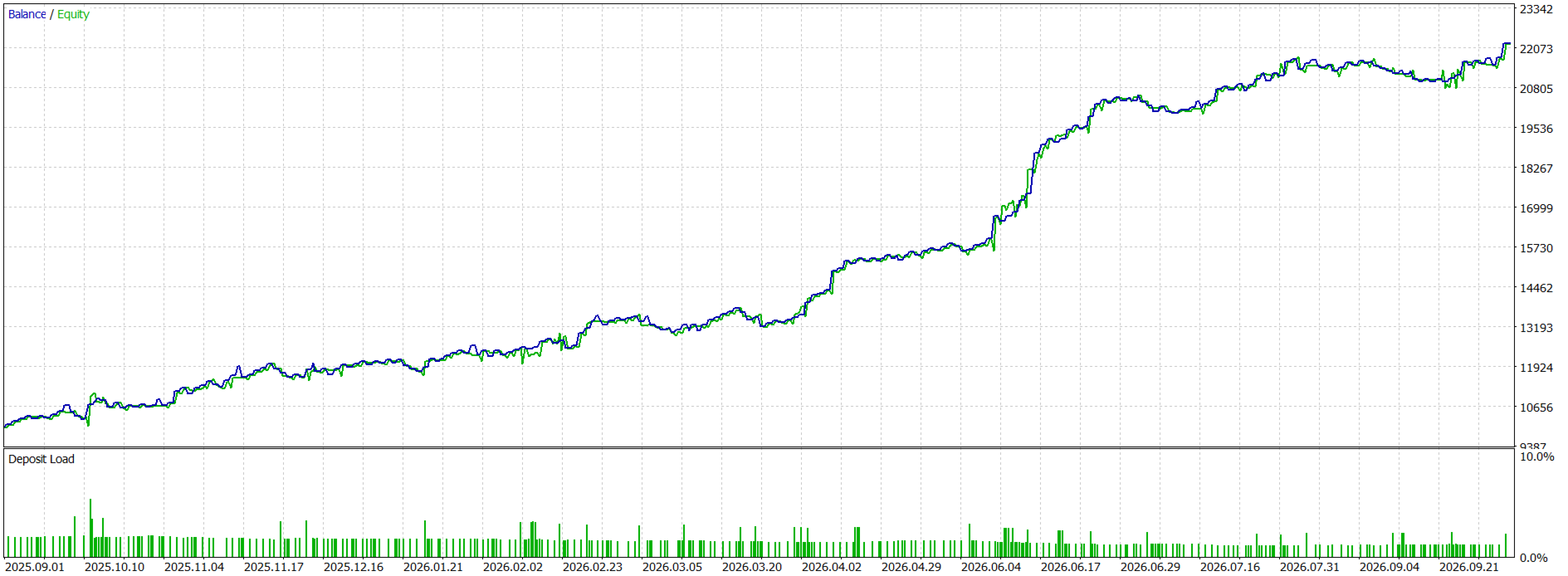
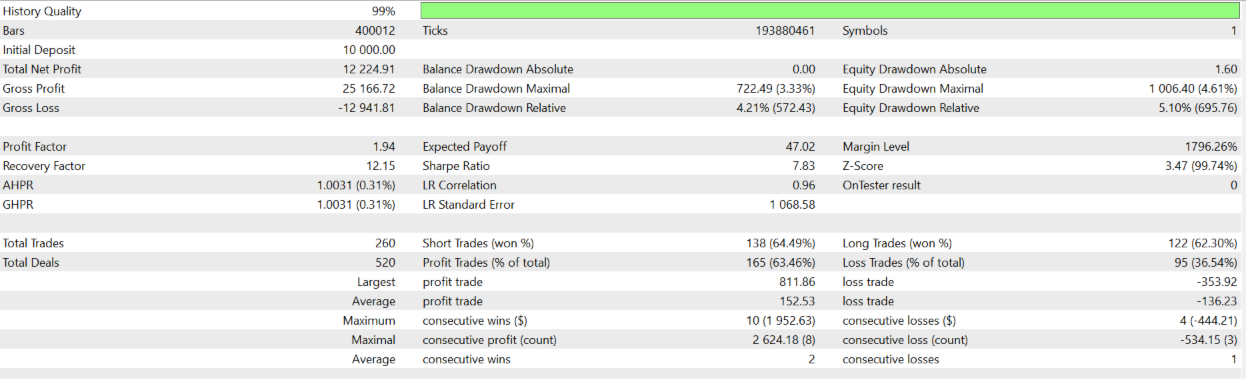
The backtest figures on this page come from the MetaTrader strategy tester on historical data, not from live trading. They were produced with the position size raised to 0.8 lots for both trade types, on a starting balance of 10 000 USD, on the Nasdaq 100 on the 1 minute chart. Everything else was left at the supplied defaults.
Those tester figures are not the only results on this page. The strategy has also been run forward in real time on a live price feed, which is the section headed Forward test on a demo account below.
To reproduce that test, two values change and nothing else:
-
Bar lot size (fixed-lot mode), set to 0.8.
-
Beach lot size (fixed-lot mode), set to 0.8.
The two switches that size a trade from a percentage of equity stay off, which is how they are supplied, because otherwise the two values above are ignored. The account protection settings were left exactly as supplied, so none of them needs to be changed or switched off to repeat the test.
Please size this to your own account rather than copying the number. 0.8 lots of a Nasdaq index is a large position on a balance of 10 000 USD, and it belongs to an account of at least that size held at a broker whose contract value is comparable. On a smaller balance, or where one lot is worth more, it should be reduced.
Settings file
A Nasdaq 100 settings file is attached to a post on my MQL5 blog: Spring Break for Nasdaq 100: settings file, and the lot size behind the published results.
The file is set to 0.1 lots rather than the 0.8 lots the figures above were produced at, so loading it will not reproduce those figures and it is not faulty. The post lists every value in the file that differs from the shipped defaults, gives the result at both sizes on the same history so the difference can be seen rather than estimated, states the exact conditions of the test, and explains the one input you must set for your own broker before you trade it.
Forward test on a demo account
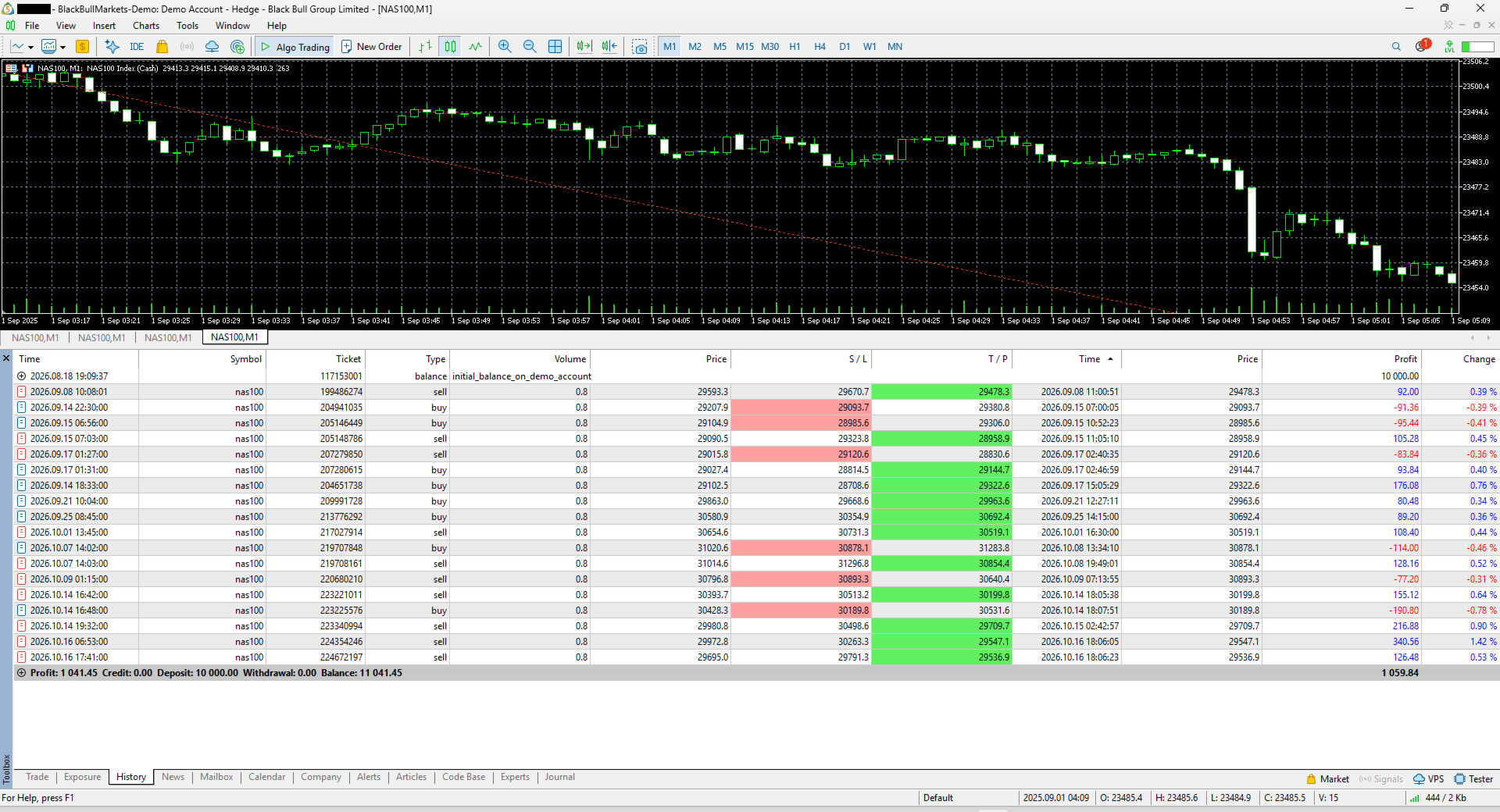
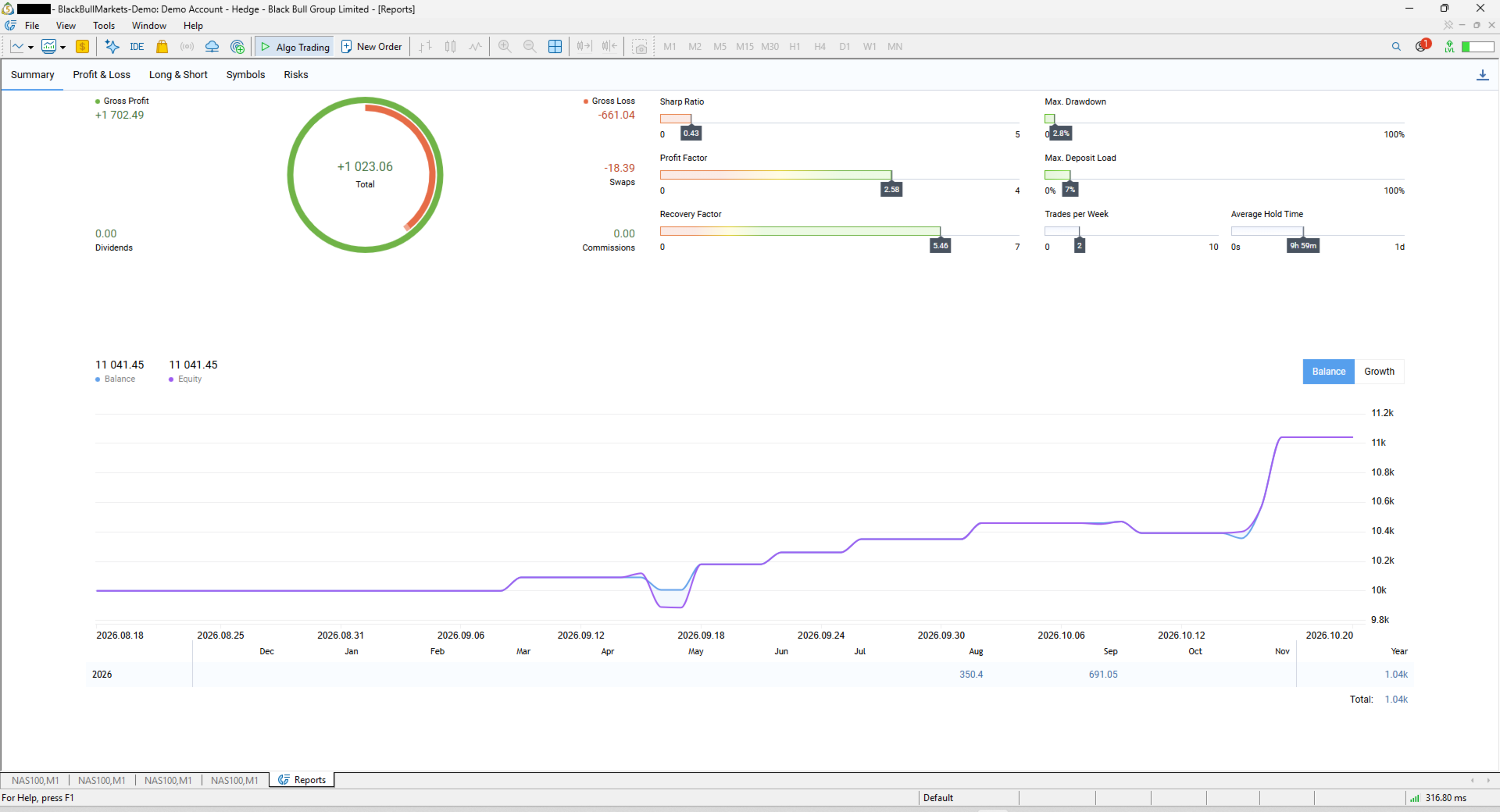
Separately from the tester figures above, the strategy was run forward in real time on a BlackBull Markets demo account, on the Nasdaq 100 1 minute chart, from 8 September to 16 October 2026. The trade history and balance curve screenshots on this page are from that account.
That test is a different class of evidence from the tester figures above, which is why both are published here. The account traded the same live Nasdaq 100 price feed, the same spread and the same clock a real account trades, in real time, through real sessions, real news releases and real weekend gaps, and every trade was taken before its outcome was known. Historical testing can be re-run and adjusted until a result looks good. A forward test cannot be, which is the whole reason for running one.
The account is still running and still trading. The figures below will be updated as it builds further history.
What the account recorded over that period:
-
18 closed trades, 12 profitable and 6 losing.
-
Starting balance 10 000 USD, closing balance 11 041.45 USD.
-
Profit factor 2.58 and a maximum drawdown of 2.8 percent, as reported by the platform.
-
Position size 0.8 lots on both trade types, the same size as the tester figures above.
Three things about that test are worth stating plainly rather than leaving you to work them out.
-
It is a demo account, not a live one. The prices and the timing are real and in real time, but fills on a demo server are not subject to the slippage, rejections and funding costs of a live account. Read it as evidence that the strategy behaves as described in live market conditions, not as a record of real money being made.
-
It is a small sample. Eighteen trades over five weeks is far too few to establish long term expectancy, and every figure derived from it, the profit factor included, carries very wide error bars.
Why no signal is attached to this product
The forward test was run on a demo account, and the MQL5 Signals service does not accept signals from demo, contest or cent accounts. That was an oversight when the test was set up, so there is no signal to subscribe to and no way to verify the figures above beyond the screenshots. If a verifiable signal becomes available in future, it will be linked from this page.
Risk warning
Trading leveraged products carries a high level of risk and can result in the loss of all of your capital. The backtest results shown on this page are a simulation on historical data. The forward test was taken in live market conditions, on real prices in real time, but on a demo account, where fills are not subject to the slippage, rejections and funding costs of a live account. Neither is a record of real money traded, and nothing shown here indicates future results. Only trade with money you can afford to lose.
Please run the strategy in the strategy tester, then on a demo account, until you are satisfied you understand how it behaves before you commit real capital.