Btcusd Consensus
- Experts
- Version: 1.65
- Updated: 3 October 2026
- Activations: 10

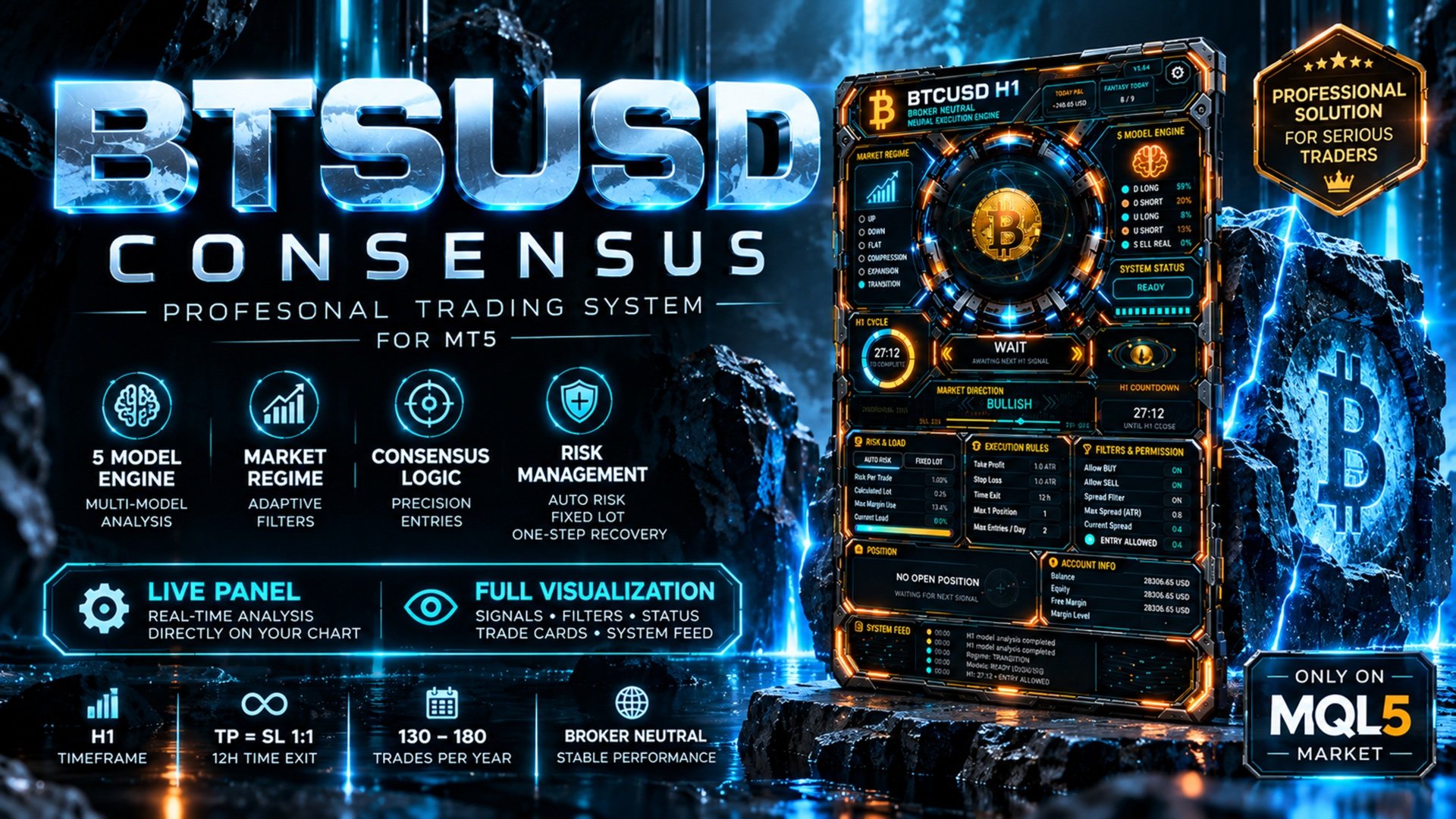
MEET BTCUSD CONSENSUS
MY NEW PROJECT FOR BITCOIN
I wanted to create something more serious for BTCUSD than just another EA built around a couple of indicators.
That is why there is not just one strategy and not just one signal here.
Inside BTCUSD Consensus there are 5 individually trained models and 1360 decision trees.
D LONG • D SHORT • U LONG • U SHORT • SELL META
Each model has its own task, its own training and its own optimization.
Before entering the market, the EA also identifies the current Bitcoin market state:
UP • DOWN • FLAT • COMPRESSION • EXPANSION • TRANSITION
After that, everything is combined into one final decision — CONSENSUS.
If there is not enough confirmation, there is simply no trade.
This is exactly how I wanted this EA to work: not to constantly force itself into the market, but to wait for a truly strong entry.
HOW I TRAINED AND TUNED BTCUSD CONSENSUS
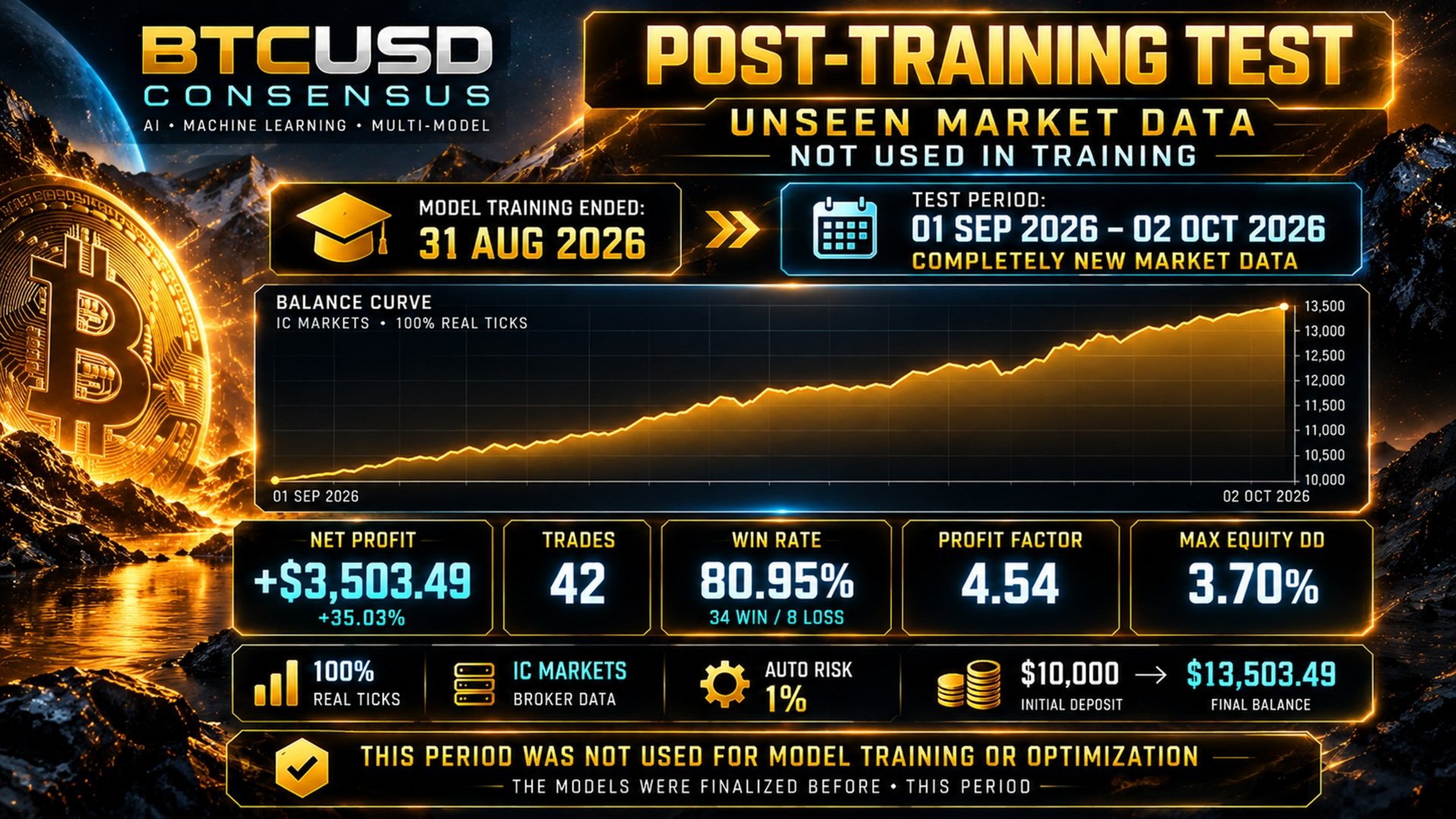
All development was based on Dukascopy BTCUSD tick history starting from 2017.
Real Bid / Ask ticks were used for tuning, model training and result verification.
Each model went through separate cycles:
≈ 6 months — training and optimization
≈ the next 6 months — Forward Test on data the model had never seen before
Then the period was shifted forward and the entire process was repeated again.
This allowed me to go through very different Bitcoin market conditions step by step — trends, flat markets, high volatility, quiet periods and sharp regime changes.
It was important to me not just to achieve a beautiful result on a historical segment.
I wanted to see what the model would do after training, when completely new data was already ahead.
LONG-TERM TEST ON THE ENTIRE AVAILABLE TICK HISTORY
Verified Dukascopy BTCUSD tick history begins in May 2017.
That is exactly where I start the long-term test.
No artificially extended history.
No M1 OHLC instead of ticks.
REAL BID / ASK TICKS.
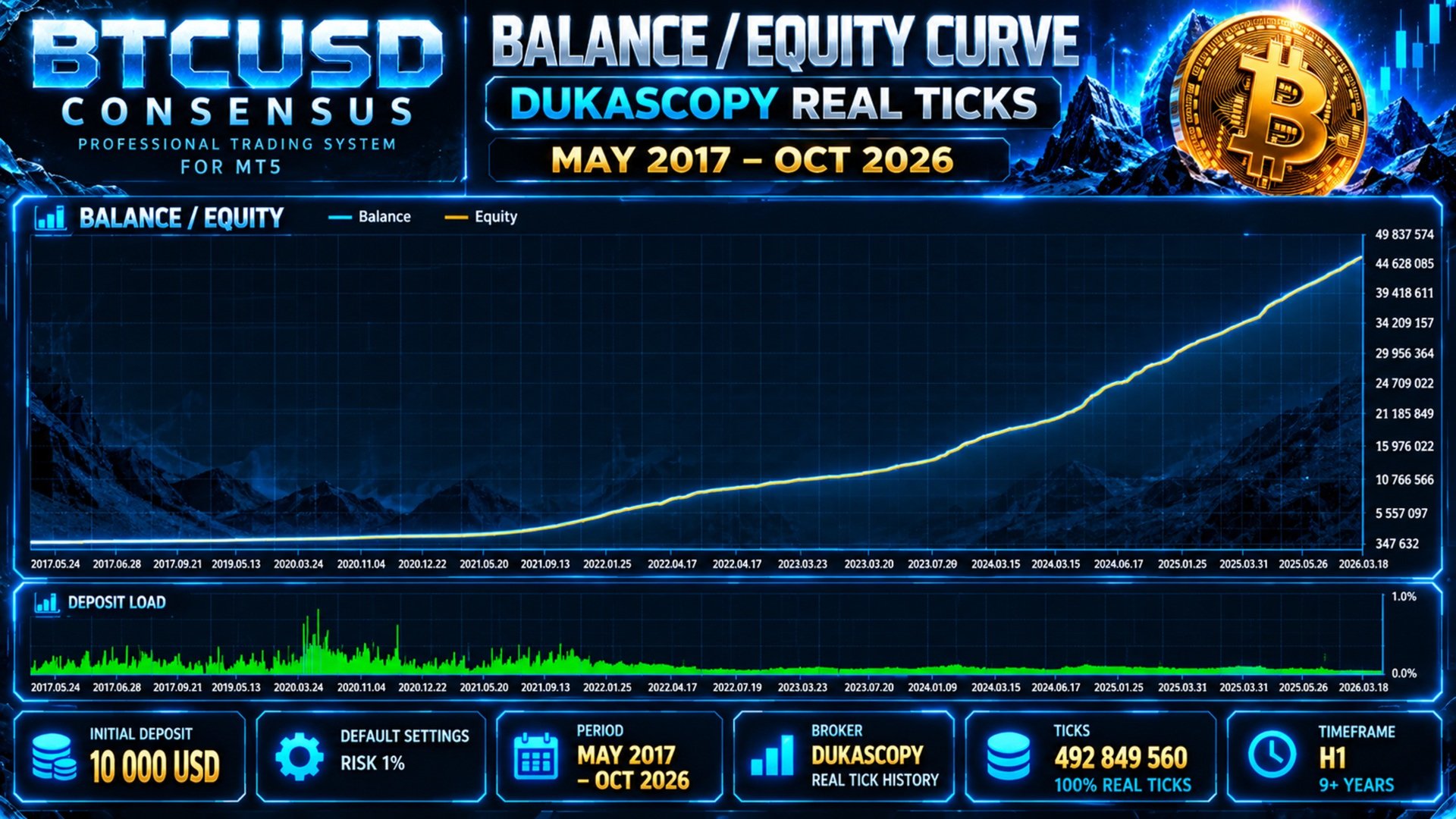
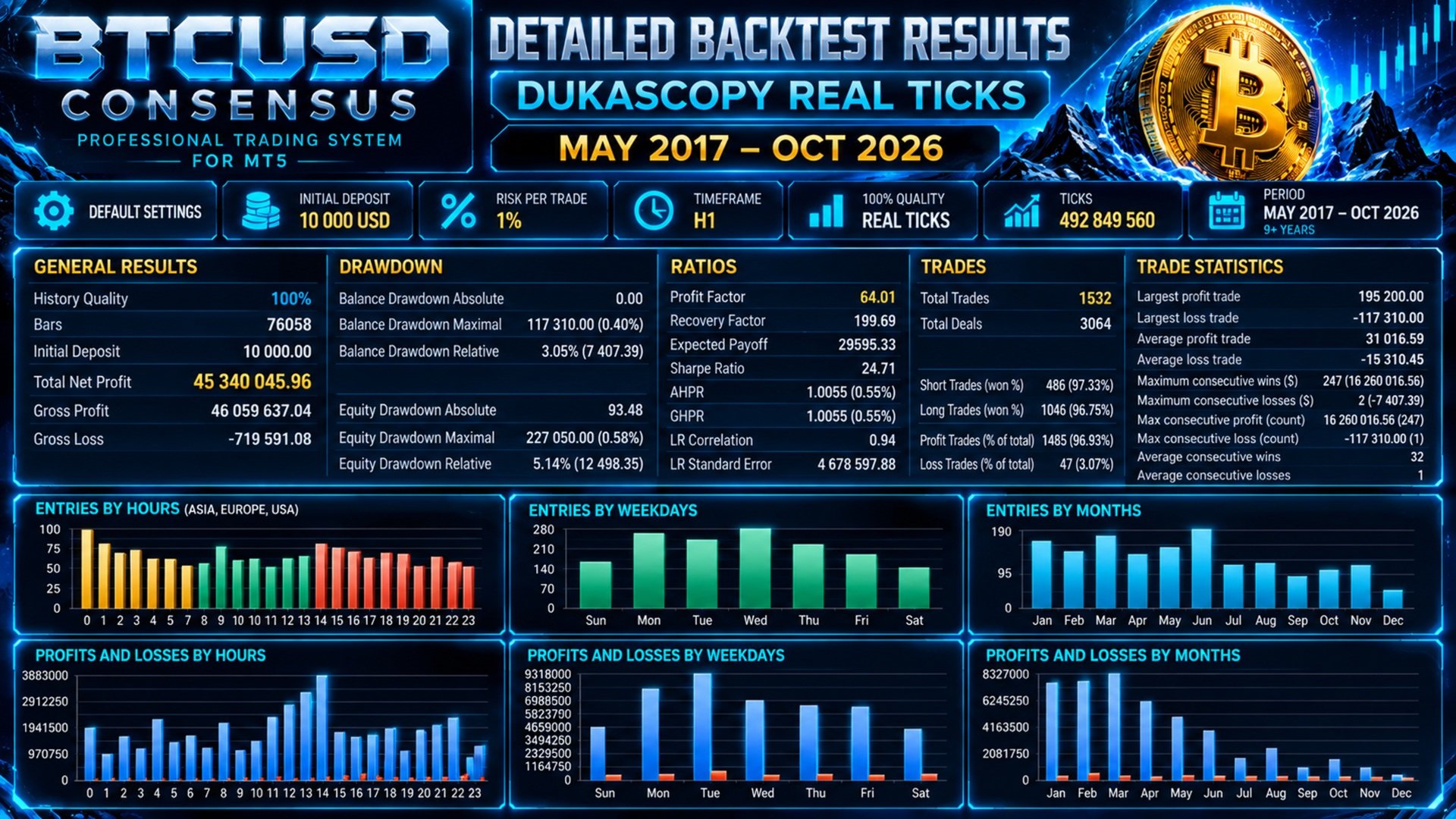
MAY 2017 — OCTOBER 2026
492,849,560 REAL TICKS
1,532 TRADES
96.93% WIN RATE
PROFIT FACTOR 64.01
EQUITY DRAWDOWN 5.14%
DEFAULT SETTINGS • AUTO RISK 1%
This is the result I reached after all the work on tuning the system.
The full original test report will be included with the product.
DUKASCOPY REAL TICK TEST RESULTS — 100% QUALITY • 2017–2026
AN IMPORTANT POINT ABOUT HISTORICAL SPREAD
On older BTCUSD history, spread was sometimes noticeably higher than it is today.
I could have enabled the modern Spread Protection across the entire history and simply removed some of the less convenient historical entries.
But I deliberately did not do that.
On the older part of the history, Spread Protection does not filter out trading signals.
At the same time, the spread itself does not disappear — the test is performed on real Bid / Ask ticks.
This means the old trading conditions remain inside the test.
In current trading, Spread Protection works normally and protects entries from excessively high spread.
I ALSO DID NOT WANT THE PANEL TO LOOK LIKE EVERY OTHER EA
It looks impressive in screenshots.
But I did not build it just for screenshots.
I wanted you to see not only an open trade, but also what is happening inside the system right now.
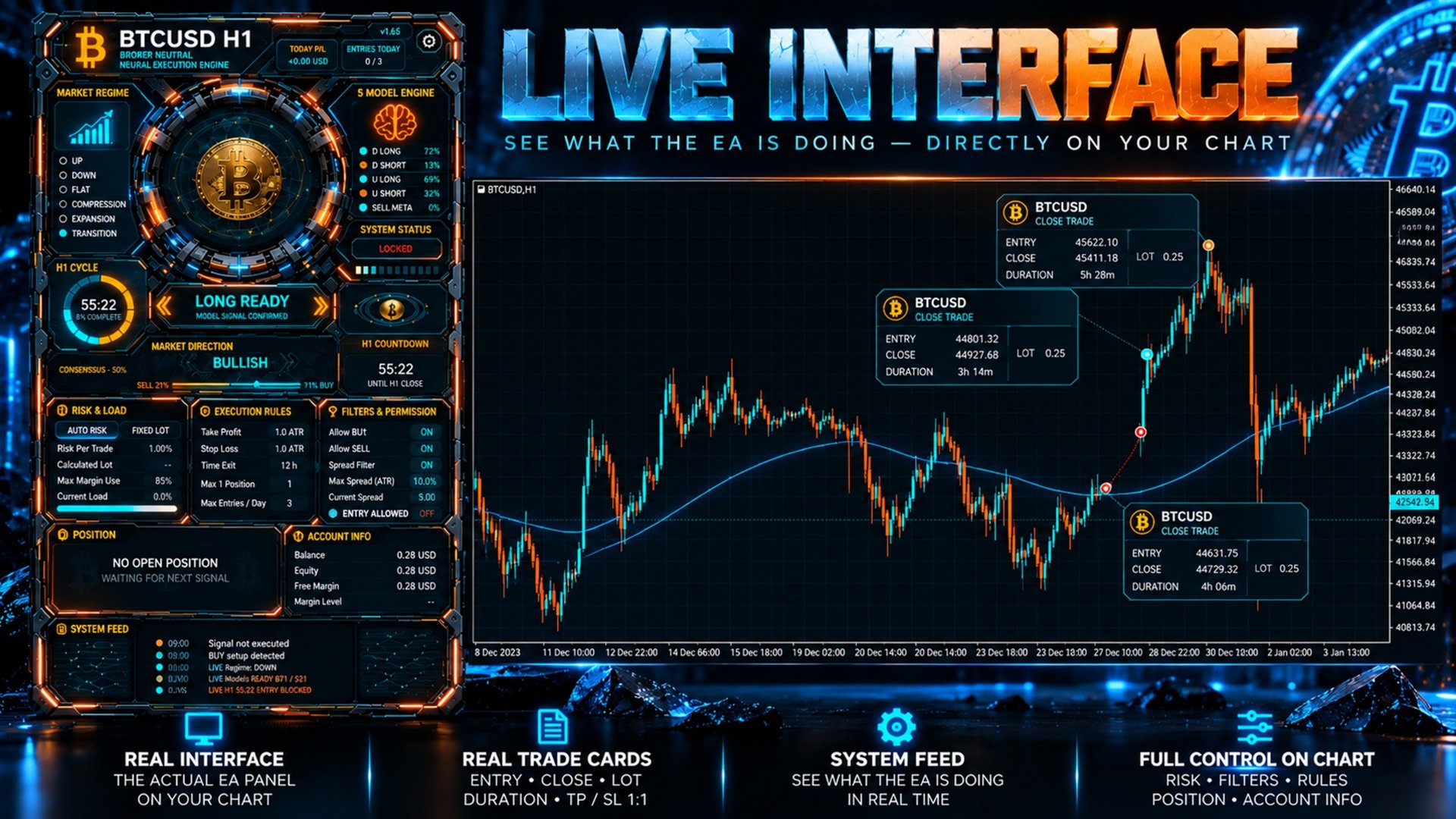
That is why the panel continuously displays:
MARKET REGIME
5 MODEL ENGINE
SYSTEM STATUS
H1 CYCLE
CONSENSUS
MARKET DIRECTION
RISK & LOAD
EXECUTION RULES
FILTERS & PERMISSION
POSITION
ACCOUNT INFO
SYSTEM FEED
This is especially easy to see in the Visual Tester.
The market changes — Market Regime changes.
The model evaluations change.
Consensus appears or disappears.
Filters either allow an entry or keep the EA waiting.
A position opens.
After it closes, a separate Trade Card appears on the chart with the result of that trade.
The panel is animated and adapted for different resolutions and DPI settings.
It was important to me to create not just a beautiful shell, but an interface that is genuinely interesting to watch while the EA is working.
That is why I strongly recommend running BTCUSD Consensus at least once in Visual Mode. A static screenshot simply cannot show half of the experience.
96.93% WIN RATE — BUT THIS NUMBER IS NOT THE ONLY THING THAT MATTERS TO ME
I understand perfectly well that the first thing most people will notice is the 96.93% Win Rate.
The result is genuinely very high.
But a high Win Rate can be achieved in very different ways.
You can use a small Take Profit and a huge Stop Loss and get a beautiful percentage of winning trades until one bad trade wipes out the result of several previous winners.
I specifically did not want to build BTCUSD Consensus that way.
Here you have:
TP ≈ SL — 1:1
only one position at a time
every trade has a Stop Loss
no grid
maximum 3 entries per day
Recovery — a separate optional function with only one additional step
In other words, the high Win Rate is not achieved by giving losing trades an enormous Stop Loss or by holding bad positions indefinitely.
That is very important to me.
This is also why, even if live trading produces a noticeably lower Win Rate than the historical 96.93%, the core idea of the system does not disappear.
With a clean TP:SL = 1:1 ratio, even 60% winning trades gives approximately +0.20R per trade before spread, commission and slippage.
I cannot promise that the future market will repeat the historical 96.93%.
Nobody can honestly promise that.
But I am much more comfortable seeing a high historical result from a system with TP ≈ SL than from a system that needs a Stop Loss several times larger than its Take Profit just to maintain a beautiful Win Rate.
RECOMMENDED SETTINGS
- Instrument: BTCUSD / Bitcoin
- Timeframe: H1
- Settings: BTCUSD Consensus is designed to work with the default settings. To get started, you only need to choose the money management mode — Auto Risk or Fixed Lot. Auto Risk is set to 1% by default.
- Broker: the EA was developed with different brokers in mind. Before live trading, I strongly recommend testing it in the Strategy Tester using your own broker's price history.
- Account type: I recommend ECN / RAW / Razor or a similar account with low spread and good execution. This is especially important for BTCUSD.
- Symbol suffixes: supported. BTCUSD, BTCUSD.m, BTCUSD.a, BTCUSD.pro and other variations — the EA works with the symbol of the chart it is attached to.
- Minimum deposit: for the minimum trading volume of 0.01 lot and leverage of 1:500, I recommend a deposit of at least $500. BTCUSD margin requirements differ between brokers, so this is my recommended starting point, not a universal requirement.
- VPS: recommended for stable continuous operation. If you do not use a VPS, MetaTrader 5, your computer and your internet connection must remain online.
MAKE SURE TO CHECK GMT / DST
This is one setting that must not be ignored before starting the EA.
By default, BTCUSD Consensus uses:
GMT Offset = +2
DST = TRUE
This means GMT+2 in winter and GMT+3 in summer.
This is a very common broker server-time configuration.
But it is not the only one.
If your trading server runs, for example, on GMT+0 all year round, you need to set:
GMT Offset = 0
DST = FALSE
For example, if your Exness server uses GMT+0 without seasonal time changes, these are the settings to use.
The reason I emphasize this separately is simple:
BTCUSD Consensus models use H1 and M15 data.
If GMT is set incorrectly, candle boundaries will shift.
And if the candles change, the models will no longer be analyzing exactly the same data structure they were trained and tuned on.
Incorrect GMT can produce different signals.
So before live trading, make sure you know the server time of your broker.
If you are not sure which GMT/DST settings to use — send me a message. I will help you set them correctly.
WHY I AM PERSONALLY HAPPY WITH THIS EA
Everything came together here:
5 individually trained models
1360 decision trees
Forward Testing
almost 10 years of real ticks
TP ≈ SL 1:1
one position at a time
risk control
a live panel that shows how the system is working
The most important thing for me is that BTCUSD Consensus does not feel like a collection of separate features.
It works as one complete system.
The models analyze the market.
The market regime is identified.
Consensus is formed.
The filters give permission.
And only then does a trade appear.
This is exactly how I wanted a Bitcoin EA to work.
Not complicated for the user.
But serious inside.