VibeFox Breakout
- Indicators
- Version: 1.0
- Activations: 5

VibeFox Breakout — Donchian channel with genuine breakout entry points
VibeFox Breakout is a real-time channel-breakout indicator for MetaTrader 5. It draws a Donchian-style channel — the highest high and lowest low of the last N closed bars — directly on the price chart, marks the exact bar where price breaks out of that channel, and gathers every control into one modern interactive panel. Instead of watching for a range to give way, you see the channel and the breakout entry at the very moment they form.
How the indicator works
The indicator builds a breakout channel from recent price action. For the last N closed bars it takes the highest high (the upper boundary) and the lowest low (the lower boundary); the midpoint between them is drawn as a dotted middle line. The channel is rendered as horizontal rays that extend to the right and update on every new bar, so the box of recent support and resistance is always in front of you.
Period sets N — the number of bars used to build the channel. A small Period makes a tight, fast-reacting channel that breaks often; a large Period makes a wide channel that only yields to major moves. The channel itself is the indicator's visual and is always drawn, even when the entry signals are switched off.
A pure high/low channel reacts to every spike, so VibeFox Breakout adds a Buffer filter. The Buffer is expressed as a percentage of the channel width: the close must clear the boundary by that fraction of the up-to-low distance before a breakout counts. Set it to 0 to react to the bare channel, or raise it to demand a stronger, cleaner push and cut down on false breaks. Because the buffer scales with the channel itself, the same setting behaves consistently across symbols and timeframes.
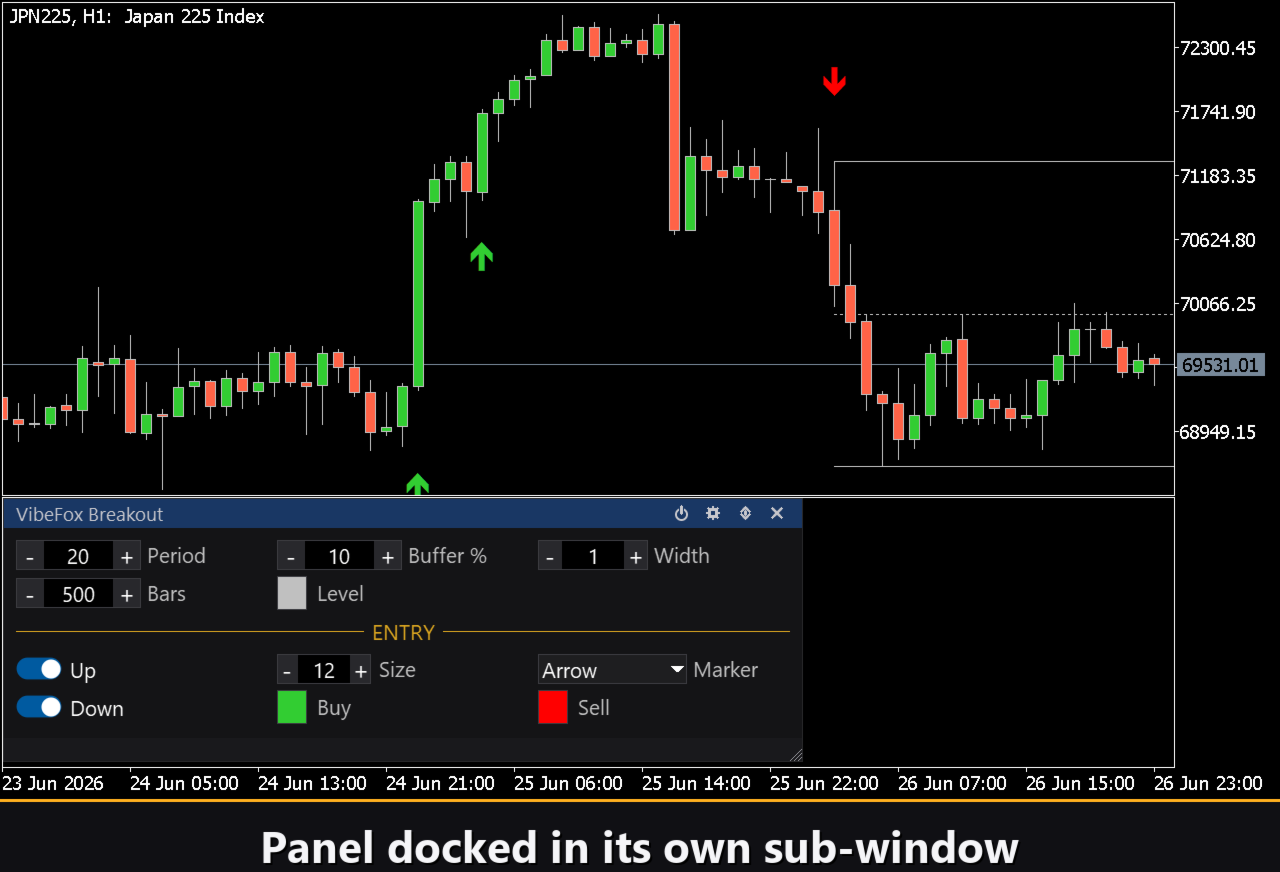
The Bars setting limits how much history is processed — set it to 0 to scan all available bars, or use a smaller value for faster redraws on heavy charts. The channel and the panel live in the indicator's own subwindow area, while the channel lines and entry markers are drawn as objects on the price chart.
Entry points
The main value of VibeFox Breakout is its automatic entry points: the indicator tracks the breakout conditions itself and places a clear marker right on the price chart. A signal is registered only on a genuine cross — the previous bar must have closed inside the channel and the current bar must close outside it — so a market that is already trading beyond the boundary does not keep firing. Two independent signal types are available, each with its own toggle.
Entry — Breakout Up
The Up signal fires when a bar closes ABOVE the upper channel plus the buffer, while the previous close was still inside the channel. A BUY marker is placed at the breakout — price has pushed through resistance and is breaking upward.
Entry — Breakout Down
The Down signal fires when a bar closes BELOW the lower channel minus the buffer, while the previous close was still inside the channel. A SELL marker is placed at the breakout — price has dropped through support and is breaking downward.
Signals are evaluated only on closed bars, and each closed bar can produce at most one notification, so you get one clean alert per breakout. Buy and sell markers are colored separately with the Buy Color and Sell Color settings, so direction is read instantly. The Marker selector switches the glyph between a plain cross (+), filled triangles, or arrows with a tail, while the Size control scales the marker in pixels (6 to 40) to fit any chart density.
Full visual control
The channel line color is set with the Level color picker and the thickness with Width from 1 to 5 pixels (the dotted midline always stays thin). The channel line and both entry markers each support a transparency setting (0-100%) in the color picker popup, so you can blend them softly into the chart background. Markers on the price chart are sized and colored independently, so entries stand out clearly against any background.
Interactive on-chart panel
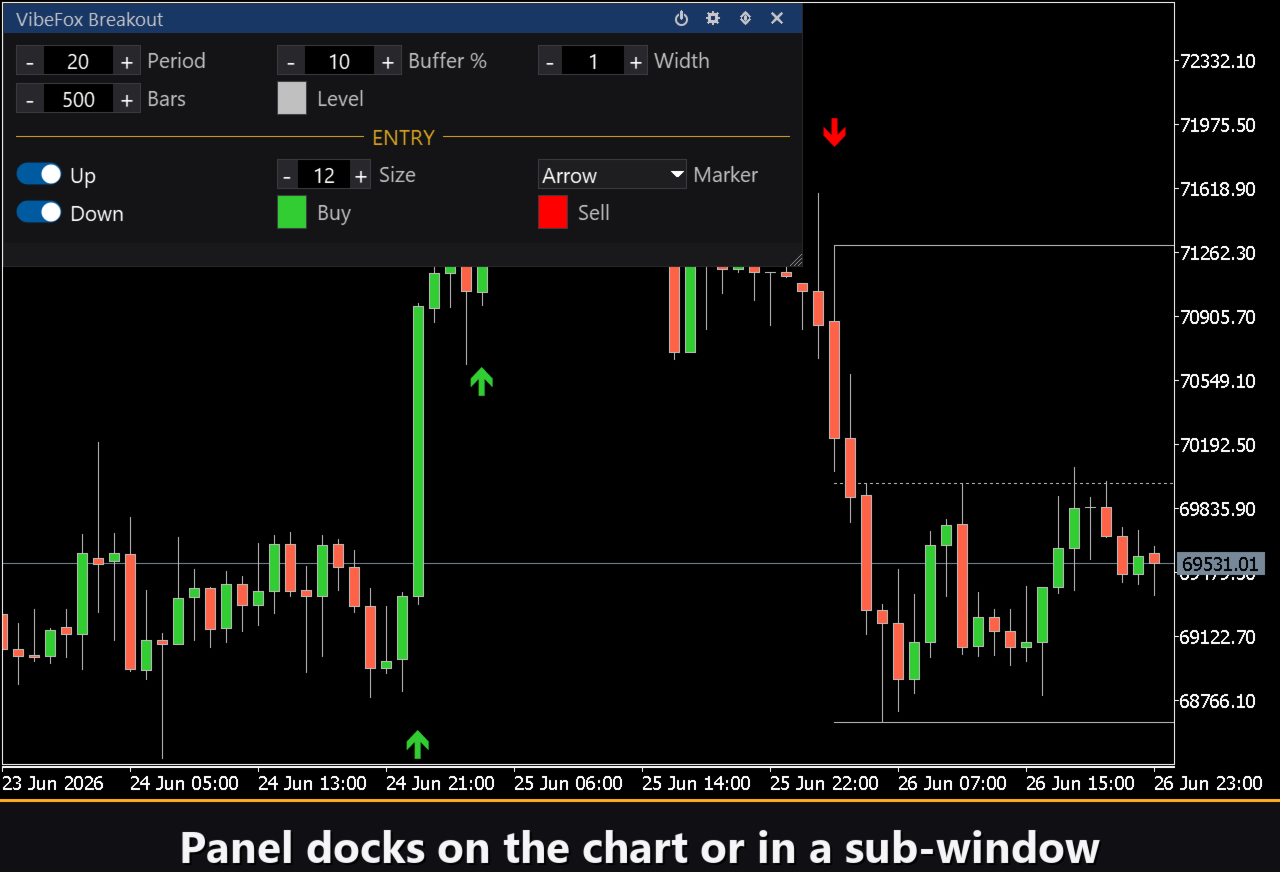
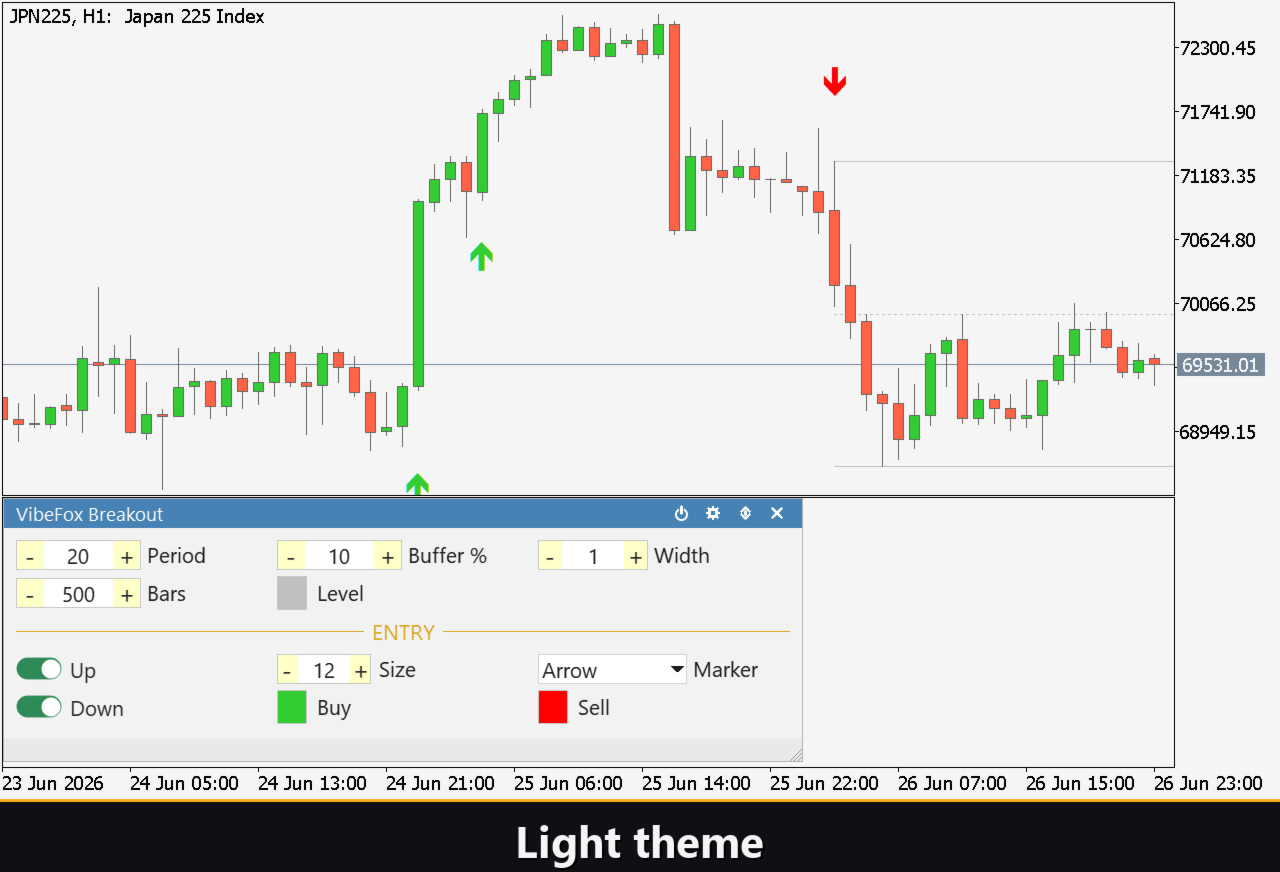
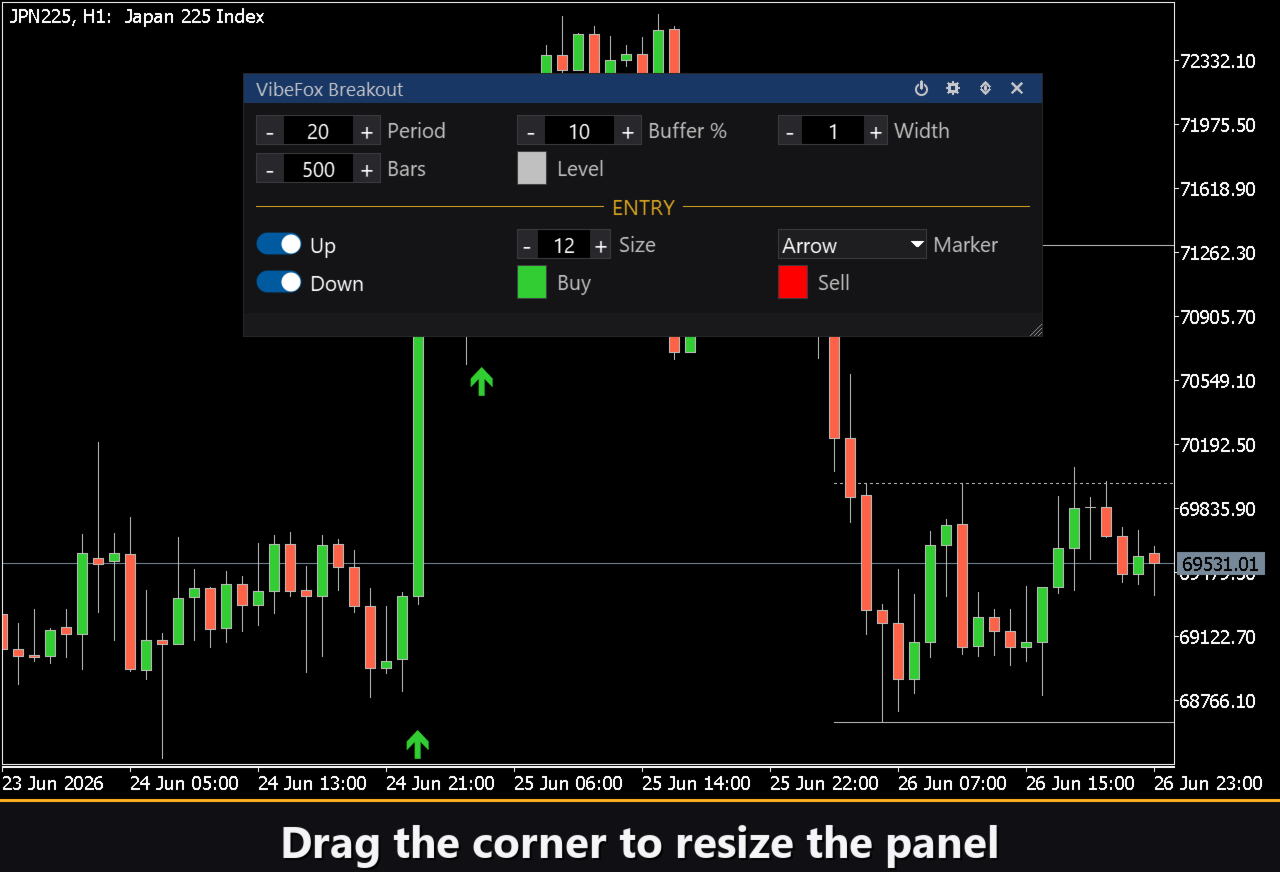
The whole interface is a smooth canvas-based panel built for fast mouse control. The channel parameters are gathered into tidy rows, and the entry block is set apart with its own gold ENTRY heading, so signal settings do not get mixed up with channel settings. The panel header holds the control icons.
Power — turns the drawing of entry markers on and off without removing the indicator from the chart (the channel stays visible).
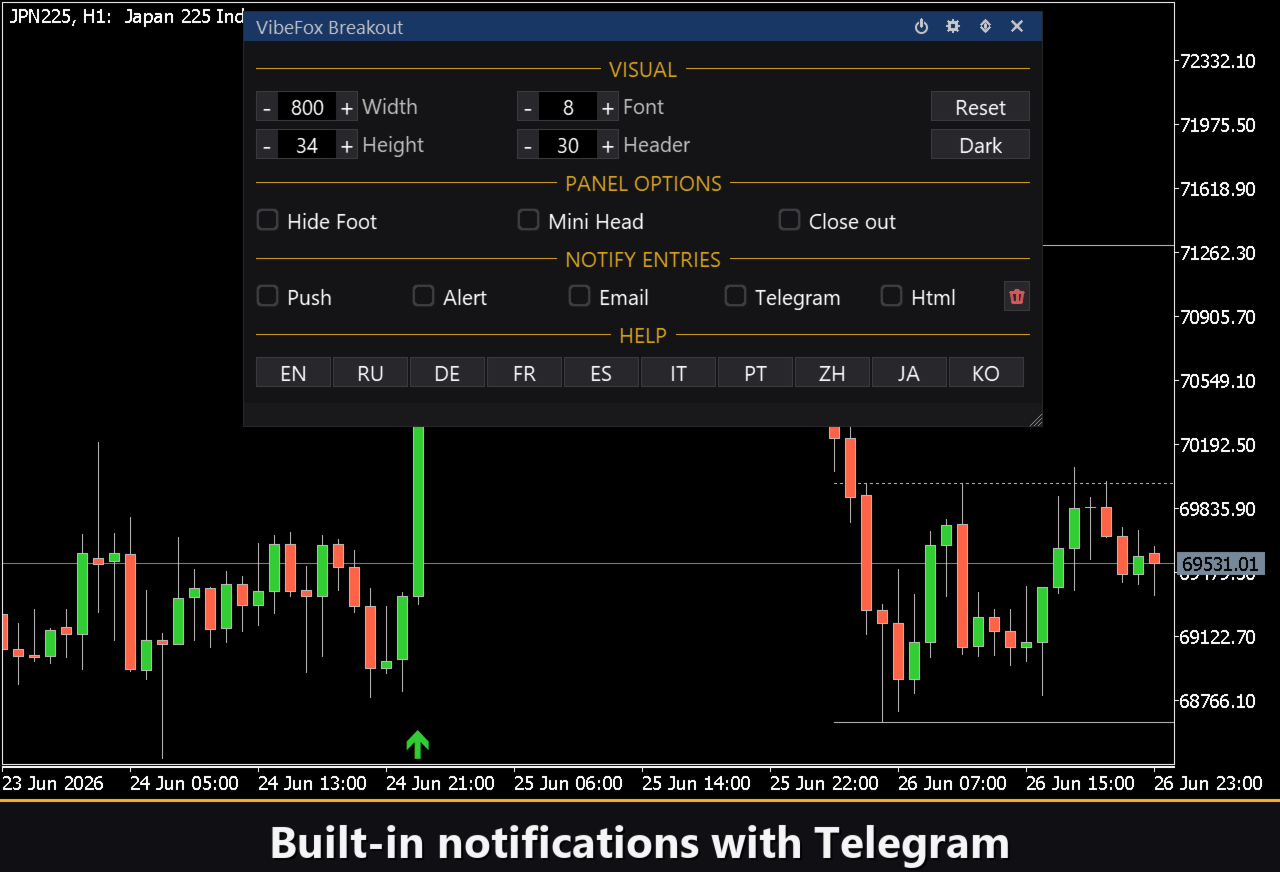
Settings (gear) — opens and closes the settings section.
Updown (arrows) — moves the panel between its subwindow and the main chart.
Close (cross) — closes the indicator.
Resizable — drag the bottom-right corner to scale the panel.
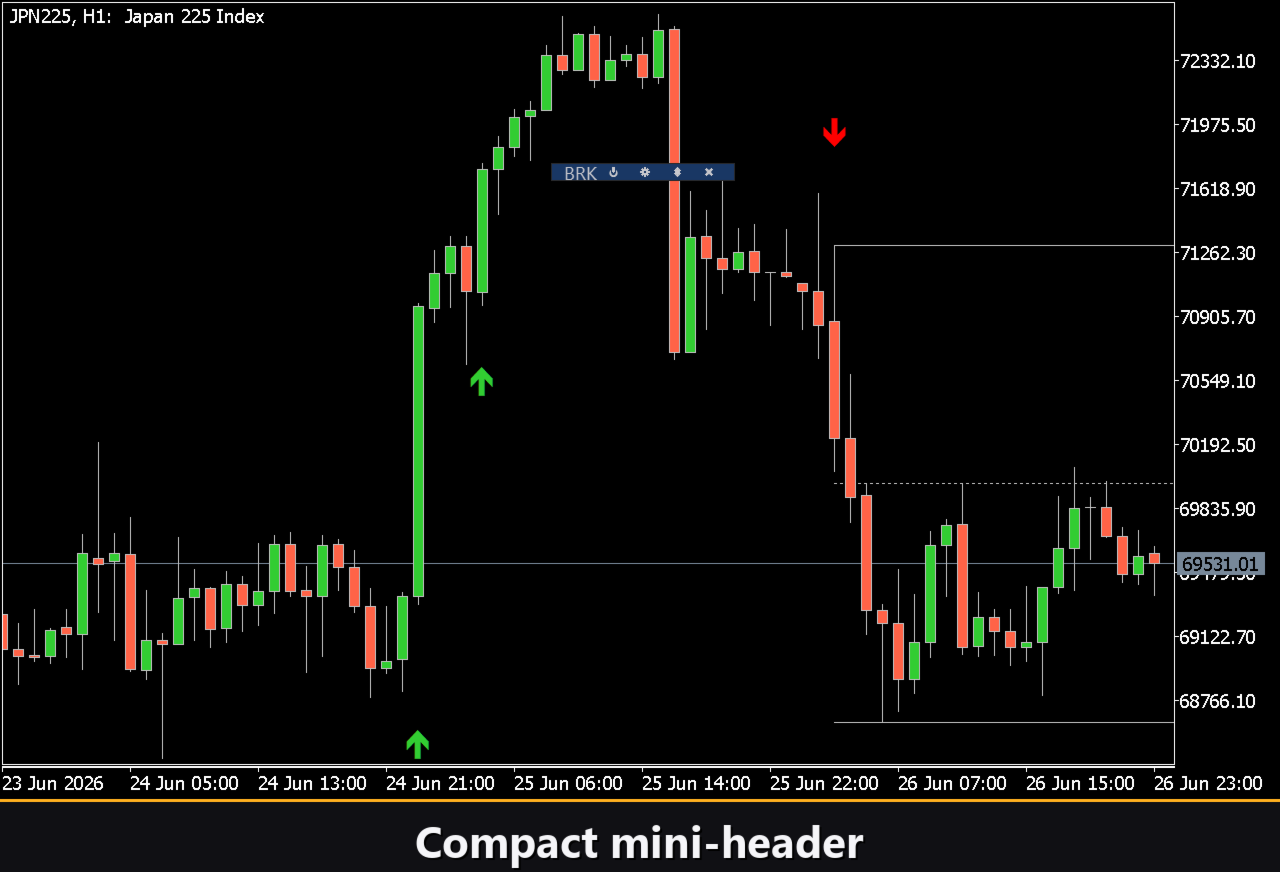
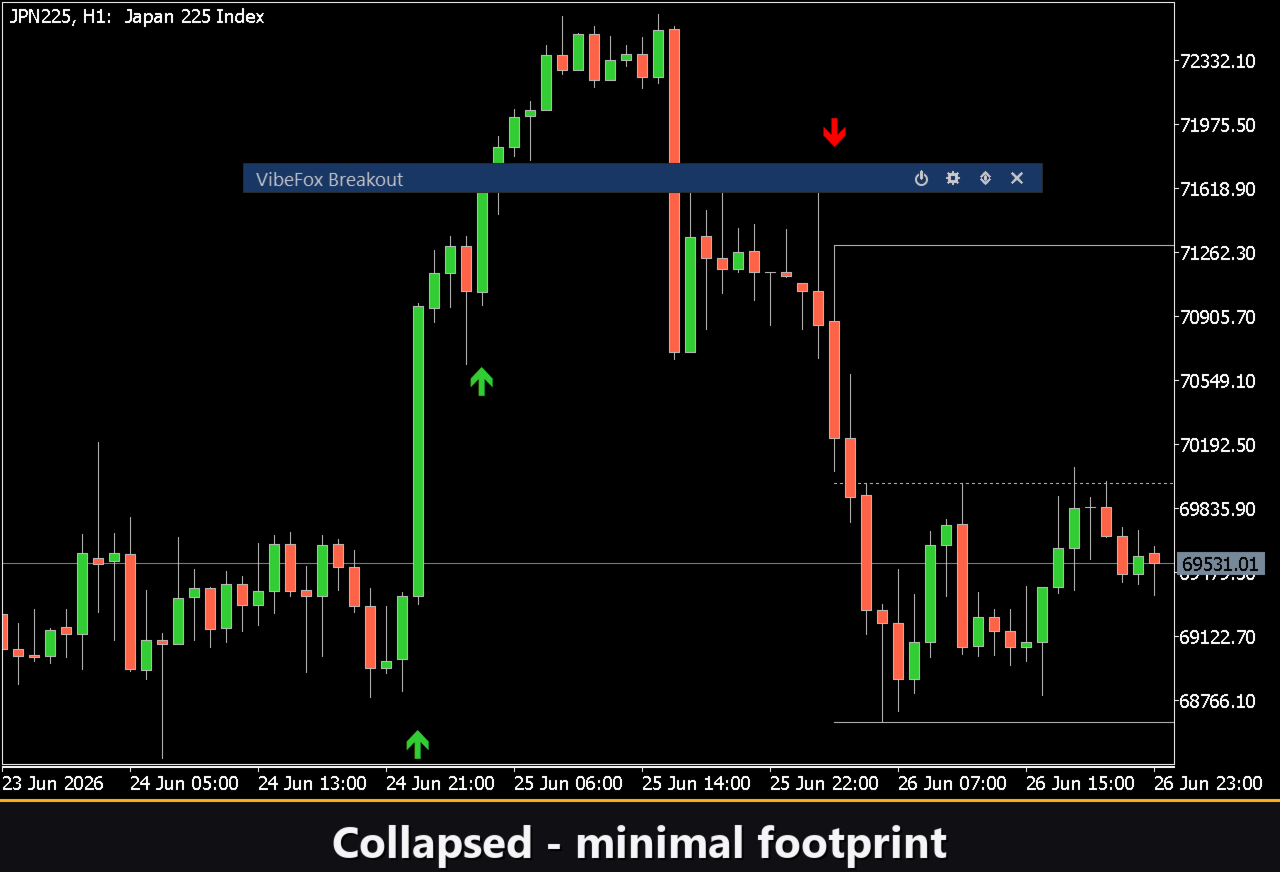
Collapsible — a double click on the header collapses the panel into a compact strip.
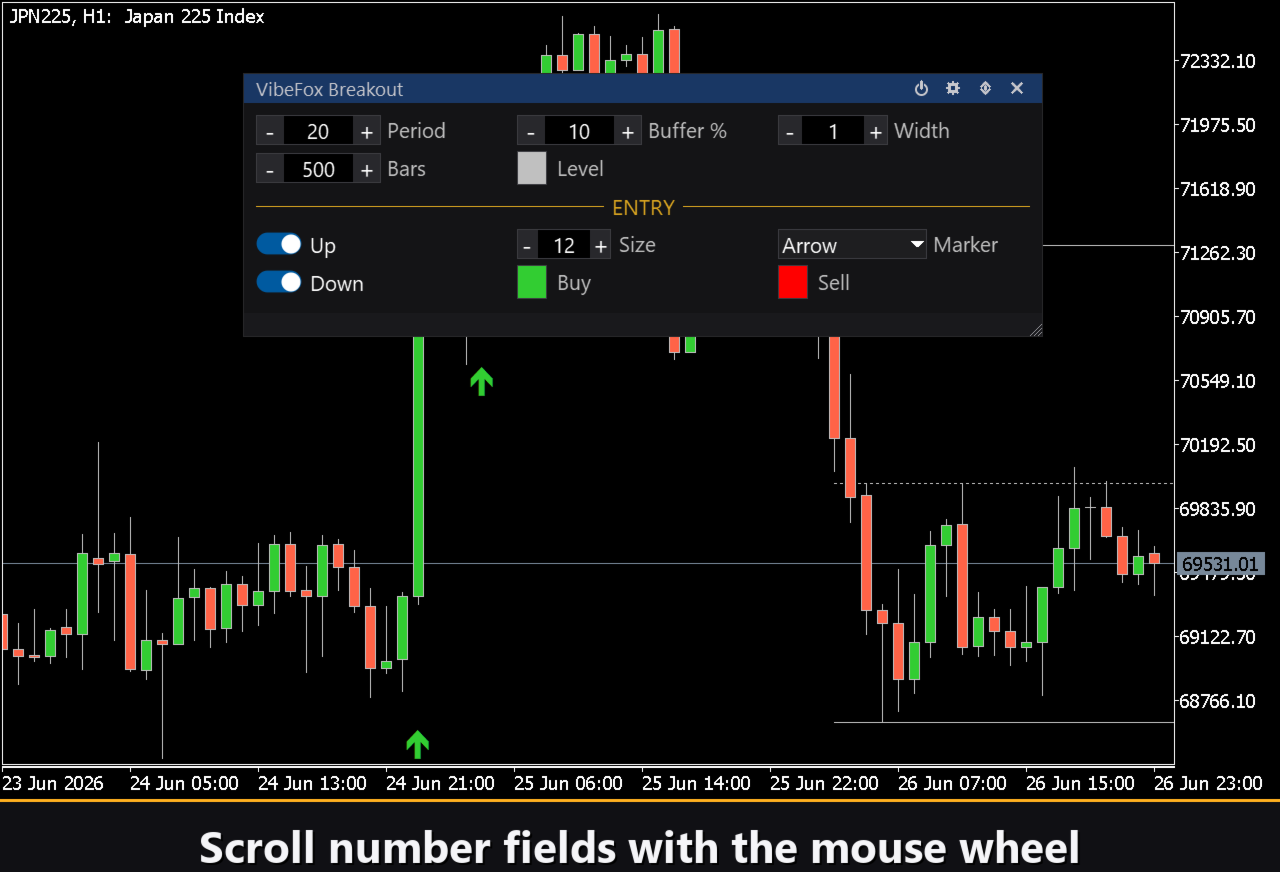
Mouse wheel — hover over any numeric field and scroll the wheel to change the value without opening the keyboard.
Settings and personalization
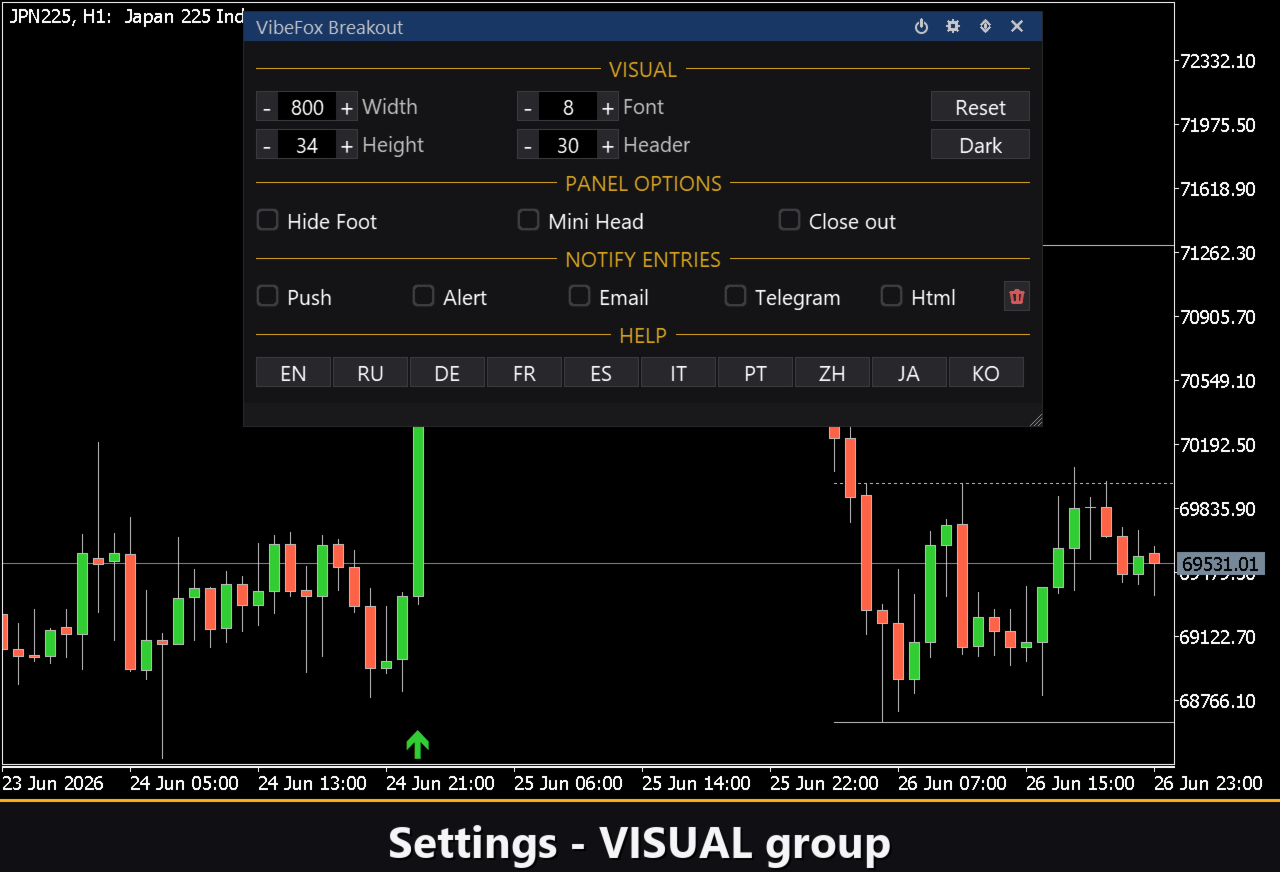
The Settings button opens a section where the panel is fitted to your workspace: a light, dark or automatic Theme, an adjustable panel width, header size, row height and font size. Extra touches let you hide the bottom bar via Hide Footer, shrink the header when collapsed with Mini Header, and automatically collapse the panel on a click outside it. Almost every parameter changes live right on the panel — the input fields on the Inputs tab only set the starting values. You can also run several independent copies on one chart by giving each a unique Instance, to compare different channel settings side by side.
Entry notifications
You do not need to sit and guard the chart waiting for a breakout. Each entry can be sent through several notification channels that are enabled independently right on the panel, in the NOTIFY ENTRIES group.
Alert — a pop-up message inside the terminal.
Push — a mobile notification to the MetaTrader app on your phone.
Email — a letter sent through the terminal's mail settings.
Telegram — the alert text together with a chart screenshot, sent straight to your Telegram chat.
Enable only the channels you need, and you will be notified the moment a new breakout appears on the symbol and timeframe you are working with.
Visual history (HTML report)
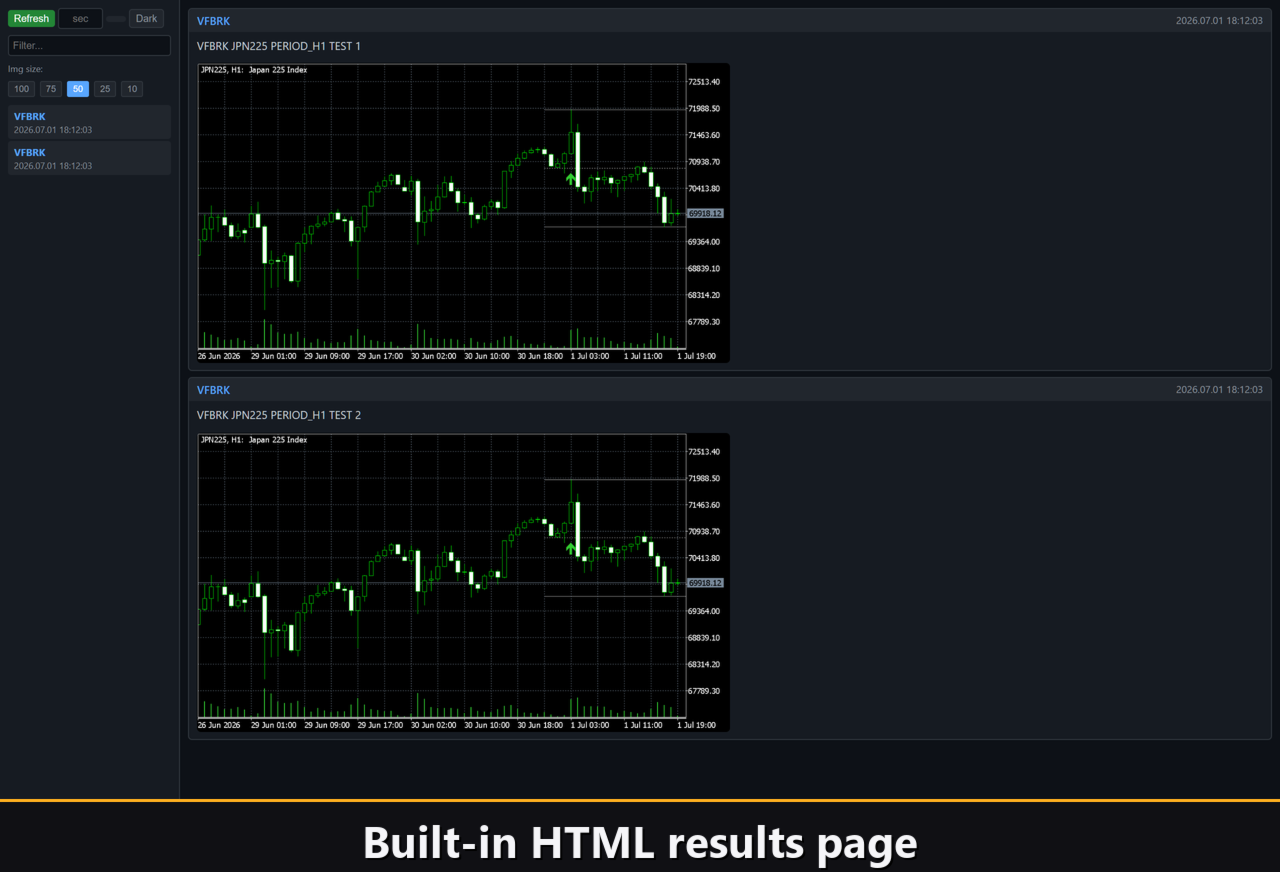
Enable the Html channel, and every entry signal is saved to an HTML report together with a screenshot of the chart at the moment it fired. The report is stored in the terminal's Files folder, in the VibeFox_Breakout directory (MQL5/Files/VibeFox_Breakout/result.html), and opens in any browser — you get a visual log of all the breakouts the indicator found. A one-click trash button clears the report and its screenshots whenever you want to start over.
Telegram Alerts
Signals can also be delivered straight to your Telegram chat — the alert text together with a screenshot of the chart at the moment of detection. Turn on the Telegram channel and enter your bot token and chat id in the inputs.
Delivery rides on the HTML report: each new signal is written into the report, and the report — opened in a browser — forwards it to your Telegram chat on its own. For this reason, enabling Telegram automatically keeps the Html report on, and the two channels work together.
Built-in multilingual help
A full help page is built into the panel, available in multiple languages, so every control is explained right where you use it.
Parameters (Inputs tab)
Most settings can also be changed live right on the panel (the Settings button) — the input parameters only set the initial values at startup.
Channel (Breakout)
Channel Period N — the number of bars used to build the channel (highest high / lowest low). Default: 20.
Buffer — the breakout filter as a percentage of the channel width; the close must clear the level by this fraction, 0 = off. Default: 10.
Bars of history to process — how many bars back the channel and breakouts are calculated, 0 = all available. Default: 500.
Channel Line Color — the color of the channel lines on the price chart. Default: Silver.
Line Transparency — channel line transparency in percent, 0-100. Default: 0.
Channel Line Width — the thickness of the channel lines in pixels, 1..5. Default: 1.
Entry Points
Up — enables BUY markers when price breaks above the upper channel. Default: on.
Down — enables SELL markers when price breaks below the lower channel. Default: on.
Marker Font Size — the size of the entry markers in pixels, 6..40. Default: 12.
Entry Marker — the marker glyph: Cross (+), Triangle, or Arrow. Default: Arrow.
Buy Color — the color of the BUY marker. Default: LimeGreen.
Buy Transparency — buy marker transparency in percent, 0-100. Default: 0.
Sell Color — the color of the SELL marker. Default: Red.
Sell Transparency — sell marker transparency in percent, 0-100. Default: 0.
Notifications
Push Notification — enables push alerts to the MetaTrader mobile app. Default: off.
Alert Popup — enables pop-up alerts inside the terminal. Default: off.
Email — enables email alerts through the terminal's mail settings. Default: off.
Html Report — saves each signal with a chart screenshot to Files/VibeFox_Breakout/result.html. Default: off.
Telegram — forwards signals with chart screenshots to a Telegram chat via the HTML report. Default: off.
Telegram - bot token — the token of the Telegram bot used for delivery. Default: empty.
Telegram - chat id — the target Telegram chat identifier. Default: empty.
Panel / Settings
Panel width, px — the width of the on-chart panel in pixels, 300..800. Default: 800.
Header size — the height of the panel header, 1..6. Default: 1.
Theme — the color theme of the panel: Light, Dark, or Auto. Default: Auto.
Row height (px) — the height of each parameter row in pixels. Default: 34.
Font size — the font size used inside the panel. Default: 8.
Hide Footer — hides the bottom bar of the panel. Default: off.
Mini Header on collapse — shows a compact header strip when the panel is collapsed. Default: off.
Close on click outside — automatically collapses the panel when clicking outside it. Default: off.
Instance — a unique number for each copy of the indicator on the same chart, allows running multiple instances side by side. Default: 1.
Panel Start Window — sets the initial position of the panel: main chart or subwindow. Default: Subwindow.