MQL4 and MQL5 Programming Articles

Study the MQL5 language for programming trading strategies in numerous published articles mostly written by you - the community members. The articles are grouped into categories to help you quicker find answers to any questions related to programming: Integration, Tester, Trading Strategies, etc.
Follow our new publications and discuss them on the Forum!
Add a new article

You are missing trading opportunities:
- Free trading apps
- Over 8,000 signals for copying
- Economic news for exploring financial markets
Registration
Log in
You agree to website policy and terms of use
If you do not have an account, please register


How We Built the Most Powerful Machine Learning-Powered Trading Platform: The Evolution of MQL and MetaTrader Through Archives, Forums, and Releases
A technical history of MQL evolution: from the limited MQL and MQL II languages, through procedural MQL4, to object-oriented MQL5 with native compilation, rich APIs, and a full-fledged engineering environment. We show here the key capabilities of the language and its integrations with Python, OpenCL, ONNX, OpenBLAS, databases, DirectX, the agentic AI Assistant, and the Model Context Protocol (MCP), which connects AI systems with the terminal, MetaEditor, market data, trading operations, and development tools. This article examines archival materials on the origins of MetaQuotes and MetaTrader, the launch of MQL4.COM and MQL5.COM, the championships, Algo Forge, and their impact on the ecosystem.


Cross-Platform Expert Advisor: Stops
This article discusses an implementation of stop levels in an expert advisor in order to make it compatible with the two platforms MetaTrader 4 and MetaTrader 5.


Advanced Order Execution Algorithms in MQL5: TWAP, VWAP, and Iceberg Orders
An MQL5 framework that brings institutional-grade execution algorithms (TWAP, VWAP, Iceberg) to retail traders through a unified execution manager and performance analyzer for smoother, more precise order slicing and analytics.


Automating Trading Strategies in MQL5 (Part 1): The Profitunity System (Trading Chaos by Bill Williams)
In this article, we examine the Profitunity System by Bill Williams, breaking down its core components and unique approach to trading within market chaos. We guide readers through implementing the system in MQL5, focusing on automating key indicators and entry/exit signals. Finally, we test and optimize the strategy, providing insights into its performance across various market scenarios.

MQL5 Cookbook: Developing a Multi-Currency Expert Advisor with Unlimited Number of Parameters
In this article, we will create a pattern that uses a single set of parameters for optimization of a trading system, while allowing for unlimited number of parameters. The list of symbols will be created in a standard text file (*.txt). Input parameters for each symbol will also be stored in files. This way we will be able to circumvent the restriction of the terminal on the number of input parameters of an Expert Advisor.


How to create a simple Multi-Currency Expert Advisor using MQL5 (Part 1): Indicator Signals based on ADX in combination with Parabolic SAR
The Multi-Currency Expert Advisor in this article is Expert Advisor or trading robot that can trade (open orders, close orders and manage orders an more) for more than 1 symbol pair only from one symbol chart.

Horizontal diagrams on MеtaTrader 5 charts
Horizontal diagrams are not a common occurrence on the terminal charts but they can still be of use in a number of tasks, for example when developing indicators displaying volume or price distribution for a certain period, when creating various market depth versions, etc. The article considers constructing and managing horizontal diagrams as arrays of graphical primitives.


Learn how to design a trading system by Relative Vigor Index
A new article in our series about how to design a trading system by the most popular technical indicator. In this article, we will learn how to do that by the Relative Vigor Index indicator.

Creating and Publishing of Trade Reports and SMS Notification
Traders don't always have ability and desire to seat at the trading terminal for hours. Especially, if trading system is more or less formalized and can automatically identify some of the market states. This article describes how to generate a report of trade results (using Expert Advisor, Indicator or Script) as HTML-file and upload it via FTP to WWW-server. We will also consider sending notification of trade events as SMS to mobile phone.

Combinatorics and probability theory for trading (Part III): The first mathematical model
A logical continuation of the earlier discussed topic would be the development of multifunctional mathematical models for trading tasks. In this article, I will describe the entire process related to the development of the first mathematical model describing fractals, from scratch. This model should become an important building block and be multifunctional and universal. It will build up our theoretical basis for further development of this idea.

Developing multi-module Expert Advisors
MQL programming language allows implementing the concept of modular development of trading strategies. The article shows an example of developing a multi-module Expert Advisor consisting of separately compiled file modules.

Indicator Alternative Ichimoku – Setup, Examples of Usage
How to set up Alternative Ichimoku correctly? Read the description of parameters setting up. The article will help you understand the methods of setting up parameters not only of the indicator Ichimoku. Certainly you will also better understand how to set up the standard Ichimoku Kinko Hyo.

Graphical Interfaces IX: The Progress Bar and Line Chart Controls (Chapter 2)
The second chapter of the part nine is dedicated to the progress bar and line chart controls. As always, there will be detailed examples provided to reveal how these controls can be used in custom MQL applications.

Graphical Interfaces V: The Vertical and Horizontal Scrollbar (Chapter 1)
We are still discussing the development of the library for creating graphical interfaces in the MetaTrader environment. In the first article of the fifth part of the series, we will write classes for creating vertical and horizontal scrollbars.

How to Prepare MetaTrader 5 Quotes for Other Applications
The article describes the examples of creating directories, copying data, filing, working with the symbols in Market Watch or the common list, as well as the examples of handling errors, etc. All these elements can eventually be gathered in a single script for filing the data in a user-defined format.

The market and the physics of its global patterns
In this article, I will try to test the assumption that any system with even a small understanding of the market can operate on a global scale. I will not invent any theories or patterns, but I will only use known facts, gradually translating these facts into the language of mathematical analysis.

Freelance Jobs on MQL5.com - Developer's Favorite Place
Developers of trading robots no longer need to market their services to traders that require Expert Advisors - as now they will find you. Already, thousands of traders place orders to MQL5 freelance developers, and pay for work in on MQL5.com. For 4 years, this service facilitated three thousand traders to pay for more than 10 000 jobs performed. And the activity of traders and developers is constantly growing!

Graphical Interfaces II: The Main Menu Element (Chapter 4)
This is the final chapter of the second part of the series about graphical interfaces. Here, we are going to consider the creation of the main menu. The development of this control and setting up handlers of the library classes for correct reaction to the user's actions will be demonstrated here. We will also discuss how to attach context menus to the items of the main menu. Adding to that, we will mention blocking currently inactive elements.

Building a Social Technology Startup, Part II: Programming an MQL5 REST Client
Let's now shape the PHP-based Twitter idea which was introduced in the first part of this article. We are assembling the different parts of the SDSS. Regarding the client side of the system architecture, we are relying on the new MQL5 WebRequest() function for sending trading signals via HTTP.

Graphic Expert Advisor: AutoGraf
The article shows the workability of graphics in creation of a convenient interface to manage trading.

Price Forecasting Using Neural Networks
Many traders speak about neural networks, but what they are and what they really can is known to few people. This article sheds some light on the world of artificial intelligence. It describes, how to prepare correctly the data for the network. Here you will also find an example of forecasting using means of the program Matlab.


How to Integrate Smart Money Concepts (BOS) Coupled with the RSI Indicator into an EA
Smart Money Concept (Break Of Structure) coupled with the RSI Indicator to make informed automated trading decisions based on the market structure.


Developing a Trading Strategy: The Butterfly Oscillator Method
In this article, we demonstrated how the fascinating mathematical concept of the Butterfly Curve can be transformed into a practical trading tool. We constructed the Butterfly Oscillator and built a foundational trading strategy around it. The strategy effectively combines the oscillator's unique cyclical signals with traditional trend confirmation from moving averages, creating a systematic approach for identifying potential market entries.


CCI indicator. Upgrade and new features
In this article, I will consider the possibility of upgrading the CCI indicator. Besides, I will present a modification of the indicator.

Extending Strategy Builder Functionality
In the previous two articles, we discussed the application of Merrill patterns to various data types. An application was developed to test the presented ideas. In this article, we will continue working with the Strategy Builder, to improve its efficiency and to implement new features and capabilities.


Brute force approach to pattern search (Part IV): Minimal functionality
The article presents an improved brute force version, based on the goals set in the previous article. I will try to cover this topic as broadly as possible using Expert Advisors with settings obtained using this method. A new program version is attached to this article.

MQL5 Cookbook: Position Properties on the Custom Info Panel
This time we will create a simple Expert Advisor that will get position properties on the current symbol and display them on the custom info panel during manual trading. The info panel will be created using graphical objects and displayed information will be refreshed at every tick. This is going to be much more convenient than all the time having to manually run the script described in the previous article of the series called "MQL5 Cookbook: Getting Position Properties".


Tips from a professional programmer (Part I): Code storing, debugging and compiling. Working with projects and logs
These are some tips from a professional programmer about methods, techniques and auxiliary tools which can make programming easier.


Trader-friendly stop loss and take profit
Stop loss and take profit can have a significant impact on trading results. In this article, we will look at several ways to find optimal stop order values.

Guide to writing a DLL for MQL5 in Delphi
The article examines the mechanism of creating a DLL module, using the popular programming language of ObjectPascal, within a Delphi programming environment. The materials, provided in this article, are designed to primarily target beginner programmers, who are working with problems, which breach the boundaries of the embedded programming language of MQL5, by connecting the outside DLL modules.

Drawing Dial Gauges Using the CCanvas Class
We can find dial gauges in cars and airplanes, in industrial production and everyday life. They are used in all spheres which require quick response to behavior of a controlled value. This article describes the library of dial gauges for MetaTrader 5.

The Prototype of a Trading Robot
This article summarizes and systematizes the principles of creating algorithms and elements of trading systems. The article considers designing of expert algorithm. As an example the CExpertAdvisor class is considered, which can be used for quick and easy development of trading systems.


Automating Trading Strategies in MQL5 (Part 34): Trendline Breakout System with R-Squared Goodness of Fit
In this article, we develop a Trendline Breakout System in MQL5 that identifies support and resistance trendlines using swing points, validated by R-squared goodness of fit and angle constraints, to automate breakout trades. Our plan is to detect swing highs and lows within a specified lookback period, construct trendlines with a minimum number of touch points, and validate them using R-squared metrics and angle constraints to ensure reliability.

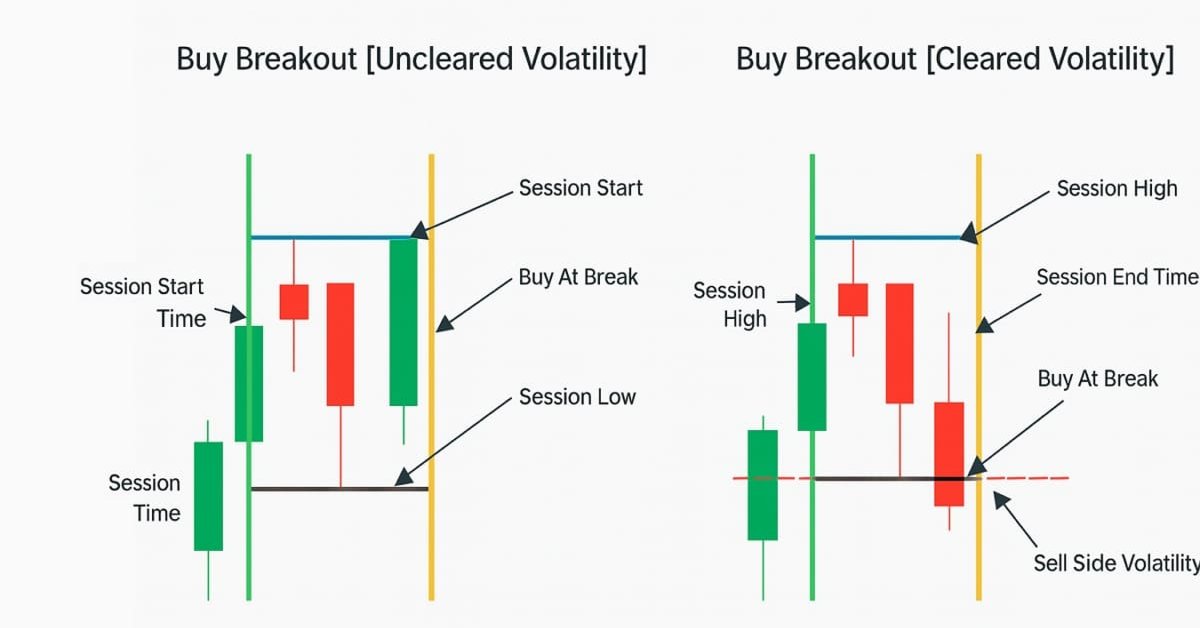
Developing a Volatility Based Breakout System
Volatility based breakout system identifies market ranges, then trades when price breaks above or below those levels, filtered by volatility measures such as ATR. This approach helps capture strong directional moves.


Multilayer perceptron and backpropagation algorithm
The popularity of these two methods grows, so a lot of libraries have been developed in Matlab, R, Python, C++ and others, which receive a training set as input and automatically create an appropriate network for the problem. Let us try to understand how the basic neural network type works (including single-neuron perceptron and multilayer perceptron). We will consider an exciting algorithm which is responsible for network training - gradient descent and backpropagation. Existing complex models are often based on such simple network models.

Library for easy and quick development of MetaTrader programs (part X): Compatibility with MQL4 - Events of opening a position and activating pending orders
In the previous articles, we started creating a large cross-platform library simplifying the development of programs for MetaTrader 5 and MetaTrader 4 platforms. In the ninth part, we started improving the library classes for working with MQL4. Here we will continue improving the library to ensure its full compatibility with MQL4.


Pair trading
In this article, we will consider pair trading, namely what its principles are and if there are any prospects for its practical application. We will also try to create a pair trading strategy.

Testing patterns that arise when trading currency pair baskets. Part II
We continue testing the patterns and trying the methods described in the articles about trading currency pair baskets. Let's consider in practice, whether it is possible to use the patterns of the combined WPR graph crossing the moving average. If the answer is yes, we should consider the appropriate usage methods.

A system of voice notifications for trade events and signals
Nowadays, voice assistants play a prominent role in human life, as we often use navigators, voice search and translators. In this article, I will try to develop a simple and user friendly system of voice notifications for various trade events, market states or signals generated by trading signals.

Creating Non-Lagging Digital Filters
The article describes one of the approaches to determining a useful signal (trend) in stream data. Small filtering (smoothing) tests applied to market quotes demonstrate the potential for creating non-lagging digital filters (indicators) that are not redrawn on the last bars.