MQL4 and MQL5 Programming Articles

Study the MQL5 language for programming trading strategies in numerous published articles mostly written by you - the community members. The articles are grouped into categories to help you quicker find answers to any questions related to programming: Integration, Tester, Trading Strategies, etc.
Follow our new publications and discuss them on the Forum!
Add a new article

You are missing trading opportunities:
- Free trading apps
- Over 8,000 signals for copying
- Economic news for exploring financial markets
Registration
Log in
You agree to website policy and terms of use
If you do not have an account, please register


Decreasing Memory Consumption by Auxiliary Indicators
If an indicator uses values of many other indicators for its calculations, it consumes a lot of memory. The article describes several methods of decreasing the memory consumption when using auxiliary indicators. Saved memory allows increasing the number of simultaneously used currency pairs, indicators and strategies in the client terminal. It increases the reliability of trade portfolio. Such a simple care about technical resources of your computer can turn into money resources at your deposit.

Graphical Interfaces IX: The Color Picker Control (Chapter 1)
With this article we begin chapter nine of series of articles dedicated to creating graphical interfaces in MetaTrader trading terminals. It consists of two chapters where new elements of controls and interface, such as color picker, color button, progress bar and line chart are presented.

Optimal approach to the development and analysis of trading systems
In this article, I will show the criteria to be used when selecting a system or a signal for investing your funds, as well as describe the optimal approach to the development of trading systems and highlight the importance of this matter in Forex trading.

Promote Your Development Projects Using EX5 Libraries
Hiding of the implementation details of classes/functions in an .ex5 file will enable you to share your know-how algorithms with other developers, set up common projects and promote them in the Web. And while the MetaQuotes team spares no effort to bring about the possibility of direct inheritance of ex5 library classes, we are going to implement it right now.


Developing a trading Expert Advisor from scratch (Part 19): New order system (II)
In this article, we will develop a graphical order system of the "look what happens" type. Please note that we are not starting from scratch this time, but we will modify the existing system by adding more objects and events on the chart of the asset we are trading.


Building a Trading System (Part 2): The Science of Position Sizing
Even with a positive-expectancy system, position sizing determines whether you thrive or collapse. It’s the pivot of risk management—translating statistical edges into real-world results while safeguarding your capital.

A scientific approach to the development of trading algorithms
The article considers the methodology for developing trading algorithms, in which a consistent scientific approach is used to analyze possible price patterns and to build trading algorithms based on these patterns. Development ideals are demonstrated using examples.

Self-organizing feature maps (Kohonen maps) - revisiting the subject
This article describes techniques of operating with Kohonen maps. The subject will be of interest to both market researchers with basic level of programing in MQL4 and MQL5 and experienced programmers that face difficulties with connecting Kohonen maps to their projects.


Everything you need to learn about the MQL5 program structure
Any Program in any programming language has a specific structure. In this article, you will learn essential parts of the MQL5 program structure by understanding the programming basics of every part of the MQL5 program structure that can be very helpful when creating our MQL5 trading system or trading tool that can be executable in the MetaTrader 5.

Graphical Interfaces X: Word wrapping algorithm in the Multiline Text box (build 12)
We continue to develop the Multiline Text box control. This time our task is to implement an automatic word wrapping in case a text box width overflow occurs, or a reverse word wrapping of the text to the previous line if the opportunity arises.


Price Action Analysis Toolkit Development (Part 51): Revolutionary Chart Search Technology for Candlestick Pattern Discovery
This article is intended for algorithmic traders, quantitative analysts, and MQL5 developers interested in enhancing their understanding of candlestick pattern recognition through practical implementation. It provides an in‑depth exploration of the CandlePatternSearch.mq5 Expert Advisor—a complete framework for detecting, visualizing, and monitoring classical candlestick formations in MetaTrader 5. Beyond a line‑by‑line review of the code, the article discusses architectural design, pattern detection logic, GUI integration, and alert mechanisms, illustrating how traditional price‑action analysis can be automated efficiently.

Practical Use of Kohonen Neural Networks in Algorithmic Trading. Part II. Optimizing and forecasting
Based on universal tools designed for working with Kohonen networks, we construct the system of analyzing and selecting the optimal EA parameters and consider forecasting time series. In Part I, we corrected and improved the publicly available neural network classes, having added necessary algorithms. Now, it is time to apply them to practice.


Graphical Interfaces I: Testing Library in Programs of Different Types and in the MetaTrader 4 Terminal (Chapter 5)
In the previous chapter of the first part of the series about graphical interfaces, the form class was enriched by methods which allowed managing the form by pressing its controls. In this article, we will test our work in different types of MQL program such as indicators and scripts. As the library was designed to be cross-platform so it could be used in all MetaTrader platforms, we will also test it in MetaTrader 4.


Automating Trading Strategies in MQL5 (Part 14): Trade Layering Strategy with MACD-RSI Statistical Methods
In this article, we introduce a trade layering strategy that combines MACD and RSI indicators with statistical methods to automate dynamic trading in MQL5. We explore the architecture of this cascading approach, detail its implementation through key code segments, and guide readers on backtesting to optimize performance. Finally, we conclude by highlighting the strategy’s potential and setting the stage for further enhancements in automated trading.


Trailing stop in trading
In this article, we will look at the use of a trailing stop in trading. We will assess how useful and effective it is, and how it can be used. The efficiency of a trailing stop largely depends on price volatility and the selection of the stop loss level. A variety of approaches can be used to set a stop loss.


Reimagining Classic Strategies (Part 20): Modern Stochastic Oscillators
This article demonstrates how the stochastic oscillator, a classical technical indicator, can be repurposed beyond its conventional use as a mean-reversion tool. By viewing the indicator through a different analytical lens, we show how familiar strategies can yield new value and support alternative trading rules, including trend-following interpretations. Ultimately, the article highlights how every technical indicator in the MetaTrader 5 terminal holds untapped potential, and how thoughtful trial and error can uncover meaningful interpretations hidden from view.

On the Long Way to Be a Successful Trader - The Two Very First Steps
The main point of this article is to show a practical way to implement an effective MM. This can be achieved only by using a certain kind of strategies that we need to identify and describe first. In the following we’ll cover the basic concepts of how to build such a strategy and we’ll point out the common mistakes which always end up in draining a trader’s account.

Can the Forex Market Be Forecasted? How to Create One's Own Trading Strategy?
Everyone starting to work in Forex tries to answer these questions. But not everyone finds the answer, even after many years of hard work and search. I personally have answered this question, as well as many other questions of this article. As a result of these answers a way of creating an efficient trading strategy was determined.

Custom Graphical Controls. Part 3. Forms
This is the last of the three articles devoted to graphical controls. It covers the creation of the main graphical interface component - the form - and its use in combination with other controls. In addition to the form classes, CFrame, CButton, CLabel classes have been added to the control library.

Better programmer (Part 05): How to become a faster developer
Every developer wants to be able to write code faster, and being able to code faster and effective is not some kind of special ability that only a few people are born with. It's a skill that can be learned, that is what I'm trying to teach in this article.

Prices in DoEasy library (Part 64): Depth of Market, classes of DOM snapshot and snapshot series objects
In this article, I will create two classes (the class of DOM snapshot object and the class of DOM snapshot series object) and test creation of the DOM data series.

MQL5 Cookbook: Analyzing Position Properties in the MetaTrader 5 Strategy Tester
We will present a modified version of the Expert Advisor from the previous article "MQL5 Cookbook: Position Properties on the Custom Info Panel". Some of the issues we will address include getting data from bars, checking for new bar events on the current symbol, including a trade class of the Standard Library to a file, creating a function to search for trading signals and a function for executing trading operations, as well as determining trade events in the OnTrade() function.


Understand and Use MQL5 Strategy Tester Effectively
There is an essential need for MQL5 programmers or developers to master important and valuable tools. One of these tools is the Strategy Tester, this article is a practical guide to understanding and using the strategy tester of MQL5.

Graphical Interfaces X: Sorting, rebuilding the table and controls in the cells (build 11)
We continue to add new features to the rendered table: data sorting, managing the number of columns and rows, setting the table cell types to place controls into them.

Timeseries in DoEasy library (part 36): Object of timeseries for all used symbol periods
In this article, we will consider combining the lists of bar objects for each used symbol period into a single symbol timeseries object. Thus, each symbol will have an object storing the lists of all used symbol timeseries periods.

Graphical Interfaces V: The List View Element (Chapter 2)
In the previous chapter, we wrote classes for creating vertical and horizontal scrollbars. In this chapter, we will implement them. We will write a class for creating the list view element, a compound part of which will be a vertical scrollbar.

Graphical Interfaces XI: Integrating the Standard Graphics Library (build 16)
A new version of the graphics library for creating scientific charts (the CGraphic class) has been presented recently. This update of the developed library for creating graphical interfaces will introduce a version with a new control for creating charts. Now it is even easier to visualize data of different types.

Implementing an ARIMA training algorithm in MQL5
In this article we will implement an algorithm that applies the Box and Jenkins Autoregressive Integrated Moving Average model by using Powells method of function minimization. Box and Jenkins stated that most time series could be modeled by one or both of two frameworks.

Contest of Expert Advisors inside an Expert Advisor
Using virtual trading, you can create an adaptive Expert Advisor, which will turn on and off trades at the real market. Combine several strategies in a single Expert Advisor! Your multisystem Expert Advisor will automatically choose a trade strategy, which is the best to trade with at the real market, on the basis of profitability of virtual trades. This kind of approach allows decreasing drawdown and increasing profitability of your work at the market. Experiment and share your results with others! I think many people will be interested to know about your portfolio of strategies.

Designing and implementing new GUI widgets based on CChartObject class
After I wrote a previous article on semi-automatic Expert Advisor with GUI interface it turned out that it would be desirable to enhance interface with some new functionalities for more complex indicators and Expert Advisors. After getting acquainted with MQL5 standard library classes I implemented new widgets. This article describes a process of designing and implementing new MQL5 GUI widgets that can be used in indicators and Expert Advisors. The widgets presented in the article are CChartObjectSpinner, CChartObjectProgressBar and CChartObjectEditTable.

Advantages of MQL5 Signals
Trading Signals service recently introduced in MetaTrader 5 allows traders to copy trading operations of any signals provider. Users can select any signal, subscribe to it and all deals will be copied at their accounts. Signals providers can set their subscription prices and receive a fixed monthly fee from their subscribers.

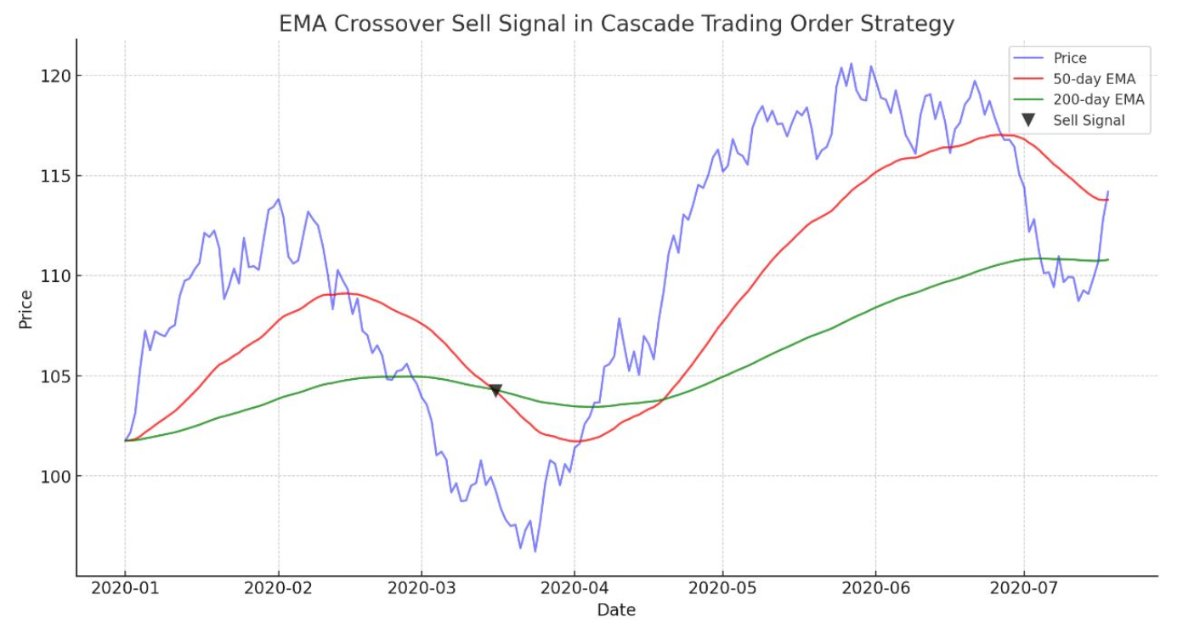
Cascade Order Trading Strategy Based on EMA Crossovers for MetaTrader 5
The article guides in demonstrating an automated algorithm based on EMA Crossovers for MetaTrader 5. Detailed information on all aspects of demonstrating an Expert Advisor in MQL5 and testing it in MetaTrader 5 - from analyzing price range behaviors to risk management.


How to create a simple Multi-Currency Expert Advisor using MQL5 (Part 6): Two RSI indicators cross each other's lines
The multi-currency expert advisor in this article is an expert advisor or trading robot that uses two RSI indicators with crossing lines, the Fast RSI which crosses with the Slow RSI.

Movement continuation model - searching on the chart and execution statistics
This article provides programmatic definition of one of the movement continuation models. The main idea is defining two waves — the main and the correction one. For extreme points, I apply fractals as well as "potential" fractals - extreme points that have not yet formed as fractals.

Graphics in DoEasy library (Part 83): Class of the abstract standard graphical object
In this article, I will create the class of the abstract graphical object. This object is to serve as a basis for creating the class of standard graphical objects. Graphical objects feature multiple properties. Therefore, I will need to do a lot of preparatory work before actually creating the abstract graphical object class. This work includes setting the properties in the library enumerations.


Introduction to Connexus (Part 1): How to Use the WebRequest Function?
This article is the beginning of a series of developments for a library called “Connexus” to facilitate HTTP requests with MQL5. The goal of this project is to provide the end user with this opportunity and show how to use this helper library. I intended to make it as simple as possible to facilitate study and to provide the possibility for future developments.


Creating a mean-reversion strategy based on machine learning
This article proposes another original approach to creating trading systems based on machine learning, using clustering and trade labeling for mean reversion strategies.


DoEasy. Controls (Part 1): First steps
This article starts an extensive topic of creating controls in Windows Forms style using MQL5. My first object of interest is creating the panel class. It is already becoming difficult to manage things without controls. Therefore, I will create all possible controls in Windows Forms style.

Graphics in DoEasy library (Part 86): Graphical object collection - managing property modification
In this article, I will consider tracking property value modification, as well as removing and renaming graphical objects in the library.