MQL4 and MQL5 Programming Articles

Study the MQL5 language for programming trading strategies in numerous published articles mostly written by you - the community members. The articles are grouped into categories to help you quicker find answers to any questions related to programming: Integration, Tester, Trading Strategies, etc.
Follow our new publications and discuss them on the Forum!
Add a new article

You are missing trading opportunities:
- Free trading apps
- Over 8,000 signals for copying
- Economic news for exploring financial markets
Registration
Log in
You agree to website policy and terms of use
If you do not have an account, please register


Reading RSS News Feeds by Means of MQL4
This article deals with an example of reading RSS markup by means of MQL4 using the functions for HTML tags analysis. We will try to make a work piece which can then be turned into a news indicator or just an RSS reader on MQL4 language.


Adaptive indicators
In this article, I will consider several possible approaches to creating adaptive indicators. Adaptive indicators are distinguished by the presence of feedback between the values of the input and output signals. This feedback allows the indicator to independently adjust to the optimal processing of financial time series values.

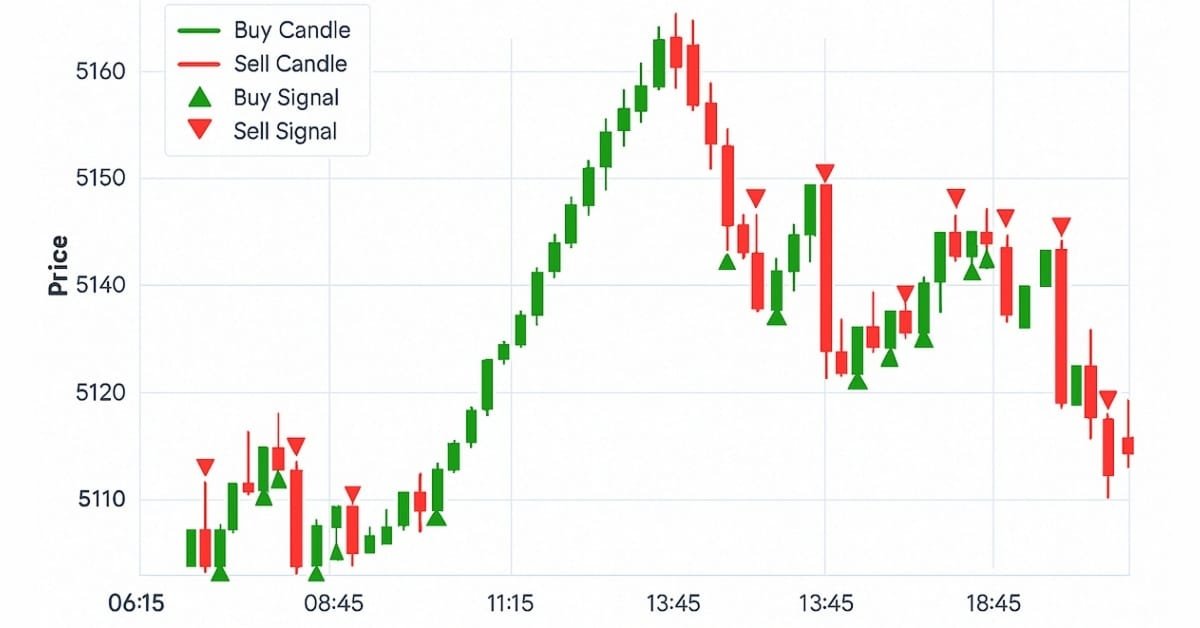
Price Action Analysis Toolkit Development (Part 32): Python Candlestick Recognition Engine (II) — Detection Using Ta-Lib
In this article, we’ve transitioned from manually coding candlestick‑pattern detection in Python to leveraging TA‑Lib, a library that recognizes over sixty distinct patterns. These formations offer valuable insights into potential market reversals and trend continuations. Follow along to learn more.

Graphics in DoEasy library (Part 78): Animation principles in the library. Image slicing
In this article, I will define the animation principles to be used in some parts of the library. I will also develop a class for copying a part of the image and pasting it to a specified form object location while preserving and restoring the part of the form background the image is to be superimposed on.

Learn how to design a trading system by OBV
This is a new article to continue our series for beginners about how to design a trading system based on some of the popular indicators. We will learn a new indicator that is On Balance Volume (OBV), and we will learn how we can use it and design a trading system based on it.

MQL5 Cookbook: Handling BookEvent
This article considers BookEvent - a Depth of Market event, and the principle of its processing. An MQL program, handling states of Depth of Market, serves as an example. It is written using the object-oriented approach. Results of handling are displayed on the screen as a panel and Depth of Market levels.

Three Aspects of Manual Trading Automation. Part 1: Trading
This article is the first in a series of articles on manual trading automation in the МetaТrader 4 trading platform. Each of the articles will be devoted to one of the following aspects: automation of manual trading, current state of trade display automation and automation of reports on trade results. In this article, I will present an interesting approach to creating EA's controlled manually by a trader.

How to visualize multicurrency trading history based on HTML and CSV reports
Since its introduction, MetaTrader 5 provides multicurrency testing options. This possibility is often used by traders. However the function is not universal. The article presents several programs for drawing graphical objects on charts based on HTML and CSV trading history reports. Multicurrency trading can be analyzed in parallel, in several sub-windows, as well as in one window using the dynamic switching command.


Larry Williams Market Secrets (Part 4): Automating Short-Term Swing Highs and Lows in MQL5
Master the automation of Larry Williams’ short-term swing patterns using MQL5. In this guide, we develop a fully configurable Expert Advisor (EA) that leverages non-random market structures. We’ll cover how to integrate robust risk management and flexible exit logic, providing a solid foundation for systematic strategy development and backtesting.

Other classes in DoEasy library (Part 66): MQL5.com Signals collection class
In this article, I will create the signal collection class of the MQL5.com Signals service with the functions for managing signals. Besides, I will improve the Depth of Market snapshot object class for displaying the total DOM buy and sell volumes.

Breakpoints in Tester: It's Possible!
The article deals with breakpoint emulation when passed through Tester, debug information being displayed.


Trading with the MQL5 Economic Calendar (Part 1): Mastering the Functions of the MQL5 Economic Calendar
In this article, we explore how to use the MQL5 Economic Calendar for trading by first understanding its core functionalities. We then implement key functions of the Economic Calendar in MQL5 to extract relevant news data for trading decisions. Finally, we conclude by showcasing how to utilize this information to enhance trading strategies effectively.

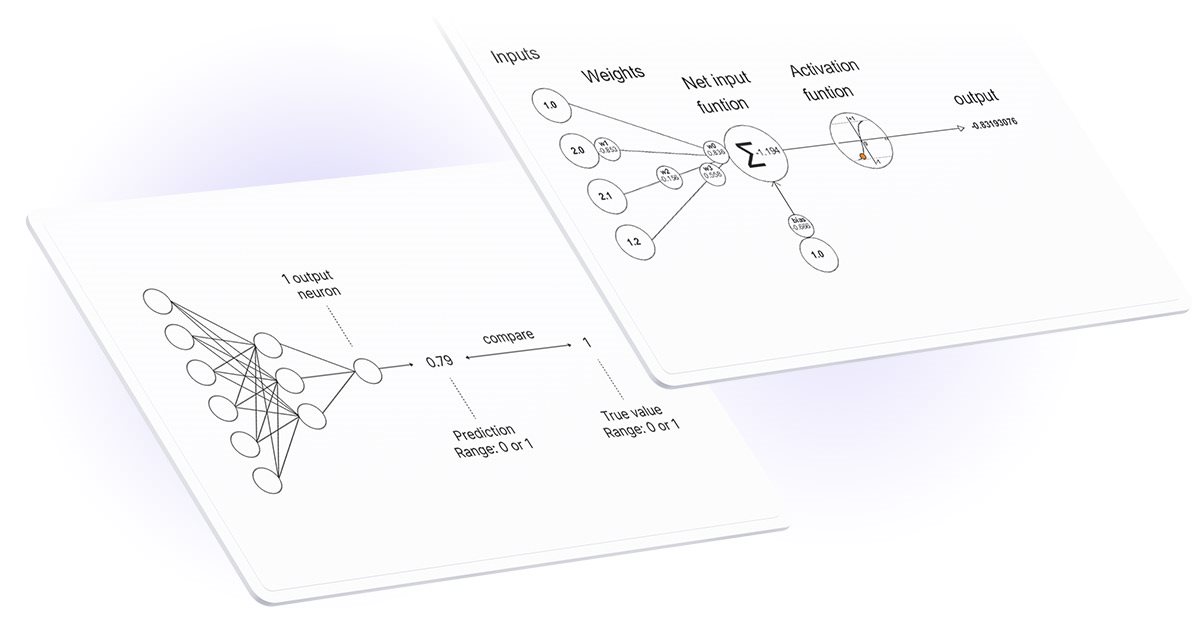
Matrix and Vector operations in MQL5
Matrices and vectors have been introduced in MQL5 for efficient operations with mathematical solutions. The new types offer built-in methods for creating concise and understandable code that is close to mathematical notation. Arrays provide extensive capabilities, but there are many cases in which matrices are much more efficient.

An Example of Developing a Spread Strategy for Moscow Exchange Futures
The MetaTrader 5 platform allows developing and testing trading robots that simultaneously trade multiple financial instruments. The built-in Strategy Tester automatically downloads required tick history from the broker's server taking into account contract specifications, so the developer does not need to do anything manually. This makes it possible to easily and reliably reproduce trading environment conditions, including even millisecond intervals between the arrival of ticks on different symbols. In this article we will demonstrate the development and testing of a spread strategy on two Moscow Exchange futures.


Experiments with neural networks (Part 1): Revisiting geometry
In this article, I will use experimentation and non-standard approaches to develop a profitable trading system and check whether neural networks can be of any help for traders.


MetaTrader 5 Machine Learning Blueprint (Part 2): Labeling Financial Data for Machine Learning
In this second installment of the MetaTrader 5 Machine Learning Blueprint series, you’ll discover why simple labels can lead your models astray—and how to apply advanced techniques like the Triple-Barrier and Trend-Scanning methods to define robust, risk-aware targets. Packed with practical Python examples that optimize these computationally intensive techniques, this hands-on guide shows you how to transform noisy market data into reliable labels that mirror real-world trading conditions.


Neural networks made easy (Part 5): Multithreaded calculations in OpenCL
We have earlier discussed some types of neural network implementations. In the considered networks, the same operations are repeated for each neuron. A logical further step is to utilize multithreaded computing capabilities provided by modern technology in an effort to speed up the neural network learning process. One of the possible implementations is described in this article.

Controlling the Slope of Balance Curve During Work of an Expert Advisor
Finding rules for a trade system and programming them in an Expert Advisor is a half of the job. Somehow, you need to correct the operation of the Expert Advisor as it accumulates the results of trading. This article describes one of approaches, which allows improving performance of an Expert Advisor through creation of a feedback that measures slope of the balance curve.

Technical Indicators and Digital Filters
In this article, technical indicators are treated as digital filters. Operation principles and basic characteristics of digital filters are explained. Also, some practical ways of receiving the filter kernel in MetaTrader 5 terminal and integration with a ready-made spectrum analyzer proposed in the article "Building a Spectrum Analyzer" are considered. Pulse and spectrum characteristics of the typical digital filters are used as examples.


Building a Professional Trading System with Heikin Ashi (Part 2): Developing an EA
This article explains how to develop a professional Heikin Ashi-based Expert Advisor (EA) in MQL5. You will learn how to set up input parameters, enumerations, indicators, global variables, and implement the core trading logic. You will also be able to run a backtest on gold to validate your work.

Learn how to design a trading system by Accelerator Oscillator
A new article from our series about how to create simple trading systems by the most popular technical indicators. We will learn about a new one which is the Accelerator Oscillator indicator and we will learn how to design a trading system using it.


How to integrate Smart Money Concepts (OB) coupled with Fibonacci indicator for Optimal Trade Entry
The SMC (Order Block) are key areas where institutional traders initiate significant buying or selling. After a significant price move, fibonacci helps to identify potential retracement from a recent swing high to a swing low to identify optimal trade entry.

MQL5 Cookbook: Using Different Print Modes
This is the first article of the MQL5 Cookbook series. I will start with simple examples to allow those who are taking their first steps in programming to gradually become familiar with the new language. I remember my first efforts at designing and programming trading systems which I may say was quite difficult, given the fact that it was the first programming language in my life. However, it turned out to be easier than I thought and it only took me a few months before I could develop a fairly complex program.


Build Self Optimizing Expert Advisors in MQL5 (Part 4): Dynamic Position Sizing
Successfully employing algorithmic trading requires continuous, interdisciplinary learning. However, the infinite range of possibilities can consume years of effort without yielding tangible results. To address this, we propose a framework that gradually introduces complexity, allowing traders to refine their strategies iteratively rather than committing indefinite time to uncertain outcomes.


Automating Trading Strategies in MQL5 (Part 4): Building a Multi-Level Zone Recovery System
In this article, we develop a Multi-Level Zone Recovery System in MQL5 that utilizes RSI to generate trading signals. Each signal instance is dynamically added to an array structure, allowing the system to manage multiple signals simultaneously within the Zone Recovery logic. Through this approach, we demonstrate how to handle complex trade management scenarios effectively while maintaining a scalable and robust code design.

Graphics in DoEasy library (Part 73): Form object of a graphical element
The article opens up a new large section of the library for working with graphics. In the current article, I will create the mouse status object, the base object of all graphical elements and the class of the form object of the library graphical elements.

MQL5 Cookbook: Indicator Subwindow Controls - Scrollbar
Let's continue exploring various controls and this time turn our attention to scrollbar. Just like in the previous article entitled "MQL5 Cookbook: Indicator Subwindow Controls - Buttons", all operations will be performed in the indicator subwindow. Take a moment to read the above mentioned article as it provides a detailed description of working with events in the OnChartEvent() function, while this point will only be casually touched upon in this article. For illustrative purposes, this time around we will create a vertical scrollbar for a large list of all financial instrument properties that can be obtained using MQL5 resources.

Library for easy and quick development of MetaTrader programs (part III). Collection of market orders and positions, search and sorting
In the first part, we started creating a large cross-platform library simplifying the development of programs for MetaTrader 5 and MetaTrader 4 platforms. Further on, we implemented the collection of history orders and deals. Our next step is creating a class for a convenient selection and sorting of orders, deals and positions in collection lists. We are going to implement the base library object called Engine and add collection of market orders and positions to the library.

Library for easy and quick development of MetaTrader programs (part XI). Compatibility with MQL4 - Position closure events
We continue the development of a large cross-platform library simplifying the development of programs for MetaTrader 5 and MetaTrader 4 platforms. In the tenth part, we resumed our work on the library compatibility with MQL4 and defined the events of opening positions and activating pending orders. In this article, we will define the events of closing positions and get rid of the unused order properties.


Formulating Dynamic Multi-Pair EA (Part 5): Scalping vs Swing Trading Approaches
This part explores how to design a Dynamic Multi-Pair Expert Advisor capable of adapting between Scalping and Swing Trading modes. It covers the structural and algorithmic differences in signal generation, trade execution, and risk management, allowing the EA to intelligently switch strategies based on market behavior and user input.


Neural networks made easy (Part 26): Reinforcement Learning
We continue to study machine learning methods. With this article, we begin another big topic, Reinforcement Learning. This approach allows the models to set up certain strategies for solving the problems. We can expect that this property of reinforcement learning will open up new horizons for building trading strategies.

Changing the External Parameters of MQL4 Programs without Restarting
The article describes a method of changing the external parameters of MQL4 programs on-the-fly, without restarting.


How to Implement Auto Optimization in MQL5 Expert Advisors
Step by step guide for auto optimization in MQL5 for Expert Advisors. We will cover robust optimization logic, best practices for parameter selection, and how to reconstruct strategies with back-testing. Additionally, higher-level methods like walk-forward optimization will be discussed to enhance your trading approach.

Indicator Taichi - a Simple Idea of Formalizing the Values of Ichimoku Kinko Hyo
Hard to interpret Ichimoku signals? This article introduces some principles of formalizing values and signals of Ichimoku Kinko Hyo. For visualization of its usage the author chose the currency pair EURUSD based on his own preferences. However, the indicator can be used on any currency pair.

Pivot Points Helping to Define Market Trends
Pivot point is a line in the price chart that shows the further trend of a currency pair. If the price is above this line, it tends to grow. If the price is below this line, accordingly, it tends to fall.


Building and testing Keltner Channel trading systems
In this article, we will try to provide trading systems using a very important concept in the financial market which is volatility. We will provide a trading system based on the Keltner Channel indicator after understanding it and how we can code it and how we can create a trading system based on a simple trading strategy and then test it on different assets.

Extending MQL5 Standard Library and Reusing Code
MQL5 Standard Library makes your life as a developer easier. Nevertheless, it does not implement all the needs of all developers in the world, so if you feel that you need some more custom stuff you can take a step further and extend. This article walks you through integrating MetaQuotes' Zig-Zag technical indicator into the Standard Library. We get inspired by MetaQuotes' design philosophy to achieve our goal.


Price Action Analysis Toolkit Development (Part 52): Master Market Structure with Multi-Timeframe Visual Analysis
This article presents the Multi‑Timeframe Visual Analyzer, an MQL5 Expert Advisor that reconstructs and overlays higher‑timeframe candles directly onto your active chart. It explains the implementation, key inputs, and practical outcomes, supported by an animated demo and chart examples showing instant toggling, multi‑timeframe confirmation, and configurable alerts. Read on to see how this tool can make chart analysis faster, clearer, and more efficient.

Research of Statistical Recurrences of Candle Directions
Is it possible to predict the behavior of the market for a short upcoming interval of time, based on the recurring tendencies of candle directions, at specific times throughout the day? That is, If such an occurrence is found in the first place. This question has probably arisen in the mind of every trader. The purpose of this article is to attempt to predict the behavior of the market, based on the statistical recurrences of candle directions during specific intervals of time.


Brute force approach to pattern search (Part III): New horizons
This article provides a continuation to the brute force topic, and it introduces new opportunities for market analysis into the program algorithm, thereby accelerating the speed of analysis and improving the quality of results. New additions enable the highest-quality view of global patterns within this approach.