MQL4 and MQL5 Programming Articles

Study the MQL5 language for programming trading strategies in numerous published articles mostly written by you - the community members. The articles are grouped into categories to help you quicker find answers to any questions related to programming: Integration, Tester, Trading Strategies, etc.
Follow our new publications and discuss them on the Forum!
Add a new article

You are missing trading opportunities:
- Free trading apps
- Over 8,000 signals for copying
- Economic news for exploring financial markets
Registration
Log in
You agree to website policy and terms of use
If you do not have an account, please register


Custom Debugging and Profiling Tools for MQL5 Development (Part I): Advanced Logging
Learn how to implement a powerful custom logging framework for MQL5 that goes beyond simple Print() statements by supporting severity levels, multiple output handlers, and automated file rotation—all configurable on‐the‐fly. Integrate the singleton CLogger with ConsoleLogHandler and FileLogHandler to capture contextual, timestamped logs in both the Experts tab and persistent files. Streamline debugging and performance tracing in your Expert Advisors with clear, customizable log formats and centralized control.


Quantitative approach to risk management: Applying VaR model to optimize multi-currency portfolio using Python and MetaTrader 5
This article explores the potential of the Value at Risk (VaR) model for multi-currency portfolio optimization. Using the power of Python and the functionality of MetaTrader 5, we demonstrate how to implement VaR analysis for efficient capital allocation and position management. From theoretical foundations to practical implementation, the article covers all aspects of applying one of the most robust risk calculation systems – VaR – in algorithmic trading.


Self Optimizing Expert Advisors in MQL5 (Part 8): Multiple Strategy Analysis (2)
Join us for our follow-up discussion, where we will merge our first two trading strategies into an ensemble trading strategy. We shall demonstrate the different schemes possible for combining multiple strategies and also how to exercise control over the parameter space, to ensure that effective optimization remains possible even as our parameter size grows.


Developing a multi-currency Expert Advisor (Part 16): Impact of different quote histories on test results
The EA under development is expected to show good results when trading with different brokers. But for now we have been using quotes from a MetaQuotes demo account to perform tests. Let's see if our EA is ready to work on a trading account with different quotes compared to those used during testing and optimization.


MQL5 Wizard Techniques you should know (Part 69): Using Patterns of SAR and the RVI
The Parabolic-SAR (SAR) and the Relative Vigour Index (RVI) are another pair of indicators that could be used in conjunction within an MQL5 Expert Advisor. This indicator pair, like those we’ve covered in the past, is also complementary since SAR defines the trend while RVI checks momentum. As usual, we use the MQL5 wizard to build and test any potential this indicator pairing may have.


Market Simulation (Part 20): First steps with SQL (III)
Although we can perform operations on a database containing about 10 records, the material is absorbed much better when we work with a file that contains more than 15 thousand records. That is, if we tried to create such a database manually, this task would be enormous. However, it is difficult to find such a database, even for educational purposes, that is available for download. But in reality, we don’t need to resort to that — we can use MetaTrader 5 to create a database for ourselves. In today's article, we will look at how to do this.


Triangular and Sawtooth Waves: Analytical Tools for Traders
Wave analysis is one of the methods used in technical analysis. This article focuses on two less conventional wave patterns: triangular and sawtooth waves. These formations underpin a number of technical indicators designed for market price analysis.


Introduction to MQL5 (Part 22): Building an Expert Advisor for the 5-0 Harmonic Pattern
This article explains how to detect and trade the 5-0 harmonic pattern in MQL5, validate it using Fibonacci levels, and display it on the chart.


Developing a Replay System — Market simulation (Part 09): Custom events
Here we'll see how custom events are triggered and how the indicator reports the state of the replay/simulation service.


Fibonacci in Forex (Part I): Examining the Price-Time Relationship
How does the market observe Fibonacci-based relationships? This sequence, where each subsequent number is equal to the sum of the two previous ones (1, 1, 2, 3, 5, 8, 13, 21...), not only describes the growth of the rabbit population. We will consider the Pythagorean hypothesis that everything in the world is subject to certain relationships of numbers...


Developing a Replay System (Part 26): Expert Advisor project — C_Terminal class
We can now start creating an Expert Advisor for use in the replay/simulation system. However, we need something improved, not a random solution. Despite this, we should not be intimidated by the initial complexity. It's important to start somewhere, otherwise we end up ruminating about the difficulty of a task without even trying to overcome it. That's what programming is all about: overcoming obstacles through learning, testing, and extensive research.


Markov Chain-Based Matrix Forecasting Model
We are going to create a matrix forecasting model based on a Markov chain. What are Markov chains, and how can we use a Markov chain for Forex trading?


The MQL5 Standard Library Explorer (Part 7): Interactive Position Labeling with CCanvas
In this article, we explore how to build a position information visualization tool using the MQL5 Standard Library’s CCanvas. This project strengthens your skills in working with library modules while providing traders with a practical tool to visualize and interact with open positions directly on a live chart. Join the discussion to learn more.


How to Detect and Normalize Chart Objects in MQL5 (Part 1): Building a Chart Object Detection Engine
This article addresses the interpretative gap between visual chart objects and algorithmic execution. You will build a systematic detector that iterates over all chart objects, identifies analytical types, and normalises their geometric data (time and price coordinates) into a structured SChartObjectInfo array. The implementation uses raw MQL5 functions, a filter‑extract‑store pipeline, and a timer‑driven test EA, resulting in a reusable framework for rule‑based trading inputs.


From Basic to Intermediate: SWITCH Statement
In this article, we will learn how to use the SWITCH statement in its simplest and most basic form. The content presented here is intended solely for educational purposes. Under no circumstances should the application be viewed for any purpose other than to learn and master the concepts presented.


Formulating Dynamic Multi-Pair EA (Part 9): Market Microstructure Execution Noise Filtering
This article presents a multi-symbol execution filter that scores real-time market quality before any trade is allowed. It measures spread behavior, tick velocity, quote gaps, micro-volatility, and a slippage estimate, then classifies the state to block degraded conditions. Once noise settles, a liquidity sweep continuation model evaluates structure shifts so entries occur only when execution is mechanically stable.


Developing a multi-currency Expert Advisor (Part 15): Preparing EA for real trading
As we gradually approach to obtaining a ready-made EA, we need to pay attention to issues that seem secondary at the stage of testing a trading strategy, but become important when moving on to real trading.


How to Research a Trading Idea: A Range Breakout Strategy Case Study
This article demonstrates a practical approach to researching trading ideas using a range breakout strategy as an example. We will go through the entire process, from formalizing trading rules and building a baseline model to parameter optimization, forward testing, and evaluating the robustness of the results. The main goal of the article is to develop an understanding of how statistics and testing can be used to identify, validate, and evaluate trading hypotheses.


Population ADAM (Adaptive Moment Estimation)
The article presents the transformation of the well-known and popular ADAM gradient optimization method into a population algorithm and its modification with the introduction of hybrid individuals. The new approach allows creating agents that combine elements of successful decisions using probability distribution. The key innovation is the formation of hybrid population individuals that adaptively accumulate information from the most promising solutions, increasing the efficiency of search in complex multidimensional spaces.


Neural networks made easy (Part 78): Decoder-free Object Detector with Transformer (DFFT)
In this article, I propose to look at the issue of building a trading strategy from a different angle. We will not predict future price movements, but will try to build a trading system based on the analysis of historical data.

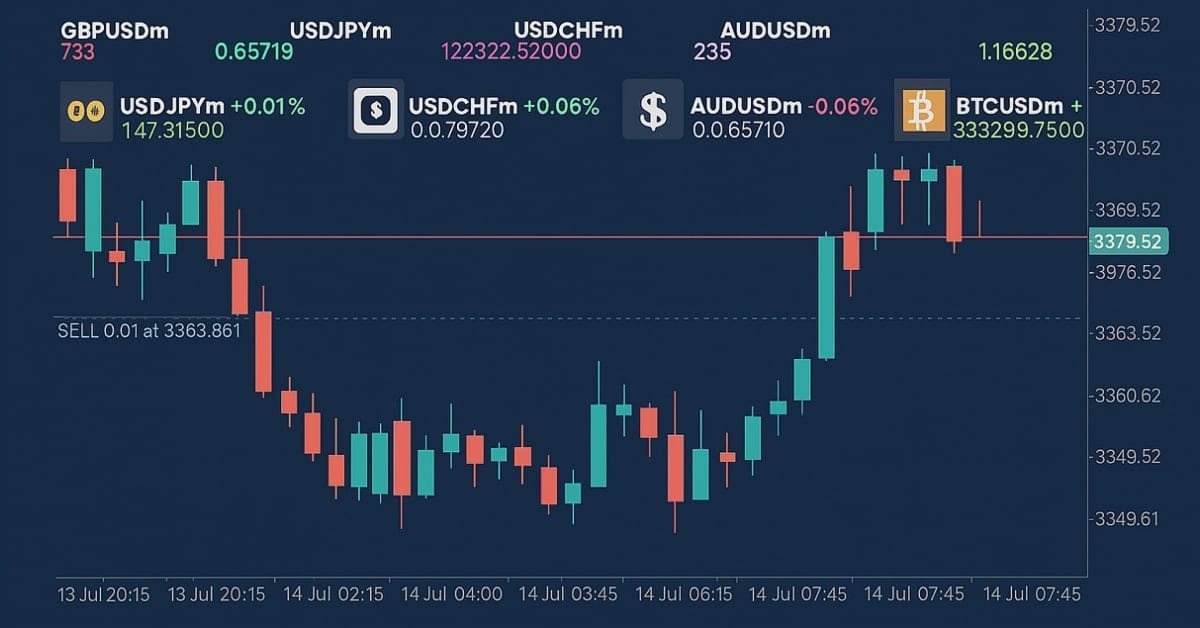
MQL5 Trading Tools (Part 5): Creating a Rolling Ticker Tape for Real-Time Symbol Monitoring
In this article, we develop a rolling ticker tape in MQL5 for real-time monitoring of multiple symbols, displaying bid prices, spreads, and daily percentage changes with scrolling effects. We implement customizable fonts, colors, and scroll speeds to highlight price movements and trends effectively.


Neural Network in Practice: The First Neuron
In this article, we'll start building something simple and humble: a neuron. We will program it with a very small amount of MQL5 code. The neuron worked great in my tests. Let's go back a bit in this series of articles about neural networks to understand what I'm talking about.


Atomic Orbital Search (AOS) algorithm
The article considers the Atomic Orbital Search (AOS) algorithm, which uses the concepts of the atomic orbital model to simulate the search for solutions. The algorithm is based on probability distributions and the dynamics of interactions in the atom. The article discusses in detail the mathematical aspects of AOS, including updating the positions of candidate solutions and the mechanisms of energy absorption and release. AOS opens new horizons for applying quantum principles to computing problems by offering an innovative approach to optimization.


From Novice to Expert: Backend Operations Monitor using MQL5
Using a ready-made solution in trading without concerning yourself with the internal workings of the system may sound comforting, but this is not always the case for developers. Eventually, an upgrade, misperformance, or unexpected error will arise, and it becomes essential to trace exactly where the issue originates to diagnose and resolve it quickly. Today’s discussion focuses on uncovering what normally happens behind the scenes of a trading Expert Advisor, and on developing a custom dedicated class for displaying and logging backend processes using MQL5. This gives both developers and traders the ability to quickly locate errors, monitor behavior, and access diagnostic information specific to each EA.


Interview with Andrei Moraru (ATC 2011)
Ukrainian programmer Andrei Moraru (enivid) is an active participant of the Automated Trading Championship beginning from 2007. Andrei had already come in our view at that time and now we have decided to find out if there occured any changes in his attitude towards trading and selection of trading strategies for the past four years, and also to know about his new Expert Advisor.


Reimagining Classic Strategies (Part X): Can AI Power The MACD?
Join us as we empirically analyzed the MACD indicator, to test if applying AI to a strategy, including the indicator, would yield any improvements in our accuracy on forecasting the EURUSD. We simultaneously assessed if the indicator itself is easier to predict than price, as well as if the indicator's value is predictive of future price levels. We will furnish you with the information you need to decide whether you should consider investing your time into integrating the MACD in your AI trading strategies.


MQL5 Wizard Techniques you should know (Part 43): Reinforcement Learning with SARSA
SARSA, which is an abbreviation for State-Action-Reward-State-Action is another algorithm that can be used when implementing reinforcement learning. So, as we saw with Q-Learning and DQN, we look into how this could be explored and implemented as an independent model rather than just a training mechanism, in wizard assembled Expert Advisors.


Larry Williams Market Secrets (Part 10): Automating Smash Day Reversal Patterns
We implement Larry Williams’ Smash Day reversal patterns in MQL5 by building a rule-based Expert Advisor with dynamic risk management, breakout confirmation logic, and one trade at a time execution. Readers can backtest, reproduce, and study parameter effects using the MetaTrader 5 Strategy Tester and the provided source.


Foundation Models in Trading: Time Series Forecasting with Google's TimesFM 2.5 in MetaTrader 5
Time series forecasting in trading has evolved from traditional statistical models (like ARIMA) to deep learning approaches, but both require heavy tuning and training. Inspired by advances in NLP, Google’s TimesFM introduces a pretrained “foundation model” for time series that can perform strong forecasts even without task-specific training. For traders, this is powerful because it can be efficiently fine-tuned on their own data using lightweight methods like LoRA, reducing overfitting while adapting to changing market conditions.


Developing a Replay System — Market simulation (Part 11): Birth of the SIMULATOR (I)
In order to use the data that forms the bars, we must abandon replay and start developing a simulator. We will use 1 minute bars because they offer the least amount of difficulty.


DoEasy. Service functions (Part 3): Outside Bar pattern
In this article, we will develop the Outside Bar Price Action pattern in the DoEasy library and optimize the methods of access to price pattern management. In addition, we will fix errors and shortcomings identified during library tests.


From Novice to Expert: Animated News Headline Using MQL5 (III) — Indicator Insights
In this article, we’ll advance the News Headline EA by introducing a dedicated indicator insights lane—a compact, on-chart display of key technical signals generated from popular indicators such as RSI, MACD, Stochastic, and CCI. This approach eliminates the need for multiple indicator subwindows on the MetaTrader 5 terminal, keeping your workspace clean and efficient. By leveraging the MQL5 API to access indicator data in the background, we can process and visualize market insights in real-time using custom logic. Join us as we explore how to manipulate indicator data in MQL5 to create an intelligent and space-saving scrolling insights system, all within a single horizontal lane on your trading chart.


Build Self Optimizing Expert Advisors in MQL5 (Part 7): Trading With Multiple Periods At Once
In this series of articles, we have considered multiple different ways of identifying the best period to use our technical indicators with. Today, we shall demonstrate to the reader how they can instead perform the opposite logic, that is to say, instead of picking the single best period to use, we will demonstrate to the reader how to employ all available periods effectively. This approach reduces the amount of data discarded, and offers alternative use cases for machine learning algorithms beyond ordinary price prediction.


Neural networks made easy (Part 45): Training state exploration skills
Training useful skills without an explicit reward function is one of the main challenges in hierarchical reinforcement learning. Previously, we already got acquainted with two algorithms for solving this problem. But the question of the completeness of environmental research remains open. This article demonstrates a different approach to skill training, the use of which directly depends on the current state of the system.


Category Theory in MQL5 (Part 5): Equalizers
Category Theory is a diverse and expanding branch of Mathematics which is only recently getting some coverage in the MQL5 community. These series of articles look to explore and examine some of its concepts & axioms with the overall goal of establishing an open library that provides insight while also hopefully furthering the use of this remarkable field in Traders' strategy development.


Category Theory in MQL5 (Part 22): A different look at Moving Averages
In this article we attempt to simplify our illustration of concepts covered in these series by dwelling on just one indicator, the most common and probably the easiest to understand. The moving average. In doing so we consider significance and possible applications of vertical natural transformations.


How can century-old functions update your trading strategies?
This article considers the Rademacher and Walsh functions. We will explore ways to apply these functions to financial time series analysis and also consider various applications for them in trading.


Neural Networks in Trading: Dual Clustering of Multivariate Time Series (DUET)
The DUET framework offers an innovative approach to time series analysis, combining temporal and channel clustering to uncover hidden patterns in the analyzed data. This allows models to adapt to changes over time and improve forecasting quality by eliminating noise.


Cross-validation and basics of causal inference in CatBoost models, export to ONNX format
The article proposes the method of creating bots using machine learning.


From Novice to Expert: Extending a Liquidity Strategy with Trend Filters
The article extends a liquidity-based strategy with a simple trend constraint: trade liquidity zones only in the direction of the EMA(50). It explains filtering rules, presents a reusable TrendFilter.mqh class and EA integration in MQL5, and compares baseline versus filtered tests. Readers gain a clear directional bias, reduced overtrading in countertrend phases, and ready-to-use source files.