

Automatización de estrategias de trading en MQL5 (Parte 19): Estrategia de scalping Trend Bounce con envolventes: Ejecución de operaciones y gestión del riesgo (Parte II)
 365
365
 0
0

Introducción
En nuestro artículo anterior (Parte 18), sentamos las bases para la estrategia de scalping «Envelopes» basada en rebotes de tendencia en MetaQuotes Language 5 (MQL5), creando la infraestructura básica del asesor experto y la lógica de generación de señales. Ahora, en la parte 19, damos un paso más al implementar la ejecución de operaciones y la gestión de riesgos para automatizar la estrategia por completo. Trataremos los siguientes temas:
- Hoja de ruta estratégica y arquitectura
- Implementación en MQL5
- Backtesting y optimización
- Conclusión
Al final, tendrás un sistema de trading completo en MQL5 para operar con rebotes de tendencia mediante scalping, optimizado para ofrecer el máximo rendimiento. ¡Empecemos!
Hoja de ruta estratégica y arquitectura
En la parte 18, sentamos las bases de la estrategia de scalping «Envelopes Trend Bounce», configurando el sistema para detectar señales de trading a partir de las interacciones del precio con el indicador «Envelopes», confirmadas por filtros de tendencia como las medias móviles y el RSI. Nos centramos en construir la infraestructura para supervisar las condiciones del mercado e identificar posibles oportunidades de trading, pero no habilitamos el sistema para ejecutar operaciones ni gestionar riesgos. Nuestra hoja de ruta para la Parte 19 se centra en la activación de la ejecución de operaciones y la implementación de la gestión de riesgos para garantizar que la estrategia pueda actuar sobre las señales de manera eficaz y segura.
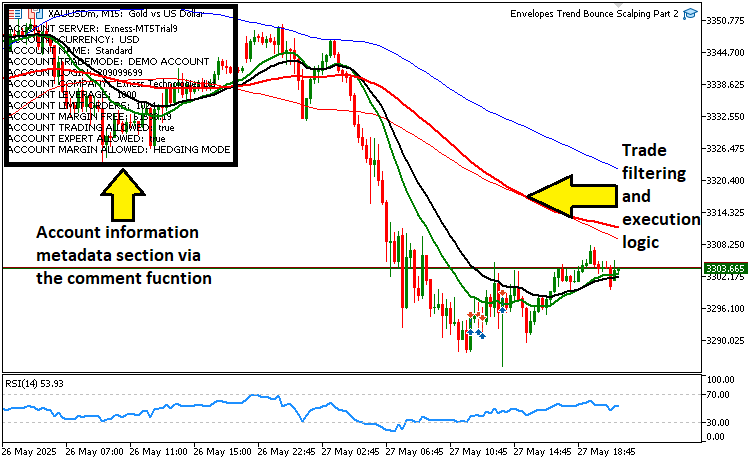
Nuestro plan arquitectónico prioriza un enfoque modular, estableciendo un proceso claro para convertir las señales en operaciones al tiempo que incorpora medidas de seguridad. Nuestro objetivo es desarrollar un mecanismo para realizar órdenes de compra y venta basadas en señales validadas, junto con un marco de gestión de riesgos que establezca niveles de stop-loss y take-profit, ajuste el tamaño de las posiciones en función del saldo de la cuenta y limite las pérdidas totales para proteger el capital. Este diseño dará lugar a un sistema de scalping automatizado y coherente. Definiremos algunas clases más para gestionar las operaciones e integraremos toda la funcionalidad en el procesamiento de ticks para que todo funcione correctamente. En resumen, esto es lo que pretendemos lograr.
Implementación en MQL5
Para crear el programa en MQL5, abre el MetaEditor, ve al Navegador, busca la carpeta «Experts», haz clic en la pestaña «Nuevo» y sigue las instrucciones para crear el archivo. Una vez creado, en el entorno de programación tendremos que declarar algunas interfaces y clases para mejorar la generación de señales, la organización y la gestión de operaciones. Empecemos por la interfaz básica de expresión de señales.
//--- Define interface for strategy signal expressions
interface IAdvisorStrategyExpression {
   bool Evaluate();                                       //--- Evaluate signal
   bool GetFireOnlyWhenReset();                           //--- Retrieve fire-only-when-reset flag
   void SetFireOnlyWhenReset(bool value);                 //--- Set fire-only-when-reset flag
   void ResetSignalValue();                               //--- Reset signal value
};

//--- Define base class for advisor signals
class ASSignal : public IAdvisorStrategyExpression {
private:
   bool _fireOnlyWhenReset;                               //--- Store fire-only-when-reset flag
   int _previousSignalValue;                              //--- Store previous signal value
   int _signalValue;                                      //--- Store current signal value

protected:
   //--- Declare pure virtual method for signal evaluation
   bool virtual EvaluateSignal() = 0;                      //--- Require derived classes to implement

public:
   //--- Initialize signal
   void ASSignal() {
      _fireOnlyWhenReset = false;                         //--- Set fire-only-when-reset to false
      _previousSignalValue = -1;                          //--- Set previous value to -1
      _signalValue = -1;                                  //--- Set current value to -1
   }

   //--- Evaluate signal
   bool Evaluate() {
      if (_signalValue == -1) {                           //--- Check if signal uncomputed
         _signalValue = EvaluateSignal();                 //--- Compute signal
      }
      if (_fireOnlyWhenReset) {                           //--- Check fire-only-when-reset
         return (_previousSignalValue <= 0 && _signalValue == 1); //--- Return true if signal transitions to 1
      } else {
         return _signalValue == 1;                        //--- Return true if signal is 1
      }
   }

   //--- Retrieve fire-only-when-reset flag
   bool GetFireOnlyWhenReset() {
      return _fireOnlyWhenReset;                          //--- Return flag
   }

   //--- Set fire-only-when-reset flag
   void SetFireOnlyWhenReset(bool value) {
      _fireOnlyWhenReset = value;                         //--- Set flag
   }

   //--- Reset signal value
   void ResetSignalValue() {
      _previousSignalValue = _signalValue;                //--- Store current as previous
      _signalValue = -1;                                  //--- Reset current value
   }
};
Para establecer un marco optimizado para el manejo de señales de trading, nos centramos en un sistema de evaluación de señales modular y fiable. Comenzamos definiendo la interfaz "IAdvisorStrategyExpression", que utilizamos para crear un modelo coherente para las operaciones de señalización. Esta interfaz incluye cuatro funciones clave: la función "Evaluate" para determinar si una señal está activa, la función "GetFireOnlyWhenReset" para comprobar un indicador que controla los disparadores de señal, la función "SetFireOnlyWhenReset" para modificar este indicador y la función "ResetSignalValue" para borrar el estado de la señal para evaluaciones posteriores.
A continuación, desarrollamos la clase «ASSignal», que diseñamos para que implemente la interfaz «IAdvisorStrategyExpression» y que servirá de base para los tipos de señales específicos de nuestra estrategia. Dentro de la clase «ASSignal», definimos tres variables privadas: «_fireOnlyWhenReset», para controlar si las señales se activan únicamente tras un reinicio; «_previousSignalValue», para registrar el estado anterior de la señal; y «_signalValue», para almacenar el estado actual. Los inicializamos en la «ASSignal» constructor de la clase, estableciendo «_fireOnlyWhenReset» en false y tanto «_previousSignalValue» como «_signalValue» en -1, lo que indica un estado no calculado. Nuestra función «Evaluate» comprueba si «_signalValue» es -1, invocando la función virtual pura «EvaluateSignal» (que se definirá en las clases derivadas) para calcular la señal, y devuelve «true» en función de «_fireOnlyWhenReset»: bien cuando «_signalValue» es 1, bien cuando se produce una transición de un «_previousSignalValue» no positivo a 1.
Para gestionar el comportamiento de las señales, implementamos la función «GetFireOnlyWhenReset» para recuperar el valor del indicador «_fireOnlyWhenReset» y la función «SetFireOnlyWhenReset» para actualizarlo, lo que nos permite ajustar con precisión cuándo se activan las señales. También incluimos la función «ResetSignalValue», que utilizamos para almacenar «_signalValue» en «_previousSignalValue» y restablecer «_signalValue» a -1, preparándonos así para el siguiente ciclo de evaluación. Al marcar «EvaluateSignal» como método virtual puro, exigimos que las clases derivadas proporcionen una lógica de señal específica, lo que garantiza la flexibilidad. Ahora podemos definir algunas clases más para la lógica de gestión de señales.
//--- Define class for managing trade signals
class TradeSignalCollection {
private:
   IAdvisorStrategyExpression* _tradeSignals[];           //--- Store array of signal pointers
   int _pointer;                                          //--- Track current iteration index
   int _size;                                             //--- Track number of signals

public:
   //--- Initialize empty signal collection
   void TradeSignalCollection() {
      _pointer = -1;                                      //--- Set initial pointer to -1
      _size = 0;                                          //--- Set initial size to 0
   }

   //--- Destructor to clean up signals
   void ~TradeSignalCollection() {
      for (int i = 0; i < ArraySize(_tradeSignals); i++) { //--- Iterate signals
         delete(_tradeSignals[i]);                        //--- Delete each signal
      }
   }

   //--- Add signal to collection
   void Add(IAdvisorStrategyExpression* item) {
      _size = _size + 1;                                  //--- Increment size
      ArrayResize(_tradeSignals, _size, 8);               //--- Resize array with reserve
      _tradeSignals[(_size - 1)] = item;                  //--- Store signal at last index
   }

   //--- Remove signal at index
   IAdvisorStrategyExpression* Remove(int index) {
      IAdvisorStrategyExpression* removed = NULL;         //--- Initialize removed signal as null
      if (index >= 0 && index < _size) {                  //--- Check valid index
         removed = _tradeSignals[index];                  //--- Store signal to remove
         for (int i = index; i < (_size - 1); i++) {      //--- Shift signals left
            _tradeSignals[i] = _tradeSignals[i + 1];      //--- Move signal
         }
         ArrayResize(_tradeSignals, ArraySize(_tradeSignals) - 1, 8); //--- Reduce array size
         _size = _size - 1;                               //--- Decrement size
      }
      return removed;                                     //--- Return removed signal or null
   }

   //--- Retrieve signal at index
   IAdvisorStrategyExpression* Get(int index) {
      if (index >= 0 && index < _size) {                  //--- Check valid index
         return _tradeSignals[index];                     //--- Return signal
      }
      return NULL;                                        //--- Return null for invalid index
   }

   //--- Retrieve number of signals
   int Count() {
      return _size;                                       //--- Return current size
   }

   //--- Reset iterator to start
   void Rewind() {
      _pointer = -1;                                      //--- Set pointer to -1
   }

   //--- Move to next signal
   IAdvisorStrategyExpression* Next() {
      _pointer++;                                         //--- Increment pointer
      if (_pointer == _size) {                            //--- Check if at end
         Rewind();                                        //--- Reset pointer
         return NULL;                                     //--- Return null
      }
      return Current();                                   //--- Return current signal
   }

   //--- Move to previous signal
   IAdvisorStrategyExpression* Prev() {
      _pointer--;                                         //--- Decrement pointer
      if (_pointer == -1) {                               //--- Check if before start
         return NULL;                                     //--- Return null
      }
      return Current();                                   //--- Return current signal
   }

   //--- Check if more signals exist
   bool HasNext() {
      return (_pointer < (_size - 1));                    //--- Return true if pointer is before end
   }

   //--- Retrieve current signal
   IAdvisorStrategyExpression* Current() {
      return _tradeSignals[_pointer];                     //--- Return signal at pointer
   }

   //--- Retrieve current iterator index
   int Key() {
      return _pointer;                                    //--- Return current pointer
   }
};

//--- Define class for managing trading signals
class AdvisorStrategy {
private:
   TradeSignalCollection* _openBuySignals;                //--- Store open Buy signals
   TradeSignalCollection* _openSellSignals;               //--- Store open Sell signals
   TradeSignalCollection* _closeBuySignals;               //--- Store close Buy signals
   TradeSignalCollection* _closeSellSignals;              //--- Store close Sell signals

   //--- Evaluate signal at specified level
   bool EvaluateASLevel(TradeSignalCollection* signals, int level) {
      if (level > 0 && level <= signals.Count()) {        //--- Check valid level
         return signals.Get(level - 1).Evaluate();        //--- Evaluate signal
      }
      return false;                                       //--- Return false for invalid level
   }

public:
   //--- Initialize strategy
   void AdvisorStrategy() {
      _openBuySignals = new TradeSignalCollection();      //--- Create open Buy signals collection
      _openSellSignals = new TradeSignalCollection();     //--- Create open Sell signals collection
      _closeBuySignals = new TradeSignalCollection();     //--- Create close Buy signals collection
      _closeSellSignals = new TradeSignalCollection();    //--- Create close Sell signals collection
   }

   //--- Destructor to clean up signals
   void ~AdvisorStrategy() {
      delete(_openBuySignals);                            //--- Delete open Buy signals
      delete(_openSellSignals);                           //--- Delete open Sell signals
      delete(_closeBuySignals);                           //--- Delete close Buy signals
      delete(_closeSellSignals);                          //--- Delete close Sell signals
   }

   //--- Retrieve trading advice
   bool GetAdvice(TradeAction tradeAction, int level) {
      if (tradeAction == OpenBuyAction) {                  //--- Check open Buy action
         return EvaluateASLevel(_openBuySignals, level);   //--- Evaluate Buy signal
      } else if (tradeAction == OpenSellAction) {          //--- Check open Sell action
         return EvaluateASLevel(_openSellSignals, level);  //--- Evaluate Sell signal
      } else if (tradeAction == CloseBuyAction) {          //--- Check close Buy action
         return EvaluateASLevel(_closeBuySignals, level);  //--- Evaluate close Buy signal
      } else if (tradeAction == CloseSellAction) {         //--- Check close Sell action
         return EvaluateASLevel(_closeSellSignals, level); //--- Evaluate close Sell signal
      } else {
         Alert("Unsupported TradeAction in Advisor Strategy. TradeAction: " + DoubleToStr(tradeAction)); //--- Log unsupported action
      }
      return false;                                       //--- Return false for invalid action
   }

   //--- Register open Buy signal
   void RegisterOpenBuy(IAdvisorStrategyExpression* openBuySignal, int level) {
      if (level <= _openBuySignals.Count()) {             //--- Check if level already set
         Alert("Register Open Buy failed: level already set."); //--- Log failure
         return;                                          //--- Exit
      }
      _openBuySignals.Add(openBuySignal);                 //--- Add signal
   }

   //--- Register open Sell signal
   void RegisterOpenSell(IAdvisorStrategyExpression* openSellSignal, int level) {
      if (level <= _openSellSignals.Count()) {            //--- Check if level already set
         Alert("Register Open Sell failed: level already set."); //--- Log failure
         return;                                          //--- Exit
      }
      _openSellSignals.Add(openSellSignal);               //--- Add signal
   }

   //--- Register close Buy signal
   void RegisterCloseBuy(IAdvisorStrategyExpression* closeBuySignal, int level) {
      if (level <= _closeBuySignals.Count()) {            //--- Check if level already set
         Alert("Register Close Buy failed: level already set."); //--- Log failure
         return;                                          //--- Exit
      }
      _closeBuySignals.Add(closeBuySignal);               //--- Add signal
   }

   //--- Register close Sell signal
   void RegisterCloseSell(IAdvisorStrategyExpression* closeSellSignal, int level) {
      if (level <= _closeSellSignals.Count()) {           //--- Check if level already set
         Alert("Register Close Sell failed: level already set."); //--- Log failure
         return;                                          //--- Exit
      }
      _closeSellSignals.Add(closeSellSignal);             //--- Add signal
   }

   //--- Retrieve number of signals for action
   int GetNumberOfExpressions(TradeAction tradeAction) {
      if (tradeAction == OpenBuyAction) {                 //--- Check open Buy action
         return _openBuySignals.Count();                  //--- Return Buy signal count
      } else if (tradeAction == OpenSellAction) {         //--- Check open Sell action
         return _openSellSignals.Count();                 //--- Return Sell signal count
      } else if (tradeAction == CloseBuyAction) {         //--- Check close Buy action
         return _closeBuySignals.Count();                 //--- Return close Buy signal count
      } else if (tradeAction == CloseSellAction) {        //--- Check close Sell action
         return _closeSellSignals.Count();                //--- Return close Sell signal count
      }
      return 0;                                           //--- Return 0 for invalid action
   }

   //--- Set fire-only-when-reset for all signals
   void SetFireOnlyWhenReset(bool value) {
      _openBuySignals.Rewind();                           //--- Reset Buy signals iterator
      while (_openBuySignals.Next() != NULL) {            //--- Iterate Buy signals
         _openBuySignals.Current().SetFireOnlyWhenReset(value); //--- Set flag
      }
      _openSellSignals.Rewind();                          //--- Reset Sell signals iterator
      while (_openSellSignals.Next() != NULL) {           //--- Iterate Sell signals
         _openSellSignals.Current().SetFireOnlyWhenReset(value); //--- Set flag
      }
      _closeBuySignals.Rewind();                          //--- Reset close Buy signals iterator
      while (_closeBuySignals.Next() != NULL) {           //--- Iterate close Buy signals
         _closeBuySignals.Current().SetFireOnlyWhenReset(value); //--- Set flag
      }
      _closeSellSignals.Rewind();                         //--- Reset close Sell signals iterator
      while (_closeSellSignals.Next() != NULL) {          //--- Iterate close Sell signals
         _closeSellSignals.Current().SetFireOnlyWhenReset(value); //--- Set flag
      }
   }

   //--- Handle tick event for signals
   void HandleTick() {
      _openBuySignals.Rewind();                           //--- Reset Buy signals iterator
      while (_openBuySignals.Next() != NULL) {            //--- Iterate Buy signals
         _openBuySignals.Current().ResetSignalValue();    //--- Reset signal value
         if (_openBuySignals.Current().GetFireOnlyWhenReset()) { //--- Check fire-only-when-reset
            _openBuySignals.Current().Evaluate();         //--- Evaluate signal
         }
      }
      _openSellSignals.Rewind();                          //--- Reset Sell signals iterator
      while (_openSellSignals.Next() != NULL) {           //--- Iterate Sell signals
         _openSellSignals.Current().ResetSignalValue();   //--- Reset signal value
         if (_openSellSignals.Current().GetFireOnlyWhenReset()) { //--- Check fire-only-when-reset
            _openSellSignals.Current().Evaluate();        //--- Evaluate signal
         }
      }
      _closeBuySignals.Rewind();                          //--- Reset close Buy signals iterator
      while (_closeBuySignals.Next() != NULL) {           //--- Iterate close Buy signals
         _closeBuySignals.Current().ResetSignalValue();   //--- Reset signal value
         if (_closeBuySignals.Current().GetFireOnlyWhenReset()) { //--- Check fire-only-when-reset
            _closeBuySignals.Current().Evaluate();        //--- Evaluate signal
         }
      }
      _closeSellSignals.Rewind();                         //--- Reset close Sell signals iterator
      while (_closeSellSignals.Next() != NULL) {          //--- Iterate close Sell signals
         _closeSellSignals.Current().ResetSignalValue();  //--- Reset signal value
         if (_closeSellSignals.Current().GetFireOnlyWhenReset()) { //--- Check fire-only-when-reset
            _closeSellSignals.Current().Evaluate();       //--- Evaluate signal
         }
      }
   }
};
Aquí implementamos más clases para gestionar las señales de trading. Dado que ya hemos explicado en parte qué son las clases en las secciones anteriores, esperamos que ya conozcas la sintaxis de las clases, por lo que nos limitaremos a mostrar los aspectos más importantes. Creamos la clase «TradeSignalCollection», utilizando «_tradeSignals» para almacenar punteros a «IAdvisorStrategyExpression», «_pointer» para la iteración y «_size» para el recuento de señales, inicializados en el constructor de «TradeSignalCollection». Añadimos señales con la función «Add», las eliminamos con «Remove» y nos desplazamos utilizando las funciones «Next», «Prev», «Current», «Rewind» y «HasNext», mientras que la limpieza la gestiona el destructor.
En la clase «AdvisorStrategy», definimos «_openBuySignals», «_openSellSignals», «_closeBuySignals» y «_closeSellSignals» como objetos de tipo «TradeSignalCollection», que se configuran en el constructor de «AdvisorStrategy». Evaluamos las señales con las funciones «GetAdvice» y «EvaluateASLevel», registramos las señales mediante «RegisterOpenBuy», «RegisterOpenSell», «RegisterCloseBuy» y «RegisterCloseSell», y gestionamos el recuento de señales con «GetNumberOfExpressions». La función «SetFireOnlyWhenReset» aplica indicadores de reinicio, y «HandleTick» reinicia y evalúa las señales mediante «ResetSignalValue» y «Evaluate», lo que garantiza una gestión eficiente de las señales para nuestra estrategia. Ahora podemos definir clases para las señales de venta y compra en niveles determinados. Empecemos por la clase de ventas.
//--- Define class for open Sell signal at level 1
class ASOpenSellLevel1 : public ASSignal {
protected:
   //--- Evaluate Sell signal
   bool EvaluateSignal() {
      Order* openOrder = _ea.GetWallet().GetMostRecentOpenOrder(); //--- Retrieve recent open order
      if (openOrder != NULL && openOrder.Type == ORDER_TYPE_BUY) { //--- Check if Buy order
         openOrder = NULL;                                //--- Clear if Buy to avoid conflict
      }
      if (((((openOrder != NULL ? TimeCurrent() - openOrder.OpenTime : EMPTY_VALUE) == EMPTY_VALUE) //--- Check no recent order
            && ((BidFunc.GetValue(0) < fn_iMA_SMA_4(Symbol(), 0)) //--- Check Bid below 4-period SMA
                && ((BidFunc.GetValue(0) > fn_iMA_SMA8(Symbol(), 0)) //--- Check Bid above 8-period SMA
                    && ((BidFunc.GetValue(0) < fn_iEnvelopes_ENV_UPPER(Symbol(), 0, 0)) //--- Check Bid below upper Envelope
                        && ((fn_iRSI_RSI(Symbol(), 1) < OpenSell_Const_0) //--- Check previous RSI below threshold
                            && (fn_iRSI_RSI(Symbol(), 0) >= OpenSell_Const_0) //--- Check current RSI above threshold
                           )
                       )
                   )
               )
           )
            || (((openOrder != NULL ? TimeCurrent() - openOrder.OpenTime : EMPTY_VALUE) != EMPTY_VALUE) //--- Check existing order
                && (BidFunc.GetValue(0) > ((openOrder != NULL ? openOrder.OpenPrice : EMPTY_VALUE) + (PipPoint * OpenSell_Const_1))) //--- Check Bid above open price plus offset
               )
          )) {
         return true;                                     //--- Return true for Sell signal
      }
      return false;                                       //--- Return false if no signal
   }

public:
   //--- Initialize Sell signal
   void ASOpenSellLevel1() {}                             //--- Empty constructor
};
Desarrollamos una lógica de señal de venta utilizando la clase «ASOpenSellLevel1», derivada de la clase «ASSignal». En la función protegida «EvaluateSignal», comprobamos la última orden mediante la función «GetMostRecentOpenOrder» desde el «Wallet» de «_ea», y descartamos esa referencia si se trata de una orden de compra. Activamos una señal de venta si no existe ninguna orden reciente y el precio de compra, obtenido mediante la función «GetValue» de «BidFunc», se encuentra por debajo de la media móvil simple (SMA) de 4 períodos («fn_iMA_SMA_4»), por encima de la media móvil simple (SMA) de 8 períodos («fn_iMA_SMA8»), por debajo de la banda superior de las envolventes («fn_iEnvelopes_ENV_UPPER»), con el RSI anterior («fn_iRSI_RSI») por debajo de «OpenSell_Const_0» y el RSI actual igual o superior a dicho valor, o si existe una orden y la oferta supera el precio de apertura más «PipPoint» multiplicado por «OpenSell_Const_1».
Devolvemos «true» si la señal es válida; en caso contrario, «false». La función constructora «ASOpenSellLevel1» está vacía, ya que aprovecha la inicialización de «ASSignal». Aplicamos la misma lógica para una señal de compra.
//--- Define class for open Buy signal at level 1
class ASOpenBuyLevel1 : public ASSignal {
protected:
   //--- Evaluate Buy signal
   bool EvaluateSignal() {
      Order* openOrder = _ea.GetWallet().GetMostRecentOpenOrder();  //--- Retrieve most recent open order
      if (openOrder != NULL && openOrder.Type == ORDER_TYPE_SELL) { //--- Check if Sell order
         openOrder = NULL;                                          //--- Clear if Sell to avoid conflict
      }
      if (((((openOrder != NULL ? TimeCurrent() - openOrder.OpenTime : EMPTY_VALUE) == EMPTY_VALUE) //--- Check no recent order
            && ((AskFunc.GetValue(0) > fn_iMA_SMA_4(Symbol(), 0))                                   //--- Check Ask above 4-period SMA
                && ((AskFunc.GetValue(0) < fn_iMA_SMA8(Symbol(), 0))                                //--- Check Ask below 8-period SMA
                    && ((AskFunc.GetValue(0) > fn_iEnvelopes_ENV_LOW(Symbol(), 1, 0))               //--- Check Ask above lower Envelope
                        && ((fn_iRSI_RSI(Symbol(), 1) > OpenBuy_Const_0)                            //--- Check previous RSI above threshold
                            && (fn_iRSI_RSI(Symbol(), 0) <= OpenBuy_Const_0)                        //--- Check current RSI below threshold
                           )
                       )
                   )
               )
           )
            || (((openOrder != NULL ? TimeCurrent() - openOrder.OpenTime : EMPTY_VALUE) != EMPTY_VALUE) //--- Check existing order
                && (AskFunc.GetValue(0) < ((openOrder != NULL ? openOrder.OpenPrice : EMPTY_VALUE) - (PipPoint * OpenBuy_Const_1))) //--- Check Ask below open price minus offset
               )
          )) {
         return true;                                     //--- Return true for Buy signal
      }
      return false;                                       //--- Return false if no signal
   }

public:
   //--- Initialize Buy signal
   void ASOpenBuyLevel1() {}                              //--- Empty constructor
};
Para definir la lógica de compra, simplemente utilizamos la misma lógica que utilizamos para la venta. A continuación, podemos añadir algunas entradas para controlar la lógica de negociación de señales.
//--- Define input group for trade and risk module settings
input string trademodule = "------TRADE/RISK MODULE------";//--- Label trade/risk module inputs
//--- Define input group for open Buy constants
input double LotSizePercentage = 1;                        //--- Set lot size as percentage of account balance (default: 1%)
input double OpenBuy_Const_0 = 11;                         //--- Set RSI threshold for Buy signal (default: 11)
input double OpenBuy_Const_1 = 10;                         //--- Set pip offset for additional Buy orders (default: 10 pips)
input double OpenSell_Const_0 = 89;                        //--- Set RSI threshold for Sell signal (default: 89)
input double OpenSell_Const_1 = 10;                        //--- Set pip offset for additional Sell orders (default: 10 pips)
Una vez definidas las variables input para la generación de señales, podemos pasar a definir la lógica para la gestión de riesgos y la gestión de operaciones tras la ejecución de la señal. Para ello, necesitaremos otra interfaz y otra clase.
//--- Define interface for money management
interface IMoneyManager {
   double GetLotSize();                                   //--- Retrieve lot size
   int GetNextLevel(Wallet* wallet);                      //--- Retrieve next trading level
};

//--- Define class for money management
class MoneyManager : public IMoneyManager {
public:
   //--- Initialize money manager
   void MoneyManager(Wallet* wallet) {
      _minLot = MarketInfo_LibFunc(Symbol(), MODE_MINLOT);   //--- Set minimum lot size
      _maxLot = MarketInfo_LibFunc(Symbol(), MODE_MAXLOT);   //--- Set maximum lot size
      _lotStep = MarketInfo_LibFunc(Symbol(), MODE_LOTSTEP); //--- Set lot step
   }

   //--- Retrieve calculated lot size
   double GetLotSize() {
      double lotSize = NormalizeLots(NormalizeDouble(AccountInfoDouble(ACCOUNT_BALANCE) * 0.0001 * LotSizePercentage / 100.0, 2)); //--- Calculate lot size
      return lotSize;                                     //--- Return normalized lot size
   }

   //--- Retrieve next trading level
   int GetNextLevel(Wallet* wallet) {
      return wallet.GetOpenOrders().Count() + 1;          //--- Return next level based on open orders
   }

private:
   double _minLot;                                        //--- Store minimum lot size
   double _maxLot;                                        //--- Store maximum lot size
   double _lotStep;                                       //--- Store lot step

   //--- Normalize lot size to broker specifications
   double NormalizeLots(double lots) {
      lots = MathRound(lots / _lotStep) * _lotStep;       //--- Round to lot step
      if (lots < _minLot) lots = _minLot;                 //--- Enforce minimum lot
      else if (lots > _maxLot) lots = _maxLot;            //--- Enforce maximum lot
      return lots;                                        //--- Return normalized lot size
   }
};
Para configurar la gestión del capital de la estrategia, definimos la interfaz «IMoneyManager» con las funciones «GetLotSize» y «GetNextLevel», con el fin de estandarizar el tamaño de las operaciones y la progresión de niveles. En la clase «MoneyManager», que implementa la interfaz «IMoneyManager», inicializamos las variables «_minLot», «_maxLot» y «_lotStep» en el constructor de «MoneyManager» mediante la función «MarketInfo_LibFunc». Nuestra función «GetLotSize» calcula el tamaño del lote a partir del saldo de la cuenta mediante AccountInfoDouble, lo ajusta según «LotSizePercentage» y lo normaliza con «NormalizeLots» para que se ajuste a las normas del bróker.
La función «GetNextLevel» devuelve el número de órdenes abiertas obtenido con «GetOpenOrders» más uno. La función «NormalizeLots» garantiza que los tamaños de lote sean válidos redondeando a «_lotStep» y respetando los valores de «_minLot» y «_maxLot». Esto contribuirá a crear un sistema conciso de gestión del volumen y el nivel de operaciones. Ahora podemos pasar a gestionar las operaciones, y para ello necesitaremos otra interfaz.
//--- Define enumeration for trading module demands
enum TradingModuleDemand {
   NoneDemand = 0,                                        //--- Represent no demand
   NoBuyDemand = 1,                                       //--- Prevent Buy orders
   NoSellDemand = 2,                                      //--- Prevent Sell orders
   NoOpenDemand = 4,                                      //--- Prevent all open orders
   OpenBuySellDemand = 8,                                 //--- Demand both Buy and Sell opens
   OpenBuyDemand = 16,                                    //--- Demand Buy open
   OpenSellDemand = 32,                                   //--- Demand Sell open
   CloseBuyDemand = 64,                                   //--- Demand Buy close
   CloseSellDemand = 128,                                 //--- Demand Sell close
   CloseBuySellDemand = 256                               //--- Demand both Buy and Sell closes
};

//--- Define interface for trading module signals
interface ITradingModuleSignal {
   string GetName();                                      //--- Retrieve signal name
   bool Evaluate(Order* openOrder = NULL);                //--- Evaluate signal
};

//--- Define interface for trading module values
interface ITradingModuleValue {
   string GetName();                                      //--- Retrieve value name
   double Evaluate(Order* openOrder = NULL);              //--- Evaluate value
};

//--- Define interface for trade strategy modules
interface ITradeStrategyModule {
   TradingModuleDemand Evaluate(Wallet* wallet, TradingModuleDemand demand, int level = 1); //--- Evaluate module
   void RegisterTradeSignal(ITradingModuleSignal* tradeSignal); //--- Register signal
};

//--- Define interface for open trade strategy modules
interface ITradeStrategyOpenModule : public ITradeStrategyModule {
   TradingModuleDemand EvaluateOpenSignals(Wallet* wallet, TradingModuleDemand demand, int requestedEvaluationLevel = 0); //--- Evaluate open signals
   TradingModuleDemand EvaluateCloseSignals(Wallet* wallet, TradingModuleDemand demand); //--- Evaluate close signals
};

//--- Define interface for close trade strategy modules
interface ITradeStrategyCloseModule : public ITradeStrategyModule {
   ORDER_GROUP_TYPE GetOrderGroupingType();                  //--- Retrieve grouping type
   void RegisterTradeValue(ITradingModuleValue* tradeValue); //--- Register value
};
Aquí sentamos las bases para gestionar las decisiones de negociación mediante la definición de un conjunto estructurado de enumeraciones e interfaces. Empezamos creando la enumeración «TradingModuleDemand», que utilizamos para clasificar las acciones y restricciones de negociación, como «NoneDemand» para indicar que no hay acción, «NoBuyDemand» y «NoSellDemand» para bloquear tipos de órdenes específicos, «OpenBuyDemand» y «OpenSellDemand» para iniciar operaciones, y «CloseBuyDemand» y «CloseSellDemand» para cerrar posiciones, entre otras. Esta enumeración servirá para indicar claramente la intención de la estrategia en cuanto a la ejecución de las operaciones.
A continuación, definimos la interfaz «ITradingModuleSignal», que hemos diseñado para estandarizar las operaciones relacionadas con las señales de negociación, incluyendo la función «GetName» para recuperar el identificador de una señal y la función «Evaluate» para determinar si una señal está activa, teniendo en cuenta, de forma opcional, una orden abierta. Del mismo modo, introducimos la interfaz «ITradingModuleValue», que incluye las funciones «GetName» y «Evaluate», para gestionar los valores numéricos asociados a las decisiones de negociación, como los objetivos de beneficios. Para los módulos de estrategia, creamos la interfaz «ITradeStrategyModule», que incluye la función «Evaluate» para procesar las órdenes de negociación basadas en un objeto «Wallet» y la función «RegisterTradeSignal» para incorporar señales.
Ampliamos esto con la interfaz «ITradeStrategyOpenModule», añadiendo las funciones «EvaluateOpenSignals» y «EvaluateCloseSignals» para gestionar las señales de apertura y cierre de operaciones, y con la interfaz «ITradeStrategyCloseModule», que incluye la función «GetOrderGroupingType» para la agrupación de órdenes y la función «RegisterTradeValue» para el registro de valores. En conjunto, estos componentes constituirán un marco flexible para coordinar las acciones operativas de nuestra estrategia. Ahora podemos definir clases de gestión basadas en estos módulos.
//--- Define class for managing trade strategy
class TradeStrategy {
public:
   ITradeStrategyCloseModule* CloseModules[];             //--- Store close modules

private:
   ITradeStrategyModule* _preventOpenModules[];           //--- Store prevent-open modules
   ITradeStrategyOpenModule* _openModule;                 //--- Store open module

   //--- Evaluate prevent-open modules
   TradingModuleDemand EvaluatePreventOpenModules(Wallet* wallet, TradingModuleDemand preventOpenDemand, int evaluationLevel = 1) {
      TradingModuleDemand preventOpenDemands[];                           //--- Declare prevent-open demands array
      ArrayResize(preventOpenDemands, ArraySize(_preventOpenModules), 8); //--- Resize array
      for (int i = 0; i < ArraySize(_preventOpenModules); i++) {          //--- Iterate modules
         preventOpenDemands[i] = _preventOpenModules[i].Evaluate(wallet, NoneDemand, evaluationLevel); //--- Evaluate module
      }
      return PreventOpenModuleBase::GetCombinedPreventOpenDemand(preventOpenDemands); //--- Return combined demand
   }

   //--- Evaluate close modules
   TradingModuleDemand EvaluateCloseModules(Wallet* wallet, TradingModuleDemand closeDemand, int evaluationLevel = 1) {
      TradingModuleDemand closeDemands[];                    //--- Declare close demands array
      ArrayResize(closeDemands, ArraySize(CloseModules), 8); //--- Resize array
      for (int i = 0; i < ArraySize(CloseModules); i++) {    //--- Iterate modules
         closeDemands[i] = CloseModules[i].Evaluate(wallet, NoneDemand, evaluationLevel); //--- Evaluate module
      }
      return CloseModuleBase::GetCombinedCloseDemand(closeDemands); //--- Return combined demand
   }

   //--- Evaluate close conditions for TP/SL
   void EvaluateCloseConditions(Wallet* wallet, TradingModuleDemand signalDemand) {
      OrderCollection* openOrders = wallet.GetOpenOrders(); //--- Retrieve open orders
      if (openOrders.Count() == 0) {                        //--- Check if no open orders
         return;                                            //--- Exit
      }
      double bid = Bid_LibFunc();                           //--- Retrieve Bid price
      double ask = Ask_LibFunc();                           //--- Retrieve Ask price
      for (int i = openOrders.Count() - 1; i >= 0; i--) {   //--- Iterate open orders
         Order* order = openOrders.Get(i);                  //--- Get order
         bool closeSignal = (order.Type == OP_BUY && signalDemand == CloseBuyDemand) ||   //--- Check Buy close signal
                            (order.Type == OP_SELL && signalDemand == CloseSellDemand) || //--- Check Sell close signal
                            signalDemand == CloseBuySellDemand;                           //--- Check Buy/Sell close signal
         bool closeManualSLTP = AllowManualTPSLChanges && ((order.StopLossManual != 0 && order.Type == OP_BUY && bid <= order.StopLossManual) ||    //--- Check manual Buy SL
                                                          (order.StopLossManual != 0 && order.Type == OP_SELL && ask >= order.StopLossManual) ||    //--- Check manual Sell SL
                                                          (order.TakeProfitManual != 0 && order.Type == OP_BUY && bid >= order.TakeProfitManual) || //--- Check manual Buy TP
                                                          (order.TakeProfitManual != 0 && order.Type == OP_SELL && ask <= order.TakeProfitManual)); //--- Check manual Sell TP
         bool fullOrderClose = closeSignal || closeManualSLTP; //--- Determine full close
         OrderCloseInfo* activePartialCloseCloseInfo = NULL;   //--- Initialize partial close info
         if (!fullOrderClose) {                                //--- Check if not full close
            if (!AllowManualTPSLChanges || order.StopLossManual == 0) { //--- Check manual SL
               for (int cli = 0; cli < ArraySize(order.CloseInfosSL); cli++) { //--- Iterate SL info
                  if (order.CloseInfosSL[cli].IsOld) continue; //--- Skip old info
                  if (order.CloseInfosSL[cli].IsClosePriceSLHit(order.Type, ask, bid)) { //--- Check SL hit
                     if (activePartialCloseCloseInfo == NULL || order.CloseInfosSL[cli].Percentage > activePartialCloseCloseInfo.Percentage) { //--- Check higher percentage
                        activePartialCloseCloseInfo = order.CloseInfosSL[cli]; //--- Set active info
                     }
                  }
               }
            }
            if (!AllowManualTPSLChanges || order.TakeProfitManual == 0) {      //--- Check manual TP
               for (int cli = 0; cli < ArraySize(order.CloseInfosTP); cli++) { //--- Iterate TP info
                  if (order.CloseInfosTP[cli].IsOld) continue;                 //--- Skip old info
                  if (order.CloseInfosTP[cli].IsClosePriceTPHit(order.Type, ask, bid)) { //--- Check TP hit
                     if (activePartialCloseCloseInfo == NULL || order.CloseInfosTP[cli].Percentage > activePartialCloseCloseInfo.Percentage) { //--- Check higher percentage
                        activePartialCloseCloseInfo = order.CloseInfosTP[cli]; //--- Set active info
                     }
                  }
               }
            }
            fullOrderClose = activePartialCloseCloseInfo != NULL && activePartialCloseCloseInfo.Percentage == 100; //--- Check if full close
         }
         if (fullOrderClose) {                            //--- Handle full close
            TradingModuleDemand finalPreventOpenAdvice = EvaluatePreventOpenModules(wallet, NoneDemand, 0);      //--- Evaluate prevent-open
            TradingModuleDemand openDemand = _openModule.EvaluateOpenSignals(wallet, finalPreventOpenAdvice, 1); //--- Evaluate open signals
            int orderTypeOfOpeningOrder = wallet.GetOpenOrders().Get(0).Type;                                    //--- Get first order type
            if ((orderTypeOfOpeningOrder == ORDER_TYPE_BUY && openDemand == OpenBuyDemand) ||                    //--- Check Buy re-entry
                (orderTypeOfOpeningOrder == ORDER_TYPE_SELL && openDemand == OpenSellDemand) ||                  //--- Check Sell re-entry
                (openDemand == OpenBuySellDemand)) {      //--- Check Buy/Sell re-entry
               return;                                    //--- Block close to prevent re-entry
            }
            wallet.SetOpenOrderToPendingClose(order);      //--- Move order to pending close
         } else if (activePartialCloseCloseInfo != NULL) { //--- Handle partial close
            Order* partialCloseOrder = order.SplitOrder(activePartialCloseCloseInfo.Percentage); //--- Split order
            if (partialCloseOrder.Lots < 1e-13) {          //--- Check if last piece
               delete(partialCloseOrder);                  //--- Delete split order
               wallet.SetOpenOrderToPendingClose(order);   //--- Move to pending close
            } else {
               partialCloseOrder.ParentOrder = order;      //--- Link to parent order
               if (wallet.AddPendingCloseOrder(partialCloseOrder)) { //--- Add to pending close
                  activePartialCloseCloseInfo.IsOld = true; //--- Mark info as old
               }
            }
         }
      }
   }

public:
   //--- Initialize trade strategy
   void TradeStrategy(ITradeStrategyOpenModule* openModule) {
      _openModule = openModule;                           //--- Set open module
   }

   //--- Destructor to clean up strategy
   void ~TradeStrategy() {
      for (int i = ArraySize(_preventOpenModules) - 1; i >= 0; i--) { //--- Iterate prevent-open modules
         delete(_preventOpenModules[i]);                  //--- Delete module
      }
      delete(_openModule);                                //--- Delete open module
      for (int i = ArraySize(CloseModules) - 1; i >= 0; i--) { //--- Iterate close modules
         delete(CloseModules[i]);                         //--- Delete module
      }
   }

   //--- Evaluate trading strategy
   void Evaluate(Wallet* wallet) {
      int orderCount = wallet.GetOpenOrders().Count();    //--- Retrieve open order count
      TradingModuleDemand finalPreventOpenAdvice = EvaluatePreventOpenModules(wallet, NoneDemand, orderCount + 1); //--- Evaluate prevent-open
      if (orderCount > 0) {                               //--- Check if orders exist
         EvaluateCloseModules(wallet, NoneDemand);        //--- Evaluate close modules
         TradingModuleDemand signalDemand = _openModule.EvaluateCloseSignals(wallet, finalPreventOpenAdvice); //--- Evaluate close signals
         EvaluateCloseConditions(wallet, signalDemand);   //--- Evaluate close conditions
      }
      _openModule.Evaluate(wallet, finalPreventOpenAdvice, 0); //--- Evaluate open module
   }

   //--- Register prevent-open module
   void RegisterPreventOpenModule(ITradeStrategyModule* preventOpenModule) {
      int size = ArraySize(_preventOpenModules);          //--- Get current array size
      ArrayResize(_preventOpenModules, size + 1, 8);      //--- Resize array
      _preventOpenModules[size] = preventOpenModule;      //--- Add module
   }

   //--- Register close module
   void RegisterCloseModule(ITradeStrategyCloseModule* closeModule) {
      int size = ArraySize(CloseModules);                 //--- Get current array size
      ArrayResize(CloseModules, size + 1, 8);             //--- Resize array
      CloseModules[size] = closeModule;                   //--- Add module
   }
};

//--- Define base class for module calculations
class ModuleCalculationsBase {
public:
   //--- Calculate profit for order collection
   static double CalculateOrderCollectionProfit(OrderCollection &orders, ORDER_PROFIT_CALCULATION_TYPE calculationType) {
      double collectionProfit = 0;                        //--- Initialize profit
      for (int i = 0; i < orders.Count(); i++) {          //--- Iterate orders
         Order* order = orders.Get(i);                    //--- Get order
         collectionProfit += CalculateOrderProfit(order, calculationType); //--- Add order profit
      }
      return collectionProfit;                            //--- Return total profit
   }

   //--- Calculate profit for single order
   static double CalculateOrderProfit(Order* order, ORDER_PROFIT_CALCULATION_TYPE calculationType) {
      if (calculationType == Pips) {                      //--- Check pips calculation
         return order.CalculateProfitPips();              //--- Return profit in pips
      } else if (calculationType == Money) {              //--- Check money calculation
         return order.CalculateProfitCurrency();          //--- Return profit in currency
      } else if (calculationType == EquityPercentage) {   //--- Check equity percentage
         return order.CalculateProfitEquityPercentage();  //--- Return profit as percentage
      } else {
         Alert("Can't execute CalculateOrderCollectionProfit. Unknown calculationType: " + IntegerToString(calculationType)); //--- Log error
         return 0;                                        //--- Return 0 for invalid type
      }
   }
};

//--- Define base class for open trade modules
class OpenModuleBase : public ITradeStrategyOpenModule {
protected:
   AdvisorStrategy* _advisorStrategy;                     //--- Store advisor strategy
   IMoneyManager* _moneyManager;                          //--- Store money manager

   //--- Create new order
   Order* OpenOrder(ENUM_ORDER_TYPE orderType, bool mustBeVisibleOnChart) {
      Order* order = new Order(mustBeVisibleOnChart);     //--- Create new order
      order.SymbolCode = Symbol();                        //--- Set symbol
      order.Type = orderType;                             //--- Set order type
      order.MagicNumber = MagicNumber;                    //--- Set magic number
      order.Lots = _moneyManager.GetLotSize();            //--- Set lot size
      if (order.Type == ORDER_TYPE_BUY) {                 //--- Check Buy order
         order.OpenPrice = Ask_LibFunc();                 //--- Set open price to Ask
         order.StopLoss = -DBL_MAX;                       //--- Set initial SL to minimum
         order.TakeProfit = DBL_MAX;                      //--- Set initial TP to maximum
      } else if (order.Type == ORDER_TYPE_SELL) {         //--- Check Sell order
         order.OpenPrice = Bid_LibFunc();                 //--- Set open price to Bid
         order.StopLoss = DBL_MAX;                        //--- Set initial SL to maximum
         order.TakeProfit = -DBL_MAX;                     //--- Set initial TP to minimum
      }
      order.LowestProfitPips = DBL_MAX;                   //--- Set initial lowest profit
      order.HighestProfitPips = -DBL_MAX;                 //--- Set initial highest profit
      order.Comment = OrderComment;                       //--- Set order comment
      OrderRepository::CalculateAndSetCommision(order);   //--- Calculate and set commission
      return order;                                       //--- Return order
   }

public:
   //--- Initialize open module
   void OpenModuleBase(AdvisorStrategy* advisorStrategy, IMoneyManager* moneyManager) {
      _advisorStrategy = advisorStrategy;                 //--- Set advisor strategy
      _moneyManager = moneyManager;                       //--- Set money manager
   }

   //--- Retrieve trade actions
   void GetTradeActions(Wallet* wallet, TradingModuleDemand preventOpenDemand, TradeAction& result[]) {
      TradeAction tempresult[];                             //--- Declare temporary actions array
      if (wallet.GetOpenOrders().Count() > 0) {             //--- Check if open orders exist
         Order* firstOrder = wallet.GetOpenOrders().Get(0); //--- Get first open order
         if (firstOrder.Type == ORDER_TYPE_BUY) {           //--- Check if Buy order
            ArrayResize(tempresult, ArraySize(tempresult) + 1, 8); //--- Resize array
            tempresult[0] = OpenBuyAction;                  //--- Add open Buy action
            ArrayResize(tempresult, ArraySize(tempresult) + 1, 8); //--- Resize array
            tempresult[1] = CloseBuyAction;                 //--- Add close Buy action
         } else if (firstOrder.Type == ORDER_TYPE_SELL) {   //--- Check if Sell order
            ArrayResize(tempresult, ArraySize(tempresult) + 1, 8); //--- Resize array
            tempresult[0] = OpenSellAction;                 //--- Add open Sell action
            ArrayResize(tempresult, ArraySize(tempresult) + 1, 8); //--- Resize array
            tempresult[1] = CloseSellAction;                //--- Add close Sell action
         } else {
            Alert("Unsupported ordertype. Ordertype: " + DoubleToStr(firstOrder.Type)); //--- Log error
         }
      } else {
         ArrayResize(tempresult, ArraySize(tempresult) + 1, 8); //--- Resize array
         tempresult[0] = OpenBuyAction;                   //--- Add open Buy action
         ArrayResize(tempresult, ArraySize(tempresult) + 1, 8); //--- Resize array
         tempresult[1] = OpenSellAction;                  //--- Add open Sell action
      }
      for (int i = 0; i < ArraySize(tempresult); i++) {   //--- Iterate actions
         if ((preventOpenDemand == NoOpenDemand && (tempresult[i] == OpenBuyAction || tempresult[i] == OpenSellAction)) || //--- Check no open demand
             (preventOpenDemand == NoBuyDemand && tempresult[i] == OpenBuyAction) || //--- Check no Buy demand
             (preventOpenDemand == NoSellDemand && tempresult[i] == OpenSellAction)) { //--- Check no Sell demand
            continue;                                     //--- Skip action
         }
         ArrayResize(result, ArraySize(result) + 1, 8);   //--- Resize result array
         result[ArraySize(result) - 1] = tempresult[i];   //--- Add action
      }
   }

   //--- Register trade signal (empty implementation)
   virtual void RegisterTradeSignal(ITradingModuleSignal* tradeSignal) {} //--- Do nothing

   //--- Combine open demands
   static TradingModuleDemand GetCombinedOpenDemand(TradingModuleDemand &openDemands[]) {
      TradingModuleDemand result = NoneDemand;            //--- Initialize result
      for (int i = 0; i < ArraySize(openDemands); i++) {  //--- Iterate demands
         if (result == OpenBuySellDemand) {               //--- Check if Buy/Sell demand
            return OpenBuySellDemand;                     //--- Return Buy/Sell demand
         }
         if (openDemands[i] == OpenBuySellDemand) {       //--- Check if demand is Buy/Sell
            result = OpenBuySellDemand;                   //--- Set Buy/Sell demand
         } else if (result == NoneDemand && openDemands[i] == OpenBuyDemand) { //--- Check Buy demand
            result = OpenBuyDemand;                       //--- Set Buy demand
         } else if (result == NoneDemand && openDemands[i] == OpenSellDemand) { //--- Check Sell demand
            result = OpenSellDemand;                      //--- Set Sell demand
         } else if (result == OpenBuyDemand && openDemands[i] == OpenSellDemand) { //--- Check mixed demands
            result = OpenBuySellDemand;                   //--- Set Buy/Sell demand
         } else if (result == OpenSellDemand && openDemands[i] == OpenBuyDemand) { //--- Check mixed demands
            result = OpenBuySellDemand;                   //--- Set Buy/Sell demand
         }
      }
      return result;                                      //--- Return combined demand
   }

   //--- Combine close demands
   static TradingModuleDemand GetCombinedCloseDemand(TradingModuleDemand &closeDemands[]) {
      TradingModuleDemand result = NoneDemand;            //--- Initialize result
      for (int i = 0; i < ArraySize(closeDemands); i++) { //--- Iterate demands
         if (result == CloseBuySellDemand) {              //--- Check if Buy/Sell demand
            return CloseBuySellDemand;                    //--- Return Buy/Sell demand
         }
         if (closeDemands[i] == CloseBuySellDemand) {     //--- Check if demand is Buy/Sell
            result = CloseBuySellDemand;                  //--- Set Buy/Sell demand
         } else if (result == NoneDemand && closeDemands[i] == CloseBuyDemand) { //--- Check Buy demand
            result = CloseBuyDemand;                      //--- Set Buy demand
         } else if (result == NoneDemand && closeDemands[i] == CloseSellDemand) { //--- Check Sell demand
            result = CloseSellDemand;                     //--- Set Sell demand
         } else if (result == CloseBuyDemand && closeDemands[i] == CloseSellDemand) { //--- Check mixed demands
            result = CloseBuySellDemand;                  //--- Set Buy/Sell demand
         } else if (result == CloseSellDemand && closeDemands[i] == CloseBuyDemand) { //--- Check mixed demands
            result = CloseBuySellDemand;                  //--- Set Buy/Sell demand
         }
      }
      return result;                                      //--- Return combined demand
   }

   //--- Retrieve number of open orders
   int GetNumberOfOpenOrders(Wallet* wallet) {
      return wallet.GetOpenOrders().Count();              //--- Return open order count
   }
};
Creamos el marco de la estrategia de negociación utilizando la clase «TradeStrategy», almacenando los objetos «ITradeStrategyCloseModule» en «CloseModules», los objetos «ITradeStrategyModule» en «_preventOpenModules» y un objeto «ITradeStrategyOpenModule» en «_openModule». Inicializamos «_openModule» en el constructor de «TradeStrategy» y liberamos los módulos en el destructor. Nuestra función «Evaluate» analiza las órdenes abiertas mediante «GetOpenOrders», evalúa «_preventOpenModules» con «EvaluatePreventOpenModules» y «GetCombinedPreventOpenDemand», y procesa «CloseModules» con «EvaluateCloseModules» y «GetCombinedCloseDemand».
La función «EvaluateCloseConditions» comprueba si los tipos de orden coinciden con «CloseBuyDemand» o «CloseSellDemand», verifica los stop-loss y take-profit manuales mediante «Ask_LibFunc» y «Bid_LibFunc», y gestiona los cierres con «SetOpenOrderToPendingClose» o «SplitOrder». Registramos los módulos mediante «RegisterPreventOpenModule» y «RegisterCloseModule». La clase «ModuleCalculationsBase» calcula los beneficios mediante los métodos «CalculateOrderCollectionProfit» y «CalculateOrderProfit», mientras que «OpenModuleBase» crea órdenes con «OpenOrder» y determina las acciones con «GetTradeActions», fusionando las demandas mediante «GetCombinedOpenDemand» y «GetCombinedCloseDemand» para lograr un sistema coherente.
Ya estamos listos para realizar operaciones y, para asegurarnos de no operar en exceso, podemos utilizar una variable externa que controle el número máximo de operaciones por instancia.
//--- Define input for maximum open orders
input int MaxNumberOfOpenOrders1 = 1;                     //--- Set maximum number of open orders (default: 1)
Tras establecer la variable de restricción del número de operaciones, ya podemos definir una clase para abrir varios módulos.
//--- Define class for multiple open module
class MultipleOpenModule_1 : public OpenModuleBase {
protected:
   TradingModuleDemand previousSignalDemand;              //--- Store previous signal demand

public:
   //--- Initialize multiple open module
   void MultipleOpenModule_1(AdvisorStrategy* advisorStrategy, MoneyManager* moneyManager)
      : OpenModuleBase(advisorStrategy, moneyManager) {
      _advisorStrategy.SetFireOnlyWhenReset(true);         //--- Configure signals to fire only when reset
   }

   //--- Evaluate and act on signals
   TradingModuleDemand Evaluate(Wallet* wallet, TradingModuleDemand preventOpenDemand, int level) {
      TradingModuleDemand newSignalsDemand = EvaluateSignals(wallet, preventOpenDemand, level); //--- Evaluate signals
      if (newSignalsDemand != NoneDemand) {                //--- Check if demand exists
         EvaluateOpenConditions(wallet, newSignalsDemand); //--- Evaluate open conditions
      }
      return newSignalsDemand;                             //--- Return new signal demand
   }

   //--- Evaluate open signals without acting
   TradingModuleDemand EvaluateOpenSignals(Wallet* wallet, TradingModuleDemand preventOpenDemand, int requestedEvaluationLevel) {
      TradingModuleDemand openDemands[];                   //--- Declare open demands array
      TradeAction tradeActionsToEvaluate[];                //--- Declare actions to evaluate
      GetTradeActions(wallet, preventOpenDemand, tradeActionsToEvaluate); //--- Retrieve actions
      AddPreviousDemandTradeActionIfMissing(tradeActionsToEvaluate); //--- Add previous demand actions
      int level;                                           //--- Declare level
      if (requestedEvaluationLevel == 0) {                 //--- Check if level unspecified
         level = _moneyManager.GetNextLevel(wallet);       //--- Set level based on orders
      } else {
         level = requestedEvaluationLevel;                 //--- Use specified level
      }
      for (int i = 0; i < ArraySize(tradeActionsToEvaluate); i++) { //--- Iterate actions
         if (tradeActionsToEvaluate[i] == CloseBuyAction || tradeActionsToEvaluate[i] == CloseSellAction) { //--- Skip close actions
            continue;                                      //--- Move to next
         }
         if (requestedEvaluationLevel == 0) {              //--- Check if level unspecified
            level = GetTopLevel(tradeActionsToEvaluate[i], level); //--- Cap level
            if (wallet.GetOpenOrders().Count() >= MaxNumberOfOpenOrders1) { //--- Check order limit
               level += 1;                                 //--- Increment level
            }
         }
         if (_advisorStrategy.GetAdvice(tradeActionsToEvaluate[i], level)) { //--- Check if action advised
            if (tradeActionsToEvaluate[i] == OpenBuyAction) { //--- Check Buy action
               int size = ArraySize(openDemands);             //--- Get current size
               int newSize = size + 1;                        //--- Calculate new size
               ArrayResize(openDemands, newSize, 8);          //--- Resize array
               openDemands[newSize - 1] = OpenBuyDemand;      //--- Add Buy demand
            } else if (tradeActionsToEvaluate[i] == OpenSellAction) { //--- Check Sell action
               int size = ArraySize(openDemands);             //--- Get current size
               int newSize = size + 1;                        //--- Calculate new size
               ArrayResize(openDemands, newSize, 8);          //--- Resize array
               openDemands[newSize - 1] = OpenSellDemand;     //--- Add Sell demand
            }
         }
      }
      TradingModuleDemand combinedOpenSignalDemand = OpenModuleBase::GetCombinedOpenDemand(openDemands); //--- Combine open demands
      TradingModuleDemand multiOrderOpenSignal = GetOpenDemandBasedOnPreviousOpenDemand(combinedOpenSignalDemand, level - 1); //--- Adjust for previous demand
      multiOrderOpenSignal = FilterPreventOpenDemand(multiOrderOpenSignal, preventOpenDemand); //--- Filter prevent-open demands
      return multiOrderOpenSignal;                        //--- Return final open signal
   }

   //--- Retrieve trade actions (custom for multiple orders)
   void GetTradeActions(Wallet* wallet, TradingModuleDemand preventOpenDemand, TradeAction& result[]) {
      if (wallet.GetOpenOrders().Count() > 0) {             //--- Check if open orders exist
         Order* firstOrder = wallet.GetOpenOrders().Get(0); //--- Get first open order
         if (firstOrder.Type == ORDER_TYPE_BUY) {           //--- Check if Buy order
            ArrayResize(result, ArraySize(result) + 1, 8);  //--- Resize array
            result[0] = OpenBuyAction;                      //--- Add open Buy action
            ArrayResize(result, ArraySize(result) + 1, 8);  //--- Resize array
            result[1] = CloseBuyAction;                     //--- Add close Buy action
         } else if (firstOrder.Type == ORDER_TYPE_SELL) {   //--- Check if Sell order
            ArrayResize(result, ArraySize(result) + 1, 8);  //--- Resize array
            result[0] = OpenSellAction;                     //--- Add open Sell action
            ArrayResize(result, ArraySize(result) + 1, 8);  //--- Resize array
            result[1] = CloseSellAction;                    //--- Add close Sell action
         } else {
            Alert("Unsupported ordertype");                 //--- Log error
         }
      } else {
         ArrayResize(result, ArraySize(result) + 1, 8);     //--- Resize array
         result[0] = OpenBuyAction;                         //--- Add open Buy action
         ArrayResize(result, ArraySize(result) + 1, 8);     //--- Resize array
         result[1] = OpenSellAction;                        //--- Add open Sell action
      }
   }

   //--- Evaluate close signals
   TradingModuleDemand EvaluateCloseSignals(Wallet* wallet, TradingModuleDemand preventOpenDemand) {
      TradingModuleDemand closeDemands[];                 //--- Declare close demands array
      TradeAction tradeActionsToEvaluate[];               //--- Declare actions to evaluate
      GetTradeActions(wallet, preventOpenDemand, tradeActionsToEvaluate); //--- Retrieve actions
      for (int i = 0; i < ArraySize(tradeActionsToEvaluate); i++) { //--- Iterate actions
         if (tradeActionsToEvaluate[i] != CloseBuyAction && tradeActionsToEvaluate[i] != CloseSellAction) { //--- Skip non-close actions
            continue;                                     //--- Move to next
         }
         if (_advisorStrategy.GetAdvice(tradeActionsToEvaluate[i], 1)) { //--- Check if action advised (level 1)
            if (tradeActionsToEvaluate[i] == CloseBuyAction) { //--- Check Buy close
               int size = ArraySize(closeDemands);          //--- Get current size
               int newSize = size + 1;                      //--- Calculate new size
               ArrayResize(closeDemands, newSize, 8);       //--- Resize array
               closeDemands[newSize - 1] = CloseBuyDemand;  //--- Add Buy close demand
            } else if (tradeActionsToEvaluate[i] == CloseSellAction) { //--- Check Sell close
               int size = ArraySize(closeDemands);          //--- Get current size
               int newSize = size + 1;                      //--- Calculate new size
               ArrayResize(closeDemands, newSize, 8);       //--- Resize array
               closeDemands[newSize - 1] = CloseSellDemand; //--- Add Sell close demand
            }
         }
      }
      TradingModuleDemand combinedCloseSignalDemand = OpenModuleBase::GetCombinedCloseDemand(closeDemands); //--- Combine close demands
      return combinedCloseSignalDemand;                   //--- Return combined demand
   }

private:
   //--- Evaluate open and close signals
   TradingModuleDemand EvaluateSignals(Wallet* wallet, TradingModuleDemand preventOpenDemand, int requestedEvaluationLevel) {
      TradingModuleDemand openDemands[];                  //--- Declare open demands array
      TradingModuleDemand closeDemands[];                 //--- Declare close demands array
      TradeAction tradeActionsToEvaluate[];               //--- Declare actions to evaluate
      GetTradeActions(wallet, preventOpenDemand, tradeActionsToEvaluate); //--- Retrieve actions
      AddPreviousDemandTradeActionIfMissing(tradeActionsToEvaluate); //--- Add previous demand actions
      int moneyManagementLevel;                           //--- Declare level
      if (requestedEvaluationLevel == 0) {                //--- Check if level unspecified
         moneyManagementLevel = _moneyManager.GetNextLevel(wallet); //--- Set level based on orders
      } else {
         moneyManagementLevel = requestedEvaluationLevel; //--- Use specified level
      }
      for (int i = 0; i < ArraySize(tradeActionsToEvaluate); i++) { //--- Iterate actions
         int tradeActionEvaluationLevel = GetTopLevel(tradeActionsToEvaluate[i], moneyManagementLevel); //--- Cap level
         if (wallet.GetOpenOrders().Count() >= MaxNumberOfOpenOrders1) { //--- Check order limit
            tradeActionEvaluationLevel += 1;              //--- Increment level
         }
         if (_advisorStrategy.GetAdvice(tradeActionsToEvaluate[i], tradeActionEvaluationLevel)) { //--- Check if action advised
            if (tradeActionsToEvaluate[i] == OpenBuyAction) { //--- Check Buy open
               int size = ArraySize(openDemands);         //--- Get current size
               int newSize = size + 1;                    //--- Calculate new size
               ArrayResize(openDemands, newSize, 8);      //--- Resize array
               openDemands[newSize - 1] = OpenBuyDemand;  //--- Add Buy demand
            } else if (tradeActionsToEvaluate[i] == OpenSellAction) { //--- Check Sell open
               int size = ArraySize(openDemands);         //--- Get current size
               int newSize = size + 1;                    //--- Calculate new size
               ArrayResize(openDemands, newSize, 8);      //--- Resize array
               openDemands[newSize - 1] = OpenSellDemand; //--- Add Sell demand
            } else if (tradeActionsToEvaluate[i] == CloseBuyAction) { //--- Check Buy close
               int size = ArraySize(closeDemands);        //--- Get current size
               int newSize = size + 1;                    //--- Calculate new size
               ArrayResize(closeDemands, newSize, 8);     //--- Resize array
               closeDemands[newSize - 1] = CloseBuyDemand; //--- Add Buy close demand
            } else if (tradeActionsToEvaluate[i] == CloseSellAction) { //--- Check Sell close
               int size = ArraySize(closeDemands);        //--- Get current size
               int newSize = size + 1;                    //--- Calculate new size
               ArrayResize(closeDemands, newSize, 8);     //--- Resize array
               closeDemands[newSize - 1] = CloseSellDemand; //--- Add Sell close demand
            }
         }
      }
      TradingModuleDemand combinedCloseSignalDemand = OpenModuleBase::GetCombinedCloseDemand(closeDemands); //--- Combine close demands
      if (combinedCloseSignalDemand != NoneDemand) {       //--- Check if close demand exists
         return combinedCloseSignalDemand;                //--- Return close demand
      }
      TradingModuleDemand combinedOpenSignalDemand = OpenModuleBase::GetCombinedOpenDemand(openDemands); //--- Combine open demands
      TradingModuleDemand multiOrderOpenSignal = GetOpenDemandBasedOnPreviousOpenDemand(combinedOpenSignalDemand, GetNumberOfOpenOrders(wallet)); //--- Adjust for previous demand
      previousSignalDemand = combinedOpenSignalDemand;    //--- Update previous demand
      multiOrderOpenSignal = FilterPreventOpenDemand(multiOrderOpenSignal, preventOpenDemand); //--- Filter prevent-open demands
      return multiOrderOpenSignal;                        //--- Return final signal
   }

   //--- Evaluate open conditions and add orders
   void EvaluateOpenConditions(Wallet* wallet, TradingModuleDemand signalDemand) {
      if (signalDemand == OpenBuySellDemand) {            //--- Check Buy/Sell demand
         return;                                          //--- Exit (hedging not supported)
      } else {
         double currentFreeMargin = AccountFreeMargin_LibFunc(); //--- Retrieve free margin
         double requiredMargin;                           //--- Declare required margin
         if (signalDemand == OpenBuyDemand) {             //--- Check Buy demand
            if (!MarginRequired(ORDER_TYPE_BUY, _moneyManager.GetLotSize(), requiredMargin)) { //--- Check margin
               return;                                    //--- Exit if margin check fails
            }
            if (currentFreeMargin < requiredMargin) {     //--- Check sufficient margin
               HandleErrors("Not enough free margin to open buy order with requested volume."); //--- Log error
               return;                                    //--- Exit
            }
            wallet.GetPendingOpenOrders().Add(OpenOrder(ORDER_TYPE_BUY, false)); //--- Add Buy order
         } else if (signalDemand == OpenSellDemand) {     //--- Check Sell demand
            if (!MarginRequired(ORDER_TYPE_SELL, _moneyManager.GetLotSize(), requiredMargin)) { //--- Check margin
               return;                                    //--- Exit if margin check fails
            }
            if (currentFreeMargin < requiredMargin) {     //--- Check sufficient margin
               HandleErrors("Not enough free margin to open sell order with requested volume."); //--- Log error
               return;                                    //--- Exit
            }
            wallet.GetPendingOpenOrders().Add(OpenOrder(ORDER_TYPE_SELL, false)); //--- Add Sell order
         }
      }
   }

   //--- Adjust open demand based on previous demand
   TradingModuleDemand GetOpenDemandBasedOnPreviousOpenDemand(TradingModuleDemand openDemand, int numberOfOpenOrders) {
      if (numberOfOpenOrders == 0 || previousSignalDemand == NoneDemand) { //--- Check no orders or no previous demand
         return openDemand;                               //--- Return current demand
      }
      if (previousSignalDemand == OpenBuyDemand && openDemand == OpenSellDemand) { //--- Check Buy to Sell switch
         return openDemand;                               //--- Allow Sell demand
      } else if (previousSignalDemand == OpenSellDemand && openDemand == OpenBuyDemand) { //--- Check Sell to Buy switch
         return openDemand;                               //--- Allow Buy demand
      }
      return NoneDemand;                                  //--- Block same-direction or mixed demands
   }

private:
   //--- Cap evaluation level
   int GetTopLevel(TradeAction tradeAction, int level) {
      int numberOfExpressions = _advisorStrategy.GetNumberOfExpressions(tradeAction); //--- Retrieve expression count
      if (level > numberOfExpressions) {                  //--- Check if level exceeds expressions
         level = numberOfExpressions;                     //--- Cap level
      }
      return level;                                       //--- Return capped level
   }

   //--- Add previous demand action if missing
   void AddPreviousDemandTradeActionIfMissing(TradeAction& result[]) {
      if (previousSignalDemand == NoneDemand) {           //--- Check if no previous demand
         return;                                          //--- Exit
      }
      bool foundPreviousDemand = false;                   //--- Initialize found flag
      if (previousSignalDemand == OpenBuyDemand) {        //--- Check Buy demand
         AddPreviousDemandTradeAction(result, OpenBuyDemand, OpenBuyAction); //--- Add Buy action
      } else if (previousSignalDemand == OpenSellDemand) { //--- Check Sell demand
         AddPreviousDemandTradeAction(result, OpenSellDemand, OpenSellAction); //--- Add Sell action
      } else if (previousSignalDemand == OpenBuySellDemand) { //--- Check Buy/Sell demand
         AddPreviousDemandTradeAction(result, OpenBuyDemand, OpenBuyAction); //--- Add Buy action
         AddPreviousDemandTradeAction(result, OpenSellDemand, OpenSellAction); //--- Add Sell action
      }
   }

   //--- Add specific previous demand action
   void AddPreviousDemandTradeAction(TradeAction& result[], TradingModuleDemand demand, TradeAction action) {
      bool foundPreviousDemand = false;                   //--- Initialize found flag
      if (previousSignalDemand == demand) {               //--- Check matching demand
         for (int i = 0; i < ArraySize(result); i++) {    //--- Iterate actions
            if (action == result[i]) {                    //--- Check if action exists
               foundPreviousDemand = true;                //--- Set found flag
            }
         }
         if (!foundPreviousDemand) {                      //--- Check if action missing
            ArrayResize(result, ArraySize(result) + 1, 8); //--- Resize array
            result[ArraySize(result) - 1] = action;       //--- Add action
         }
      }
   }

   //--- Filter prevent-open demands
   TradingModuleDemand FilterPreventOpenDemand(TradingModuleDemand multiOrderOpendDemand, TradingModuleDemand preventOpenDemand) {
      if (multiOrderOpendDemand == NoneDemand) {          //--- Check no demand
         return multiOrderOpendDemand;                    //--- Return no demand
      } else if (multiOrderOpendDemand == OpenBuyDemand && (preventOpenDemand == NoBuyDemand || preventOpenDemand == NoOpenDemand)) { //--- Check blocked Buy
         return NoneDemand;                               //--- Block Buy demand
      } else if (multiOrderOpendDemand == OpenSellDemand && (preventOpenDemand == NoSellDemand || preventOpenDemand == NoOpenDemand)) { //--- Check blocked Sell
         return NoneDemand;                               //--- Block Sell demand
      } else if (multiOrderOpendDemand == OpenBuySellDemand) { //--- Check Buy/Sell demand
         if (preventOpenDemand == NoBuyDemand) {          //--- Check no Buy
            return OpenSellDemand;                        //--- Allow Sell demand
         } else if (preventOpenDemand == NoSellDemand) {  //--- Check no Sell
            return OpenBuyDemand;                         //--- Allow Buy demand
         } else if (preventOpenDemand == NoOpenDemand) {  //--- Check no open
            return NoneDemand;                            //--- Block all demands
         }
      }
      return multiOrderOpendDemand;                       //--- Return unfiltered demand
   }
};
En este apartado, desarrollamos un módulo para gestionar múltiples posiciones abiertas utilizando la clase «MultipleOpenModule_1», derivada de «OpenModuleBase». Lo inicializamos con el constructor «MultipleOpenModule_1», configurando «_advisorStrategy» para que active las señales únicamente tras un reinicio mediante «SetFireOnlyWhenReset» y almacenando las demandas anteriores en «previousSignalDemand». Nuestra función «Evaluate» evalúa las señales mediante «EvaluateSignals» y actúa sobre las demandas válidas utilizando «EvaluateOpenConditions», devolviendo la demanda.
En «EvaluateOpenSignals», recuperamos las acciones con «GetTradeActions», añadimos las demandas anteriores mediante «AddPreviousDemandTradeActionIfMissing» y establecemos el nivel utilizando «GetNextLevel» de «_moneyManager» o un valor especificado. Iteramos sobre las acciones, omitiendo «CloseBuyAction» y «CloseSellAction», limitamos los niveles con «GetTopLevel» y comprobamos los límites de las órdenes con «GetOpenOrders» y «MaxNumberOfOpenOrders1». Las señales válidas procedentes del método «GetAdvice» de «_advisorStrategy» añaden «OpenBuyDemand» u «OpenSellDemand» a un array, se combinan con «GetCombinedOpenDemand», se ajustan mediante «GetOpenDemandBasedOnPreviousOpenDemand» y se filtran mediante «FilterPreventOpenDemand».
La función «EvaluateCloseSignals» evalúa de forma similar «CloseBuyAction» y «CloseSellAction», añadiendo «CloseBuyDemand» o «CloseSellDemand» y combinándolas con «GetCombinedCloseDemand».
En «EvaluateOpenConditions», verificamos el margen con «AccountFreeMargin_LibFunc» y «MarginRequired», y, si es suficiente, añadimos órdenes de compra o venta mediante «OpenOrder»; de lo contrario, registramos los errores con «HandleErrors». Utilizamos una lógica similar para cerrar las órdenes abiertas, establecer el «take profit» y el «stop loss», así como de las variables de entrada correspondientes. Tras la ejecución, ahora disponemos de los siguientes datos de entrada.
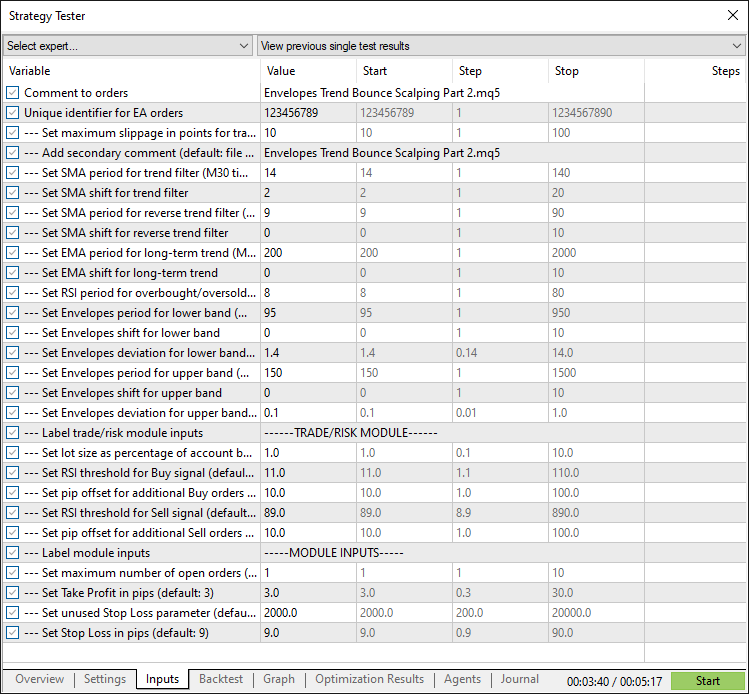
Ahora podemos crear una clase final que se encargue de toda la ejecución y la gestión ya implementadas. Para lograrlo, utilizamos la siguiente lógica.
//--- Define interface for trader
interface ITrader {
   void HandleTick();                                     //--- Handle tick event
   void Init();                                           //--- Initialize trader
   Wallet* GetWallet();                                   //--- Retrieve wallet
};

//--- Declare global trader pointer
ITrader *_ea;                                             //--- Store EA instance

//--- Define main Expert Advisor class
class EA : public ITrader {
private:
   bool _firstTick;                                       //--- Track first tick
   TradeStrategy* _tradeStrategy;                         //--- Store trade strategy
   AdvisorStrategy* _advisorStrategy;                     //--- Store advisor strategy
   IMoneyManager* _moneyManager;                          //--- Store money manager
   Wallet* _wallet;                                       //--- Store wallet

public:
   //--- Initialize EA
   void EA() {
      _firstTick = true;                                  //--- Set first tick flag
      _wallet = new Wallet();                             //--- Create wallet
      _wallet.SetLastClosedOrdersByTimeframe(DisplayOrderDuringTimeframe); //--- Set closed orders timeframe
      _advisorStrategy = new AdvisorStrategy();           //--- Create advisor strategy
      _advisorStrategy.RegisterOpenBuy(new ASOpenBuyLevel1(), 1); //--- Register Buy signal
      _advisorStrategy.RegisterOpenSell(new ASOpenSellLevel1(), 1); //--- Register Sell signal
      _moneyManager = new MoneyManager(_wallet);          //--- Create money manager
      _tradeStrategy = new TradeStrategy(new MultipleOpenModule_1(_advisorStrategy, _moneyManager)); //--- Create trade strategy
      _tradeStrategy.RegisterCloseModule(new TakeProfitCloseModule_1()); //--- Register TP module
      _tradeStrategy.RegisterCloseModule(new StopLossCloseModule_1()); //--- Register SL module
   }

   //--- Destructor to clean up EA
   void ~EA() {
      delete(_tradeStrategy);                             //--- Delete trade strategy
      delete(_moneyManager);                              //--- Delete money manager
      delete(_advisorStrategy);                           //--- Delete advisor strategy
      delete(_wallet);                                    //--- Delete wallet
   }

   //--- Initialize EA components
   void Init() {
      IsDemoLiveOrVisualMode = !MQLInfoInteger(MQL_TESTER) || MQLInfoInteger(MQL_VISUAL_MODE); //--- Set mode flag
      UnitsOneLot = MarketInfo_LibFunc(Symbol(), MODE_LOTSIZE); //--- Set lot size
      SetOrderGrouping();                                 //--- Configure order grouping
      _wallet.LoadOrdersFromBroker();                     //--- Load orders from broker
   }

   //--- Handle tick event
   void HandleTick() {
      if (MQLInfoInteger(MQL_TESTER) == 0) {              //--- Check if not in tester
         SyncOrders();                                    //--- Synchronize orders
      }
      if (AllowManualTPSLChanges) {                       //--- Check if manual TP/SL allowed
         SyncManualTPSLChanges();                         //--- Synchronize manual TP/SL
      }
      AskFunc.Evaluate();                                 //--- Update Ask price
      BidFunc.Evaluate();                                 //--- Update Bid price
      UpdateOrders();                                     //--- Update order profits
      if (!StopEA) {                                      //--- Check if EA not stopped
         _wallet.HandleTick();                            //--- Handle wallet tick
         _advisorStrategy.HandleTick();                   //--- Handle strategy tick
         if (_wallet.GetPendingOpenOrders().Count() == 0 && _wallet.GetPendingCloseOrders().Count() == 0) { //--- Check no pending orders
            _tradeStrategy.Evaluate(_wallet);             //--- Evaluate strategy
         }
         if (ExecutePendingCloseOrders()) {               //--- Execute close orders
            if (!ExecutePendingOpenOrders()) {            //--- Execute open orders
               HandleErrors(StringFormat("Open (all) order(s) failed. Please check EA %d and look at the Journal and Expert tab.", MagicNumber)); //--- Log error
            }
         } else {
            HandleErrors(StringFormat("Close (all) order(s) failed! Please check EA %d and look at the Journal and Expert tab.", MagicNumber)); //--- Log error
         }
      } else {
         if (ExecutePendingCloseOrders()) {               //--- Execute close orders
            _wallet.SetAllOpenOrdersToPendingClose();     //--- Move open orders to pending close
         } else {
            HandleErrors(StringFormat("Close (all) order(s) failed! Please check EA %d and look at the Journal and Expert tab.", MagicNumber)); //--- Log error
         }
      }
      if (_firstTick) {                                   //--- Check if first tick
         _firstTick = false;                              //--- Clear first tick flag
      }
   }

   //--- Retrieve wallet
   Wallet* GetWallet() {
      return _wallet;                                     //--- Return wallet
   }

private:
   //--- Configure order grouping
   void SetOrderGrouping() {
      int size = ArraySize(_tradeStrategy.CloseModules);  //--- Get close modules size
      ORDER_GROUP_TYPE groups[];                          //--- Declare groups array
      ArrayResize(groups, size);                          //--- Resize array
      for (int i = 0; i < ArraySize(_tradeStrategy.CloseModules); i++) { //--- Iterate modules
         groups[i] = _tradeStrategy.CloseModules[i].GetOrderGroupingType(); //--- Set grouping type
      }
      _wallet.ActivateOrderGroups(groups);                //--- Activate groups
   }

   //--- Synchronize orders with broker
   void SyncOrders() {
      OrderCollection* currentOpenOrders = OrderRepository::GetOpenOrders(MagicNumber, NULL, Symbol()); //--- Retrieve open orders
      if (currentOpenOrders.Count() != (_wallet.GetOpenOrders().Count() + _wallet.GetPendingCloseOrders().Count())) { //--- Check order mismatch
         Print("(Manual) orderchanges detected" + " (found in MT: " + IntegerToString(currentOpenOrders.Count()) + " and in wallet: " + IntegerToString(_wallet.GetOpenOrders().Count()) + "), resetting EA, loading open orders."); //--- Log mismatch
         _wallet.ResetOpenOrders();                       //--- Reset open orders
         _wallet.ResetPendingOrders();                    //--- Reset pending orders
         _wallet.LoadOrdersFromBroker();                  //--- Reload orders
      }
      delete(currentOpenOrders);                          //--- Delete orders collection
   }

   //--- Synchronize manual TP/SL changes
   void SyncManualTPSLChanges() {
      _wallet.GetOpenOrders().Rewind();                   //--- Reset orders iterator
      while (_wallet.GetOpenOrders().HasNext()) {         //--- Iterate orders
         Order* order = _wallet.GetOpenOrders().Next();   //--- Get order
         uint lineFindResult = ObjectFind(ChartID(), IntegerToString(order.Ticket) + "_SL"); //--- Find SL line
         if (lineFindResult != UINT_MAX) {                //--- Check if SL line exists
            double currentPosition = ObjectGetDouble(ChartID(), IntegerToString(order.Ticket) + "_SL", OBJPROP_PRICE); //--- Get SL position
            if ((order.StopLossManual == 0 && currentPosition != order.GetClosestSL()) || //--- Check manual SL change
                (order.StopLossManual != 0 && currentPosition != order.StopLossManual)) { //--- Check manual SL mismatch
               order.StopLossManual = currentPosition;       //--- Update manual SL
            }
         }
         lineFindResult = ObjectFind(ChartID(), IntegerToString(order.Ticket) + "_TP"); //--- Find TP line
         if (lineFindResult != UINT_MAX) {                //--- Check if TP line exists
            double currentPosition = ObjectGetDouble(ChartID(), IntegerToString(order.Ticket) + "_TP", OBJPROP_PRICE); //--- Get TP position
            if ((order.TakeProfitManual == 0 && currentPosition != order.GetClosestTP()) || //--- Check manual TP change
                (order.TakeProfitManual != 0 && currentPosition != order.TakeProfitManual)) { //--- Check manual TP mismatch
               order.TakeProfitManual = currentPosition;     //--- Update manual TP
            }
         }
      }
   }

   //--- Update order profits
   void UpdateOrders() {
      _wallet.GetOpenOrders().Rewind();                   //--- Reset orders iterator
      while (_wallet.GetOpenOrders().HasNext()) {         //--- Iterate orders
         Order* order = _wallet.GetOpenOrders().Next();   //--- Get order
         double pipsProfit = order.CalculateProfitPips(); //--- Calculate profit
         order.CurrentProfitPips = pipsProfit;            //--- Update current profit
         if (pipsProfit < order.LowestProfitPips) {       //--- Check if lowest profit
            order.LowestProfitPips = pipsProfit;          //--- Update lowest profit
         } else if (pipsProfit > order.HighestProfitPips) { //--- Check if highest profit
            order.HighestProfitPips = pipsProfit;         //--- Update highest profit
         }
      }
   }

   //--- Execute pending close orders
   bool ExecutePendingCloseOrders() {
      OrderCollection* pendingCloseOrders = _wallet.GetPendingCloseOrders(); //--- Retrieve pending close orders
      int ordersToCloseCount = pendingCloseOrders.Count(); //--- Get count
      if (ordersToCloseCount == 0) {                      //--- Check if no orders
         return true;                                     //--- Return true
      }
      if (_wallet.AreOrdersBeingOpened()) {               //--- Check if orders being opened
         return true;                                     //--- Return true
      }
      int ordersCloseSuccessCount = 0;                    //--- Initialize success count
      for (int i = ordersToCloseCount - 1; i >= 0; i--) { //--- Iterate orders
         Order* pendingCloseOrder = pendingCloseOrders.Get(i); //--- Get order
         if (pendingCloseOrder.IsAwaitingDealExecution) { //--- Check if awaiting execution
            ordersCloseSuccessCount++;                    //--- Increment success count
            continue;                                     //--- Move to next
         }
         bool success;                                    //--- Declare success flag
         if (AccountMarginMode == ACCOUNT_MARGIN_MODE_RETAIL_NETTING) { //--- Check netting mode
            Order* reversedOrder = new Order(pendingCloseOrder, false); //--- Create reversed order
            reversedOrder.Type = pendingCloseOrder.Type == ORDER_TYPE_BUY ? ORDER_TYPE_SELL : ORDER_TYPE_BUY; //--- Set opposite type
            success = OrderRepository::OpenOrder(reversedOrder); //--- Open reversed order
            if (success) {                                //--- Check if successful
               pendingCloseOrder.Ticket = reversedOrder.Ticket; //--- Update ticket
            }
            delete(reversedOrder);                        //--- Delete reversed order
         } else {
            success = OrderRepository::ClosePosition(pendingCloseOrder); //--- Close position
         }
         if (success) {                                   //--- Check if successful
            ordersCloseSuccessCount++;                    //--- Increment success count
         }
      }
      return ordersCloseSuccessCount == ordersToCloseCount; //--- Return true if all successful
   }

   //--- Execute pending open orders
   bool ExecutePendingOpenOrders() {
      OrderCollection* pendingOpenOrders = _wallet.GetPendingOpenOrders(); //--- Retrieve pending open orders
      int ordersToOpenCount = pendingOpenOrders.Count();  //--- Get count
      if (ordersToOpenCount == 0) {                       //--- Check if no orders
         return true;                                     //--- Return true
      }
      int ordersOpenSuccessCount = 0;                     //--- Initialize success count
      for (int i = ordersToOpenCount - 1; i >= 0; i--) {  //--- Iterate orders
         Order* order = pendingOpenOrders.Get(i);         //--- Get order
         if (order.IsAwaitingDealExecution) {             //--- Check if awaiting execution
            ordersOpenSuccessCount++;                     //--- Increment success count
            continue;                                     //--- Move to next
         }
         bool isTradeContextFree = false;                 //--- Initialize trade context flag
         double StartWaitingTime = GetTickCount();        //--- Start timer
         while (true) {                                   //--- Wait for trade context
            if (MQL5InfoInteger(MQL5_TRADE_ALLOWED)) {    //--- Check if trade allowed
               isTradeContextFree = true;                 //--- Set trade context free
               break;                                     //--- Exit loop
            }
            int MaxWaiting_sec = 10;                      //--- Set max wait time
            if (IsStopped()) {                            //--- Check if EA stopped
               HandleErrors("The expert was stopped by a user action."); //--- Log error
               break;                                     //--- Exit loop
            }
            if (GetTickCount() - StartWaitingTime > MaxWaiting_sec * 1000) { //--- Check if timeout
               HandleErrors(StringFormat("The (%d seconds) waiting time exceeded. Trade not allowed: EA disabled, market closed or trade context still not free.", MaxWaiting_sec)); //--- Log error
               break;                                     //--- Exit loop
            }
            Sleep(100);                                   //--- Wait briefly
         }
         if (!isTradeContextFree) {                       //--- Check if trade context not free
            if (!_wallet.CancelPendingOpenOrder(order)) { //--- Attempt to cancel order
               HandleErrors("Failed to cancel an order (because it couldn't open). Please see the Journal and Expert tab in Metatrader for more information."); //--- Log error
            }
            continue;                                     //--- Move to next
         }
         bool success = OrderRepository::OpenOrder(order); //--- Open order
         if (success) {                                    //--- Check if successful
            ordersOpenSuccessCount++;                      //--- Increment success count
         } else {
            if (!_wallet.CancelPendingOpenOrder(order)) {  //--- Attempt to cancel order
               HandleErrors("Failed to cancel an order (because it couldn't open). Please see the Journal and Expert tab in Metatrader for more information."); //--- Log error
            }
         }
      }
      return ordersOpenSuccessCount == ordersToOpenCount;  //--- Return true if all successful
   }
};
Por último, definimos la lógica de control principal utilizando la clase «EA», que implementa la interfaz «ITrader» con las funciones «HandleTick», «Init» y «GetWallet». A estas alturas ya deberías conocer a la perfección estas funciones que ya hemos visto. Definimos las variables privadas «_firstTick», «_tradeStrategy», «_advisorStrategy», «_moneyManager» y «_wallet» para gestionar el estado y los componentes. En el constructor de «EA», establecemos «_firstTick» en «true», inicializamos «_wallet» con un nuevo objeto «Wallet», configuramos su intervalo de tiempo mediante «SetLastClosedOrdersByTimeframe», y creamos «_advisorStrategy» con un nuevo objeto «AdvisorStrategy», registrando las señales «ASOpenBuyLevel1» y «ASOpenSellLevel1» mediante «RegisterOpenBuy» y «RegisterOpenSell».
También instanciamos «_moneyManager» con un objeto «MoneyManager» y «_tradeStrategy» con un objeto «TradeStrategy» que contiene un «MultipleOpenModule_1», registrando «TakeProfitCloseModule_1» y «StopLossCloseModule_1» mediante «RegisterCloseModule». El destructor libera todos los componentes.
Nuestra función «Init» establece los indicadores de modo con MQLInfoInteger, configura el tamaño del lote mediante «MarketInfo_LibFunc», llama a «SetOrderGrouping» para activar los grupos de órdenes utilizando «GetOrderGroupingType» y carga las órdenes con «LoadOrdersFromBroker». La función «HandleTick» gestiona los ticks, sincroniza las órdenes con «SyncOrders» si no se está en modo de prueba, actualiza los TP/SL manuales con «SyncManualTPSLChanges» si está permitido y actualiza los precios a través de las funciones «Evaluate» de «AskFunc» y «BidFunc».
Actualiza los beneficios con «UpdateOrders», procesa los ticks de la cartera y de la estrategia con «HandleTick», evalúa «_tradeStrategy» con «Evaluate» si no hay órdenes pendientes y ejecuta los cierres y aperturas pendientes con «ExecutePendingCloseOrders» y «ExecutePendingOpenOrders», registrando los errores con «HandleErrors» si se producen fallos. Si se detiene el EA, este cierra las órdenes mediante «SetAllOpenOrdersToPendingClose». Ahora podemos llamar a esto en el controlador de eventos OnTick para gestionar las operaciones.
//--- Handle tick event
datetime LastActionTime = 0;                          //--- Track last action time
void OnTick() {
   string AccountServer = AccountInfoString(ACCOUNT_SERVER);                //--- Retrieve account server
   string AccountCurrency = AccountInfoString(ACCOUNT_CURRENCY);            //--- Retrieve account currency
   string AccountName = AccountInfoString(ACCOUNT_NAME);                    //--- Retrieve account name
   long AccountTradeMode = AccountInfoInteger(ACCOUNT_TRADE_MODE);          //--- Retrieve trade mode
   string ReadableAccountTrademode = "";                                    //--- Initialize readable trade mode
   if (AccountTradeMode == 0) ReadableAccountTrademode = "DEMO ACCOUNT";    //--- Set demo mode
   if (AccountTradeMode == 1) ReadableAccountTrademode = "CONTEST ACCOUNT"; //--- Set contest mode
   if (AccountTradeMode == 2) ReadableAccountTrademode = "REAL ACCOUNT";    //--- Set real mode
   long AccountLogin = AccountInfoInteger(ACCOUNT_LOGIN);                   //--- Retrieve account login
   string AccountCompany = AccountInfoString(ACCOUNT_COMPANY);              //--- Retrieve account company
   long AccountLeverage = AccountInfoInteger(ACCOUNT_LEVERAGE);             //--- Retrieve account leverage
   long AccountLimitOrders = AccountInfoInteger(ACCOUNT_LIMIT_ORDERS);      //--- Retrieve order limit
   double AccountMarginFree = AccountInfoDouble(ACCOUNT_MARGIN_FREE);       //--- Retrieve free margin
   bool AccountTradeAllowed = AccountInfoInteger(ACCOUNT_TRADE_ALLOWED);    //--- Retrieve trade allowed
   bool AccountTradeExpert = AccountInfoInteger(ACCOUNT_TRADE_EXPERT);      //--- Retrieve expert allowed
   string ReadableAccountMarginMode = "";                                   //--- Initialize readable margin mode
   if (AccountMarginMode == 0) ReadableAccountMarginMode = "NETTING MODE";  //--- Set netting mode
   if (AccountMarginMode == 1) ReadableAccountMarginMode = "EXCHANGE MODE"; //--- Set exchange mode
   if (AccountMarginMode == 2) ReadableAccountMarginMode = "HEDGING MODE";  //--- Set hedging mode
   if (OneQuotePerBar) {                                 //--- Check one quote per bar
      datetime currentTime = iTime(_Symbol, _Period, 0); //--- Get current bar time
      if (LastActionTime == currentTime) {               //--- Check if same bar
         return;                                         //--- Exit
      } else {
         LastActionTime = currentTime;                   //--- Update last action time
      }
   }
   Error = NULL;                                         //--- Clear current error
   _ea.HandleTick();                                     //--- Handle tick
   if (IsDemoLiveOrVisualMode) {                         //--- Check visual mode
      MqlDateTime mql_datetime;                          //--- Declare datetime
      TimeCurrent(mql_datetime);                         //--- Get current time
      string comment = "\n" + (string)mql_datetime.year + "." + (string)mql_datetime.mon + "." + (string)mql_datetime.day + "   " + TimeToString(TimeCurrent(), TIME_SECONDS) + OrderInfoComment; //--- Build comment
      if (DisplayOnChartError) {                         //--- Check if error display enabled
         if (Error != NULL) comment += "\n      :: Current error : " + Error; //--- Add current error
         if (ErrorPreviousQuote != NULL) comment += "\n      :: Last error : " + ErrorPreviousQuote; //--- Add previous error
      }
      comment += "";                                     //--- Append empty line
      Comment("ACCOUNT SERVER:  ", AccountServer, "\n",  //--- Display account info
              "ACCOUNT CURRENCY:  ", AccountCurrency, "\n",
              "ACCOUNT NAME:  ", AccountName, "\n",
              "ACCOUNT TRADEMODE:  ", ReadableAccountTrademode, "\n",
              "ACCOUNT LOGIN:  ", AccountLogin, "\n",
              "ACCOUNT COMPANY:  ", AccountCompany, "\n",
              "ACCOUNT LEVERAGE:  ", AccountLeverage, "\n",
              "ACCOUNT LIMIT ORDERS:  ", AccountLimitOrders, "\n",
              "ACCOUNT MARGIN FREE:  ", AccountMarginFree, "\n",
              "ACCOUNT TRADING ALLOWED:  ", AccountTradeAllowed, "\n",
              "ACCOUNT EXPERT ALLOWED:  ", AccountTradeExpert, "\n",
              "ACCOUNT MARGIN ALLOWED:  ", ReadableAccountMarginMode);
   }
}
Aquí gestionamos las actualizaciones del mercado en tiempo real para el programa mediante el controlador de eventos OnTick, que procesa cada nuevo tick de precios. Comenzamos recopilando los datos de la cuenta mediante funciones como «AccountInfoString» para el servidor, la divisa, el nombre y la empresa; AccountInfoInteger para el modo de negociación, el login de la cuenta, el apalancamiento y los límites de las órdenes; y AccountInfoDouble para el margen libre. Convertimos el modo de negociación en una cadena legible («DEMO ACCOUNT», «CONTEST ACCOUNT» o «REAL ACCOUNT») y el modo de margen, almacenado en «AccountMarginMode», en «NETTING MODE», «EXCHANGE MODE» o «HEDGING MODE» para mayor claridad.
Para controlar el procesamiento de los ticks, comprobamos el indicador «OneQuotePerBar» y, si está activado, utilizamos la función iTime para obtener la hora de inicio de la barra actual y la comparamos con «LastActionTime». Si coinciden, salimos para evitar un procesamiento duplicado; en caso contrario, actualizamos «LastActionTime». Borramos cualquier error existente estableciendo «Error» en nulo y llamamos a la función «HandleTick» en «_ea» para ejecutar la lógica de la estrategia.
Para la visualización, comprobamos «IsDemoLiveOrVisualMode» y, a continuación, utilizamos TimeCurrent y MqlDateTime para dar formato a la marca de tiempo, creando una cadena de comentario con «OrderInfoComment». Si la opción «DisplayOnChartError» está activada, añadimos los errores de «Error» y «ErrorPreviousQuote». Por último, utilizamos la función Comment para mostrar los detalles de la cuenta en el gráfico, lo que garantiza un seguimiento e información en tiempo real para el sistema de trading. Al ejecutar el programa, obtenemos el siguiente resultado.
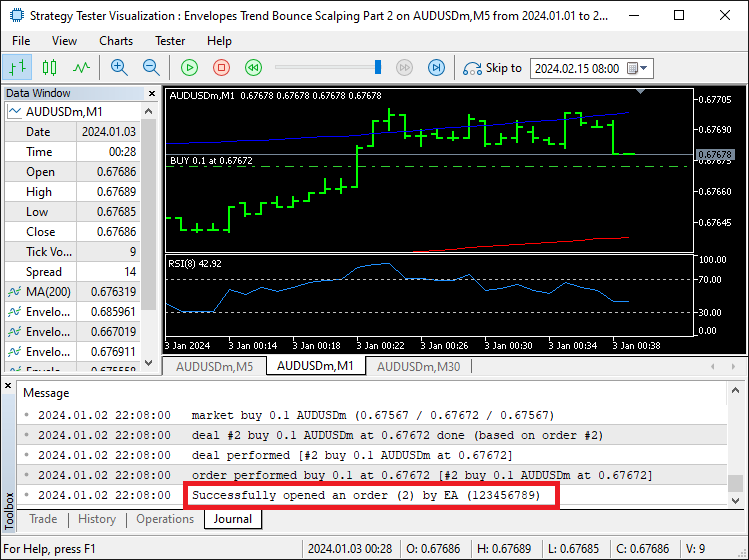
En la imagen podemos ver que podemos generar y ejecutar una operación; en este caso, una operación de compra. Lo que tenemos que hacer ahora es gestionar las operaciones y, para ello, debemos llevar un seguimiento de las transacciones; por eso utilizaremos el controlador de eventos OnTradeTransaction para detectar las operaciones que se hayan abierto correctamente y gestionarlas de la siguiente manera.
//--- Handle trade transactions
void OnTradeTransaction(const MqlTradeTransaction& trans, const MqlTradeRequest& request, const MqlTradeResult& result) {
   switch (trans.type) {                               //--- Handle transaction type
   case TRADE_TRANSACTION_DEAL_ADD: {                  //--- Handle deal addition
      datetime end = TimeCurrent();                    //--- Get current server time
      datetime start = end - PeriodSeconds(PERIOD_D1); //--- Set start time (1 day ago)
      HistorySelect(start, end + PeriodSeconds(PERIOD_D1)); //--- Select history
      int dealsTotal = HistoryDealsTotal();            //--- Get total deals
      if (dealsTotal == 0) {                           //--- Check if no deals
         Print("No deals found");                      //--- Log message
         return;                                       //--- Exit
      }
      ulong orderTicketId = HistoryDealGetInteger(trans.deal, DEAL_ORDER); //--- Get order ticket
      CDealInfo dealInfo;                              //--- Declare deal info
      dealInfo.Ticket(trans.deal);                     //--- Set deal ticket
      ENUM_DEAL_ENTRY deal_entry = dealInfo.Entry();   //--- Get deal entry type
      bool found = false;                              //--- Initialize found flag
      if (deal_entry == DEAL_ENTRY_IN) {               //--- Handle deal entry
         OrderCollection* pendingOpenOrders = _ea.GetWallet().GetPendingOpenOrders(); //--- Retrieve pending open orders
         for (int i = 0; i < pendingOpenOrders.Count(); i++) { //--- Iterate orders
            Order* order = pendingOpenOrders.Get(i);   //--- Get order
            if (order.Ticket == orderTicketId) {       //--- Check matching ticket
               found = true;                           //--- Set found flag
               order.OpenTime = dealInfo.Time();       //--- Set open time
               order.OpenPrice = trans.price;          //--- Set open price
               order.TradePrice = order.OpenPrice;     //--- Set trade price
               if (OrderFillingType == ORDER_FILLING_FOK) {                 //--- Check FOK filling
                  order.OrderFilledLots += trans.volume;                    //--- Add volume
                  if (MathAbs(order.Lots - order.OrderFilledLots) < 1e-5) { //--- Check if fully filled
                     order.IsAwaitingDealExecution = false;                 //--- Clear execution flag
                     order.Lots = order.OrderFilledLots;                    //--- Update lots
                     order.TradeVolume = order.Lots;                        //--- Update trade volume
                     _ea.GetWallet().SetPendingOpenOrderToOpen(order);      //--- Move to open
                     Print(StringFormat("Execution done for order (%d) by EA (%d)", orderTicketId, MagicNumber)); //--- Log success
                  }
               } else {
                  order.IsAwaitingDealExecution = false; //--- Clear execution flag
                  bool actualVolumeDiffers = MathAbs(order.Lots - trans.volume) > 1e-5; //--- Check volume difference
                  order.OrderFilledLots += trans.volume; //--- Add volume
                  order.Lots = order.OrderFilledLots;    //--- Update lots
                  order.TradeVolume = order.Lots;        //--- Update trade volume
                  if (actualVolumeDiffers) {             //--- Check if volume differs
                     Print("Broker executed volume differs from requested volume. Executed volume: " + DoubleToStr(trans.volume)); //--- Log difference
                     OrderRepository::CalculateAndSetCommision(order); //--- Recalculate commission
                  }
                  _ea.GetWallet().SetPendingOpenOrderToOpen(order); //--- Move to open
                  Print(StringFormat("Execution done for order (%d) by EA (%d)", orderTicketId, MagicNumber)); //--- Log success
               }
            }
         }
      } else if (deal_entry == DEAL_ENTRY_OUT) {      //--- Handle deal exit
         OrderCollection* pendingCloseOrders = _ea.GetWallet().GetPendingCloseOrders(); //--- Retrieve pending close orders
         for (int i = 0; i < pendingCloseOrders.Count(); i++) { //--- Iterate orders
            Order* order = pendingCloseOrders.Get(i); //--- Get order
            if (order.Ticket == orderTicketId) {      //--- Check matching ticket
               found = true;                          //--- Set found flag
               if (OrderFillingType == ORDER_FILLING_FOK) {   //--- Check FOK filling
                  order.OrderFilledLots += trans.volume;      //--- Add volume
                  if (MathAbs(order.Lots - order.OrderFilledLots) < 1e-5) { //--- Check if fully filled
                     order.IsAwaitingDealExecution = false;   //--- Clear execution flag
                     order.CloseTime = dealInfo.Time();       //--- Set close time
                     order.ClosePrice = trans.price;          //--- Set close price
                     if (order.MagicNumber == MagicNumber) {  //--- Check EA order
                        TotalCommission += order.Commission;  //--- Add commission
                     }
                     if (IsDemoLiveOrVisualMode) {      //--- Check visual mode
                        AnyChartObjectDelete(ChartID(), IntegerToString(order.Ticket) + "_TP"); //--- Delete TP line
                        AnyChartObjectDelete(ChartID(), IntegerToString(order.Ticket) + "_SL"); //--- Delete SL line
                     }
                     if (order.ParentOrder != NULL) {   //--- Check if parent order
                        order.ParentOrder.Paint();      //--- Redraw parent
                     }
                     _ea.GetWallet().SetPendingCloseOrderToClosed(order); //--- Move to closed
                     Print(StringFormat("Execution done for order (%d) by EA (%d)", orderTicketId, MagicNumber)); //--- Log success
                  }
               } else {
                  bool actualVolumeDiffers = MathAbs(order.Lots - trans.volume) > 1e-5; //--- Check volume difference
                  if (actualVolumeDiffers) {                           //--- Handle partial close
                     Print("Broker executed volume differs from requested volume.Requested volume: " + DoubleToStr(order.Lots) + ".Executed volume: " + DoubleToStr(trans.volume)); //--- Log difference
                     Order* remainderOrder = new Order(order, false);  //--- Create remainder order
                     remainderOrder.Ticket = 0;                        //--- Clear ticket
                     remainderOrder.Lots = order.Lots - trans.volume;  //--- Set remaining volume
                     remainderOrder.TradeVolume = remainderOrder.Lots; //--- Update trade volume
                     OrderRepository::CalculateAndSetCommision(remainderOrder); //--- Recalculate commission
                     _ea.GetWallet().GetPendingCloseOrders().Add(remainderOrder); //--- Add remainder
                     order.Lots = trans.volume;                        //--- Update original volume
                     order.TradeVolume = order.Lots;                   //--- Update trade volume
                     OrderRepository::CalculateAndSetCommision(order); //--- Recalculate commission
                  } else {
                     Print("Broker executed volume: " + DoubleToStr(trans.volume)); //--- Log volume
                  }
                  order.IsAwaitingDealExecution = false;   //--- Clear execution flag
                  order.CloseTime = dealInfo.Time();       //--- Set close time
                  order.ClosePrice = trans.price;          //--- Set close price
                  if (order.MagicNumber == MagicNumber) {  //--- Check EA order
                     TotalCommission += order.Commission;  //--- Add commission
                  }
                  if (IsDemoLiveOrVisualMode) {            //--- Check visual mode
                     AnyChartObjectDelete(ChartID(), IntegerToString(order.Ticket) + "_TP"); //--- Delete TP line
                     AnyChartObjectDelete(ChartID(), IntegerToString(order.Ticket) + "_SL"); //--- Delete SL line
                  }
                  _ea.GetWallet().SetPendingCloseOrderToClosed(order); //--- Move to closed
                  Print(StringFormat("Execution done for order (%d) by EA (%d)", orderTicketId, MagicNumber)); //--- Log success
               }
            }
         }
      }
      if (found) {                                         //--- Check if deal found
         Print("Updated order with deal info.");           //--- Log update
      } else if (trans.symbol == Symbol() && dealInfo.Magic() == MagicNumber) { //--- Check EA deal
         Print("Couldn't find deal info for place/done order"); //--- Log missing deal
      }
      break;
   }
   }
}
En el controlador de eventos OnTradeTransaction, donde procesamos los eventos MqlTradeTransaction, nos centramos en las transacciones TRADE_TRANSACTION_DEAL_ADD, en las que recuperamos una ventana de historial de un día con TimeCurrent y «PeriodSeconds» a través de HistorySelect. Si no se encuentran operaciones con «HistoryDealsTotal», registramos un mensaje con «Print» y salimos. Para cada operación, extraemos el comprobante de pedido mediante «HistoryDealGetInteger» y creamos un objeto «CDealInfo» con «Ticket» para comprobar el tipo de entrada a través de «Entry».
Para DEAL_ENTRY_IN (nuevas operaciones), iteramos sobre «GetPendingOpenOrders» desde el «Wallet» de «_ea», haciendo coincidir los tickets para actualizar las órdenes con el «Time» y el «price» de «trans». Si «OrderFillingType» es «ORDER_FILLING_FOK», actualizamos «OrderFilledLots» y, si se ha ejecutado, desactivamos «IsAwaitingDealExecution» y movemos la orden al estado de abierta con «SetPendingOpenOrderToOpen». De lo contrario, gestionamos los llenados parciales, registrando las diferencias de volumen con «Print» y actualizando los datos mediante «Calcular y establecer comisión».
En el caso de «DEAL_ENTRY_OUT» (cierres), procesamos «GetPendingCloseOrders», actualizando las órdenes coincidentes de forma similar, eliminando las líneas del gráfico con «AnyChartObjectDelete» si «IsDemoLiveOrVisualMode», añadiendo comisiones a «TotalCommission» y pasando las órdenes a cerradas con «SetPendingCloseOrderToClosed». Los cierres parciales generan una nueva orden con «CalculateAndSetCommission» para el volumen restante. Registramos las actualizaciones o los errores con «Print», lo que garantiza un seguimiento preciso de las operaciones. Ahora, al compilar, obtenemos el siguiente resultado.
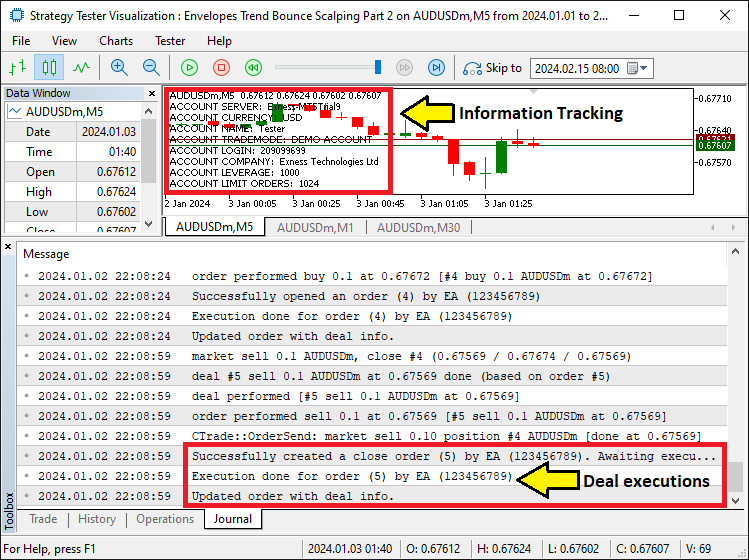
En la imagen se puede ver que gestionamos la ejecución de las operaciones y mostramos los metadatos en la ventana. Lo que queda por hacer es realizar pruebas retrospectivas del programa para asegurarnos de que funciona correctamente, y eso se trata en la siguiente sección.
Backtesting y optimización
Al probar el programa, nos dimos cuenta de un descuido que se nos había pasado por alto: la liberación del programa y sus componentes al eliminarlo del gráfico. El asunto era el siguiente.
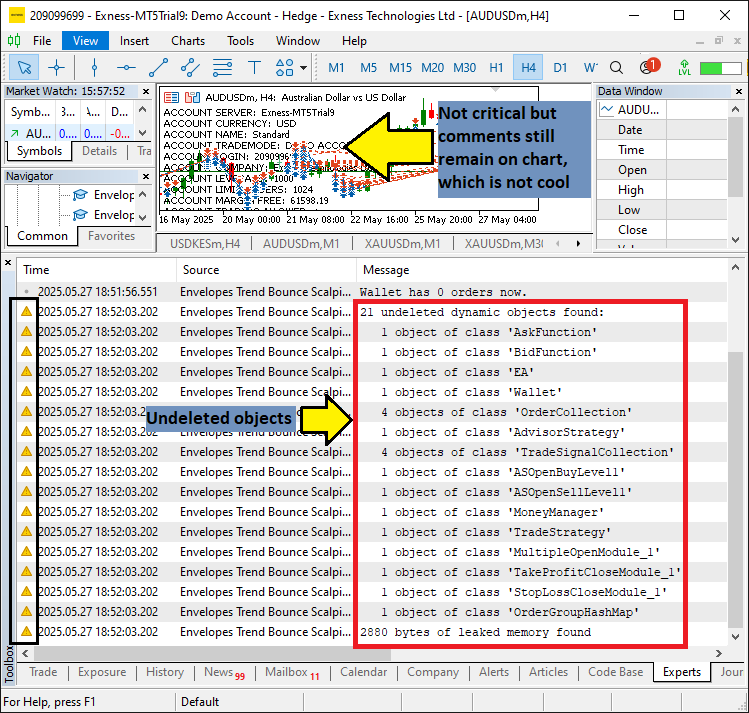
En la imagen podemos ver una representación de los problemas. Para resolver estos problemas, hemos implementado la siguiente lógica en el controlador de eventos OnDeinit.
//--- Deinitialize Expert Advisor
void OnDeinit(const int reason) {
   Comment("");
   delete(_ea);                                        //--- Delete EA instance
   delete(AskFunc);                                    //--- Delete Ask function
   delete(BidFunc);                                    //--- Delete Bid function
}
Hemos gestionado el proceso de limpieza del programa mediante el controlador de eventos OnDeinit, que se activa cuando se elimina el asesor experto o se cierra la terminal. Empezamos borrando todos los comentarios del gráfico con la función Comment, para dejar el gráfico limpio. A continuación, liberamos memoria eliminando el objeto «_ea», que representa la instancia principal de «EA», mediante el operador delete. También hemos eliminado los objetos «AskFunc» y «BidFunc», que se encargan de recuperar los datos de precios, para liberar recursos.
Este proceso conciso garantizaba una desinicialización adecuada, evitando fugas de memoria y manteniendo la eficiencia del sistema cuando se detenía el programa. Con eso se solucionó todo y, tras una optimización exhaustiva y una serie de pruebas retrospectivas, utilizando la configuración predeterminada y modificando los parámetros del módulo de operaciones o de riesgo para utilizar valores del 1 %, 5, 30, 10 y 60, respectivamente, hemos obtenido los siguientes resultados.
Gráfico de backtest:
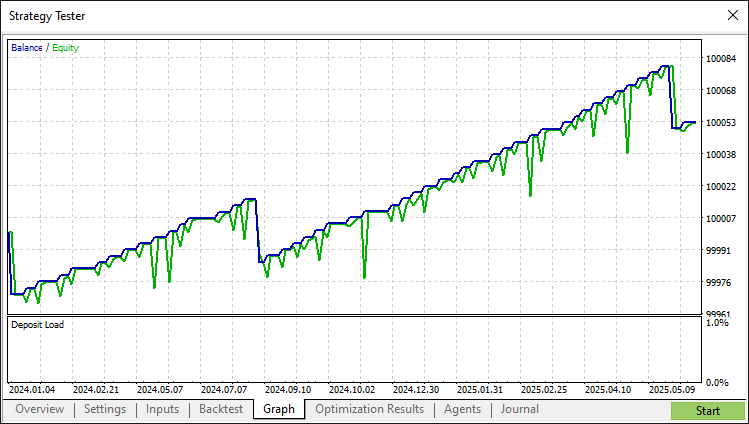
Informe de backtest:
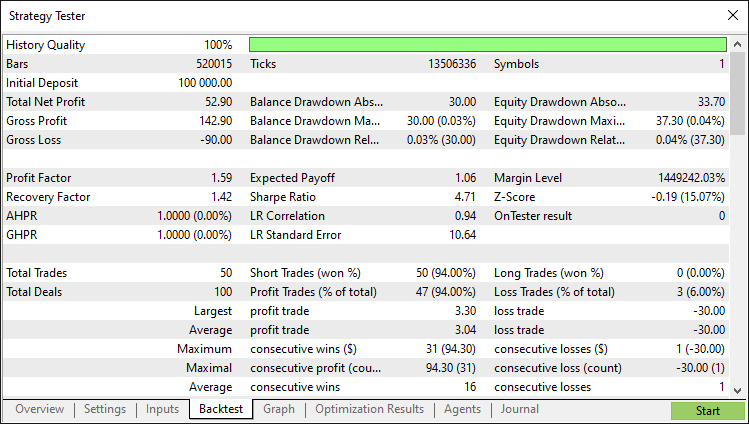
Conclusión
En conclusión, hemos desarrollado una implementación en MQL5 de la estrategia de scalping «Envelopes Trend Bounce», que permite la ejecución automatizada de operaciones basada en señales precisas de los indicadores «Envelopes», «Medias móviles» e «Índice de fuerza relativa», con una gestión de riesgos integrada para controlar el tamaño de las posiciones y proteger el capital frente a pérdidas. Nuestro marco modular, que incluye la evaluación dinámica de señales, la ejecución de operaciones y el seguimiento de órdenes en tiempo real, ofrece una base escalable para el scalping. Puedes perfeccionar aún más este programa ajustando los umbrales de señal, optimizando los parámetros de riesgo o incorporando indicadores adicionales para adaptarlo a tus objetivos de negociación.
Descargo de responsabilidad: Esta implementación tiene fines exclusivamente educativos. El trading conlleva riesgos financieros considerables, y la volatilidad del mercado puede provocar pérdidas importantes. Es fundamental realizar pruebas retrospectivas exhaustivas y aplicar una gestión prudente del riesgo antes de utilizar este programa en entornos de negociación reales.
Al dominar estas técnicas, podemos mejorar la adaptabilidad y la solidez del programa o aprovechar su estructura para desarrollar otras estrategias de negociación, mejorando así el algoritmo de negociación del programa.
Traducción del inglés realizada por MetaQuotes Ltd.
Artículo original: https://www.mql5.com/en/articles/18298
Advertencia: todos los derechos de estos materiales pertenecen a MetaQuotes Ltd. Queda totalmente prohibido el copiado total o parcial.
Este artículo ha sido escrito por un usuario del sitio web y refleja su punto de vista personal. MetaQuotes Ltd. no se responsabiliza de la exactitud de la información ofrecida, ni de las posibles consecuencias del uso de las soluciones, estrategias o recomendaciones descritas.

 Introducción a MQL5 (Parte 24): Creación de un asesor experto (EA) que opere a partir de objetos del gráfico
 De novato a experto: Utilidad de control de parámetros
 Redes neuronales en el trading: Modelo multidimensional de extremo a extremo para la previsión de series temporales (Componentes principales)
 Características del Wizard MQL5 que debe conocer (Parte 69): Uso de patrones del SAR y del RVI

- Aplicaciones de trading gratuitas
- 8 000+ señales para copiar
- Noticias económicas para analizar los mercados financieros
Usted acepta la política del sitio web y las condiciones de uso