Articles on manual and algorithmic trading in MetaTrader 5

This category features articles on all aspects of trading - from manual to fully automatic trading, from Expert Advisor ideas to trading robot creation using the MQL5 Wizard. Position management, processing of trade events and money management - these integral parts of trading are covered in theses articles.
Learn how to copy trading signals and how to provide around-the-clock operation of Expert Advisors, how to create a trading robot and how to run MetaTrader on Linux and MacOS, what social trading is and how to order a trading robot.
Add a new article

You are missing trading opportunities:
- Free trading apps
- Over 8,000 signals for copying
- Economic news for exploring financial markets
Registration
Log in
You agree to website policy and terms of use
If you do not have an account, please register


Capital management in trading and the trader's home accounting program with a database
How can a trader manage capital? How can a trader and investor keep track of expenses, income, assets, and liabilities? I am not just going to introduce you to accounting software; I am going to show you a tool that might become your reliable financial navigator in the stormy sea of trading.


The Dragonfly Algorithm (DA)
In this article, we will examine the Dragonfly Algorithm (DA), inspired by the collective behavior of dragonflies in nature — their ability to coordinate flight in a swarm, avoid collisions, follow prey, and evade predators. Let's look at how five simple behavioral rules and an adaptive mechanism for transitioning from exploration to exploitation are implemented in MQL5, and test the algorithm on our test bench.


Analyzing the Hourly Movement of Trading Symbols and Their Spreads in MetaTrader 5
The ProSpread seasonality index indicator with a Moving Average is a technical analysis tool that identifies seasonal patterns in price movements, analyzes price behavior during specific trading hours and is able to work with either a single instrument or a spread between two assets. It also visualizes the statistical probability of directional movements.


Automating Trading Strategies in MQL5 (Part 51): The Bread and Butter Judas Swing Model with Premium and Discount
We build a session-based reversal program in MQL5 using the Bread and Butter Judas Swing model. It derives a higher-timeframe daily bias, defines New York kill zones, maps each session's premium and discount from the live range, and requires a sweep before a market structure shift confirms entry. Readers get a ready approach to arm setups only during active sessions and execute in the bias direction with clear, testable rules.


Animal Migration Optimization (AMO) algorithm
The article is devoted to the AMO algorithm, which models the seasonal migration of animals in search of optimal conditions for life and reproduction. The main features of AMO include the use of topological neighborhood and a probabilistic update mechanism, which makes it easy to implement and flexible for various optimization tasks.


Developing Smart Chart Objects in MQL5 (Part 1): Building a Stateful Trendline Management Framework
This article details a practical framework for converting MetaTrader 5 trendlines from static drawings into managed runtime entities. It covers object discovery, event-driven synchronization of user edits, and confirmation logic based on ATR multipliers and closed candles. A central manager coordinates multiple lines and updates their visual state. Readers can implement consistent, extensible rules for detecting proximity, validating bounces, and confirming breakouts.


MQL5 Bootstrap (IV): Trailing and Break-even Stop Helpers
This article presents reusable MQL5 utilities for managing trailing and break-even stops. It covers fixed-point, moving average, ATR, Parabolic SAR, money-based, and time-periodic trailing, plus break-even by points and by money, with activation thresholds, step logic, reverse-move protection, and broker-level validation. Code examples and Bootstrap classes show how to integrate these helpers into Expert Advisors to standardize position control and reduce duplicate code.


Designing a Partial Close Engine in MQL5 with Configurable Profit Ladders
This MQL5 engine applies configurable profit ladders in R‑multiples to manage partial closes reliably. It prevents stranded remainders by rounding to lot step, computes close percentages from the original entry volume, and moves the stop to breakeven when configured. A supported filling mode is chosen automatically, and the download includes seven include files, a demo EA, and a verification script.


Poll: Traders’ Estimate of the Mobile Terminal
Unfortunately, there are no clear projections available at this moment about the future of the mobile trading. However, there are a lot of speculations surrounding this matter. In our attempt to resolve this ambiguity we decided to conduct a survey among traders to find out their opinion about our mobile terminals. Through the efforts of this survey, we have managed to established a clear picture of what our clients currently think about the product as well as their requests and wishes in future developments of our mobile terminals.


Dolphin Echolocation Algorithm (DEA)
In this article, we take a closer look at the DEA algorithm, a metaheuristic optimization method inspired by dolphins' unique ability to find prey using echolocation. From mathematical foundations to practical implementation in MQL5, from analysis to comparison with classical algorithms, we will examine in detail why this relatively new method deserves a place in the arsenal of researchers facing optimization problems.


The MQL5 Standard Library Explorer (Part 6): Optimizing a generated Expert Advisor
In this discussion, we follow up on the previously developed multi-signal Expert Advisor with the objective of exploring and applying available optimization methods. The aim is to determine whether the trading performance of the EA can be meaningfully improved through systematic optimization based on historical data.


Building a Divergence System (Part III): The Adaptive SuperTrend EA
The article implements a self-sufficient Adaptive SuperTrend EA with internal calculations on a selectable timeframe, avoiding external buffers and indicator files. It includes risk-based lot sizing, ATR stops, stepwise RR trailing, optional anti-repainting confirmation, and session control. Practitioners can reuse the structure for consistent new‑bar signal handling and broker‑compliant order validation.


Tabu Search (TS)
The article discusses the Tabu Search algorithm, one of the first and most well-known metaheuristic methods. We will go through the algorithm operation in detail, starting with choosing an initial solution and exploring neighboring options, with an emphasis on using a tabu list. The article covers the key aspects of the algorithm and its features.

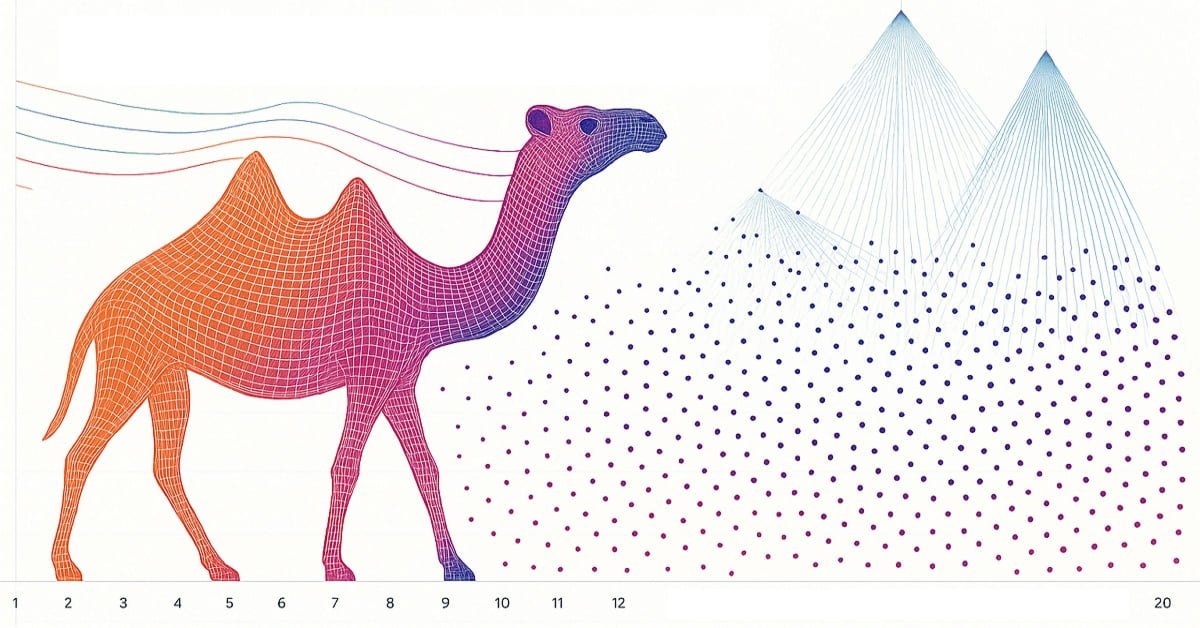
Camel Algorithm (CA)
The Camel Algorithm, developed in 2016, simulates the behavior of camels in the desert to solve optimization problems, taking into account temperature, supply, and endurance. This article also presents a modified version of the algorithm (CAm) with key improvements: the use of a Gaussian distribution in generating solutions and the optimization of the oasis effect parameters.


African Buffalo Optimization (ABO)
The article presents the African Buffalo Optimization (ABO) algorithm, a metaheuristic approach developed in 2015 based on the unique behavior of these animals. The article describes in detail the stages of the algorithm implementation and its efficiency in finding solutions to complex problems, which makes it a valuable tool in the field of optimization.


Battle Royale Optimizer (BRO)
The article explores the Battle Royale Optimizer algorithm — a metaheuristic in which solutions compete with their nearest neighbors, accumulate “damage,” are replaced when a threshold is exceeded, and periodically shrink the search space around the current best solution. It presents both pseudocode and an MQL5 implementation of the CAOBRO class, including neighbor search, movement toward the best solution, and an adaptive delta interval. Test results on the Hilly, Forest, and Megacity functions highlight the strengths and limitations of the approach. The reader is provided with a ready-to-use foundation for experimentation and tuning key parameters such as popSize and maxDamage.


Deterministic Oscillatory Search (DOS)
Deterministic Oscillatory Search (DOS) algorithm is an innovative global optimization method that combines the advantages of gradient and swarm algorithms without the use of random numbers. The fitness oscillation and slope mechanism allows DOS to explore complex search spaces in a deterministic manner.


MQL5 Trading Tools (Part 17): Exploring Vector-Based Rounded Rectangles and Triangles
In this article, we explore vector-based methods for drawing rounded rectangles and triangles in MQL5 using canvas, with supersampling for anti-aliased rendering. We implement scanline filling, geometric precomputations for arcs and tangents, and border drawing to create smooth, customizable shapes. This approach lays the groundwork for modern UI elements in future trading tools, supporting inputs for sizes, radii, borders, and opacities.


Building a Divergence System: Creating the MPO4 Custom Indicator
We introduce MPO4, a pressure-based oscillator that emphasizes the body and direction of candles in the context of current volatility. The article details its mathematics, normalization into a bounded range, and the EMA smoothing, then builds a pivot-driven divergence module designed not to repaint. You get complete MQL5 implementation and practical guidance for interpreting signals, including a comparison with RSI as an alternative source.


Central Force Optimization (CFO) algorithm
The article presents the Central Force Optimization (CFO) algorithm inspired by the laws of gravity. It explores how principles of physical attraction can solve optimization problems where "heavier" solutions attract less successful counterparts.


Chaos optimization algorithm (COA): Continued
We continue studying the chaotic optimization algorithm. The second part of the article deals with the practical aspects of the algorithm implementation, its testing and conclusions.


Extremal Optimization (EO)
The article discusses the Extremal Optimization (EO) algorithm, an optimization method inspired by the Bak-Sneppen self-organized criticality model, where evolution occurs through the elimination of the worst-case components of the system. The modified population version of the algorithm demonstrates a shift away from theoretical principles in favor of practical efficiency, leading to the creation of powerful computational tools.


Creating a Probabilistic Market-Neutral Trading Robot Based on a Return Distribution
A market-neutral trading strategy based on the empirical return distribution offers an alternative to traditional technical analysis methods, replacing price direction forecasting with the statistical placement of orders at levels the price is likely to reach. This article provides a detailed analysis of the mathematical framework for calculating percentiles, algorithms for weighting position sizes based on the probability of an order being triggered, and mechanisms for adapting to changing market conditions through grid expiration. A complete implementation in MQL5 is provided.


Artificial Tribe Algorithm (ATA)
The article provides a detailed discussion of the key components and innovations of the ATA optimization algorithm, which is an evolutionary method with a unique dual behavior system that adapts depending on the situation. ATA combines individual and social learning while using crossover for explorations and migration to find solutions when stuck in local optima.


Unified Multi-Timeframe Renko: Synthesizing the Market's Temporal Dimensions
The article presents an innovative concept for a multi-timeframe Renko chart that combines signals from four timeframes (M5, M15, H1, H4) into a unified synthetic instrument. The system creates a virtual symbol in MetaTrader 5 by using the EMA of each timeframe to generate a composite signal through three methods: simple average, weighted average, and consensus. The implementation includes ATR-based adaptive brick sizing, real-time operation, and full integration with MetaTrader 5.


Neuroboids Optimization Algorithm 2 (NOA2)
The new proprietary optimization algorithm NOA2 (Neuroboids Optimization Algorithm 2) combines the principles of swarm intelligence with neural control. NOA2 combines the mechanics of a neuroboid swarm with an adaptive neural system that allows agents to self-correct their behavior while searching for the optimum. The algorithm is under active development and demonstrates potential for solving complex optimization problems.


Overcoming Accessibility Challenges in MQL5 Trading Tools (Part II): Enabling EA Voice Using a Python Text-to-Speech Engine
Let's discuss how we can make our Expert Advisors speech‑capable using text‑to‑speech technology, partnering Python and MQL5. After reading this article, you will walk away with a working example of an EA that speaks dynamic market information. You will master the application of TTS, the WebRequest function, and learn how Python libraries integrate with the MQL5 language to create a truly voice‑aware trading tool.


Building a Correlation-Aware Portfolio Risk Monitor in MQL5
The article quantifies correlation and portfolio risk in MetaTrader 5: from time-aligned returns to a covariance matrix, true portfolio variance against the independent-sum assumption, and position-level risk attribution. A MetaTrader 5 service runs in the background, shows the metrics on a small chart panel, and pushes alerts when risk thresholds are crossed. Source code is provided for an example script, a reusable risk engine class, and the service.


MQL5 Bootstrap (I): Reusable Functions for Working with Positions and Orders
This article presents a compact MQL5 utility layer for routine trade operations. It includes position existence checkers, position counters, bulk close helpers, and functions to retrieve the most recent or oldest position by symbol, magic, or type. A simple SMA crossover Expert Advisor demonstrates integration. The result is cleaner EAs, fewer inconsistencies across projects, and faster maintenance.


Detecting and Classifying Fractal Patterns Using Machine Learning
In this article, we will touch upon the intriguing topic of fractal analysis and market forecasting using machine learning. These are just the first steps towards exploring the diverse fractal structures that form on financial price charts. We will use the correlation to find patterns and the CatBoost algorithm to classify these patterns.


Developing a Terminal Manager (Part 2): Running Multiple Terminal Instances
Let's move on to using multiple terminal instances on the server by setting up a simple control panel for starting and stopping them. Now it is time to expand the functionality and move on to the next stages — implementing more complex features, such as managing multiple terminal instances, state persistence, integration with the MetaTrader 5 API, and a web interface with comprehensive information about the terminals.


Automating Chart Patterns in MQL5 (Part 2): The Double Top and Double Bottom
We build a robust MQL5 detector for double tops and double bottoms that first confirms the H4 trend, then validates six conditions (point equality, neckline placement, ordering, width, height, and ATR‑based tolerances). The neckline break is timed on the chart's timeframe, and a three-state machine ensures each pattern trades once. The measured‑move target translates structure into clear exits.


Implementing a Breakeven Mechanism in MQL5 (Part 2): ATR- and RRR-Based Breakeven
This article completes the implementation of ATR- and RRRR-based breakeven mechanisms in MQL5 and develops, from scratch, a class that makes it easy to switch breakeven modes without having to enter the parameters again. To evaluate the effectiveness of each breakeven type, several backtests are run, analyzing their advantages and disadvantages in the context of algorithmic trading.


Automating Trading Strategies in MQL5 (Part 53): Double Top and Double Bottom Reversal Model
We build an MQL5 program that detects and trades Double Top and Double Bottom patterns from confirmed swing pivots with rule-based logic. The detector matches peaks within a tolerance, derives the neckline, and applies leg-balance and spacing filters to reject weak shapes. It supports entry on a neckline break or an optional pullback, with a stop beyond the extreme and targets by measured move or reward-to-risk.


Bacterial Chemotaxis Optimization (BCO)
The article presents the original version of the Bacterial Chemotaxis Optimization (BCO) algorithm and its modified version. We will take a closer look at all the differences, with a special focus on the new version of BCOm, which simplifies the bacterial movement mechanism, reduces the dependence on positional history, and uses simpler math than the computationally heavy original version. We will also conduct the tests and summarize the results.


Neuroboids Optimization Algorithm (NOA)
A new bioinspired optimization metaheuristic, NOA (Neuroboids Optimization Algorithm), combines the principles of collective intelligence and neural networks. Unlike conventional methods, the algorithm uses a population of self-learning "neuroboids", each with its own neural network that adapts its search strategy in real time. The article reveals the architecture of the algorithm, the mechanisms of self-learning of agents, and the prospects for applying this hybrid approach to complex optimization problems.


MQL5 Bootstrap (III): Simplified Functions for Working with News
This article presents a unified news model and a set of reusable MQL5 classes for working with the MetaTrader 5 Economic Calendar. You will retrieve, filter, and cache events by time, currency, country, and importance using a single interface across three providers: built-in calendar, CSV, and SQLite. The framework supports export/import, next/previous event lookup, and reliable strategy‑tester backtesting without changing trading logic.


Creating a Trading Administrator Panel in MQL5 (Part VII): Trusted User, Recovery and Cryptography
Security prompts, such as those triggered every time you refresh the chart, add a new pair to the chat with the Admin Panel EA, or restart the terminal, can become tedious. In this discussion, we will explore and implement a feature that tracks the number of login attempts to identify a trusted user. After a set number of failed attempts, the application will transition to an advanced login procedure, which also facilitates passcode recovery for users who may have forgotten it. Additionally, we will cover how cryptography can be effectively integrated into the Admin Panel to enhance security.


Building Your Personal Expert Advisor (Part 1): From Fragile Script to Working EA
This article focuses on EA architecture rather than signal design. Starting with a flawed Moving Average crossover EA, we add new‑bar detection to prevent duplicate entries, Magic Number and position awareness, ATR‑based risk levels, and data and trade result validation, along with basic safeguards. You obtain a practical base to build and test advanced systems.


The MQL5 Standard Library Explorer (Part 13): Implementing the Math Solvers Library in Trading
We present a complete workflow for adaptive filtering in MQL5 using the CNlEq Levenberg–Marquardt–like solver. The EA fits a VAMAC model—two EWMAs with an ATR‑based scaling—by supplying residuals and a Jacobian through CNlEq's reverse‑communication loop, with optional numerical or analytical derivatives. Code, setup instructions, and GBPUSD H1 tests show how to replace static thresholds with on‑bar re‑estimation.