Trixter SVM
- Experts
-
Andrei Samokhin
 Welcome to my seller page. I develop applications in the fields of AI and machine learning, and I am also passionate about trading systems. My products are based on various machine learning techniques. I research and apply state-of-the-art algorithms for time series analysis and am constantly
 - Version: 1.0
- Activations: 10
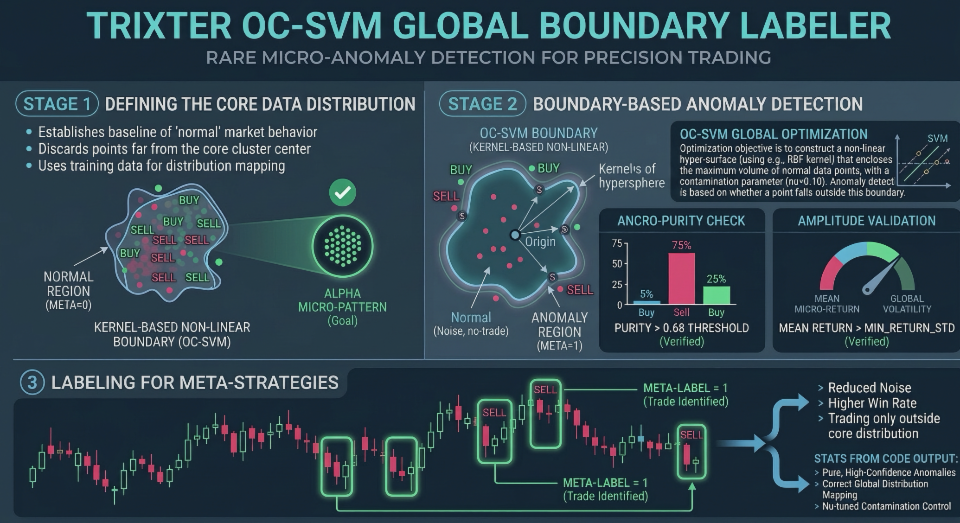
SVM solves a binary classification problem: it separates two classes. But One-Class SVM is trained only on data from one class ("normal" examples) and builds a boundary around them (a hyperplane in the transformed space) that separates this region from everything else.
Everything that falls inside the region is considered normal, everything outside is an anomaly.
How it works
-
Data is mapped into a feature space (via a kernel, e.g., RBF).
-
The algorithm looks for a hyperplane maximally distant from the origin that separates most points from zero.
-
The parameter ν (nu) defines:
-
the upper bound on the fraction of outliers in the training sample,
-
the lower bound on the fraction of support vectors.
-
-
Points that end up "on the other side" of the boundary are considered anomalies.
What it is used for
-
Anomaly / outlier detection (fraud detection, network intrusions, spikes in quotes).
-
Novelty detection — when there is only "clean" normal data, and deviations need to be caught.
-
System monitoring — deviation of metrics from normal behavior, searching for market inefficiencies.
The Trixter SVM bot is built using this approach.
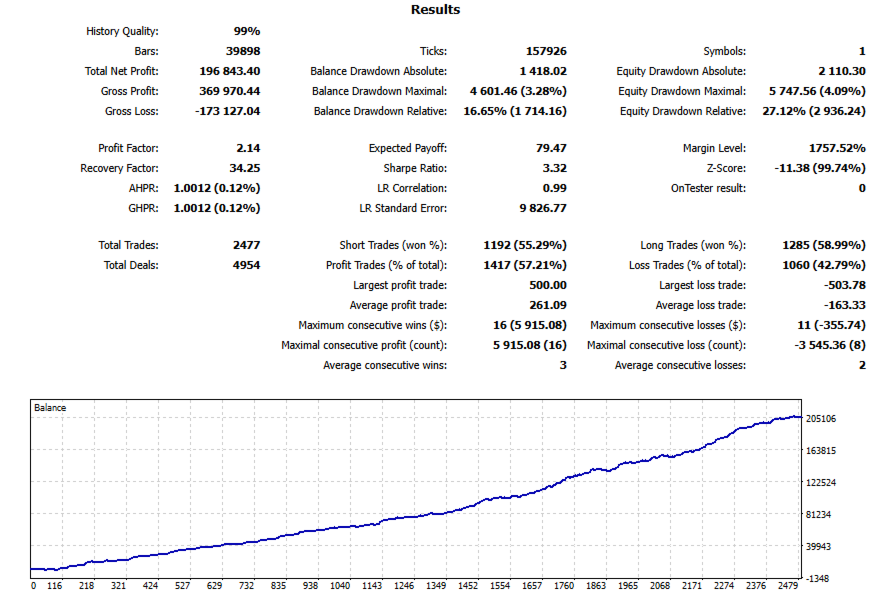
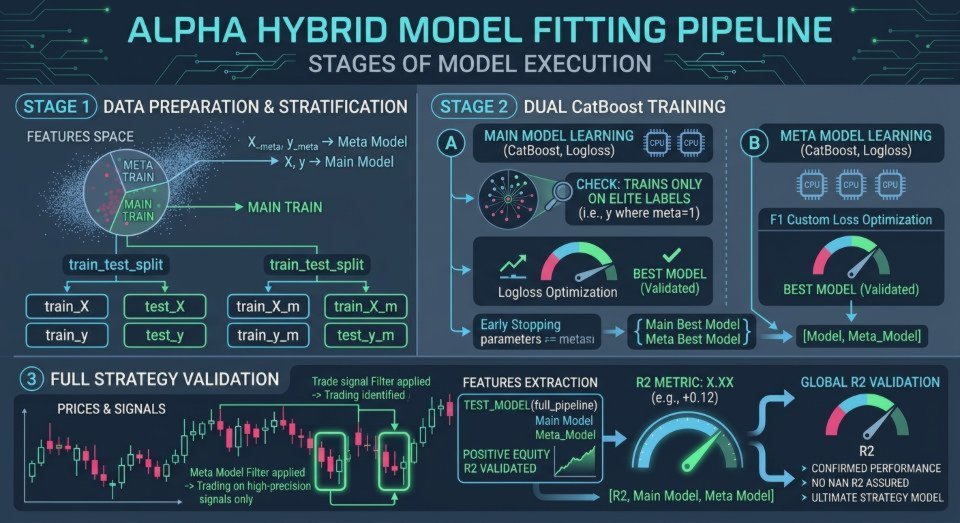
The Trixter SVM algorithm implements pattern search using Support vector machine (SVM for short). We proceed from the assumption that the gold market is sufficiently efficient and most price fluctuations form market noise that cannot be predicted. But we can identify fragments of the gold chart (so-called anomalies) in which it is maximally predictable. Thus I identified 40% of the chart segments that are well predictable.
Key principles
- Analysis of gold volatility across multiple timeframes and indicator periods.
- Grouping of volatility to find effective patterns (from 100 to 3000).
- Statistical verification: high mathematical expectation of profit and statistical significance.
- Patterns that fail verification are marked as noise — in such situations no trades are opened.
- Mandatory 2-year forward test before being allowed to a real account.
Features of the trading logic
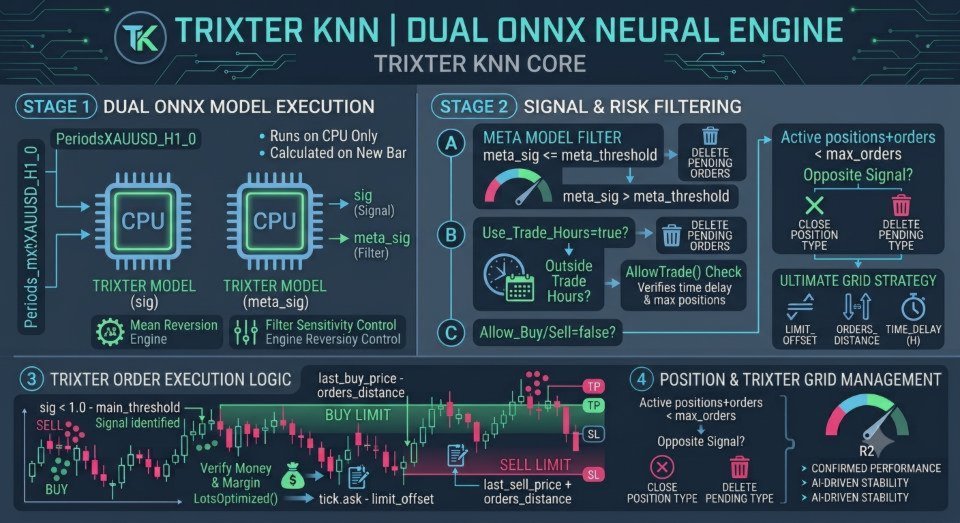
- Opening trades with limit orders at a selected distance from the price — minimal slippage.
- If a limit order does not trigger (the price did not touch the level) and the signal disappears — the order is deleted.
- Open positions are accompanied by stop-loss and take-profit, and are closed at market on an opposite signal.
- The robot does not use martingale, arbitrage, or other high-risk strategies.
- Recommended timeframes: from M5 to H1. Optimal — H1 XAUUSD.
- Flexible adjustment of trading activity is provided (parameters below).
Main settings
- Allow BUY signals, Allow SELL signals — allow or prohibit buys/sells when there is confidence in the market direction.
- Signals sensitivity, Filter sensitivity — threshold for signal sensitivity and noise filtering. Default value — 0.5. Can be raised to 0.7–0.9 for cleaner signals.
- Filter by trading hours — restriction of trading time. By default — around the clock.
Money management settings
- Distance in points for limit order — distance from the price to the limit order. Default: 250. Less → more trades, more → more conservative.
- Max positions + orders number — maximum number of simultaneously open positions (without averaging). Default: 3.
- Additionally configurable: delay between openings, maximum spread control, stop-loss and take-profit levels.