Ridgeline
- Experts
- Version: 1.10
- Updated: 17 September 2026
- Activations: 20

Ridgeline waits at the price levels that gold has left alone. It reads daily bars, marks the highs and lows that no later bar has taken out, and parks a pending stop order there. Seven sets of rules search at different depths of history, so one may be waiting at a level formed last week while another watches one from three months back.
A set that takes a loss stands down for two days before it places anything again. Each set carries its own magic number and its own distances, and no set ever adds to a position opened by another. A losing trade is closed by its stop, never averaged and never doubled.
How It Finds A Level
Each set reads daily bars and looks for one thing: a level the market has not taken out since it was formed. A resistance is a daily high that is higher than every bar after it and higher than the bars immediately before it. A support is the mirror image. A level that price has already passed is not a level any more, and the set moves on to the next one.
The level must also sit at a minimum distance from the current price. If the nearest unbroken level is too close, the set waits rather than trading a level the market is already sitting on.
The entry is a pending stop order placed near that level with a fixed offset. A buy stop sits slightly below a resistance rather than above it, so the order is filled while price is still approaching the level. Stop loss and take profit are attached to the order at the moment it is placed, not after the fill.
Every pending order has a lifetime of its own, from three to nineteen days depending on the set. The expiry is registered with the broker wherever the symbol allows it, so an order that was never filled is withdrawn on time even if the terminal was closed that week. The set then looks for a level again on current data.
Why There Are Seven Sets
The sets differ in how deep they look for a level, how far the order sits from it, how long the order waits, and in the size of the stop, the target and the trailing stop. One set works with shallow swings and reacts quickly, another looks back through months of daily bars and waits. They ship as one product, one block of code and one group of inputs.
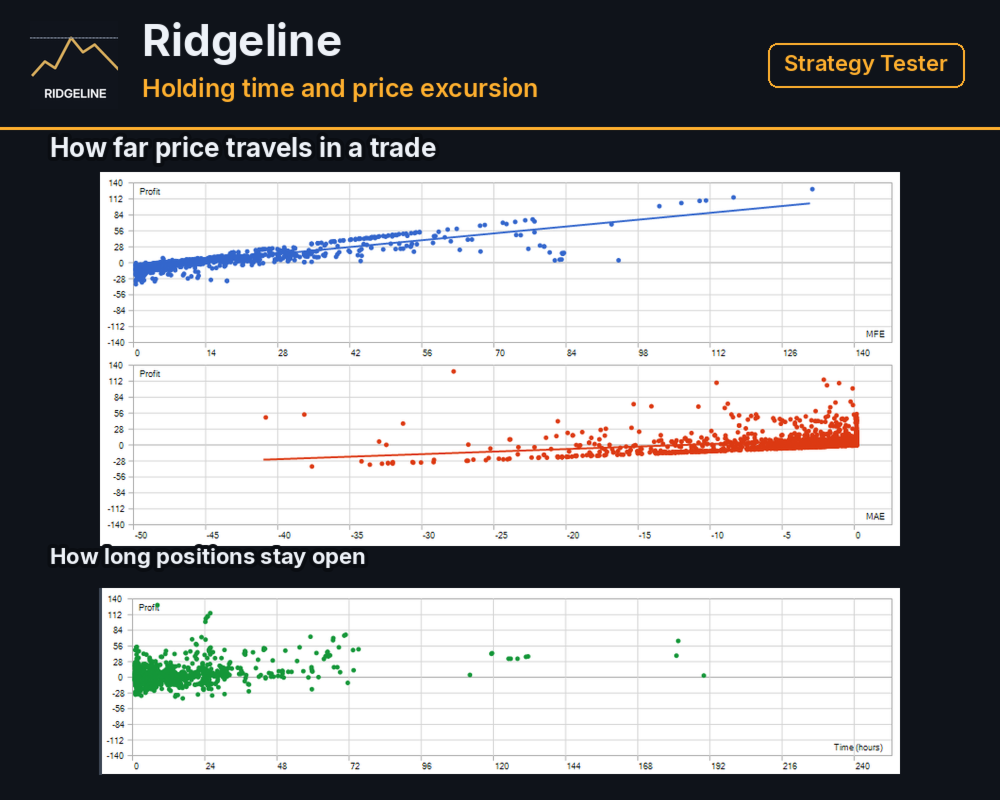
Because the sets read the same instrument, several of them can find the same level and place orders around it at the same time. Over the test window the portfolio held as many as 17 positions at once, and on that day every one of them was on the same side of the market. This is the reason the risk profile matters more here than the choice of any single setting.
Three Ways Out Of A Trade
A position leaves the market in one of three ways: the take profit, the stop loss, or a trailing stop that follows price at a fixed distance once the trade has moved far enough in its favour. The trailing stop stops moving once it has locked in the amount its set allows, so a trade that has already secured its result is left to run to the target.
A safety net closes a position at market if price has passed the stop level while the stop itself was not executed - after a requote or a broken connection, for example.
Standing Down After A Loss
When a set takes a loss it stops trading for a set number of hours and withdraws its own pending orders. The reason is simple: the same level in the same choppy market tends to produce the same loss twice in a row. Standing down for two days is the default.
The other six sets are not affected and keep working. In the test window this rule raised the ratio of gross positive to gross negative and cut the number of trades: it removes entries, it does not add them. The number of hours is an input, and zero switches the rule off.
Distances Follow The Price Of Gold
A stop of a fixed number of dollars means a different risk at different price levels. Ridgeline measures every distance against a reference price and scales it with the market, so a level, a stop and a target keep their proportion as gold moves. The reference price is an input, and scaling can be switched off.
Risk Profile
One input decides how the traded volume is derived from the account balance: Conservative, Medium, High risk, or a custom figure. The rule applies equally to all seven sets, so their weight against each other never changes. A fixed lot is also available.
The profile sets the level of risk, not the quality of the system, and it moves the result and the drawdown in the same direction. Over the test window above, measured in percent of the account: the fixed minimum volume gave 9.67 balance and 12.60 equity; Medium, which is the factory setting, gave 19.82 and 32.52; High risk gave 30.50 and 39.40. Run the tester on the profile you intend to use before you use it - the figures in the block above are the fixed volume, not the factory profile.
Numbers From The Report
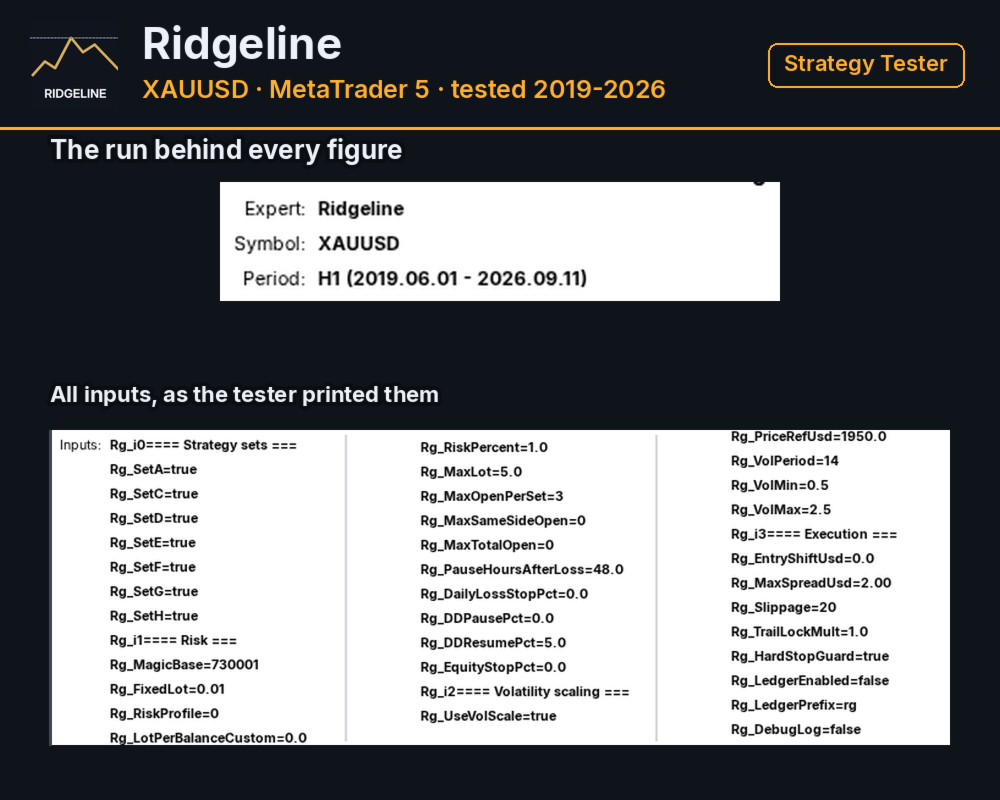
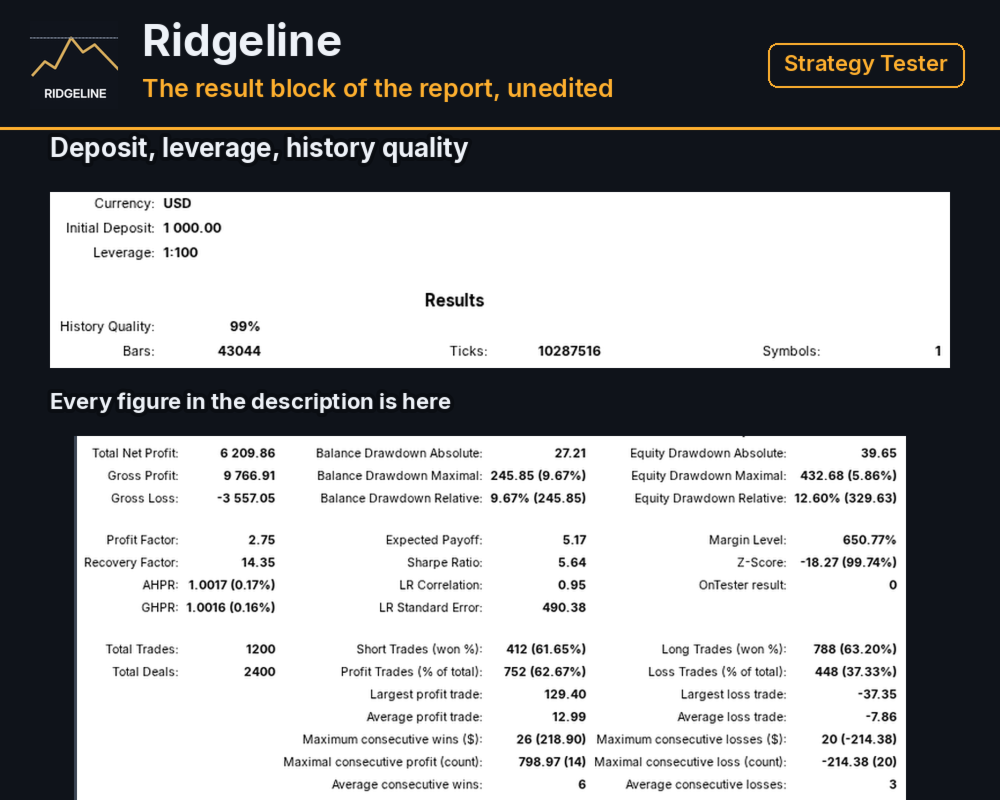
Strategy Tester, XAUUSD, H1, the period 2019.06.01 - 2026.09.11, history quality 99%, starting deposit 1000, and the risk profile set so that the fixed minimum volume applies. Every other input was left at the value it ships with. The factory setting of the risk profile is not the fixed lot - see the section below:
- net result 6215.93
- gross positive divided by gross negative: 2.75
- largest balance drawdown in percent 9.67%
- largest equity drawdown in percent 12.60%
- 1200 trades, 62.67% of them closed positive
- average positive trade 13.00, average negative trade -7.86
- largest negative trade -37.35
The deepest drawdown in money over the run was 245.85, and it arrived when the account had already grown well past the starting deposit. A fresh account trading the same fixed volume meets that same stretch at a smaller balance, so the percentage it sees is larger.
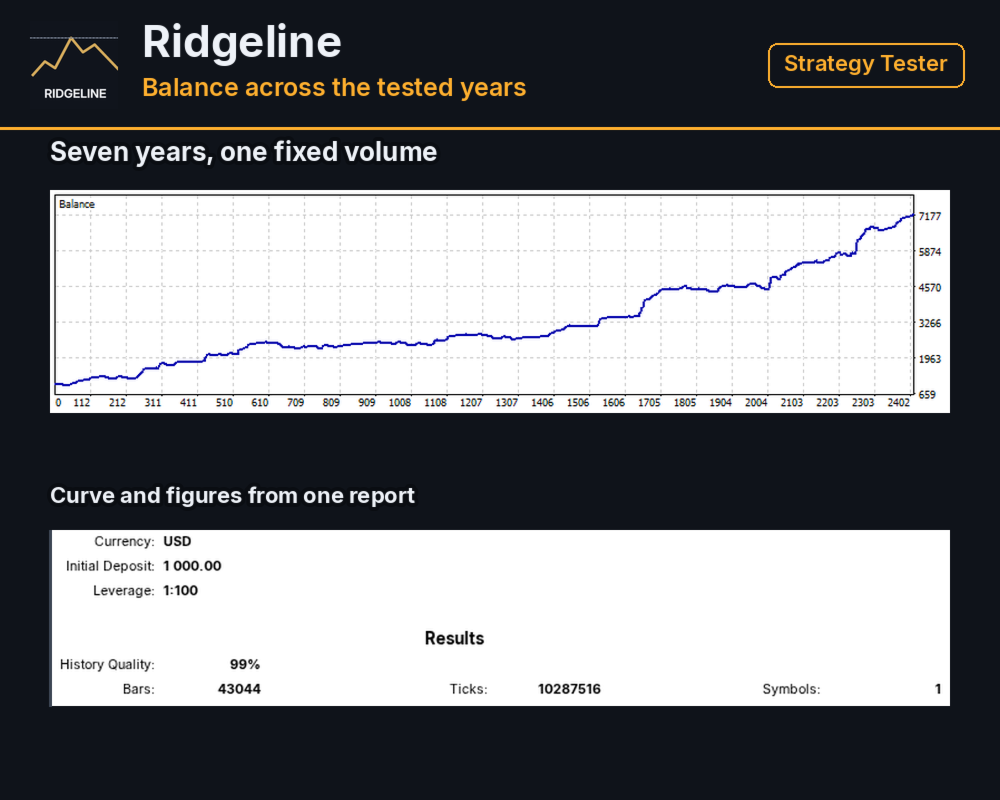
The figures come from one report on one fixed volume. A different risk profile, a different broker and a different spread on gold will give different figures.
Requirements
XAUUSD, any timeframe on the chart - the sets read daily bars themselves. A hedging account is required: the seven sets hold their positions separately, and netting merges them into one. A broker with a tight spread on gold matters here more than usual, because the distances are measured in dollars per ounce.
Input Parameters
Seven switches turn the sets on and off. The risk group holds the profile, the fixed lot and the limit of open positions per set. The rest cover the scaling reference price, the hours a set stands down after a loss, the spread ceiling, the safety net and the trade log.
Support
Write to me in private messages on mql5.com with the name of your broker and your set file, and I will answer.