
Microedge Neural Matrix EA
- Experts
-
Peter Robert Grange
 Senior AI Algo-Trading Developer
- Experience: 7+ years in developing algorithmic trading systems and automated strategies.
- Specialization: Building high-performance AI-driven trading engines for financial markets. - Version: 1.2
- Updated: 30 August 2026
- Activations: 12
Precision at the Edge of Market Structure
LIVE SIGNAL — REAL ACCOUNT PERFORMANCE
Follow MicroEdge Neural Matrix EA under real market conditions, including current and historical trades, balance and equity development, drawdown, trading frequency, spreads, liquidity changes, and broker execution.
Historical testing demonstrates how the architecture behaved under previous market conditions. The live signal demonstrates how the system operates in the current market.
OVERVIEW
MicroEdge Neural Matrix EA is a structured algorithmic trading system developed specifically for XAUUSD on the H1 timeframe.
The system approaches the market as a continuously evolving matrix of price structure, momentum, volatility, liquidity, session behaviour, and directional expansion.
Rather than reacting to every candle or entering the market simply because price is moving, MicroEdge evaluates whether several internal conditions are aligned before allowing a trade.
Its purpose is not to trade constantly.
Its purpose is to recognise structured opportunities, filter unstable conditions, and execute with discipline.
Precision. Intelligence. Execution.
THE MICROEDGE CONCEPT
The name MicroEdge reflects the main principle behind the system.
A sustainable trading advantage is rarely created by one perfect prediction. It is created through a sequence of smaller, carefully measured decisions:
-
identifying the current market environment;
-
filtering unstable price behaviour;
-
evaluating directional pressure;
-
measuring expansion potential;
-
recognising liquidity conditions;
-
controlling exposure;
-
selecting the correct execution window;
-
avoiding unnecessary market participation.
The Neural Matrix represents the interconnected structure of these decisions.
Instead of relying on one conventional indicator or one isolated entry trigger, the system combines several analytical layers into a coordinated decision framework.
Each internal module contributes information to the final trading scenario.
The result is a structured process designed to determine not only when to trade, but also when remaining outside the market may be the more disciplined decision.
MATRIX CORE ARCHITECTURE
At the centre of MicroEdge lies the Matrix Core — a multi-layer analytical environment that continuously evaluates the relationship between:
-
price structure;
-
directional momentum;
-
market volatility;
-
liquidity conditions;
-
trading-session behaviour;
-
structural expansion;
-
current risk conditions.
The Matrix Core does not treat every market signal as an independent event.
It analyses whether the broader market environment supports the potential trade before execution is permitted.
Its purpose is to transform raw market movement into a structured trading scenario.
ADAPTIVE PRICE FIELD
The Adaptive Price Field evaluates how price behaves inside the current market structure.
It is designed to identify conditions such as:
-
directional expansion;
-
structural compression;
-
market imbalance;
-
liquidity transition;
-
momentum continuation;
-
potential exhaustion;
-
unstable movement;
-
reduced-confidence conditions.
Instead of evaluating each candle in isolation, the architecture examines how current price action relates to the wider market environment.
This allows visually similar setups to be treated differently when their underlying conditions are not the same.
MARKET MEMORY LAYER
The Market Memory Layer evaluates recent price behaviour to determine whether the current environment represents:
-
continuation;
-
transition;
-
acceleration;
-
exhaustion;
-
consolidation;
-
structural recovery;
-
unstable volatility.
This contextual layer helps the system avoid making decisions based only on the latest candle or short-term impulse.
The current setup is considered within the broader sequence of recent market behaviour before the final trading decision is made.
SCENARIO RECOGNITION ENGINE
MicroEdge classifies the current market environment before allowing a position.
Depending on market conditions, the active scenario may reflect:
-
controlled trend continuation;
-
directional expansion;
-
structural breakout;
-
liquidity transition;
-
volatility acceleration;
-
balanced consolidation;
-
reduced-confidence movement.
When the required conditions are not aligned, the system can remain inactive.
This selectivity is intentional.
MicroEdge is designed around the principle that avoiding a weak trade can be just as important as entering a strong one.
MICROEDGE SIGNAL DECK
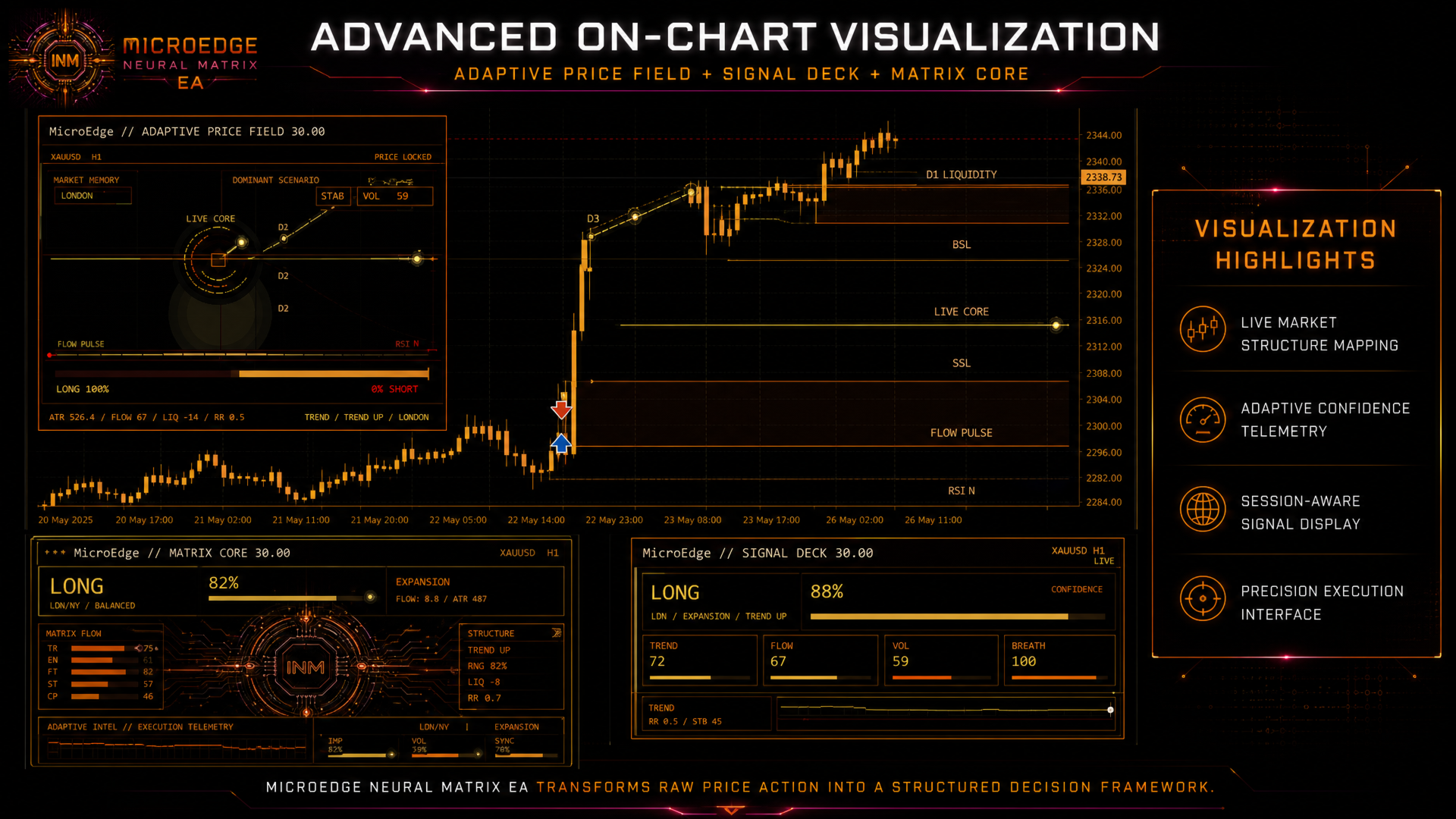
The integrated Signal Deck transforms complex internal calculations into a clear visual interface.
Depending on current market conditions, the panel may display information such as:
-
directional bias;
-
confidence level;
-
trend condition;
-
market flow;
-
volatility state;
-
liquidity assessment;
-
expansion status;
-
active session;
-
risk-to-reward context;
-
current market scenario;
-
execution readiness.
The Signal Deck does not replace the automated strategy.
It provides a visual representation of how the system currently interprets the market.
This makes it easier to understand why the advisor may:
-
prepare for an entry;
-
open a position;
-
manage an active trade;
-
reduce activity;
-
remain outside the market.
ADAPTIVE EXECUTION TELEMETRY
MicroEdge continuously monitors whether current conditions remain consistent with the active trading scenario.
Before and during a position, the system evaluates the relationship between:
-
momentum;
-
volatility;
-
market flow;
-
structural stability;
-
directional expansion;
-
liquidity;
-
selected risk profile.
The objective is to maintain consistency between the conditions that created the original entry and the conditions developing afterward.
This creates a more structured execution process than simple indicator-based order placement.
SESSION-AWARE MARKET PROCESSING
Gold can behave very differently across the Asian, London, and New York sessions.
MicroEdge takes session context into account when evaluating:
-
liquidity availability;
-
volatility expansion;
-
directional continuation;
-
false breakouts;
-
market transitions;
-
changes in trading activity.
The system may behave differently during each major session because the underlying market environment is different.
Session information is not used as an isolated entry trigger. It forms one part of the wider Matrix Core assessment.
CONTROLLED MARKET PARTICIPATION
MicroEdge Neural Matrix EA is not designed as a high-frequency trading system.
A greater number of trades does not automatically produce better results.
Excessive activity may increase exposure to:
-
market noise;
-
unstable volatility;
-
wider spreads;
-
weak liquidity;
-
false movements;
-
low-quality entry conditions.
MicroEdge therefore prioritises:
Structure over activity
The system waits for coordinated market conditions rather than reacting to every movement.
Selectivity over frequency
A period without trades may represent intentional filtering rather than inactivity or malfunction.
Execution quality over quantity
The architecture seeks structured opportunities instead of maximum market participation.
Trading frequency can vary considerably.
During some periods, the system may trade more actively. During unstable or unsuitable conditions, it may remain outside the market for several days.
RISK-STRUCTURED ARCHITECTURE
Risk management is integrated into the internal architecture of MicroEdge.
The system evaluates exposure in relation to:
-
current market volatility;
-
structural distance;
-
account configuration;
-
active trading scenario;
-
instrument conditions;
-
selected risk level.
MicroEdge is designed to pursue growth while maintaining a structured relationship between opportunity and exposure.
Losses remain an unavoidable part of algorithmic trading. No legitimate strategy can eliminate them completely.
The purpose of the risk framework is not to promise loss-free trading.
Its purpose is to maintain disciplined, measurable, and controlled market participation over time.
HISTORICAL PERFORMANCE FRAMEWORK
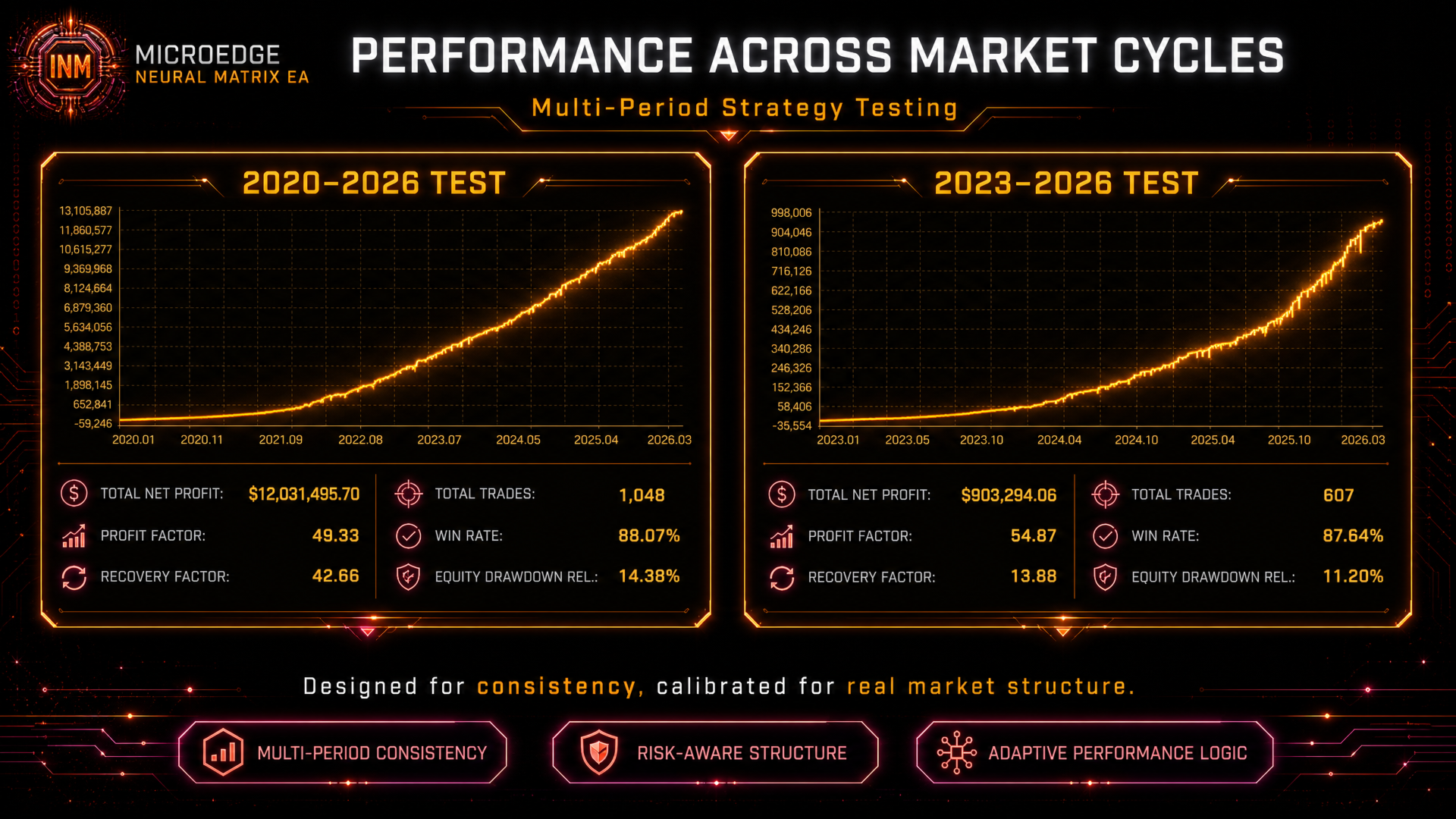
MicroEdge Neural Matrix EA has been evaluated across several historical intervals to examine its behaviour under different Gold market cycles.
2016–2026 — Extended Market-Cycle Evaluation
A broad historical test covering multiple volatility regimes, macroeconomic environments, and long-term phases of the Gold market.
This interval is intended to examine the architecture across a wide variety of market conditions rather than one isolated period.
2020–2026 — Modern Volatility Evaluation
A focused test covering recent market structure, elevated uncertainty, liquidity transitions, and periods of significant Gold volatility.
2023–2026 — Current-Market Calibration
A more concentrated evaluation based on recent Gold behaviour and contemporary trading conditions.
Historical tests are provided for analysis and informational purposes.
They do not guarantee that identical results will occur in live trading.
For current real-market behaviour, follow the public signal:
https://www.mql5.com/en/signals/2383765
CORE ADVANTAGES
Multi-Layer Market Interpretation
MicroEdge combines several analytical layers instead of relying on one traditional indicator or one isolated entry condition.
Purpose-Built Visual Interface
The Matrix Core, Adaptive Price Field, and Signal Deck create a distinctive real-time representation of current market conditions.
Structured XAUUSD Execution
The system is designed specifically around the behaviour of Gold, including its volatility, liquidity characteristics, session transitions, and directional expansion.
Adaptive Scenario Processing
The architecture can adjust its interpretation as momentum, volatility, liquidity, and market structure change.
Selective Trading Frequency
MicroEdge is designed to avoid unnecessary market participation when its internal scenario lacks sufficient confirmation.
Integrated Risk Logic
Trade exposure and position management are coordinated with the active market structure and selected risk profile.
Live Execution Transparency
The visual interface provides additional insight into the system’s current directional bias, confidence, flow, volatility, and structural assessment.
Fully Automated Operation
Once correctly installed, MicroEdge independently performs market analysis, trade execution, and position management.
ADVANCED ON-CHART VISUALISATION
MicroEdge includes a distinctive visual environment designed to make its interpretation of the market easier to understand.
The interface may display:
-
directional bias;
-
active session;
-
expansion condition;
-
trend structure;
-
volatility data;
-
market flow;
-
liquidity assessment;
-
confidence level;
-
risk-to-reward context;
-
current execution scenario.
The chart visualisation is not merely decorative.
It represents the relationship between the principal components of the trading architecture.
Matrix Core
The central decision environment responsible for coordinating the system’s analytical layers.
Adaptive Price Field
A visual representation of structural movement, expansion, compression, and directional context.
Signal Deck
A compact interface showing confidence, market flow, trend, volatility, liquidity, and directional bias.
Market Memory
A contextual layer used to interpret the current setup in relation to recent market behaviour.
Execution Telemetry
A live representation of the conditions supporting or weakening the current trading scenario.
Together, these modules transform raw XAUUSD price action into a structured and visually understandable decision environment.
TRADING CONDITIONS
Instrument: XAUUSD — Gold
Timeframe: H1
Platform: MetaTrader 5
Operating mode: Fully automated
Recommended account type: ECN or Raw Spread
Recommended environment: Stable VPS connection
Trading frequency: Variable, depending on market conditions
Risk profile: Adjustable through the available system settings
Broker execution, symbol specifications, spread, commission, liquidity, and slippage may influence live results.
WHO IS MICROEDGE DESIGNED FOR?
MicroEdge Neural Matrix EA is intended for traders who value:
-
structured automated trading;
-
clear visual market information;
-
selective market participation;
-
long-term strategy evaluation;
-
adjustable risk exposure;
-
transparent live monitoring;
-
Gold-focused algorithmic execution.
It may be used on private trading accounts and other environments where the user understands the applicable trading rules and risk limits.
Before using the advisor on a real account, users should carefully test its behaviour and select an appropriate risk profile.
LIVE SIGNAL AND TRANSPARENCY
Historical tests can be useful for analysing how a strategy behaved under previous conditions, but they cannot fully reproduce the live market.
Real trading includes variables such as:
-
changing spreads;
-
broker execution;
-
liquidity differences;
-
slippage;
-
symbol specifications;
-
commission;
-
connection quality;
-
unexpected market events.
For this reason, MicroEdge is accompanied by a public live signal.
LIVE SIGNAL:
https://www.mql5.com/en/signals/2383765
The signal allows users to observe the actual behaviour of the system before making their own decision.
It should be viewed as a real-time performance record, not as a promise or guarantee of future profitability.
FINAL THOUGHT
MicroEdge Neural Matrix EA was developed around one central principle:
A trading advantage is not one perfect prediction. It is a disciplined sequence of intelligent decisions.
The system does not attempt to predict every movement or remain permanently active.
It observes.
It evaluates.
It filters.
It waits.
And when its internal architecture recognises a structured opportunity, it executes.
MicroEdge is not built around constant trading or unrealistic promises.
It is built around:
Precision. Intelligence. Execution.
MICROEDGE NEURAL MATRIX EADecode the structure. Measure the edge. Execute with precision.
LIVE SIGNAL:
https://www.mql5.com/en/signals/2383765
DISCLAIMER
Algorithmic trading involves risk, and losses may occur.
Historical tests, screenshots, statistics, and previous performance do not guarantee future results.
Backtesting cannot fully reproduce live spreads, liquidity, slippage, execution delays, broker conditions, or unexpected market events.
The public signal demonstrates current real-account behaviour, but it also does not guarantee future performance.
Users should carefully assess their own financial situation and risk tolerance, select an appropriate risk level, test the system before live use, and trade only with capital they can afford to lose.






































Very good EA.