Articles with MQL5 programming examples

Access a huge collection of articles with code examples showing how to create indicators and trading robots for the MetaTrader platform in the MQL5 language. Source codes are attached to the articles, so you can open them in MetaEditor and run them to see how the applications work.
These articles will be useful both for those who have just started exploring automated trading and for professional traders with programming experience. They feature not only examples, but also contain new ideas.
Add a new article

You are missing trading opportunities:
- Free trading apps
- Over 8,000 signals for copying
- Economic news for exploring financial markets
Registration
Log in
You agree to website policy and terms of use
If you do not have an account, please register


Population optimization algorithms: Differential Evolution (DE)
In this article, we will consider the algorithm that demonstrates the most controversial results of all those discussed previously - the differential evolution (DE) algorithm.


Time Evolution Travel Algorithm (TETA)
This is my own algorithm. The article presents the Time Evolution Travel Algorithm (TETA) inspired by the concept of parallel universes and time streams. The basic idea of the algorithm is that, although time travel in the conventional sense is impossible, we can choose a sequence of events that lead to different realities.


The MQL5 Standard Library Explorer (Part 3): Expert Standard Deviation Channel
In this discussion, we will develop an Expert Advisor using the CTrade and CChartObjectStdDevChannel classes, while applying several filters to enhance profitability. This stage puts our previous discussion into practical application. Additionally, I’ll introduce another simple approach to help you better understand the MQL5 Standard Library and its underlying codebase. Join the discussion to explore these concepts in action.


Multiple Symbol Analysis With Python And MQL5 (Part I): NASDAQ Integrated Circuit Makers
Join us as we discuss how you can use AI to optimize your position sizing and order quantities to maximize the returns of your portfolio. We will showcase how to algorithmically identify an optimal portfolio and tailor your portfolio to your returns expectations or risk tolerance levels. In this discussion, we will use the SciPy library and the MQL5 language to create an optimal and diversified portfolio using all the data we have.


Alternative risk return metrics in MQL5
In this article we present the implementation of several risk return metrics billed as alternatives to the Sharpe ratio and examine hypothetical equity curves to analyze their characteristics.


Developing Market Entropy Indicator: Trading System Based on Information Theory
This article explores the development of a Market Entropy Indicator based on principles from Information Theory to measure the uncertainty and information content within financial markets. By applying concepts such as Shannon Entropy to price movements, the indicator quantifies whether the market is structured (trending), transitioning, or chaotic.


GUI: Tips and Tricks for creating your own Graphic Library in MQL
We'll go through the basics of GUI libraries so that you can understand how they work or even start making your own.


Reimagining Classic Strategies (Part 17): Modelling Technical Indicators
In this discussion, we focus on how we can break the glass ceiling imposed by classical machine learning techniques in finance. It appears that the greatest limitation to the value we can extract from statistical models does not lie in the models themselves — neither in the data nor in the complexity of the algorithms — but rather in the methodology we use to apply them. In other words, the true bottleneck may be how we employ the model, not the model’s intrinsic capability.


Developing a quality factor for Expert Advisors
In this article, we will see how to develop a quality score that your Expert Advisor can display in the strategy tester. We will look at two well-known calculation methods – Van Tharp and Sunny Harris.


Creating a Trading Administrator Panel in MQL5 (Part IX): Code Organization (V): AnalyticsPanel Class
In this discussion, we explore how to retrieve real-time market data and trading account information, perform various calculations, and display the results on a custom panel. To achieve this, we will dive deeper into developing an AnalyticsPanel class that encapsulates all these features, including panel creation. This effort is part of our ongoing expansion of the New Admin Panel EA, introducing advanced functionalities using modular design principles and best practices for code organization.


Developing a Replay System (Part 76): New Chart Trade (III)
In this article, we'll look at how the code of DispatchMessage, missing from the previous article, works. We will laso introduce the topic of the next article. For this reason, it is important to understand how this code works before moving on to the next topic. The content presented here is intended solely for educational purposes. Under no circumstances should the application be viewed for any purpose other than to learn and master the concepts presented.


DoEasy. Controls (Part 19): Scrolling tabs in TabControl, WinForms object events
In this article, I will create the functionality for scrolling tab headers in TabControl using scrolling buttons. The functionality is meant to place tab headers into a single line from either side of the control.


Matrix Factorization: A more practical modeling
You might not have noticed that the matrix modeling was a little strange, since only columns were specified, not rows and columns. This looks very strange when reading the code that performs matrix factorizations. If you were expecting to see the rows and columns listed, you might get confused when trying to factorize. Moreover, this matrix modeling method is not the best. This is because when we model matrices in this way, we encounter some limitations that force us to use other methods or functions that would not be necessary if the modeling were done in a more appropriate way.


Developing a Replay System — Market simulation (Part 08): Locking the indicator
In this article, we will look at how to lock the indicator while simply using the MQL5 language, and we will do it in a very interesting and amazing way.


From Basic to Intermediate: Indicator (I)
In this article, we will create our first fully practical and functional indicator. The goal is not to show how to create an application, but to help you understand how you can develop your own ideas and give you the opportunity to apply them in a safe, simple, and practical way.


Connexus Helper (Part 5): HTTP Methods and Status Codes
In this article, we will understand HTTP methods and status codes, two very important pieces of communication between client and server on the web. Understanding what each method does gives you the control to make requests more precisely, informing the server what action you want to perform and making it more efficient.


Overcoming The Limitation of Machine Learning (Part 6): Effective Memory Cross Validation
In this discussion, we contrast the classical approach to time series cross-validation with modern alternatives that challenge its core assumptions. We expose key blind spots in the traditional method—especially its failure to account for evolving market conditions. To address these gaps, we introduce Effective Memory Cross-Validation (EMCV), a domain-aware approach that questions the long-held belief that more historical data always improves performance.


From Novice to Expert: Animated News Headline Using MQL5 (VIII) — Quick Trade Buttons for News Trading
While algorithmic trading systems manage automated operations, many news traders and scalpers prefer active control during high-impact news events and fast-paced market conditions, requiring rapid order execution and management. This underscores the need for intuitive front-end tools that integrate real-time news feeds, economic calendar data, indicator insights, AI-driven analytics, and responsive trading controls.


From Novice to Expert: Animated News Headline Using MQL5 (IV) — Locally hosted AI model market insights
In today's discussion, we explore how to self-host open-source AI models and use them to generate market insights. This forms part of our ongoing effort to expand the News Headline EA, introducing an AI Insights Lane that transforms it into a multi-integration assistive tool. The upgraded EA aims to keep traders informed through calendar events, financial breaking news, technical indicators, and now AI-generated market perspectives—offering timely, diverse, and intelligent support to trading decisions. Join the conversation as we explore practical integration strategies and how MQL5 can collaborate with external resources to build a powerful and intelligent trading work terminal.


Category Theory in MQL5 (Part 4): Spans, Experiments, and Compositions
Category Theory is a diverse and expanding branch of Mathematics which as of yet is relatively uncovered in the MQL5 community. These series of articles look to introduce and examine some of its concepts with the overall goal of establishing an open library that provides insight while hopefully furthering the use of this remarkable field in Traders' strategy development.

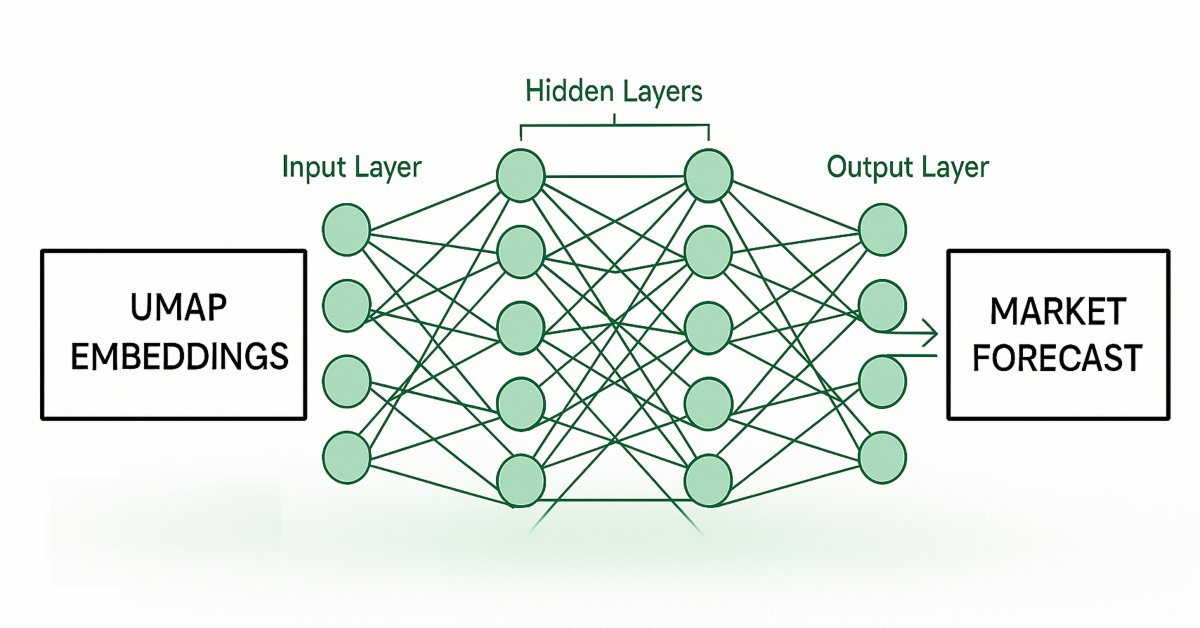
Feature Engineering With Python And MQL5 (Part IV): Candlestick Pattern Recognition With UMAP Regression
Dimension reduction techniques are widely used to improve the performance of machine learning models. Let us discuss a relatively new technique known as Uniform Manifold Approximation and Projection (UMAP). This new technique has been developed to explicitly overcome the limitations of legacy methods that create artifacts and distortions in the data. UMAP is a powerful dimension reduction technique, and it helps us group similar candle sticks in a novel and effective way that reduces our error rates on out of sample data and improves our trading performance.


Tables in the MVC Paradigm in MQL5: Integrating the Model Component into the View Component
In the article, we will create the first version of the TableControl (TableView) control. This will be a simple static table being created based on the input data defined by two arrays — a data array and an array of column headers.


Developing a Replay System (Part 73): An Unusual Communication (II)
In this article, we will look at how to transmit information in real time between the indicator and the service, and also understand why problems may arise when changing the timeframe and how to solve them. As a bonus, you will get access to the latest version of the replay /simulation app.


DoEasy. Service functions (Part 2): Inside Bar pattern
In this article, we will continue to look at price patterns in the DoEasy library. We will also create the Inside Bar pattern class of the Price Action formations.


Example of CNA (Causality Network Analysis), SMOC (Stochastic Model Optimal Control) and Nash Game Theory with Deep Learning
We will add Deep Learning to those three examples that were published in previous articles and compare results with previous. The aim is to learn how to add DL to other EA.


DoEasy. Controls (Part 31): Scrolling the contents of the ScrollBar control
In this article, I will implement the functionality of scrolling the contents of the container using the buttons of the horizontal scrollbar.


Interactive Supply and Demand Zone Manager in MQL5 (Part I): From Manual to Automated Lifecycle
Replace static drawings with automated, stateful zones controlled by a CZone wrapper. The system synchronizes user rectangles, sizes zones by ATR, validates breakouts using consecutive closes, applies ghost/deactivation rules, merges nearby structures by a 1.5×ATR threshold, and projects edges forward. Traders gain durable levels that update themselves and reduce repetitive chart management.


From Basic to Intermediate: Operators
In this article we will look at the main operators. Although the topic is simple to understand, there are certain points that are of great importance when it comes to including mathematical expressions in the code format. Without an adequate understanding of these details, programmers with little or no experience eventually give up trying to create their own solutions.


Developing a Replay System (Part 42): Chart Trade Project (I)
Let's create something more interesting. I don't want to spoil the surprise, so follow the article for a better understanding. From the very beginning of this series on developing the replay/simulator system, I was saying that the idea is to use the MetaTrader 5 platform in the same way both in the system we are developing and in the real market. It is important that this is done properly. No one wants to train and learn to fight using one tool while having to use another one during the fight.


Developing a Replay System (Part 70): Getting the Time Right (III)
In this article, we will look at how to use the CustomBookAdd function correctly and effectively. Despite its apparent simplicity, it has many nuances. For example, it allows you to tell the mouse indicator whether a custom symbol is on auction, being traded, or the market is closed. The content presented here is intended solely for educational purposes. Under no circumstances should the application be viewed for any purpose other than to learn and master the concepts presented.


Walsh Functions in Modern Trading
The article discusses the application of Walsh functions in trading. We will explore the basic principles of using these functions to analyze financial markets, forecast prices, and make trading decisions. We will also discuss the advantages and disadvantages of these functions, as well as the prospects for their application in trading and technical analysis.


Building an Interactive AnchorFlow Volume Profile Indicator (MTF) in MQL5
We implement an interactive, anchored multi-timeframe volume profile in MQL5 for MetaTrader 5. The indicator draws the current-timeframe profile on the main chart and a higher timeframe profile in a subwindow, both aligned by a draggable anchor and the visible range. You will learn keyboard-driven bin editing (E/S double-click), robust timeframe validation, viewport-aware updates, and object restoration to build a reliable, synchronized volume workflow.


From Basic to Intermediate: Variables (III)
Today we will look at how to use predefined MQL5 language variables and constants. In addition, we will analyze another special type of variables: functions. Knowing how to properly work with these variables can mean the difference between an application that works and one that doesn't. In order to understand what is presented here, it is necessary to understand the material that was discussed in previous articles.


From Basic to Intermediate: Template and Typename (V)
In this article, we'll explore one last simple use case for templates, and discuss the benefits and necessity of using typename in your code. Although this article may seem a bit complicated at first, it is important to understand it properly in order to use templates and typename later.


Gain An Edge Over Any Market (Part IV): CBOE Euro And Gold Volatility Indexes
We will analyze alternative data curated by the Chicago Board Of Options Exchange (CBOE) to improve the accuracy of our deep neural networks when forecasting the XAUEUR symbol.


Reimagining Classic Strategies (Part IX): Multiple Time Frame Analysis (II)
In today's discussion, we examine the strategy of multiple time-frame analysis to learn on which time frame our AI model performs best. Our analysis leads us to conclude that the Monthly and Hourly time-frames produce models with relatively low error rates on the EURUSD pair. We used this to our advantage and created a trading algorithm that makes AI predictions on the Monthly time frame, and executes its trades on the Hourly time frame.


Data label for time series mining (Part 4):Interpretability Decomposition Using Label Data
This series of articles introduces several time series labeling methods, which can create data that meets most artificial intelligence models, and targeted data labeling according to needs can make the trained artificial intelligence model more in line with the expected design, improve the accuracy of our model, and even help the model make a qualitative leap!


From Basic to Intermediate: Variables (I)
Many beginning programmers have a hard time understanding why their code doesn't work as they expect. There are many things that make code truly functional. It's not just a bunch of different functions and operations that make the code work. Today I invite you to learn how to properly create real code, rather than copy and paste fragments of it. The materials presented here are for didactic purposes only. Under no circumstances should the application be viewed for any purpose other than to learn and master the concepts presented.


Population optimization algorithms: Mind Evolutionary Computation (MEC) algorithm
The article considers the algorithm of the MEC family called the simple mind evolutionary computation algorithm (Simple MEC, SMEC). The algorithm is distinguished by the beauty of its idea and ease of implementation.


HTTP and Connexus (Part 2): Understanding HTTP Architecture and Library Design
This article explores the fundamentals of the HTTP protocol, covering the main methods (GET, POST, PUT, DELETE), status codes and the structure of URLs. In addition, it presents the beginning of the construction of the Conexus library with the CQueryParam and CURL classes, which facilitate the manipulation of URLs and query parameters in HTTP requests.