MQL4 and MQL5 Programming Articles

Study the MQL5 language for programming trading strategies in numerous published articles mostly written by you - the community members. The articles are grouped into categories to help you quicker find answers to any questions related to programming: Integration, Tester, Trading Strategies, etc.
Follow our new publications and discuss them on the Forum!
Add a new article

You are missing trading opportunities:
- Free trading apps
- Over 8,000 signals for copying
- Economic news for exploring financial markets
Registration
Log in
You agree to website policy and terms of use
If you do not have an account, please register


Graphics in DoEasy library (Part 88): Graphical object collection — two-dimensional dynamic array for storing dynamically changing object properties
In this article, I will create a dynamic multidimensional array class with the ability to change the amount of data in any dimension. Based on the created class, I will create a two-dimensional dynamic array to store some dynamically changed properties of graphical objects.

Timeseries in DoEasy library (part 42): Abstract indicator buffer object class
In this article, we start the development of the indicator buffer classes for the DoEasy library. We will create the base class of the abstract buffer which is to be used as a foundation for the development of different class types of indicator buffers.

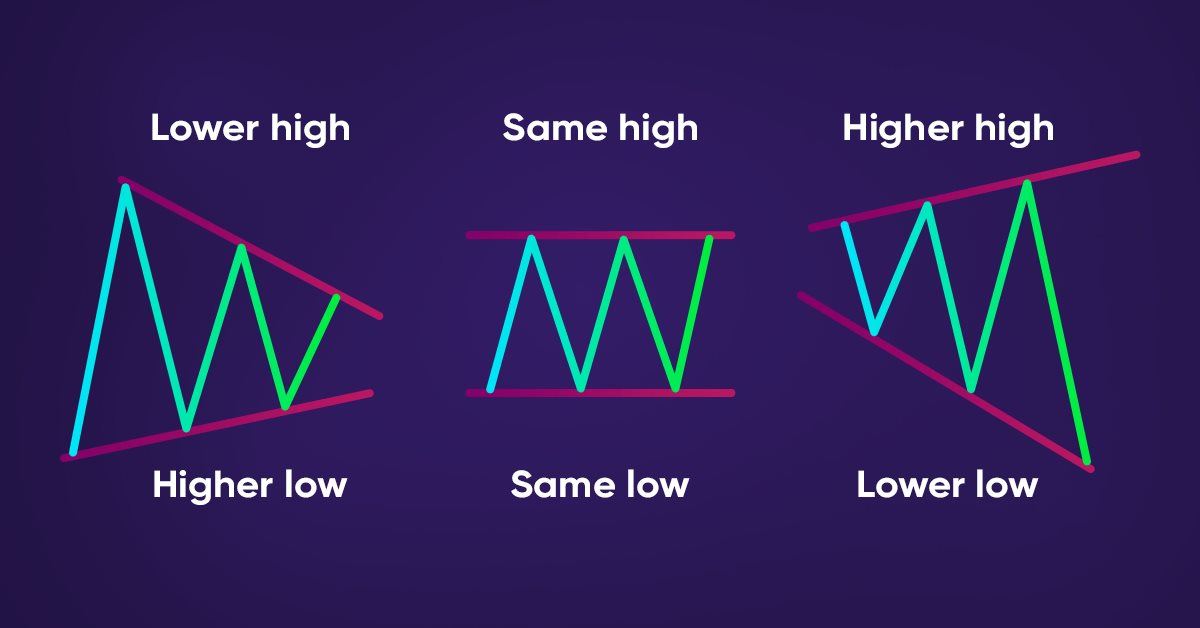
How to detect trends and chart patterns using MQL5
In this article, we will provide a method to detect price actions patterns automatically by MQL5, like trends (Uptrend, Downtrend, Sideways), Chart patterns (Double Tops, Double Bottoms).

The Indicators of the Micro, Middle and Main Trends
The aim of this article is to investigate the possibilities of trade automation and the analysis, on the basis of some ideas from a book by James Hyerczyk "Pattern, Price & Time: Using Gann Theory in Trading Systems" in the form of indicators and Expert Advisor. Without claiming to be exhaustive, here we investigate only the Model - the first part of the Gann theory.


Learn how to trade the Fair Value Gap (FVG)/Imbalances step-by-step: A Smart Money concept approach
A step-by-step guide to creating and implementing an automated trading algorithm in MQL5 based on the Fair Value Gap (FVG) trading strategy. A detailed tutorial on creating an expert advisor that can be useful for both beginners and experienced traders.

Mechanical Trading System "Chuvashov's Triangle"
Let me offer you an overview and the program code of the mechanical trading system based on ideas of Stanislav Chuvashov. Triangle's construction is based on the intersection of two trend lines built by the upper and lower fractals.

Developing the oscillator-based ZigZag indicator. Example of executing a requirements specification
The article demonstrates the development of the ZigZag indicator in accordance with one of the sample specifications described in the article "How to prepare Requirements Specification when ordering an indicator". The indicator is built by extreme values defined using an oscillator. There is an ability to use one of five oscillators: WPR, CCI, Chaikin, RSI or Stochastic Oscillator.

Creating MQL5 Expert Advisors in minutes using EA Tree: Part One
EA Tree is the first drag and drop MetaTrader MQL5 Expert Advisor builder. You can create complex MQL5 using a very easy to use graphical user interface. In EA Tree, Expert Advisors are created by connecting boxes together. Boxes may contain MQL5 functions, technical indicators, custom indicators, or values. Using the "tree of boxes", EA Tree generates the MQL5 code of the Expert Advisor.


Continuous Walk-Forward Optimization (Part 1): Working with Optimization Reports
The first article is devoted to the creation of a toolkit for working with optimization reports, for importing them from the terminal, as well as for filtering and sorting the obtained data. MetaTrader 5 allows downloading optimization results, however our purpose is to add our own data to the optimization report.

How to Write an Indicator on the Basis of Another Indicator
In MQL5 you can write an indicator both from a scratch and on the basis of another already existing indicator, in-built in the client terminal or a custom one. And here you also have two ways - to improve an indicator by adding new calculations and graphical styles to it , or to use an indicator in-built in the client terminal or a custom one via the iCustom() or IndicatorCreate() functions.

Library for easy and quick development of MetaTrader programs (part XX): Creating and storing program resources
The article deals with storing data in the program's source code and creating audio and graphical files out of them. When developing an application, we often need audio and images. The MQL language features several methods of using such data.


Use of Resources in MQL5
MQL5 programs not only automate routine calculations, but also can create a full-featured graphical environment. The functions for creating truly interactive controls are now virtually the same rich, as those in classical programming languages. If you want to write a full-fledged stand-alone program in MQL5, use resources in them. Programs with resources are easier to maintain and distribute.

Universal RSI indicator for working in two directions simultaneously
When developing trading algorithms, we often encounter a problem: how to determine where a trend/flat begins and ends? In this article, we try to create a universal indicator, in which we try to combine signals for different types of strategies. We will try to simplify the process of obtaining trade signals in an expert as much as possible. An example of combining several indicators in one will be given.

Analyzing Balance/Equity graphs by symbols and EAs' ORDER_MAGIC
With the introduction of hedging, MetaTrader 5 provides an excellent opportunity to trade several Expert Advisors on a single trading account simultaneously. When one strategy is profitable, while the second one is loss-making, the profit graph may hang around zero. In this case, it is useful to build the Balance and Equity graphs for each trading strategy separately.

Applying One Indicator to Another
When writing an indicator that uses the short form of the OnCalculate() function call, you might miss the fact that an indicator can be calculated not only by price data, but also by data of some other indicator (no matter whether it is a built-in or custom one). Do you want to improve an indicator for its correct application to the other indicator's data? In this article we'll review all the steps required for such modification.

Indicator for Point and Figure Charting
There are lots of chart types that provide information on the current market situation. Many of them, such as Point and Figure chart, are the legacy of the remote past. The article describes an example of Point and Figure charting using a real time indicator.

Library for easy and quick development of MetaTrader programs (part XXXII): Pending trading requests - placing orders under certain conditions
We continue the development of the functionality allowing users to trade using pending requests. In this article, we are going to implement the ability to place pending orders under certain conditions.

Deep Neural Networks (Part I). Preparing Data
This series of articles continues exploring deep neural networks (DNN), which are used in many application areas including trading. Here new dimensions of this theme will be explored along with testing of new methods and ideas using practical experiments. The first article of the series is dedicated to preparing data for DNN.


An attempt at developing an EA constructor
In this article, I offer my set of trading functions in the form of a ready-made EA. This method allows getting multiple trading strategies by simply adding indicators and changing inputs.

Deep Neural Networks (Part VIII). Increasing the classification quality of bagging ensembles
The article considers three methods which can be used to increase the classification quality of bagging ensembles, and their efficiency is estimated. The effects of optimization of the ELM neural network hyperparameters and postprocessing parameters are evaluated.

Building an Automatic News Trader
This is the continuation of Another MQL5 OOP class article which showed you how to build a simple OO EA from scratch and gave you some tips on object-oriented programming. Today I am showing you the technical basics needed to develop an EA able to trade the news. My goal is to keep on giving you ideas about OOP and also cover a new topic in this series of articles, working with the file system.

Moving Mini-Max: a New Indicator for Technical Analysis and Its Implementation in MQL5
In the following article I am describing a process of implementing Moving Mini-Max indicator based on a paper by Z.G.Silagadze 'Moving Mini-max: a new indicator for technical analysis'. The idea of the indicator is based on simulation of quantum tunneling phenomena, proposed by G. Gamov in the theory of alpha decay.

Displaying a News Calendar
This article contains the description of writing a simple and convenient indicator displaying in a working area the main economic events from external Internet resources.

My First "Grail"
Examined are the most frequent mistakes that lead the first-time programmers to creation of a "super-moneymaking" (when tested) trading systems. Exemplary experts that show fantastic results in tester, but result in losses during real trading are presented.

On Methods to Detect Overbought/Oversold Zones. Part I
Overbought/oversold zones characterize a certain state of the market, differentiating through weaker changes in the prices of securities. This adverse change in the synamics is pronounced most at the final stage in the development of trends of any scales. Since the profit value in trading depends directly on the capability of covering as large trend amplitude as possible, the accuracy of detecting such zones is a key task in trading with any securities whatsoever.

Library for easy and quick development of MetaTrader programs (part XXIX): Pending trading requests - request object classes
In the previous articles, we checked the concept of pending trading requests. A pending request is, in fact, a common trading order executed by a certain condition. In this article, we are going to create full-fledged classes of pending request objects — a base request object and its descendants.

Developing a self-adapting algorithm (Part I): Finding a basic pattern
In the upcoming series of articles, I will demonstrate the development of self-adapting algorithms considering most market factors, as well as show how to systematize these situations, describe them in logic and take them into account in your trading activity. I will start with a very simple algorithm that will gradually acquire theory and evolve into a very complex project.

Cross-Platform Expert Advisor: Money Management
This article discusses the implementation of money management method for a cross-platform expert advisor. The money management classes are responsible for the calculation of the lot size to be used for the next trade to be entered by the expert advisor.


Learn how to design a trading system by ATR
In this article, we will learn a new technical tool that can be used in trading, as a continuation within the series in which we learn how to design simple trading systems. This time we will work with another popular technical indicator: Average True Range (ATR).

Fuzzy logic to create manual trading strategies
This article suggests the ways of improving manual trading strategy by applying fuzzy set theory. As an example we have provided a step-by-step description of the strategy search and the selection of its parameters, followed by fuzzy logic application to blur overly formal criteria for the market entry. This way, after strategy modification we obtain flexible conditions for opening a position that has a reasonable reaction to a market situation.

MetaTrader 4 Expert Advisor exchanges information with the outside world
A simple, universal and reliable solution of information exchange between МetaТrader 4 Expert Advisor and the outside world. Suppliers and consumers of the information can be located on different computers, the connection is performed through the global IP addresses.

MQL5 Cookbook - Pivot trading signals
The article describes the development and implementation of a class for sending signals based on pivots — reversal levels. This class is used to form a strategy applying the Standard Library. Improving the pivot strategy by adding filters is considered.

Features of Custom Indicators Creation
Creation of Custom Indicators in the MetaTrader trading system has a number of features.

Developing a trading Expert Advisor from scratch
In this article, we will discuss how to develop a trading robot with minimum programming. Of course, MetaTrader 5 provides a high level of control over trading positions. However, using only the manual ability to place orders can be quite difficult and risky for less experienced users.

Custom Walk Forward optimization in MetaTrader 5
The article deals with the approaches enabling accurate simulation of walk forward optimization using the built-in tester and auxiliary libraries implemented in MQL.

Order Strategies. Multi-Purpose Expert Advisor
This article centers around strategies that actively use pending orders, a metalanguage that can be created to formally describe such strategies and the use of a multi-purpose Expert Advisor whose operation is based on those descriptions

Library for easy and quick development of MetaTrader programs (part V): Classes and collection of trading events, sending events to the program
In the previous articles, we started creating a large cross-platform library simplifying the development of programs for MetaTrader 5 and MetaTrader 4 platforms. In the fourth part, we tested tracking trading events on the account. In this article, we will develop trading event classes and place them to the event collections. From there, they will be sent to the base object of the Engine library and the control program chart.

Applying OLAP in trading (part 4): Quantitative and visual analysis of tester reports
The article offers basic tools for the OLAP analysis of tester reports relating to single passes and optimization results. The tool can work with standard format files (tst and opt), and it also provides a graphical interface. MQL source codes are attached below.


Automating Trading Strategies in MQL5 (Part 47): Nick Rypock Trailing Reverse (NRTR) with Hedging Features
In this article, we develop a Nick Rypock Trailing Reverse (NRTR) trading system in MQL5 that uses channel indicators for reversal signals, enabling trend-following entries with hedging support for buys and sells. We incorporate risk management features like auto lot sizing based on equity or balance, fixed or dynamic stop-loss and take-profit levels using ATR multipliers, and position limits.

Deep Neural Networks (Part IV). Creating, training and testing a model of neural network
This article considers new capabilities of the darch package (v.0.12.0). It contains a description of training of a deep neural networks with different data types, different structure and training sequence. Training results are included.