Fair Value Gap Trader
- Experts
-
Arslan Khan
 I sell my products only through MQL5.com. I do not have any affiliates, resellers, or representatives helping me sell my products.
If someone offers you my products through Telegram, WhatsApp, private chats, social media, or any other platform, that is NOT me. - Version: 1.32
- Updated: 28 August 2026
- Activations: 10
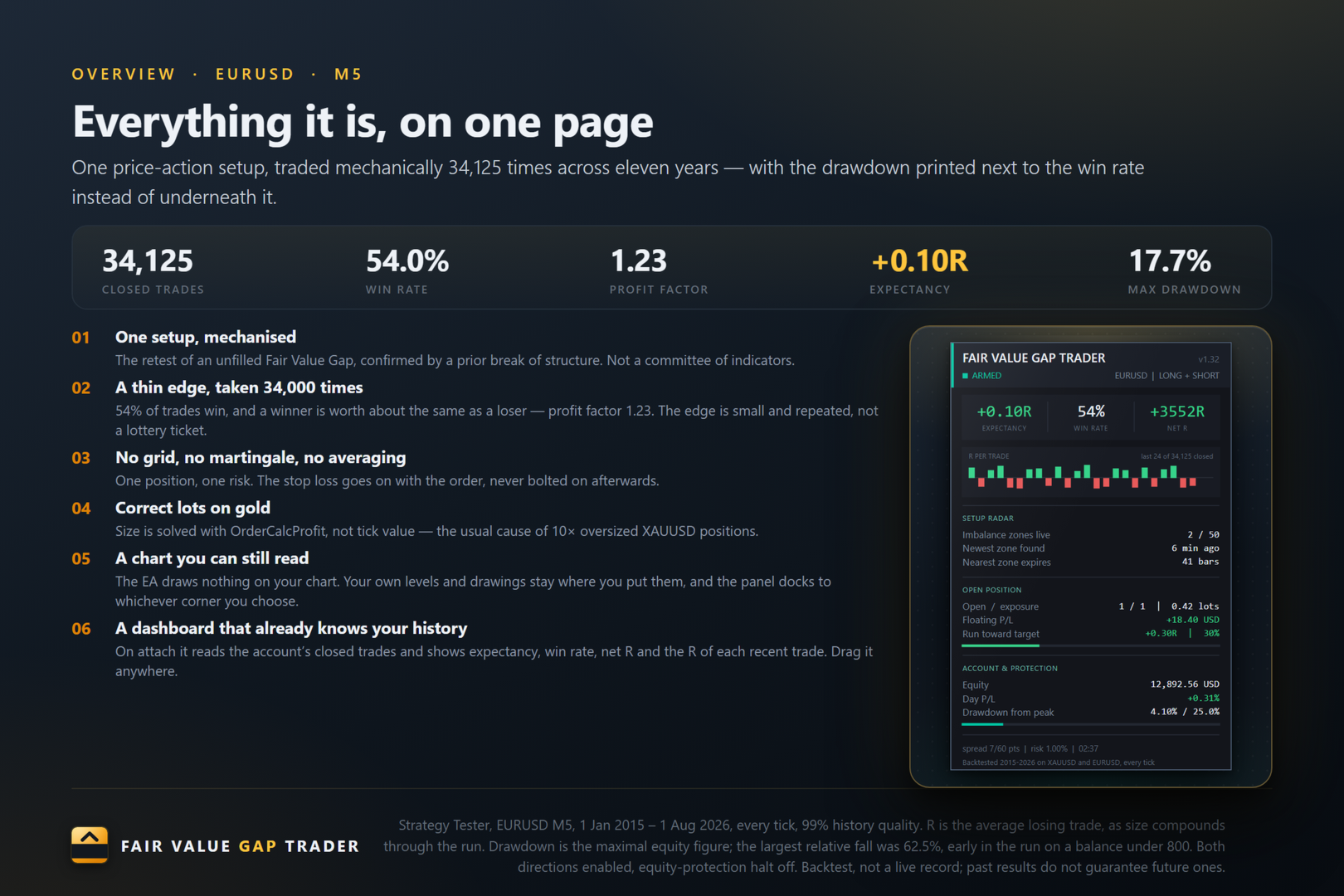
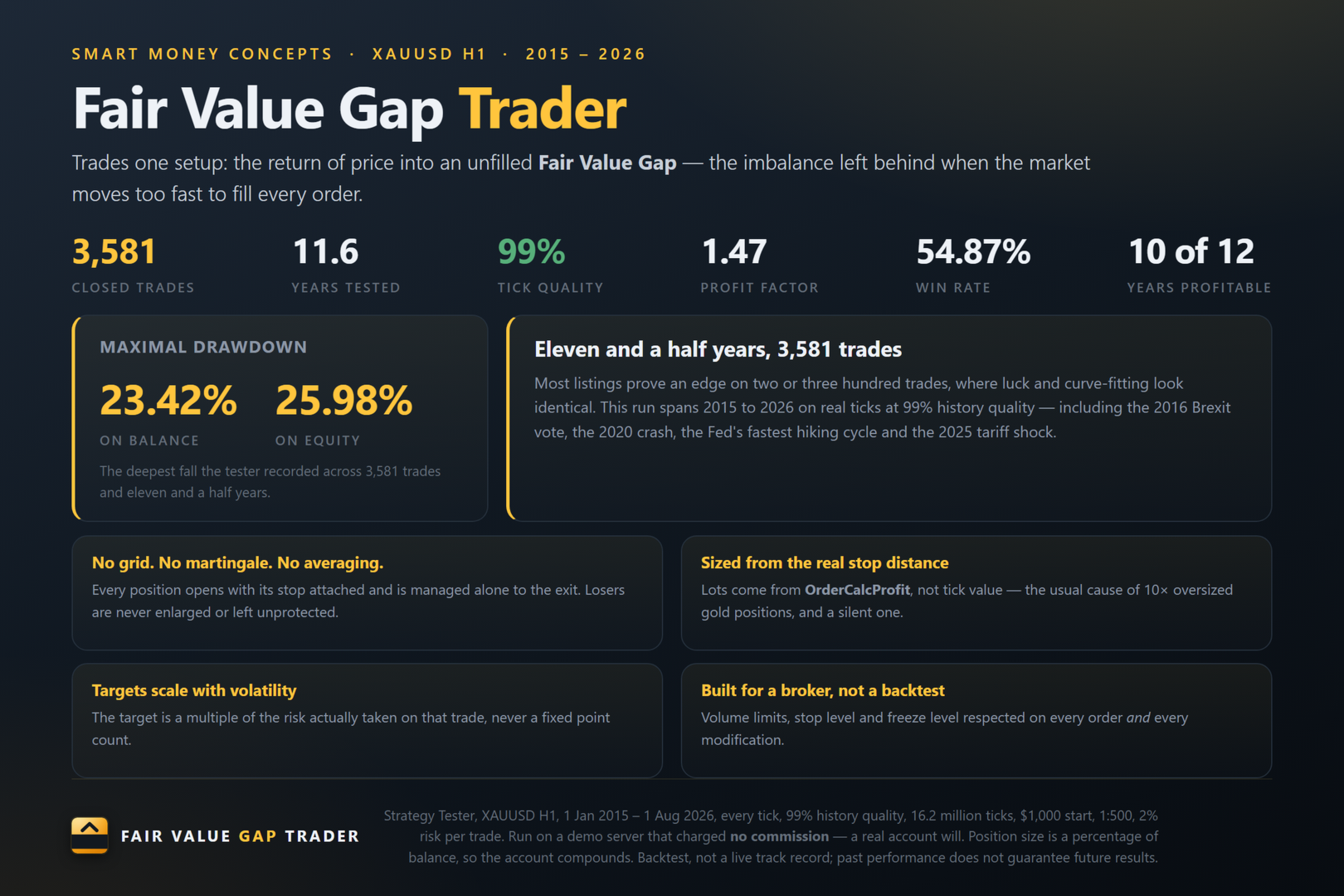
Fair Value Gap Trader trades one setup: the return of price into an unfilled Fair Value Gap.
A Fair Value Gap is a three-candle imbalance — a price range the market crossed so fast that orders were left unfilled. Price often comes back to that range before continuing.
Version 1.32 - the drawdown figure now tells the truth
Two fixes to the account protection, and one to order handling.
- The high-water mark is rebuilt from your account's deal history when the EA starts, so drawdown is measured from the account's real peak rather than from whatever the equity happened to be when you opened the chart. An account already down from an earlier high used to report zero.
- The mark is kept up to date at all times. It previously only advanced while a setup was armed, so a new high reached on a quiet chart was never recorded. It is also shared by every chart on the account and survives a restart, and deposits and withdrawals move it, so money you take out is never mistaken for a loss.
- An order whose stop would fall inside the spread is no longer sent. On very tight setups the broker refused these anyway; the EA now recognises them itself instead of retrying.
How it works
- Finds an imbalance on the timeframe you choose, and ignores gaps too small to matter.
- Waits for price to return into that range.
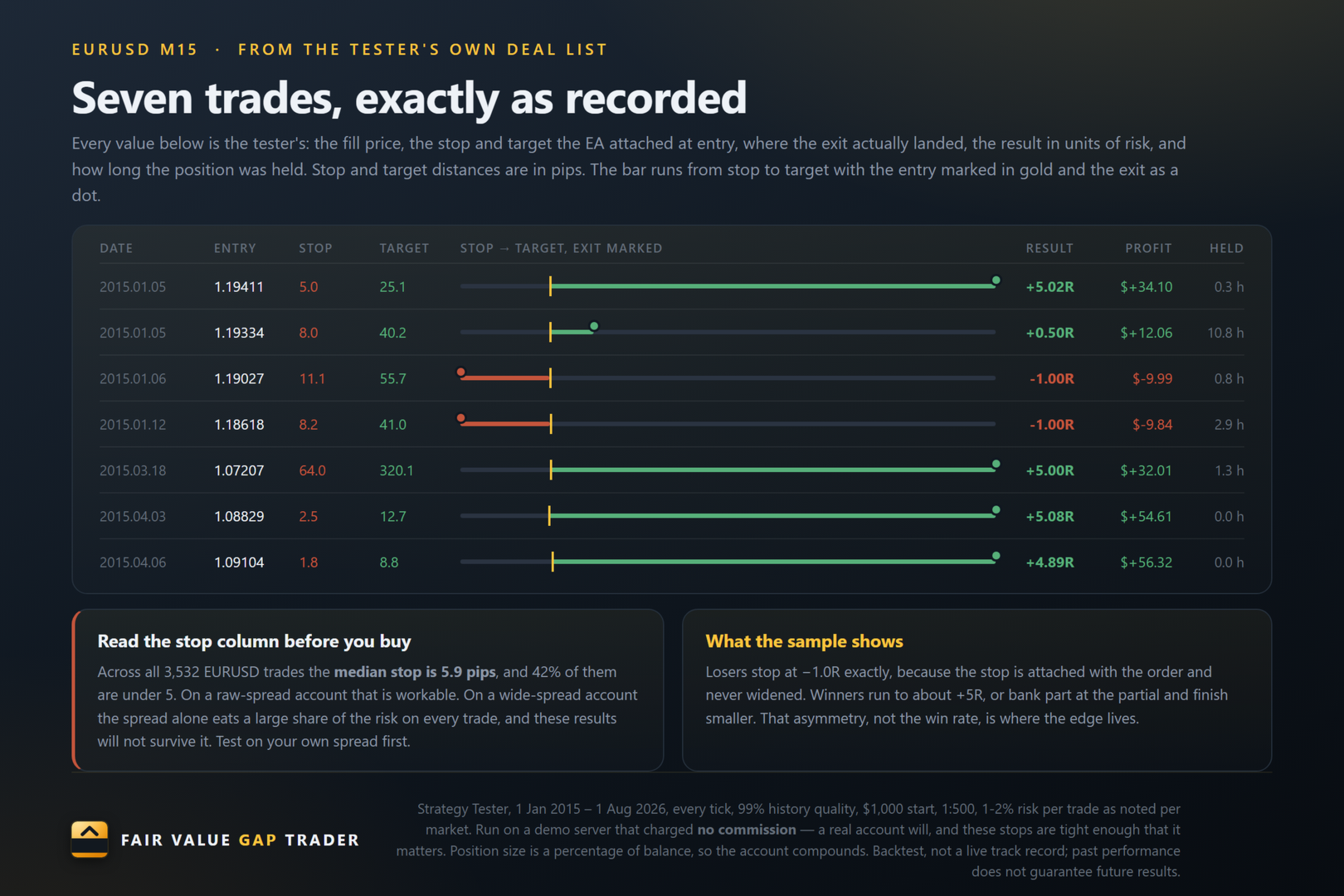
- Opens the trade with a stop loss and a take profit already attached.
- Optional confirmation filters (break of structure, retracement depth, order block) can each be switched on.
- If price does not return in time, the zone is discarded and no trade is taken.
Risk control
- Every position has a stop loss from the moment it opens.
- Take profit is a multiple of the risk taken, not a fixed number of points.
- Lot size can be fixed, or a percentage of your balance.
- Daily loss limit, equity protection stop, and a spread filter.
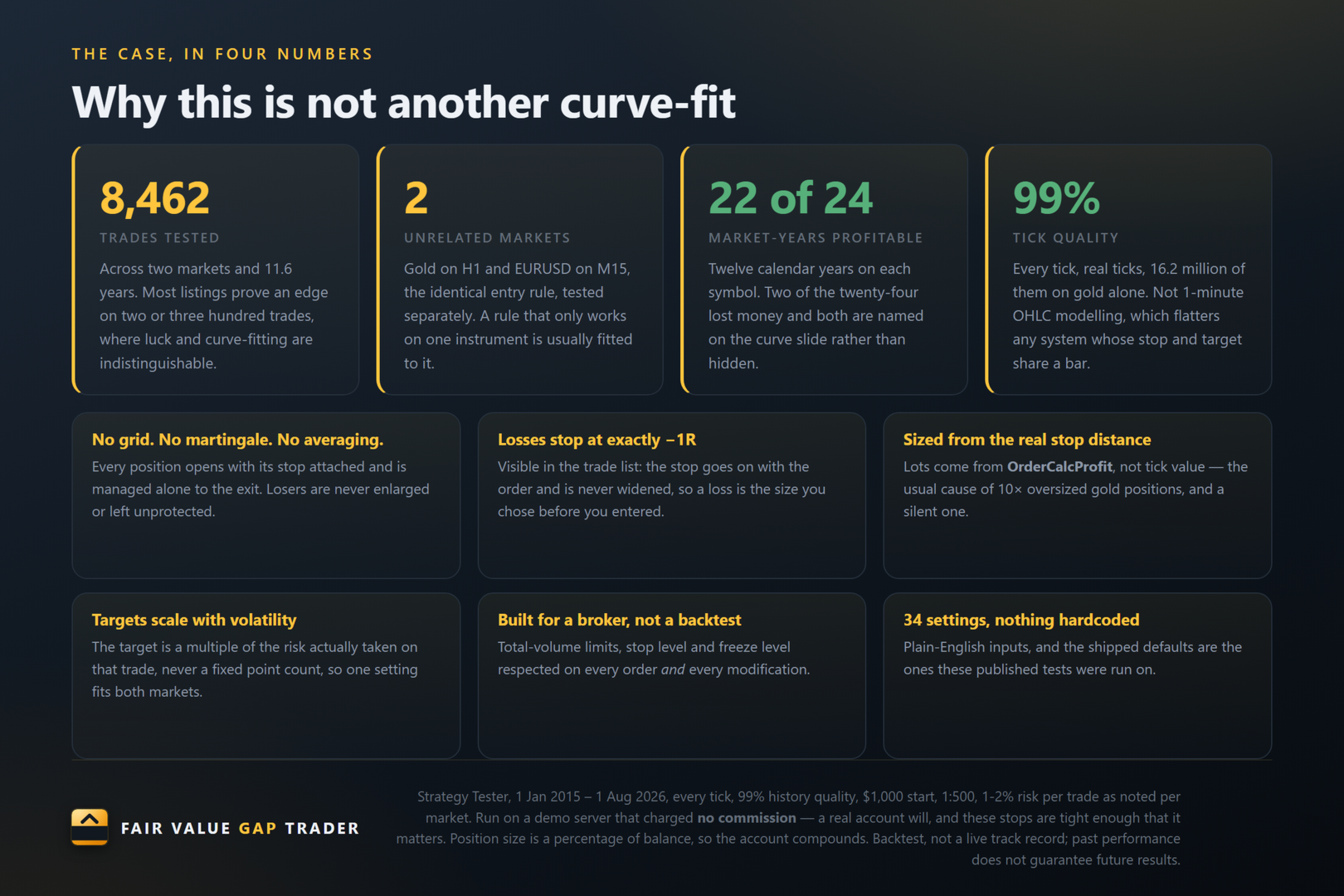
- No grid. No martingale. It never adds to a losing position.
Recommended setup
- Symbols: XAUUSD (gold) and EURUSD
- Timeframes: M5, M15, H1 and H4
- Account: hedging, with a low spread (ECN / Raw)
- Leverage: 1:100 or higher
- Minimum deposit: 100 USD; 1000 USD or more is better
- A VPS is recommended.
What to expect
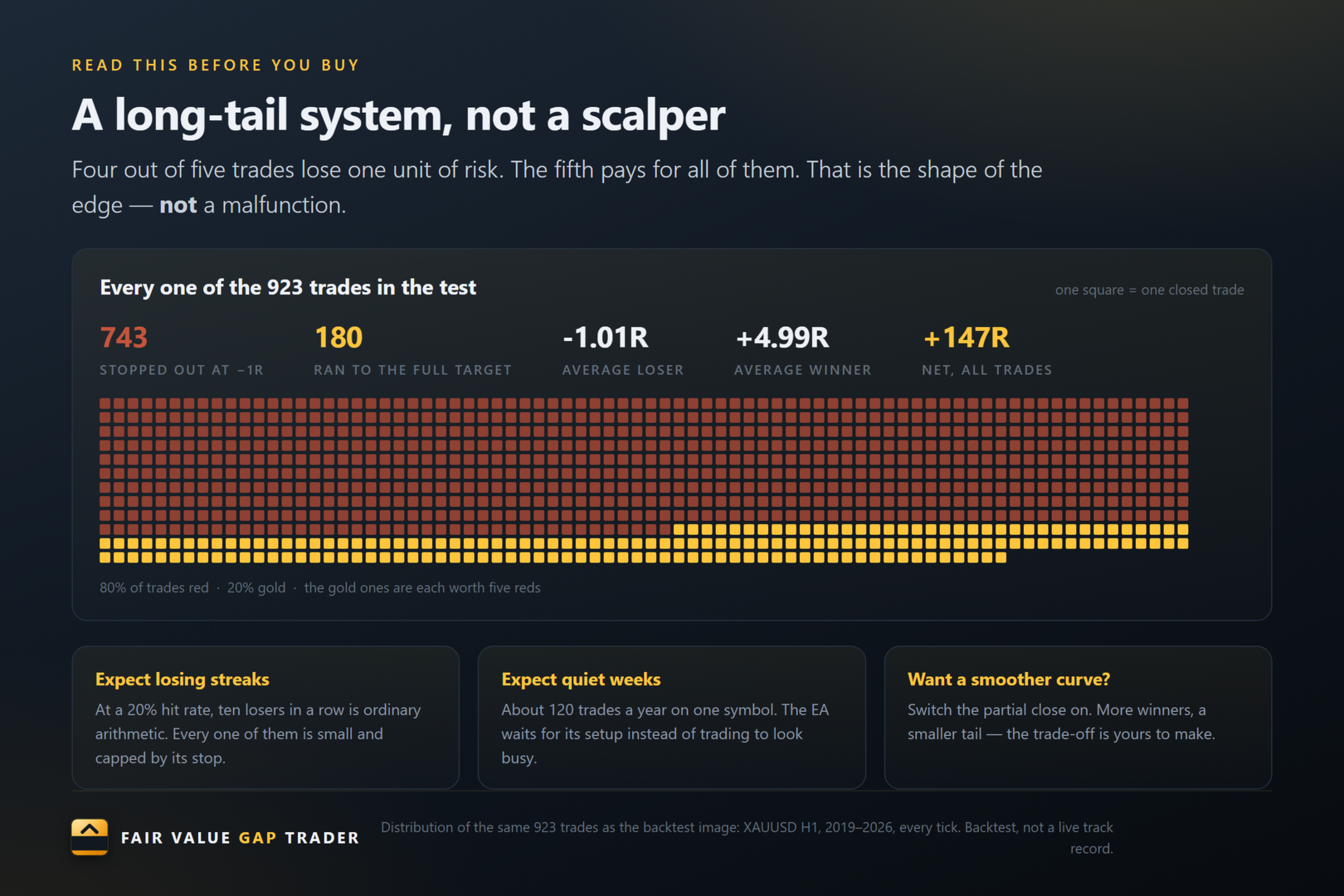
The EA is selective. On some days it does not trade at all. Losing trades are normal and they come in runs. The system is built so that each single loss stays small and controlled.
Choose a low-spread broker.
Honest note
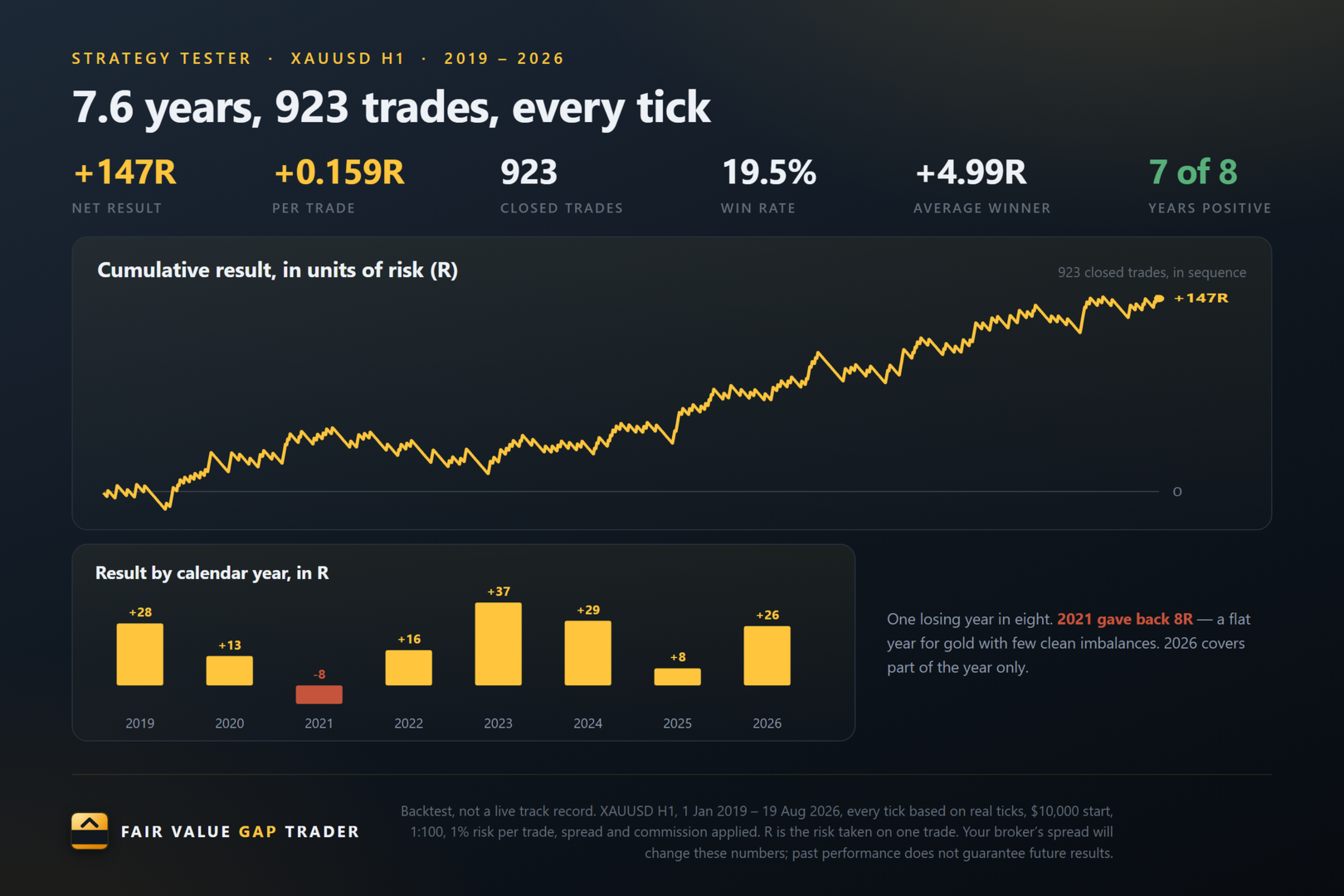
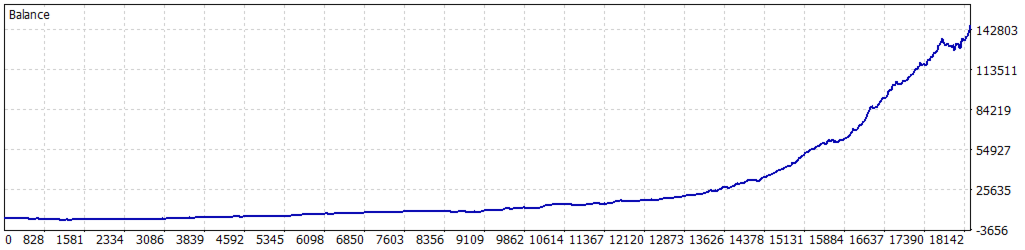
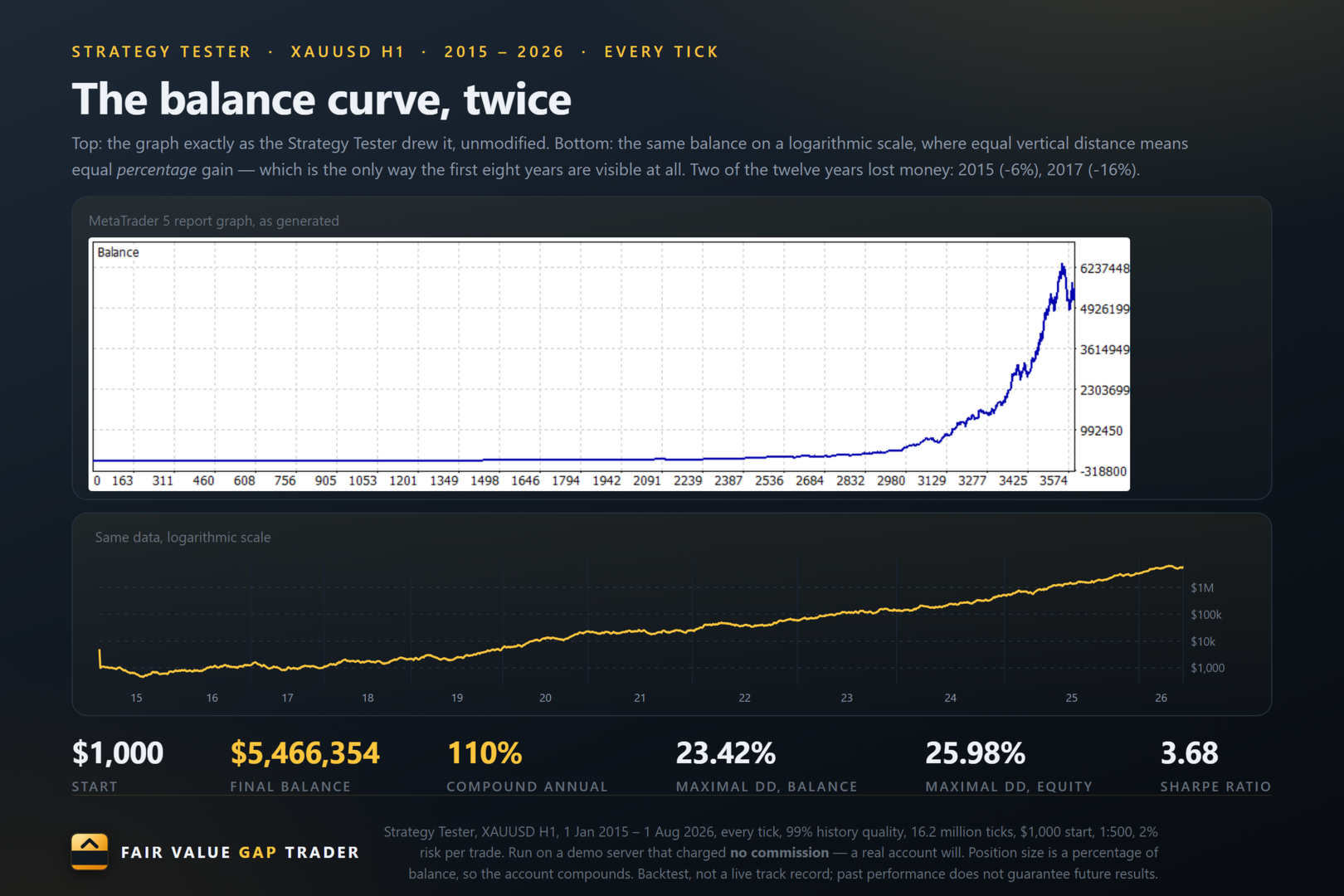
The published results come from the Strategy Tester, not from a live account. Test it on a demo account with your own broker first, then start with a small risk setting.
Why this one
The Fair Value Gap has become one of the most copied ideas in retail trading. Every month brings another version of the same breakout-and-retest concept. That tells you the idea works. It does not tell you that every implementation of it works.
What separates one Fair Value Gap expert from the next is never the idea. It is the execution — which setups are taken, which are left alone, and how tightly every loss is kept in check on the days the market does not cooperate. Those rules are the product, and they stay under the hood where they belong.
What you can judge before you buy is the person behind it:
- Support direct from the developer. You are not writing to a support desk. You are writing to the person who wrote the EA.
- Set files and setup help included. Tell me your broker, your symbol and your timeframe, and I will tell you what to run.
- Honest answers. If the EA is the wrong fit for your account, I will tell you before you buy, not after.
- Actively developed. Updates are free for the life of the licence, and buyer feedback decides what goes into them.
You are not buying only the software, you are buying the support behind it. That is where the real value is.
Support
Questions, settings and set files: message me through my MQL5 profile.
Parameters
Structure
- Timeframe the imbalance is read from — the higher timeframe used to find the gap.
- ATR period — the volatility measure used to judge gap size and stop distance.
Fair Value Gap
- Minimum gap size — gaps smaller than this multiple of ATR are ignored as noise.
- Retest window — how many bars the zone stays valid before it expires.
- Trade bullish gaps — allow long entries.
- Trade bearish gaps — allow short entries.
- Maximum zones tracked — how many unfilled gaps are followed at the same time.
Risk per trade
- Stop buffer — how far beyond the far edge of the gap the stop is placed, in ATR.
- Target — the take profit, as a multiple of the risk taken on that trade.
- Minimum stop distance — a floor on risk, so a very thin gap cannot create an unreasonable stop.
Partial close and stop into profit
- Use partial close — close part of the position once it reaches a set profit.
- Partial trigger — the profit level, in multiples of risk, that triggers it.
- Partial size — the percentage of the position to close.
- Move stop into profit — after the partial, move the stop beyond the entry price.
- Amount secured — how much of the risk to lock in when doing so.
- Use trailing stop — trail the remaining volume by ATR.
- Trail distance — the trailing distance, in ATR.
Confirmation filters
- Require break of structure — accept a gap only after price has broken the prior swing.
- Swing size — how many bars define a swing for that test.
- Require deep retracement — accept a gap only after a deep pullback.
- Minimum retracement — how deep that pullback must be.
- Require order block — accept a gap only where it overlaps the last opposing candle.
Position size
- Size from percentage of balance — on: risk a percentage; off: use a fixed lot.
- Risk per trade — the percentage of balance risked on one trade.
- Fixed lot — the lot used when percentage sizing is off.
- Maximum lot — a ceiling on the calculated lot size.
Protection
- Daily loss limit — stop trading for the rest of the day past this percentage loss.
- Equity protection stop — stop trading altogether once equity falls this percentage from its peak.
- Maximum open positions — how many positions may be open at the same time.
- Spread limit — skip entries while the spread is above this, in points.
Execution
- Maximum slippage — allowed price deviation, in points.
- Magic number — the identifier for this EA's own orders.
- Order comment — the text attached to each order.
- Show information panel — display the status panel on the chart.