Multi Asset Trading With AI: Why One Universal Algorithm Can Never Truly Master Every Market

Multi Asset Trading With AI: Why One Universal Algorithm Can Never Truly Master Every Market
There is a seductive promise that keeps reappearing across the retail trading world, the single universal algorithm, one model claimed to work equally well on forex, indices, Gold and crypto simultaneously. It is a compelling pitch precisely because it sounds efficient. It is also, almost without exception, a sign of a system that has not been engineered with any real depth at all. Markets are not interchangeable, and pretending otherwise is not a shortcut to efficiency, it is a structural compromise that quietly weakens performance everywhere it is applied.
This article explains why financial markets possess genuinely distinct statistical personalities, why a model tuned identically across all of them inevitably underperforms specialists in each, what asset specific optimization actually looks like in a real, deployed system, and where symbol agnostic approaches genuinely do make sense as a different, complementary design philosophy rather than a shortcut.
Why Financial Markets Are Not Interchangeable
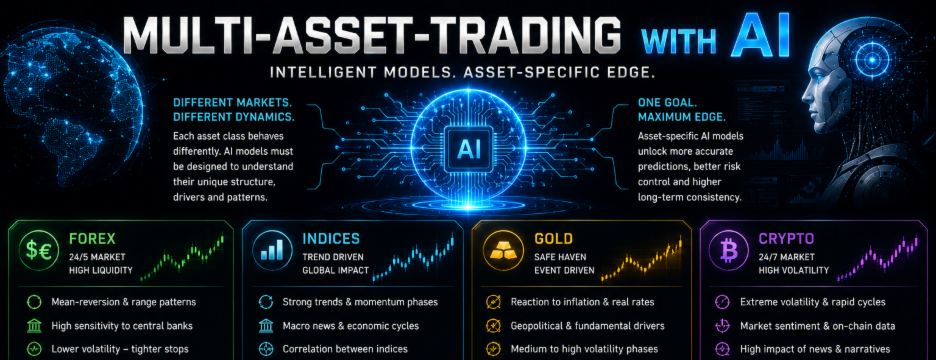
Each major asset class behaves according to a genuinely different underlying statistical character, driven by fundamentally different participants and mechanisms. Forex liquidity ebbs and flows with overlapping global trading sessions, producing distinct behavior during session overlaps versus quiet overnight hours. Indices are driven heavily by correlated equity sentiment, reacting sharply to earnings cycles and broad risk appetite shifts rather than the isolated dynamics of a single instrument. Gold behaves as a macro sensitive safe haven, reacting powerfully to interest rate expectations and scheduled economic releases in a way most instruments do not. Crypto trades continuously with no closing session at all, exhibiting structurally higher volatility and a different liquidity and participant profile entirely, often more sentiment and momentum driven than macro driven.
These are not minor stylistic differences. They represent genuinely different statistical distributions of price behavior, and any model, however sophisticated its underlying intelligence, is implicitly calibrated to the assumptions embedded in whatever data and thresholds it was tuned against.
Why a Universal Model Structurally Fails to Serve Any Market Well
When a single model or a single set of thresholds is forced to serve fundamentally different statistical regimes simultaneously, it does not become broadly capable. It converges toward an average behavior that fits none of the underlying markets precisely. A volatility threshold calibrated to feel reasonable for Gold's comparatively measured character will misfire constantly against Bitcoin's genuinely violent swings, either triggering far too often on ordinary crypto noise or, calibrated the other way, missing genuine Gold setups entirely because the same numeric threshold was never appropriate for both markets simultaneously. This is not a flaw that better programming can eliminate. It is a direct, unavoidable consequence of forcing one fixed calibration onto data with fundamentally different underlying statistics.
Asset Specific Design in Practice: One Cognitive Philosophy, Tuned Differently
The genuinely sound answer to this problem is not to abandon a proven underlying intelligence architecture for each market. It is to keep the same architectural philosophy while deliberately tuning its specific parameters and feature emphasis to the personality of the asset it is actually trading. This is precisely the approach behind ICONIC BTC AI+ and ICONIC GOLD AI+, both built on the same plastic cognitive kernel, differentiable plasticity, Hebbian neuromodulation, a MAP Elites archive of specialist behavioral variants, and Hindsight Experience Replay, proving the underlying intelligence approach itself is sound and genuinely portable across markets.
What differs deliberately between the two is how that shared architecture is tuned. ICONIC BTC AI+ incorporates Grünwald Letnikov fractional calculus specifically to capture the long memory momentum characteristic of Bitcoin's genuinely violent directional swings, paired with ATR adaptive sizing built to handle crypto's structurally wider volatility range. ICONIC GOLD AI+, sharing the same underlying kernel, is instead tuned around Welford online normalization and Sortino ratio based reward shaping suited to Gold's more macro driven statistical character, alongside drift detection built to catch genuine regime change in a market that behaves in a fundamentally different rhythm than crypto, and an integrated news filter specifically because Gold reacts powerfully to scheduled economic releases in a way that matters far less to a continuously trading crypto asset.
The Concrete Proof Hiding Inside a Single Coordinated System
Perhaps the clearest possible evidence for this entire argument exists inside ICONIC KYBERNETIC AI+, a single system trading both Bitcoin and Gold simultaneously. Its hybrid regime filter, which determines whether current conditions are structurally trending enough to justify a new position, applies a fixed trend strength prior threshold tuned differently for each symbol, precisely because Bitcoin structurally trends at a meaningfully lower reading than Gold typically requires before the same classification genuinely applies. This is not a theoretical argument about why asset specific tuning should matter. It is a direct, quantifiable example, embedded in real working code, of two different numeric thresholds being required for the exact same underlying regime concept, applied to two different markets inside a single unified system.
Specialization Does Not Mean Isolation: Coordinating Across Assets
Asset specific tuning does not require treating each market as entirely disconnected from the others. ICONIC KYBERNETIC AI+ and ICONIC NEUROCORE AI+ both demonstrate the more sophisticated answer, keeping each market governed by its own specifically tuned brain while a coordinating causal layer, built on Transfer Entropy, measures the genuine directed flow of influence between Bitcoin and Gold in real time. This is specialization and coordination operating together, each market handled according to its own personality, while the relationship between them is still measured honestly rather than assumed away or ignored entirely. A naive universal model achieves neither of these things properly, since it neither specializes correctly for either market nor genuinely measures any real relationship between them.
Where Symbol Agnostic Approaches Genuinely Make Sense
Fairness demands acknowledging that not every component of a serious trading operation benefits from being asset specific. A signal engine built around probability calibration and multi timeframe scoring, rather than hardcoded asset specific rules, can legitimately be applied across many different instruments without losing its underlying edge, because its intelligence comes from statistical calibration and quality gating rather than assumptions baked in about one specific market's personality. ICONIC TITAN AI operates on precisely this philosophy, scanning whatever timeframes and symbol it is applied to through an ensemble of trained networks and surfacing only setups that clear defined, symbol agnostic probability thresholds. This is a genuinely different, complementary design approach to the deeply specialized execution engines, not a shortcut, and both approaches are legitimate when applied to the specific problem they are actually suited for.
The Honest Limits of Universal Trading Algorithms
Stated plainly, a single, generic algorithm applied identically across radically different asset classes, with no genuine underlying differentiation in how it treats each market's actual statistical personality, will almost always underperform specialists built for each domain. This is not a marketing claim designed to sell more specialized products. It is a direct, unavoidable consequence of how statistical models actually behave when forced to average across contradictory assumptions. Any vendor offering one identical bot marketed as equally suited to forex, indices, Gold and crypto, with no meaningful architectural or parameter differentiation between them, deserves genuinely informed skepticism rather than immediate trust, regardless of how confident the marketing language sounds.
Frequently Asked Questions About Multi Asset AI Trading
Why should trading models differ across asset classes? Because forex, indices, Gold and crypto each exhibit genuinely different statistical behavior driven by different participants and mechanisms, and a model calibrated to one market's assumptions will systematically misjudge conditions in a market with a fundamentally different character.
Can the same underlying AI architecture work across different markets? Yes, provided the specific parameters and feature emphasis are deliberately tuned to each asset's personality. The underlying intelligence philosophy can remain consistent while thresholds, risk calibration and feature weighting differ meaningfully between markets.
Is a universal trading algorithm ever a good idea? Symbol agnostic approaches make sense specifically for components built around statistical calibration and probability scoring rather than asset specific rules, such as a signal engine applying consistent quality gates across many instruments. A single execution strategy applied identically everywhere without any differentiation is a different and far riskier proposition.
What is concrete evidence that asset specific tuning genuinely matters? Systems that coordinate multiple markets from one engine and apply meaningfully different calibrated thresholds to each symbol for the same underlying concept, such as trend strength classification, provide direct, quantifiable proof that a single universal threshold would misclassify conditions for at least one of the markets involved.
Does asset specific tuning mean markets are treated as completely unrelated? Not necessarily. Advanced systems can specialize each market's execution logic individually while still applying a separate causal layer to measure genuine influence between related markets, combining specialization with real coordination rather than treating them as either identical or entirely isolated.
Depth Beats Breadth, Every Time
The appeal of one universal algorithm covering every market is understandable, but it mistakes breadth for genuine capability. Markets have personalities, and pretending otherwise does not simplify trading, it simply distributes mediocrity evenly across every asset touched. Genuine edge comes from architecture that respects the specific statistical character of each market it operates in, whether that means a deeply specialized execution engine or a properly calibrated, symbol agnostic signal layer applied to the problem it actually suits.
Explore systems built with exactly this discipline, from the specifically tuned specialist kernels of ICONIC BTC AI+ and ICONIC GOLD AI+, through the coordinated, causally aware architecture of ICONIC NEUROCORE AI+ and the flagship ICONIC KYBERNETIC AI+, to the calibrated, symbol agnostic scanning of ICONIC TITAN AI, at iconicfx.tech.
Risk Disclaimer. Trading foreign exchange, cryptocurrencies, commodities and other leveraged financial instruments carries a high level of risk and may not be suitable for all investors. The high degree of leverage can work against you as well as for you. Past performance is not indicative of future results. Automated trading systems, indicators and Expert Advisors do not guarantee profits and can produce losses. ICONIC.FX provides software tools only and does not provide investment advice, portfolio management or financial recommendations. You are solely responsible for your own trading decisions. Seek advice from an independent licensed financial advisor if you have any doubts.