How I Developed FX Adaptive: From an Idea to a 22-Instrument Portfolio

The story behind a portfolio Expert Advisor, the optimization approach, rollover protection, and the principles of adaptive risk management without revealing the internal trading logic.
Open the FX Adaptive product page in the MarketHello everyone! Recently, I published my algorithm FX Adaptive in the Market, a project I have been continuously working on for the last year and a half. In this article, I want to share part of the technical background, explain the development philosophy, and describe why I completely moved away from the classic idea of searching for a Grail on a single currency pair.
The Illusion of the “Perfect Pair” and the Power of Diversification
At the beginning, like many developers, I tried to build a stable algorithm around a single currency pair. Most often it was EURUSD — the most obvious candidate for testing, optimization, and searching for “ideal” parameters.
But over time it became clear that this approach has a fundamental weakness: the market never stands still. It constantly changes its phase. What works well in a strong trend often starts producing a series of weak entries during a prolonged sideways market. What looks reliable in one market cycle can easily lose stability in the next one.
That was the moment when I realized that true long-term stability is built not on one “magic” symbol, but on diversification. This is how the concept of FX Adaptive was born — not as another EA for a single instrument, but as a full portfolio trading system that distributes exposure across multiple assets.
Today, the algorithm works with 22 instruments. The portfolio includes both major forex pairs and crosses, as well as more volatile crypto instruments. The idea is simple: when one part of the market enters a low-quality phase, another part may start forming cleaner movements and support the overall portfolio dynamics.
Optimization and Protection Against Curve Fitting
The most dangerous stage in building any trading algorithm is optimization. Creating a beautiful equity curve on historical data is not difficult. What is much harder is achieving a strategy that remains stable beyond the training sample and is not simply the result of fitting parameters to past market behavior.
That is why I used максимально strict validation conditions for FX Adaptive. Optimization was performed on real tick data covering more than three years — from 01.01.2023 to 20.04.2026. This period was chosen deliberately because it includes different market regimes, different volatility levels, and different price behavior conditions.
The key validation element was a strict Walk-Forward optimization with a mandatory 25% forward test of the total testing period. In other words, after selecting parameters on the main part of the sample, the algorithm was always required to prove itself on a separate “blind” segment of data that had not been used during optimization.
This approach helps filter out solutions that only look good inside the training interval but fail when exposed to new market data. Only those presets that maintained stability beyond the optimization window were allowed into the final release.
To process this amount of computation, I used the resources of the MQL5 Cloud Network. This made it possible to run a large number of tests across many instruments and market modes without lowering the quality standards of the selection process.
Why Rollover Protection Was Necessary
During testing and execution analysis, it quickly became clear that one of the most unpleasant technical problems for medium-term systems is night-time spread widening during rollover. At this time, liquidity drops, and even a properly calculated trade can suffer distorted execution or an early Stop Loss exit.
That is exactly why a separate module called Rollover SL Protection was added to FX Adaptive. Its purpose is not to artificially improve statistics, but to protect already open positions from market microstructure effects that are not related to entry quality.
Without revealing internal details, I can say this: the logic of this module is built around temporary adaptation of protective levels during the most vulnerable period of the trading day. This solution became an important part of the system architecture and significantly improved its real-world robustness.
Why I Rejected .set Files
Another issue I had seen for a long time in many market products was launch complexity. A user buys an EA, receives a pack of .set files, and then the confusion begins: which file belongs to which pair, what timeframe should be used, which values must be changed, and which must not be touched.
I wanted to remove this barrier. That is why FX Adaptive was originally designed as a Plug-and-Play system. All key parameters and the best selected presets were embedded directly inside the EA.
In practice, this means the user does not need to load any external settings files. It is enough to open the required chart, choose the matching preset, specify the starting deposit, and assign a unique Magic Number for each instrument. This makes the launch process much easier and reduces the chance of user-side mistakes.
Adaptive Risk Management
Special attention in the system was given to risk management. I deliberately moved away from the primitive logic of fixed lot sizes, because that approach scales poorly and does not take the current account condition into account.
In FX Adaptive, risk is calculated adaptively. At the start, the system uses the entered base deposit as a reference point, but later it works with the actual account balance. This allows trading exposure to adjust naturally as the account changes over time.
In addition, risk parameters are not identical for all instruments. Different markets have different volatility, price structure, and spread behavior. That is why the built-in presets use their own parameters for each symbol, and the final trading load may differ depending on the instrument and the market environment.
What the Final Result Looks Like
FX Adaptive is the result of long engineering work, multiple optimization cycles, forward validations, and manual selection of robust configurations. I did not aim to create an aggressive system with loud promises. The goal was different: to build a calm, systematic, and technically disciplined trading product.
That is why FX Adaptive is built around diversification, strict preset selection, thoughtful protection against market distortions, and an adaptive approach to risk. If this trading philosophy matches your own view, you can check the product page here: FX Adaptive in the MQL5 Market.
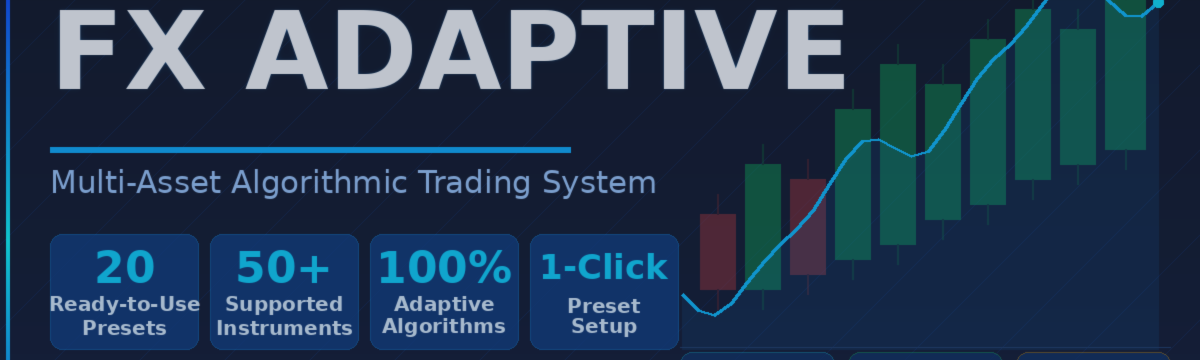
Portfolio trading system for MetaTrader 5 with built-in presets, a multi-instrument approach, and adaptive risk management [web:346].
Go to product page