Cuprum
- Experts
- Version: 1.0
- Activations: 5

It performed better on the data it had never seen.
That is the first thing worth knowing about Cuprum, because it is the
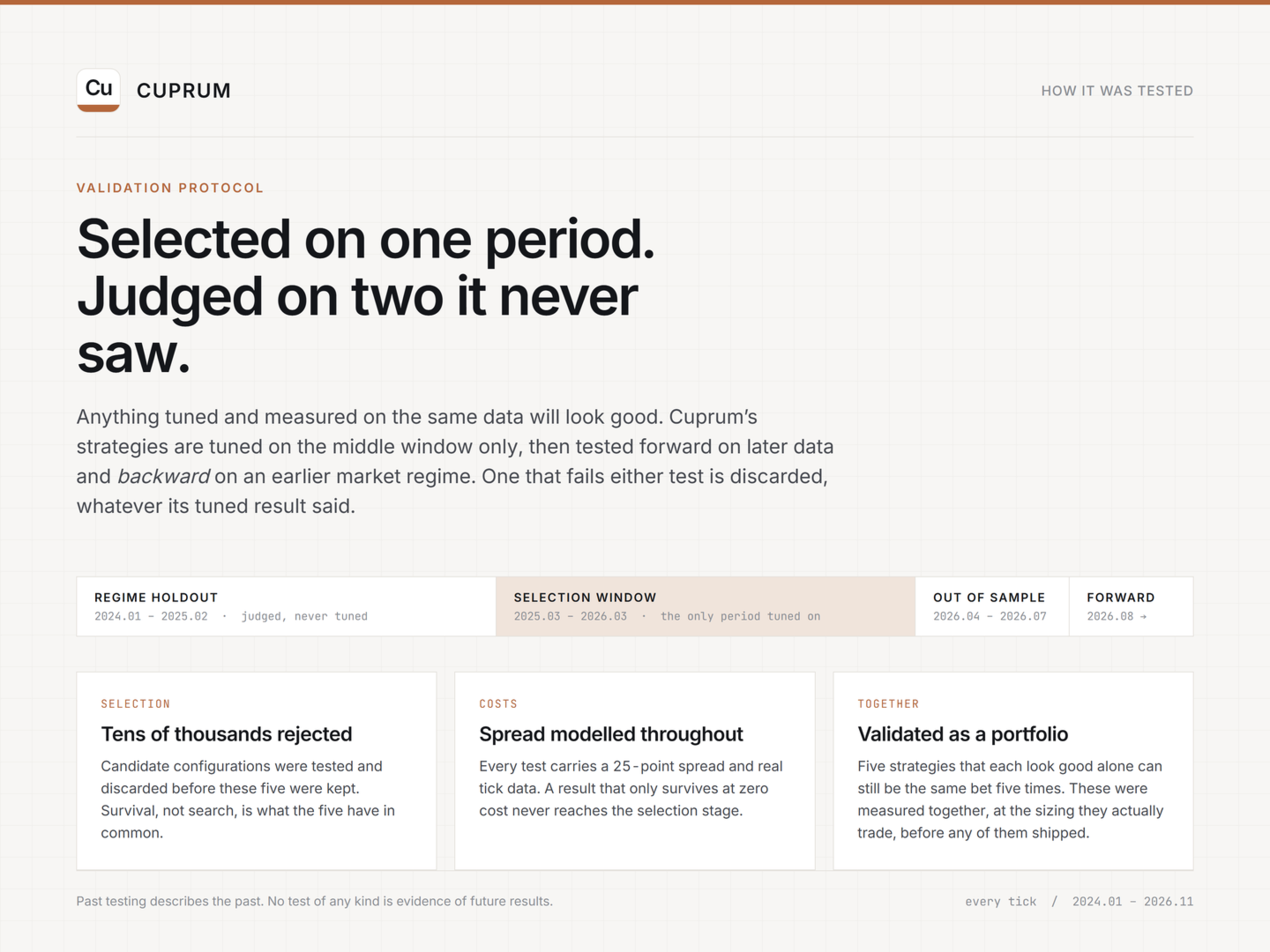
first thing a serious buyer doubts. Its components were tuned on one
window of copper history and then tested on two they were held out of.
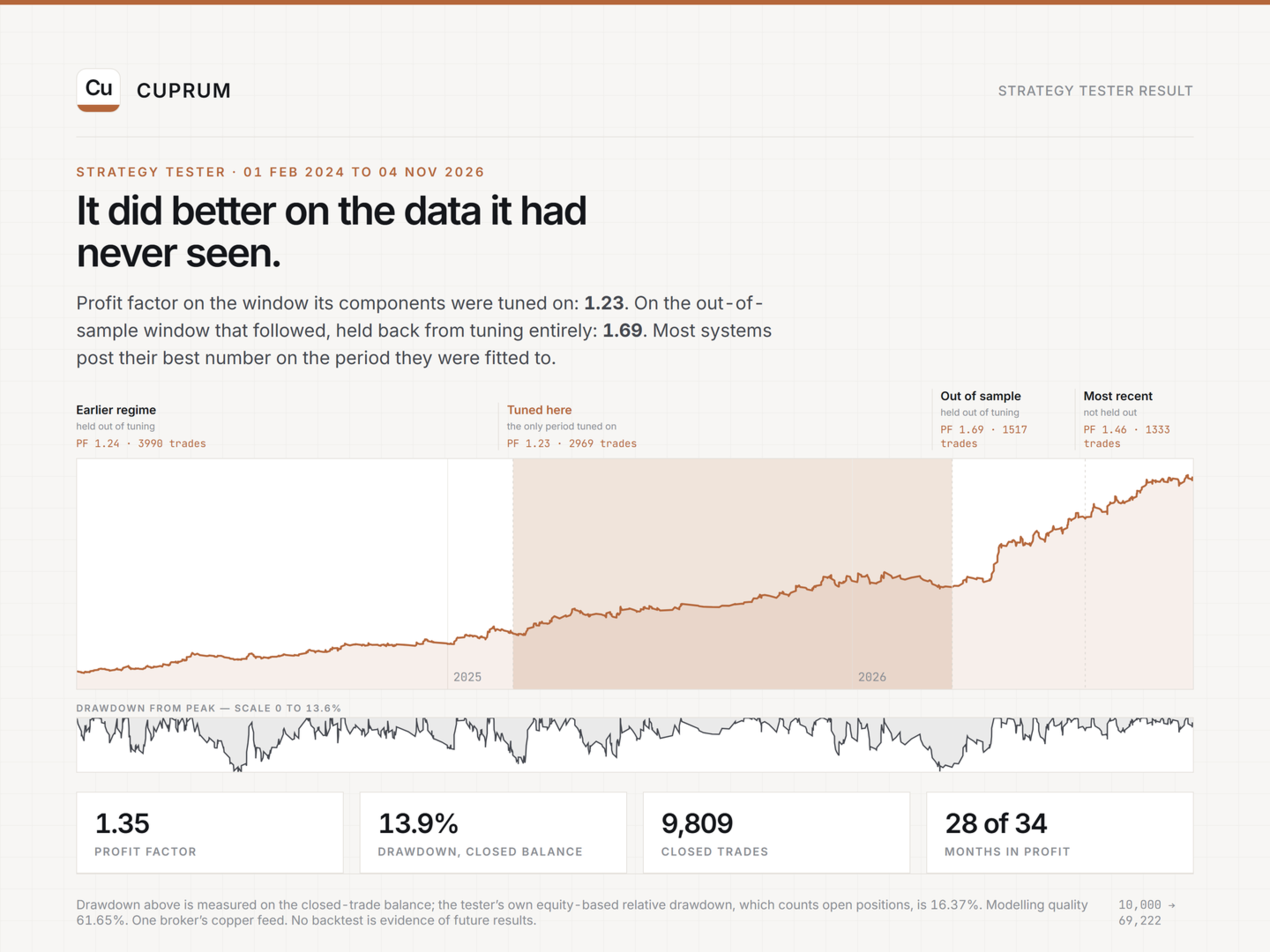
In the strategy tester, profit factor on the tuning window was 1.23. On
the out-of-sample window that followed it, 1.69.
Most systems post their best number on the period they were fitted to.
This one did not, and the chart in the screenshots shows exactly where
each window begins and ends so you can check the claim rather than take
it.
Over the full test — 1 February 2024 to 4 November 2026, every tick,
9,809 trades, a 25-point spread modelled throughout — a $10,000 account
ended at $69,222. Profit factor 1.35. The deepest the closed-trade
balance ever fell from a high was 13.9 per cent. Twenty-eight of the
thirty-four months finished in profit.
Why five strategies instead of one
A single strategy has exactly one way of being wrong, and nothing else
running when the market stops suiting it.
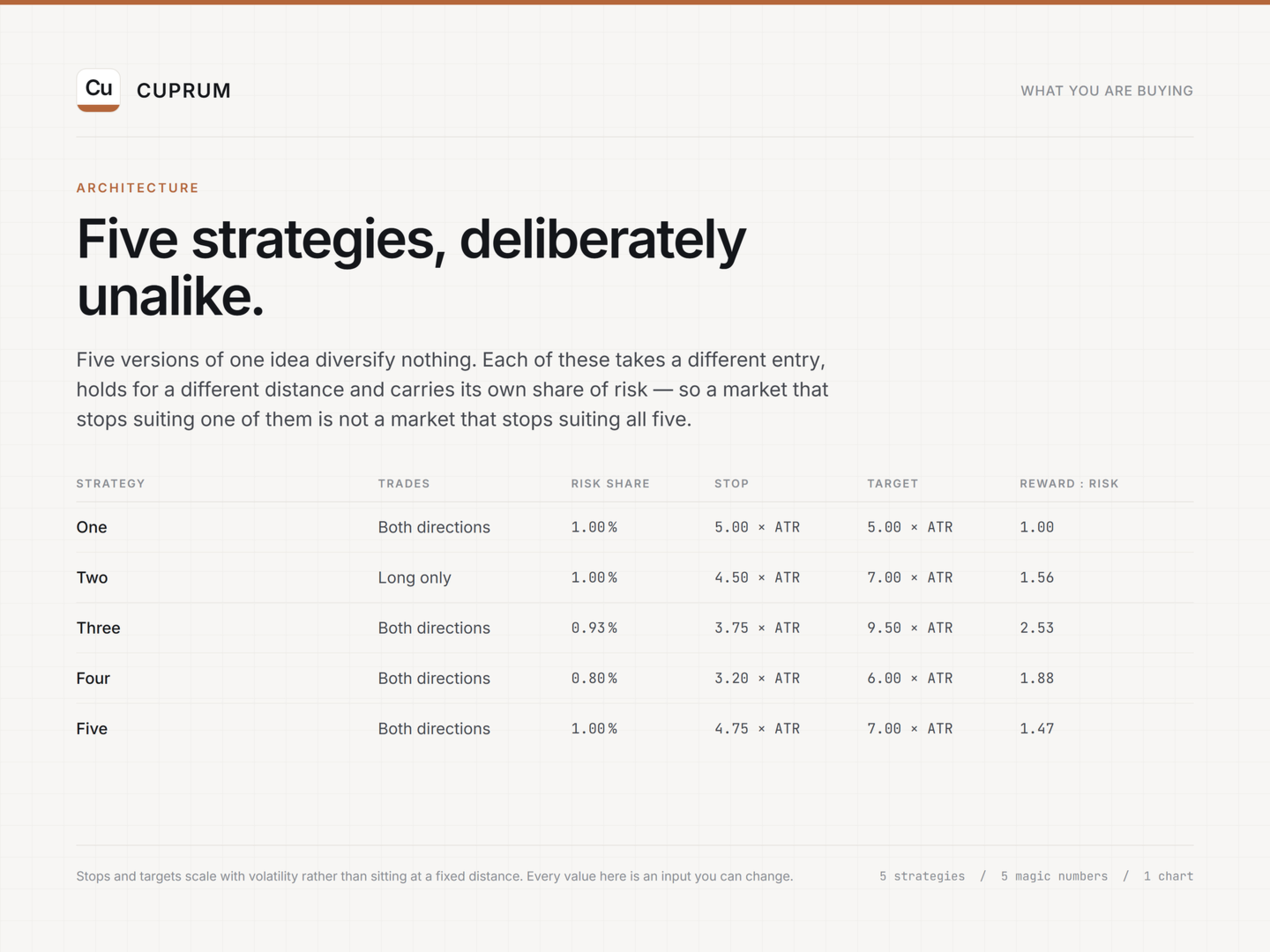
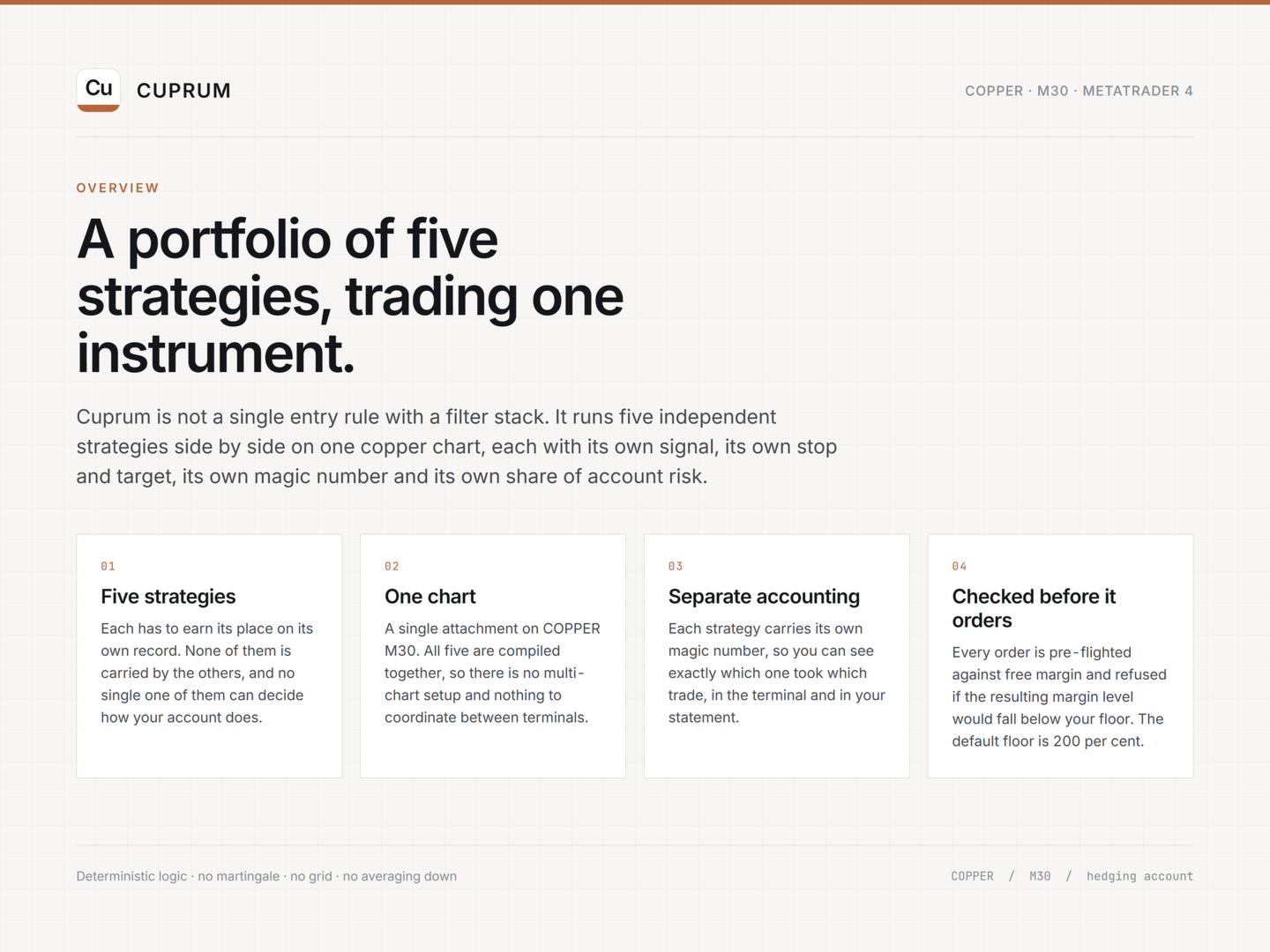
Cuprum runs five independent strategies side by side on one copper
chart. Each has its own signal, its own stop and target, its own magic
number and its own share of account risk — reward-to-risk ratios from
1.0 to 2.5, one of them long-only, all five visible and adjustable in
the inputs. Five versions of one idea diversify nothing, so these were
chosen to be unalike.
Tens of thousands of candidate configurations were tested and rejected
before these five were kept, every test carrying a modelled spread,
because a strategy that only survives at zero cost is not a strategy.
They were then validated together, at the sizing they actually trade —
five strategies that each look good alone can still be the same bet
five times.
What stands between a signal and an order
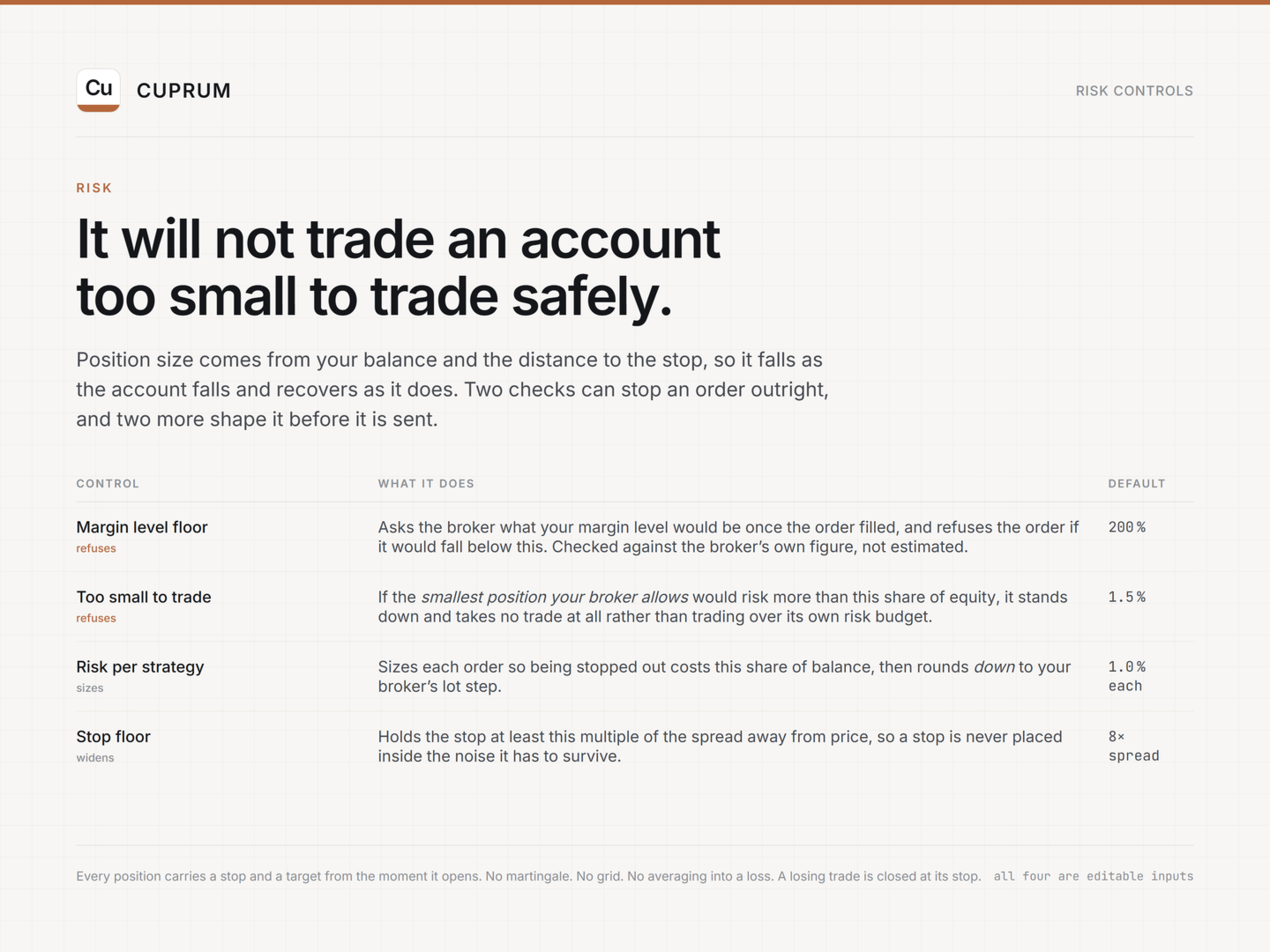
Position size is calculated from your account balance and the distance
to the stop, so it falls as the account falls and recovers as it does.
Two checks can stop an order outright, and two more shape it before it
is sent:
- Margin level floor — the EA asks your broker what the margin level
would be once the order filled, and refuses the order if it would fall
below this. Checked against the broker's own figure, not estimated.
Default 200%.
- Too small to trade — if the smallest position your broker allows
would risk more than this share of equity, it stands down and takes no
trade at all, rather than trading over its own risk budget. Default
1.5%.
- Risk per strategy — each order is sized so being stopped out costs
this share of balance, then rounded down to your broker's lot step.
Default 1.0% each.
- Stop floor — the stop is held at least this multiple of the spread
away from price, so it is never placed inside the noise it has to
survive. Default 8x.
Every position carries a stop loss and a take profit from the moment it
opens. There is no martingale, no grid, no averaging into a loss and no
recovery mode. A losing trade is closed at its stop.
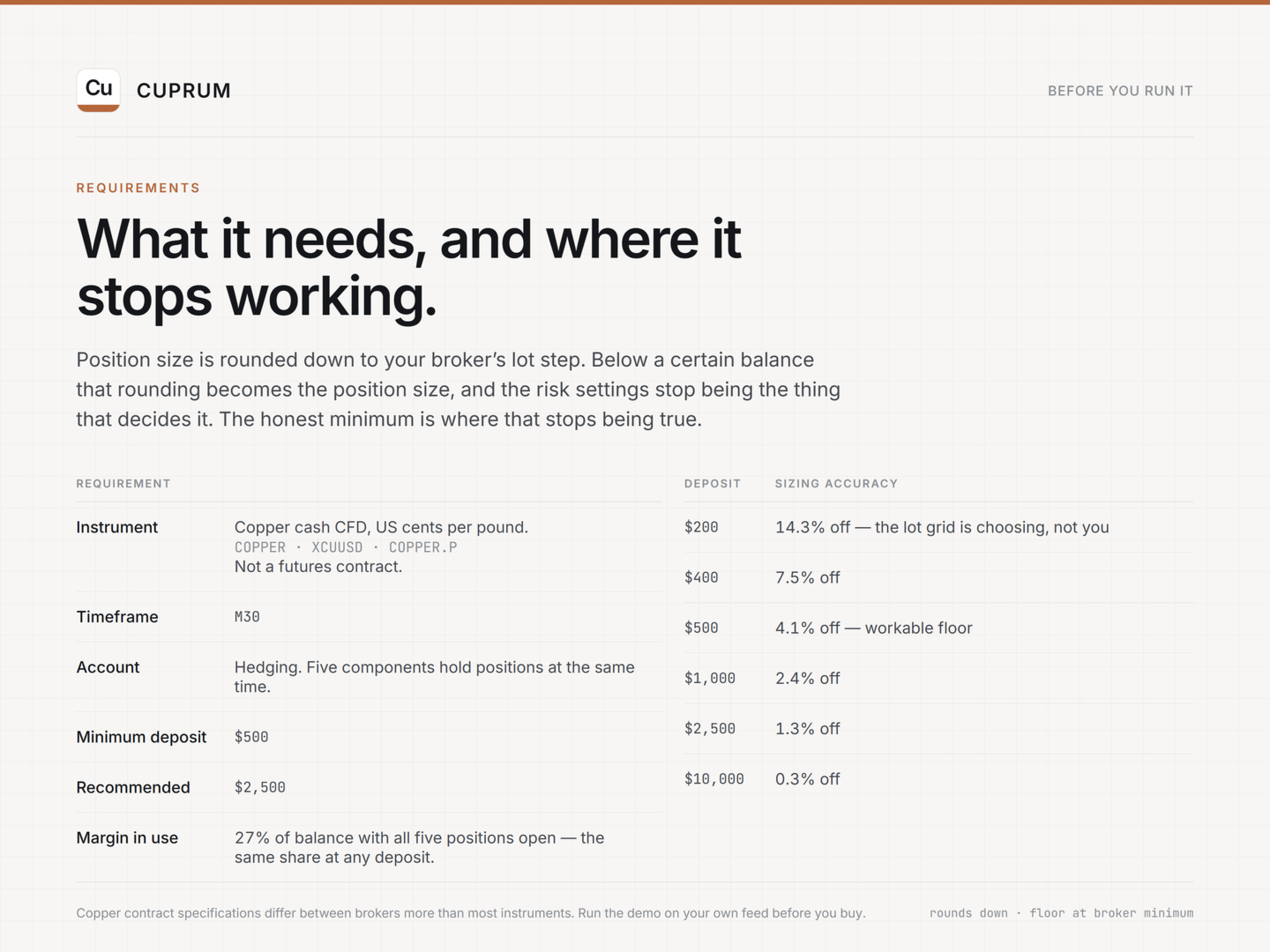
What it needs
Copper cash CFD, quoted in US cents per pound — brokers spell it COPPER,
XCUUSD or COPPER.P. This is not for a copper futures contract; the
contract size differs and position sizing would be wrong by a large
multiple. M30. A hedging account, because five components hold positions
at once. $500 minimum, $2,500 recommended — below $500 the lot step
rather than your risk setting starts choosing the position size, and the
screenshots show exactly where that line falls.
Check it yourself
Download the demo and run it in the strategy tester on your own broker's
copper feed, over your own dates, at your own deposit. Copper
specifications vary between brokers more than most instruments, and the
only test that tells you what this does on your account is one run
against your account's own conditions.
Past testing describes the past. No backtest, of any length or quality,
is evidence of future results.