LongRunner
- Experts
-
Pitt Petruschke
 Algo trader and EA developer from Germany. Founder of AlgoVerdict (algoverdict.com) – independent tests of Expert Advisors, brokers and signal platforms based on live accounts. Author of Dawnbreak, a session range breakout EA for MT5. My own EA park runs on real accounts; my signals are listed in
 - Version: 2.0
- Activations: 10
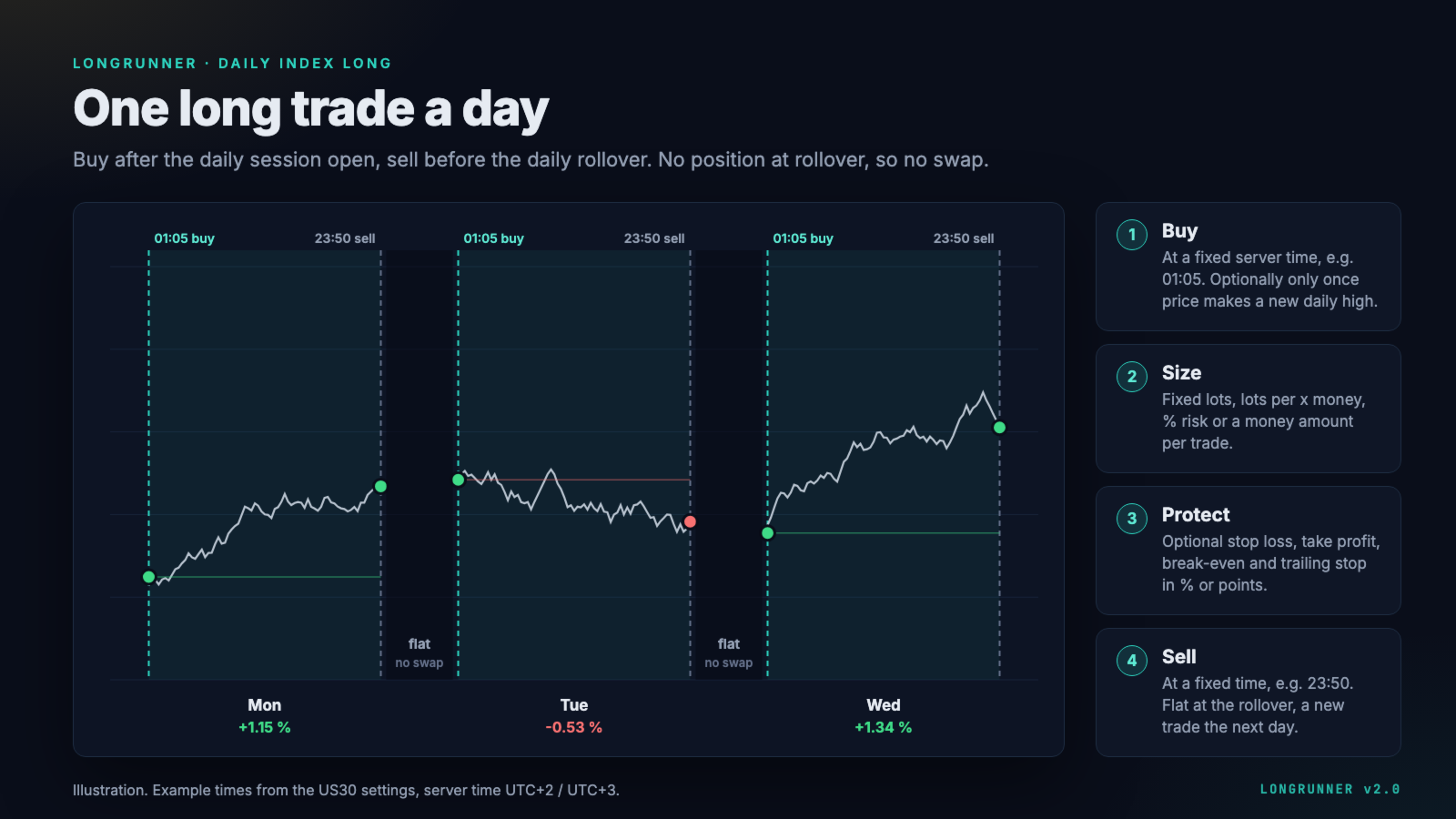
LongRunner buys a stock index once a day and sells it again before the broker's daily rollover. Stock indices have risen over the long run, but holding them as a CFD costs financing (swap) at every rollover. LongRunner takes the daily move and leaves that cost out: a new long position at a fixed server time, closed at a fixed time the same server day.
One trade per day and symbol. No grid, no martingale, no averaging, no position held over the rollover (unless you switch the close time off).
How it trades
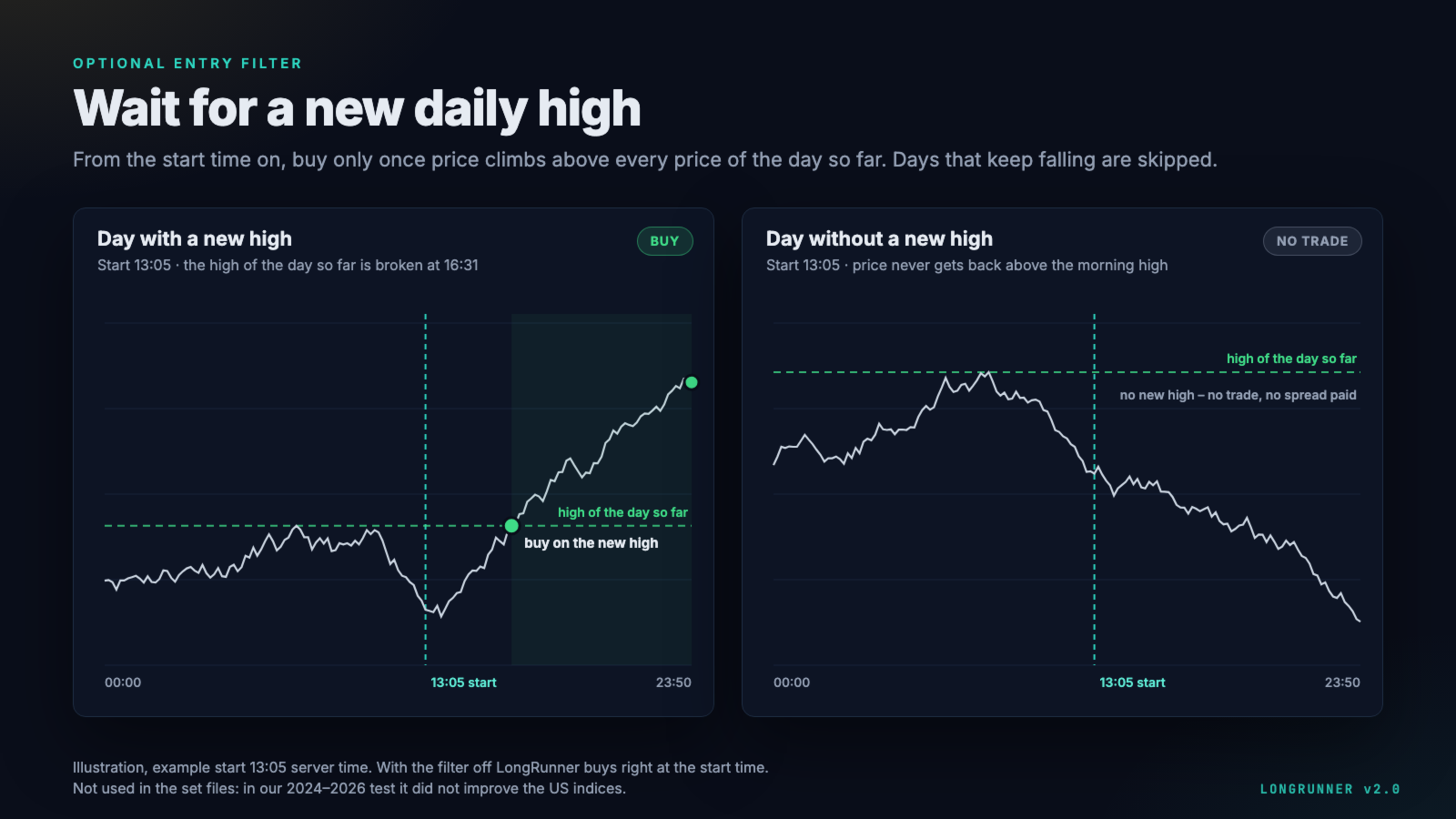
- Buy at a fixed server time, for example 01:05 on the US indices. Optionally only once price makes a new high of the day.
- Size the position: fixed lots, lots per x money, % of the balance or a fixed money amount.
- Protect it if you like: stop loss, take profit, break-even and trailing stop, in % of the entry price or in points.
- Sell at a fixed time, for example 23:50. Flat at the rollover, a new trade the next day.
Trend filter (optional)
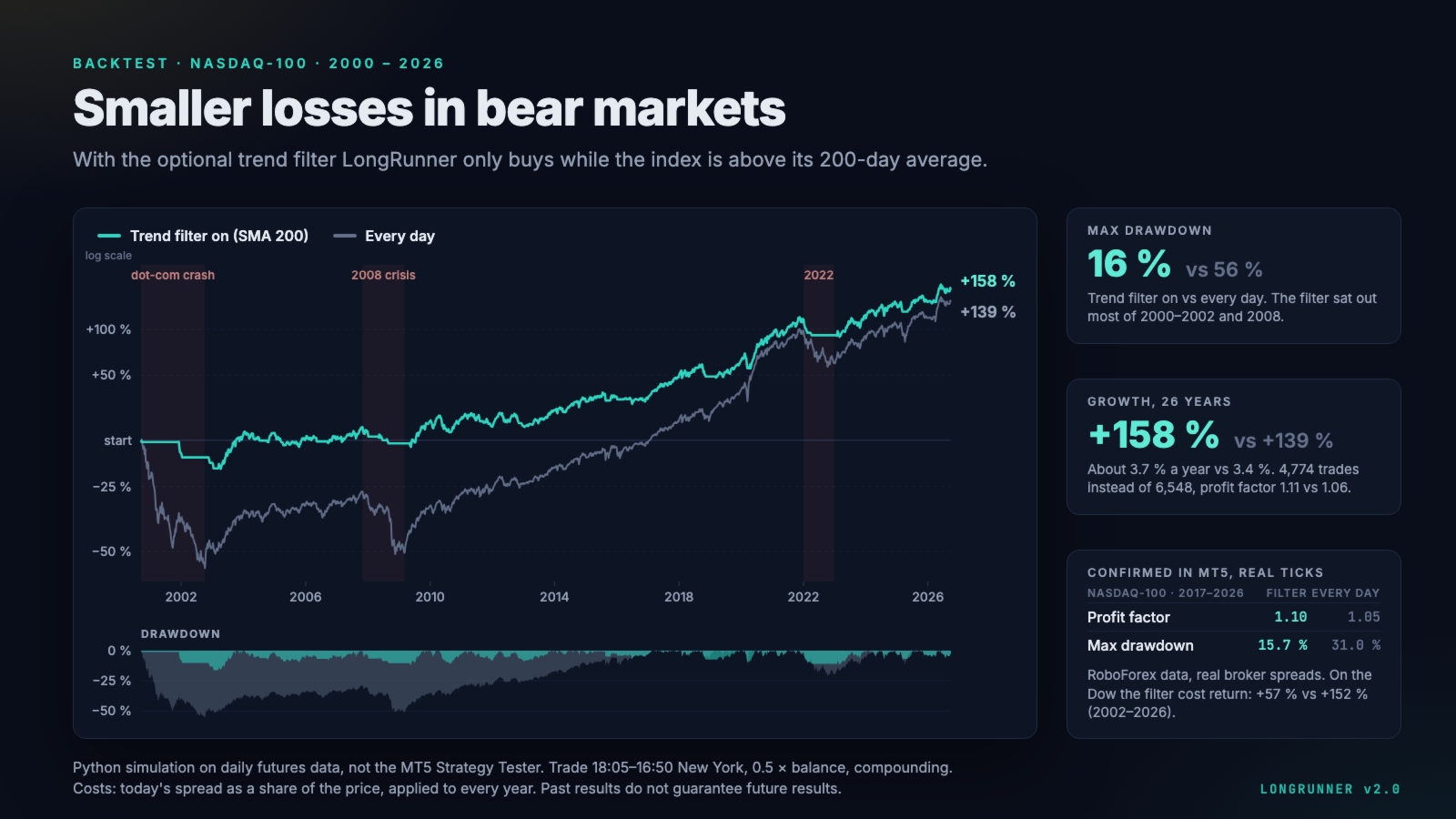
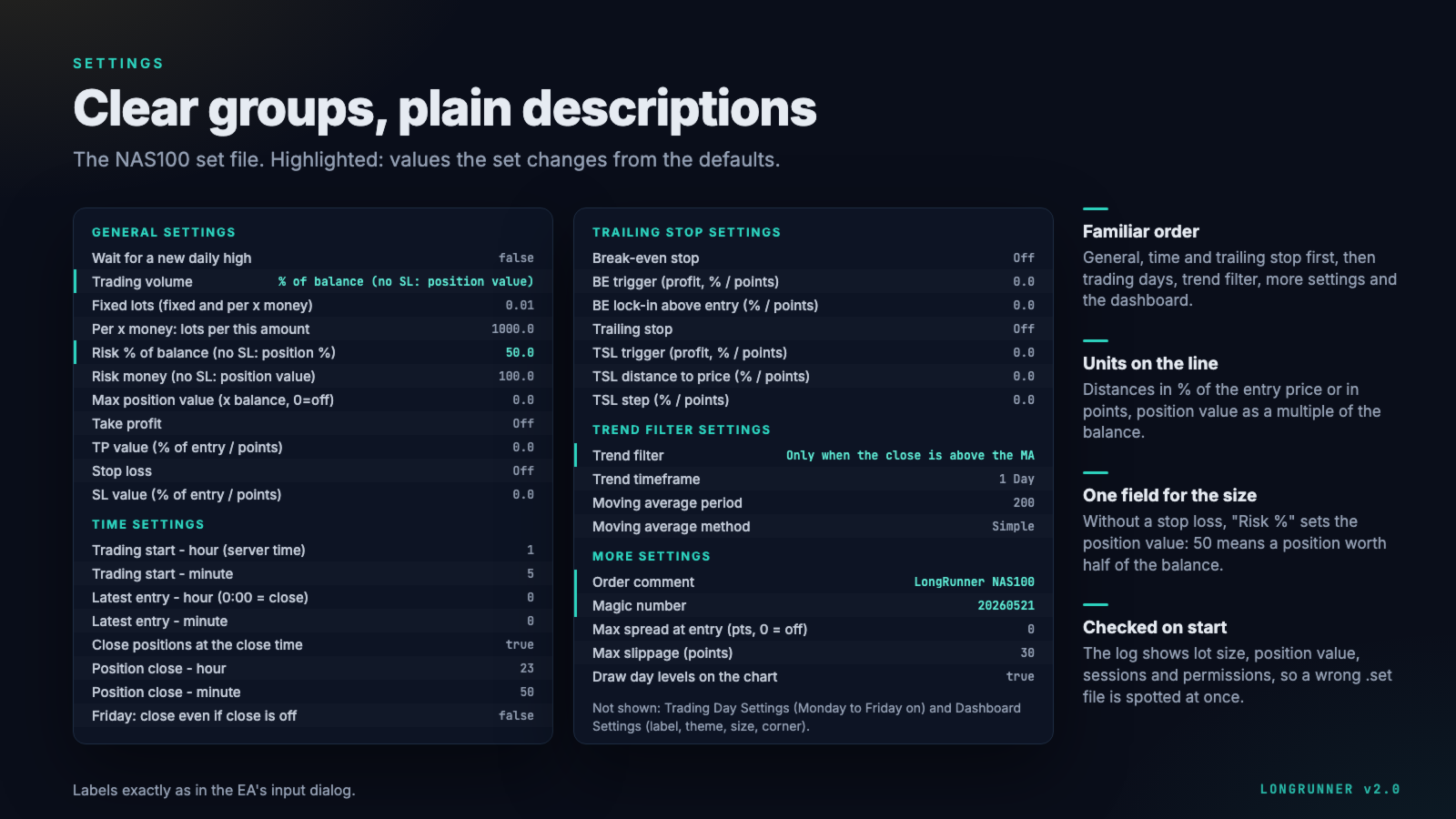
Buying every day also means buying through long bear markets. With the trend filter on, LongRunner only buys while the last daily close is above its moving average (default: 200-day SMA). In our 26-year test on the Nasdaq-100 this cut the maximum drawdown from 56 % to 16 %, because the filter sat out most of 2000–2002 and 2008. It is insurance, not a return booster: on the Dow it also cut the drawdown, but made less money than trading every day, and after a V-shaped crash it buys back late. All set files use it.
Position size your way
- Fixed lots or lots per x money (for example 0.01 lot per 1,000 of balance).
- % of the balance or a money amount: with a stop loss this is the amount lost at the stop. Without a stop loss it sets the position value: 50 % means a position worth half of the balance.
- Optional maximum position value as a multiple of the balance.
- The lot size respects the broker's minimum and maximum lot, the symbol volume limit and the free margin, so an order is reduced rather than rejected. On start the Experts log shows the lot size, the position value and what a 10 % index drop would cost.
Features
- Trading start, latest entry and close time freely adjustable (server time)
- Wait for a new daily high before buying (optional)
- Take profit, stop loss, break-even and trailing stop in % of the entry price or in points
- Trading days Monday to Sunday individually
- Maximum spread: waits for the spread to come down until the latest entry time instead of skipping at once
- Close time off: positions are held until TP/SL, with an optional close on Friday before the weekend
- Restart-safe: after a terminal restart it knows whether today's trade was already made
- Checks the symbol's trading sessions on start and warns if the start or close time lies outside them
- Start time, close time and the high to beat drawn on the chart
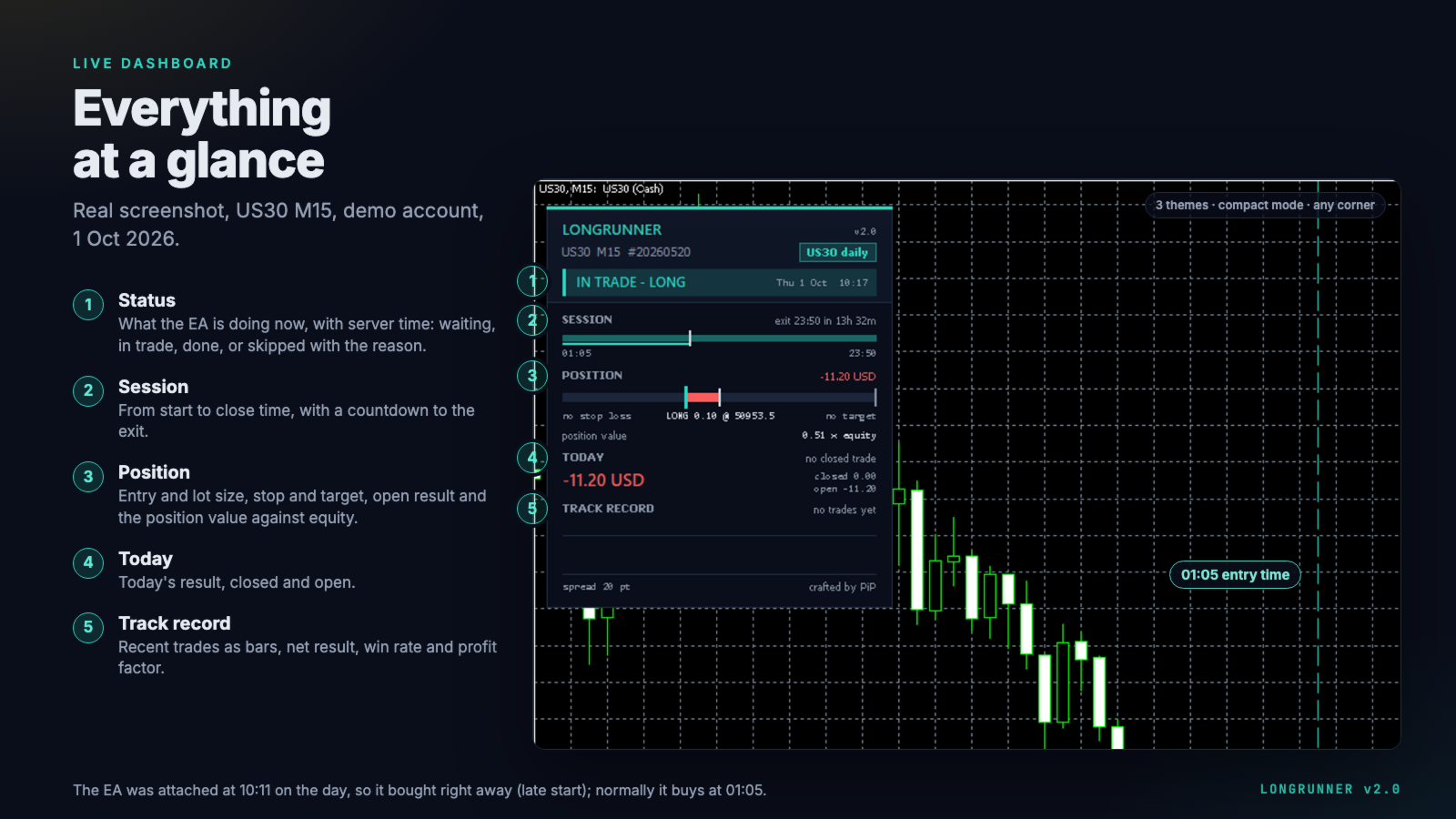
- Live dashboard: status, session timeline, next entry with lot size and position value, open position, today's result and track record
- Three dashboard themes, compact mode, any chart corner
Recommended use
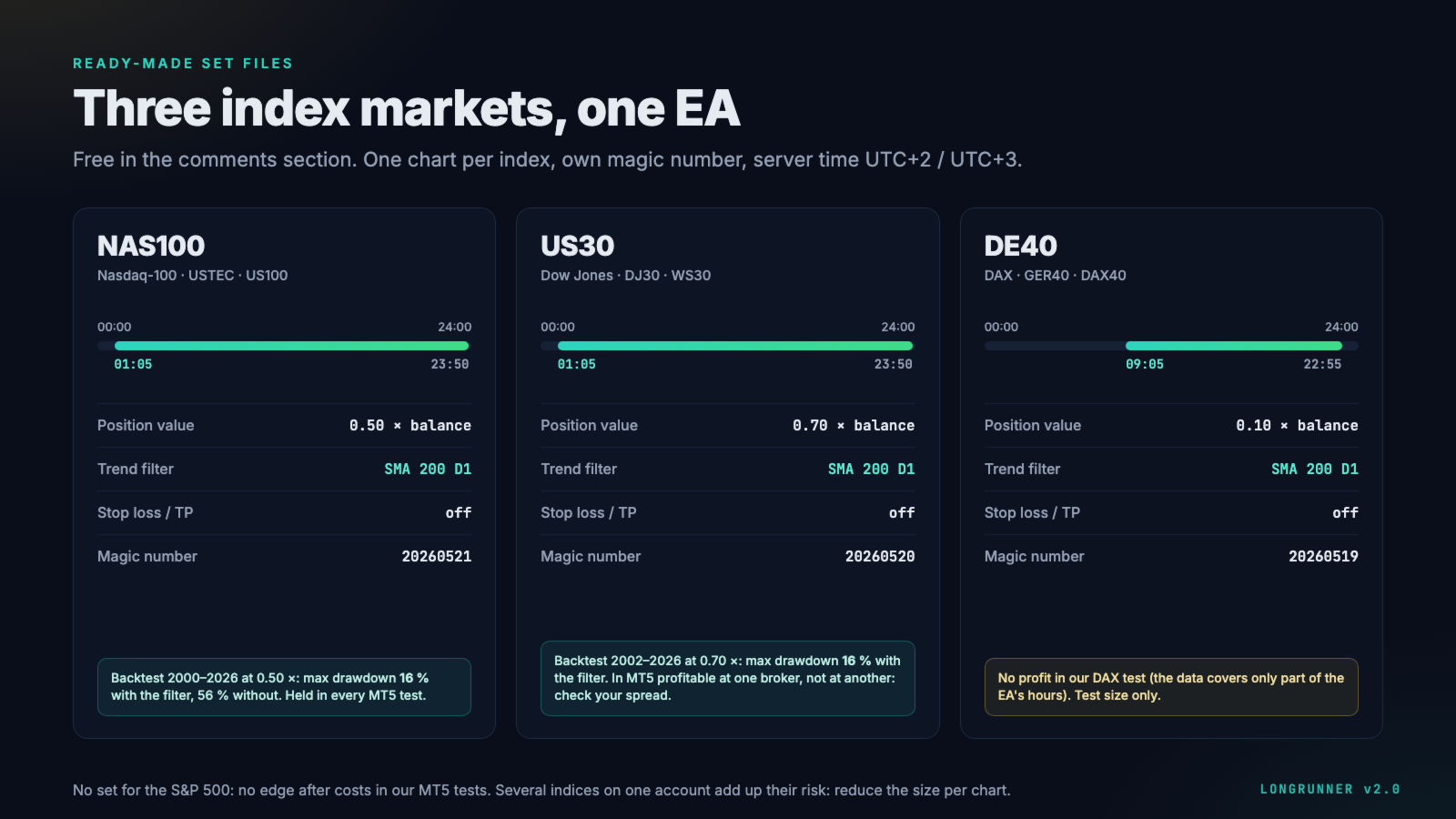
- Stock indices: set files are ready for the Nasdaq-100 (NAS100 / USTEC / US100) and the Dow Jones (US30). A DAX set (DE40) is included at test size only. There is no S&P 500 set: it showed no edge after costs in our MT5 tests.
- Server time: the set files assume UTC+2 in winter and UTC+3 in summer (New York close = midnight). Other server times: shift the start and close time by the difference.
- Spread is the main cost of a daily trade and decides whether the edge survives: in our MT5 tests the same Dow trade was profitable at one broker and lost at another. Use a broker with tight index spreads at the start and close time, set 'Max spread at entry', and run the set file in your Strategy Tester with real ticks before trading live.
- A hedging account is recommended. On a netting account LongRunner shares one position per symbol with every other EA; it then skips the day instead of buying into someone else's position.
- Position value: the US indices move together, so several index charts on one account add up their risk almost one to one. The set values (0.5–0.7 × balance per index) are meant for one index per account; reduce them when you run several.
- Test every symbol in the Strategy Tester with your broker's data, and on a demo account, before trading live.
MetaTrader 5 backtests with real ticks
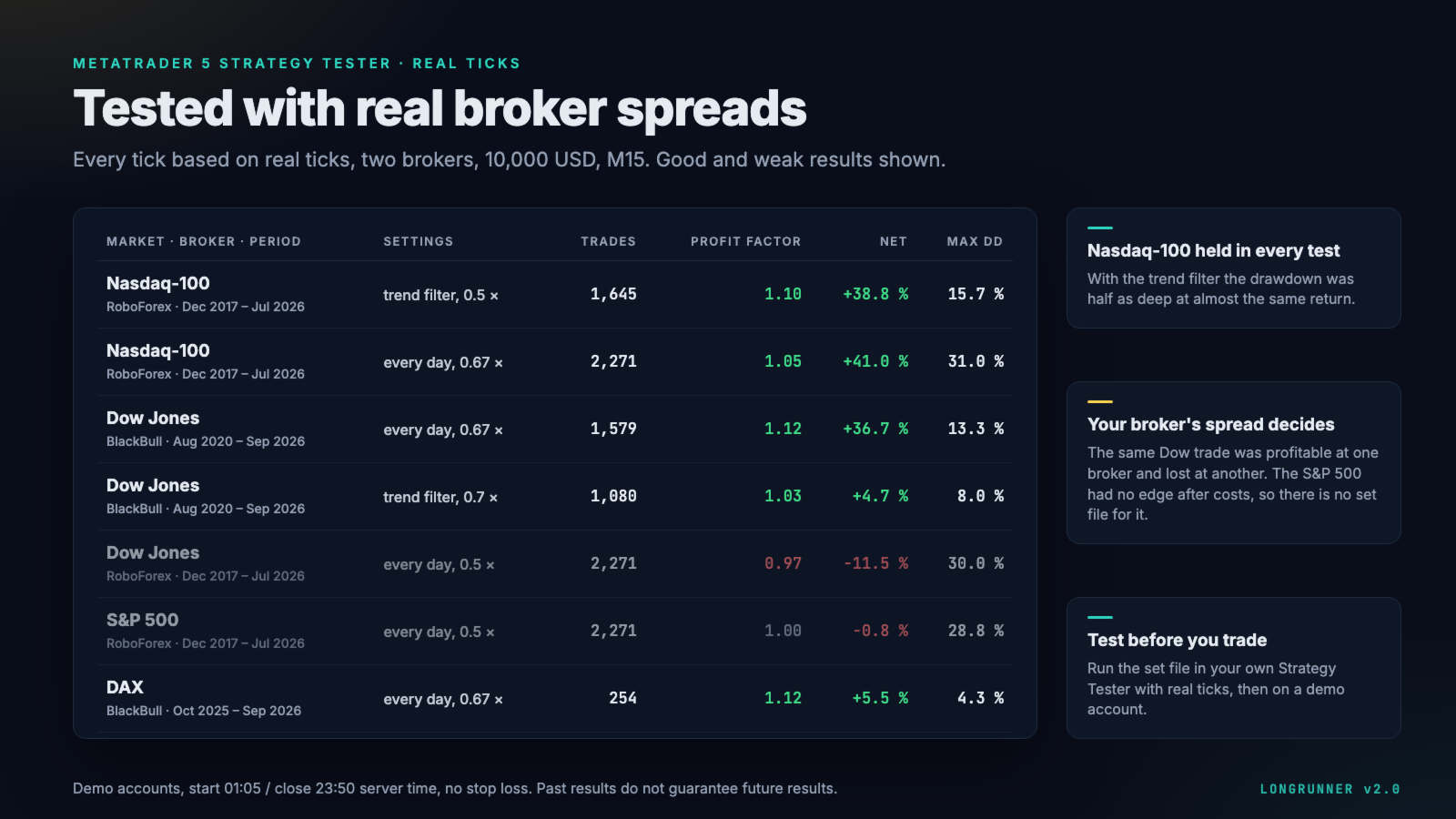
Strategy Tester, "Every tick based on real ticks", demo accounts at two brokers, 10,000 USD, start 01:05, close 23:50, no stop loss:
- Nasdaq-100, RoboForex, Dec 2017 – Jul 2026, trend filter on, 0.5 × balance: 1,645 trades, profit factor 1.10, +38.8 %, maximum drawdown 15.7 %
- Same, every day, 0.67 × balance: 2,271 trades, profit factor 1.05, +41.0 %, maximum drawdown 31.0 %
- Dow Jones, BlackBull, Aug 2020 – Sep 2026, every day, 0.67 ×: profit factor 1.12, +36.7 %, maximum drawdown 13.3 % (trend filter on, 0.7 ×: profit factor 1.03, +4.7 %, drawdown 8.0 %)
- Dow Jones, RoboForex, Dec 2017 – Jul 2026, every day, 0.5 ×: profit factor 0.97, −11.5 %, maximum drawdown 30.0 %
- S&P 500, RoboForex, Dec 2017 – Jul 2026, every day, 0.5 ×: profit factor 1.00, −0.8 % (no set file for this market)
Long-term check (Nasdaq-100, 26 years)
Python simulation on daily futures data, trade 01:05–23:50 server time (18:05–16:50 New York), Sep 2000 – Sep 2026, position value 0.5 × balance, compounding. Costs: today's spread as a share of the price (about 0.007 % per trade on the Nasdaq-100), applied to every year.
- Trend filter on (SMA 200): +158 % (about 3.7 % a year), maximum drawdown 16 %, 4,774 trades, profit factor 1.11
- Every day: +139 % (about 3.4 % a year), maximum drawdown 56 %, 6,548 trades, profit factor 1.06
- Same method, Dow Jones 2002–2026, with / without the filter: maximum drawdown 11 % / 32 %, growth +57 % / +152 %
The 26-year figures are a simulation, not the MT5 Strategy Tester: no slippage modelled, drawdown measured on daily closing equity, futures are not CFDs. Your broker's prices, spreads and session times differ.
Risk warning: trading CFDs on margin carries a high risk of loss. A position without a stop loss can lose much more than a normal daily move on a crash day: the worst test day was −10.9 % on the Nasdaq-100 (15 Oct 2008), about −5.5 % of the balance at 0.5 ×. The set sizes were chosen on this same history (about 20 % drawdown); future crashes can be deeper. Backtests are simulations; past results do not guarantee future results. Test on a demo account first.
Inputs
Logical groups: General, Time, Trailing Stop, Trading Days, Trend Filter, More and Dashboard. Values that need a unit state it on the line. Set files for all markets are posted in the comments section.
Support
Questions and bug reports through the comments or a private message. Please include your broker, symbol, the .set file and the Experts log lines from the day in question.