Crystal Trend Matrix Pro
- Indicators
-
Muhammad Jawad Shabir
 🔧 Expert Developer of Advanced Algorithmic Trading | AI, Neural Logic & Custom Systems
Welcome to my profile! - Version: 1.20
- Activations: 20
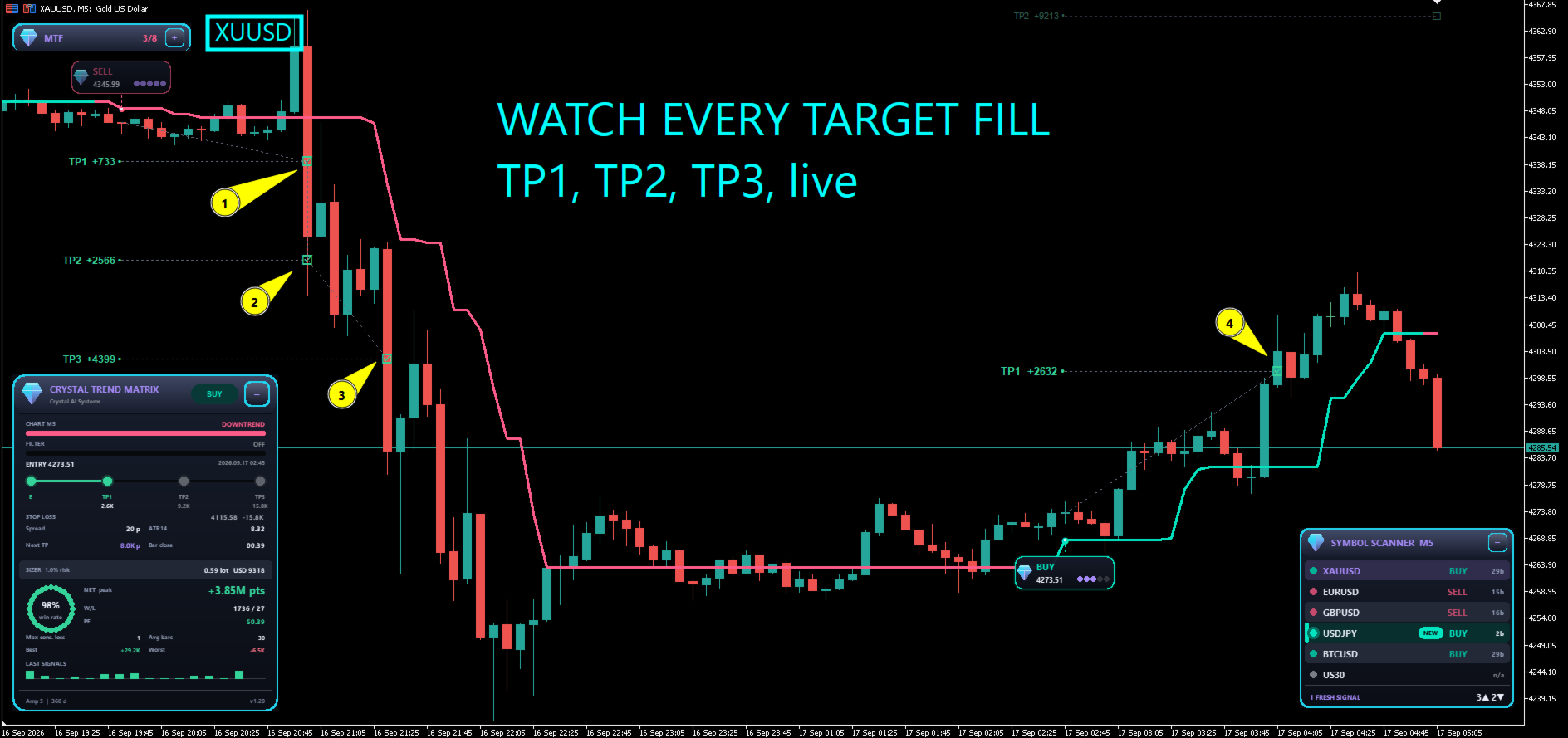
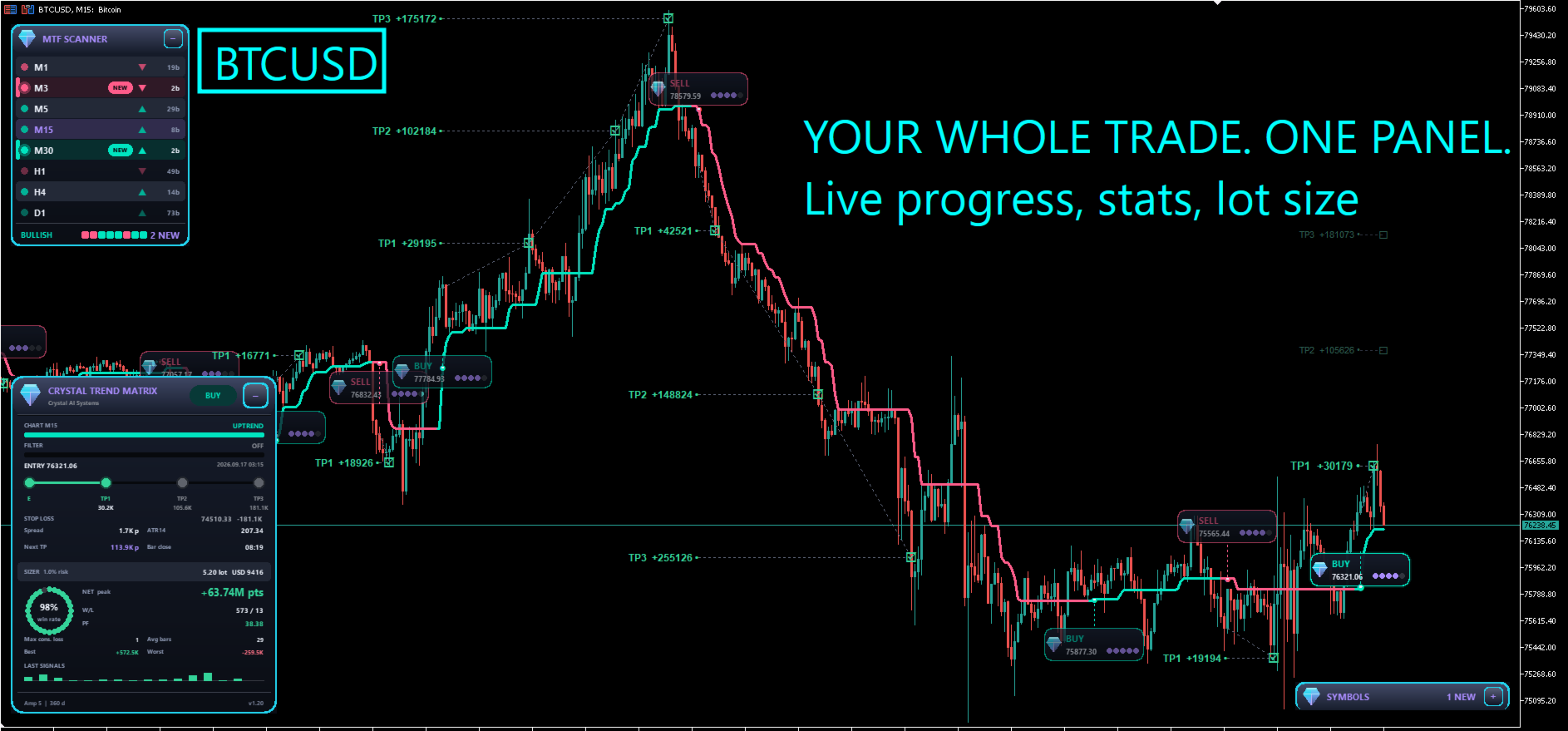
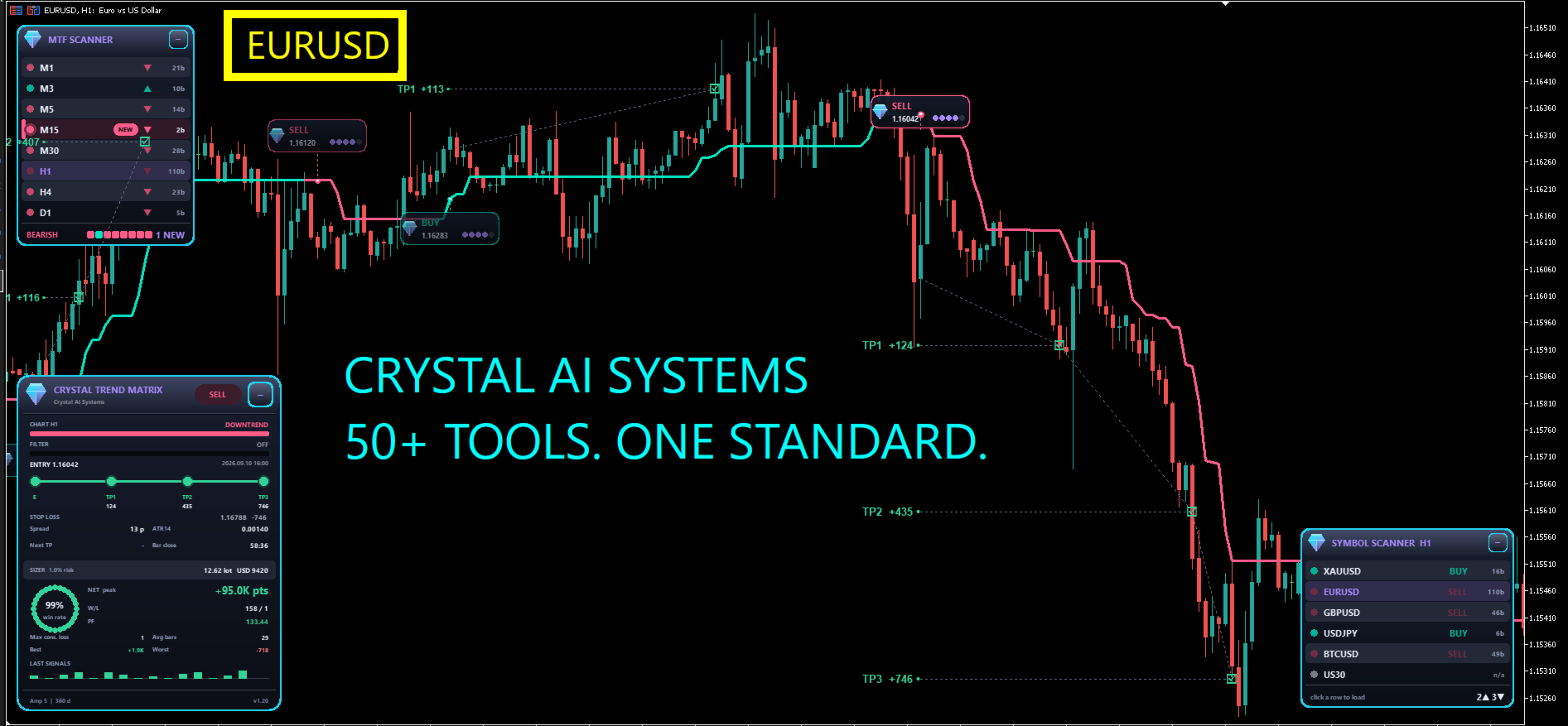
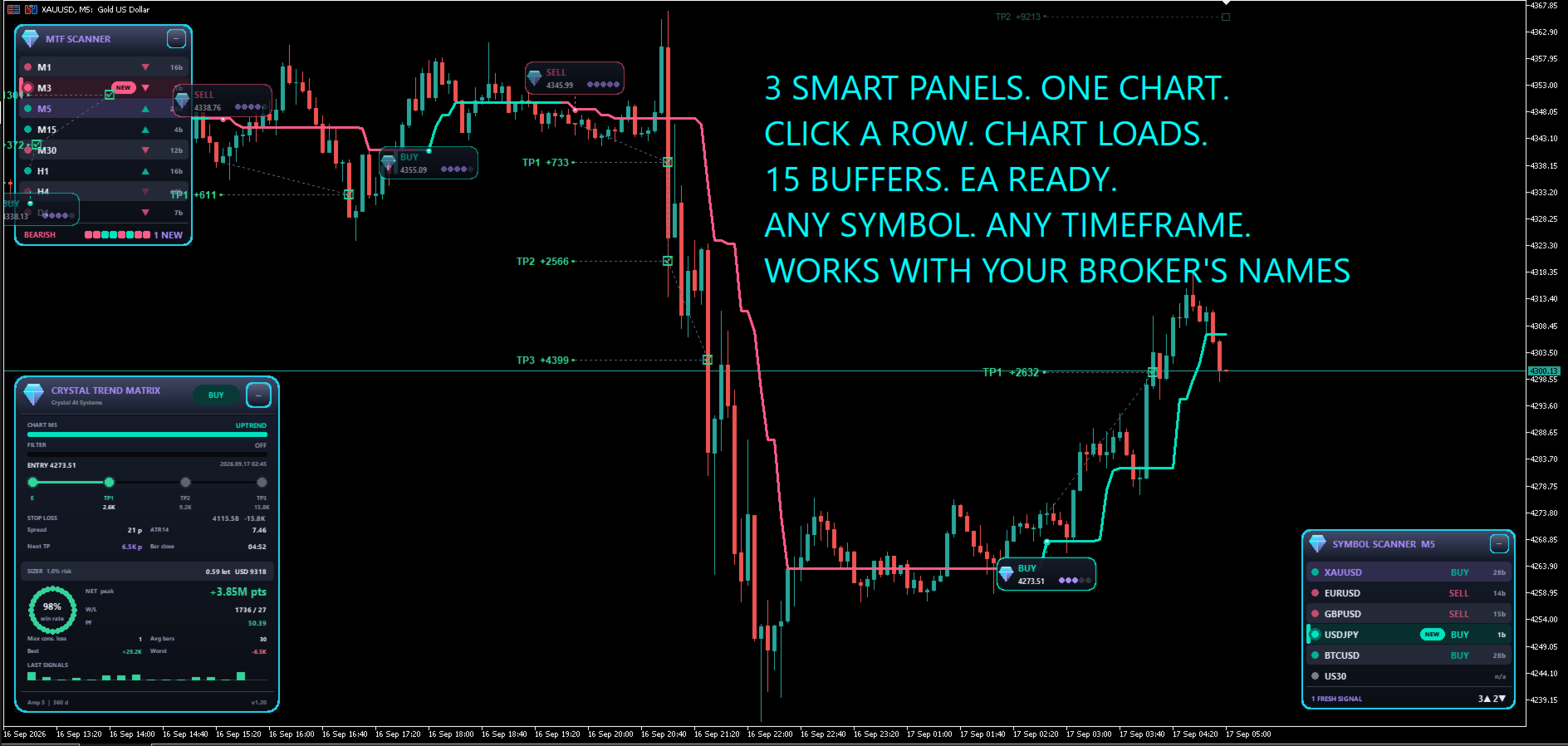
Crystal Trend Matrix Pro is a non-repainting trend indicator for MetaTrader 5. It marks the exact bar a trend turns, projects three take-profit levels and a stop loss from that entry, tracks every level to completion, and scans eight timeframes and six symbols from a single chart.
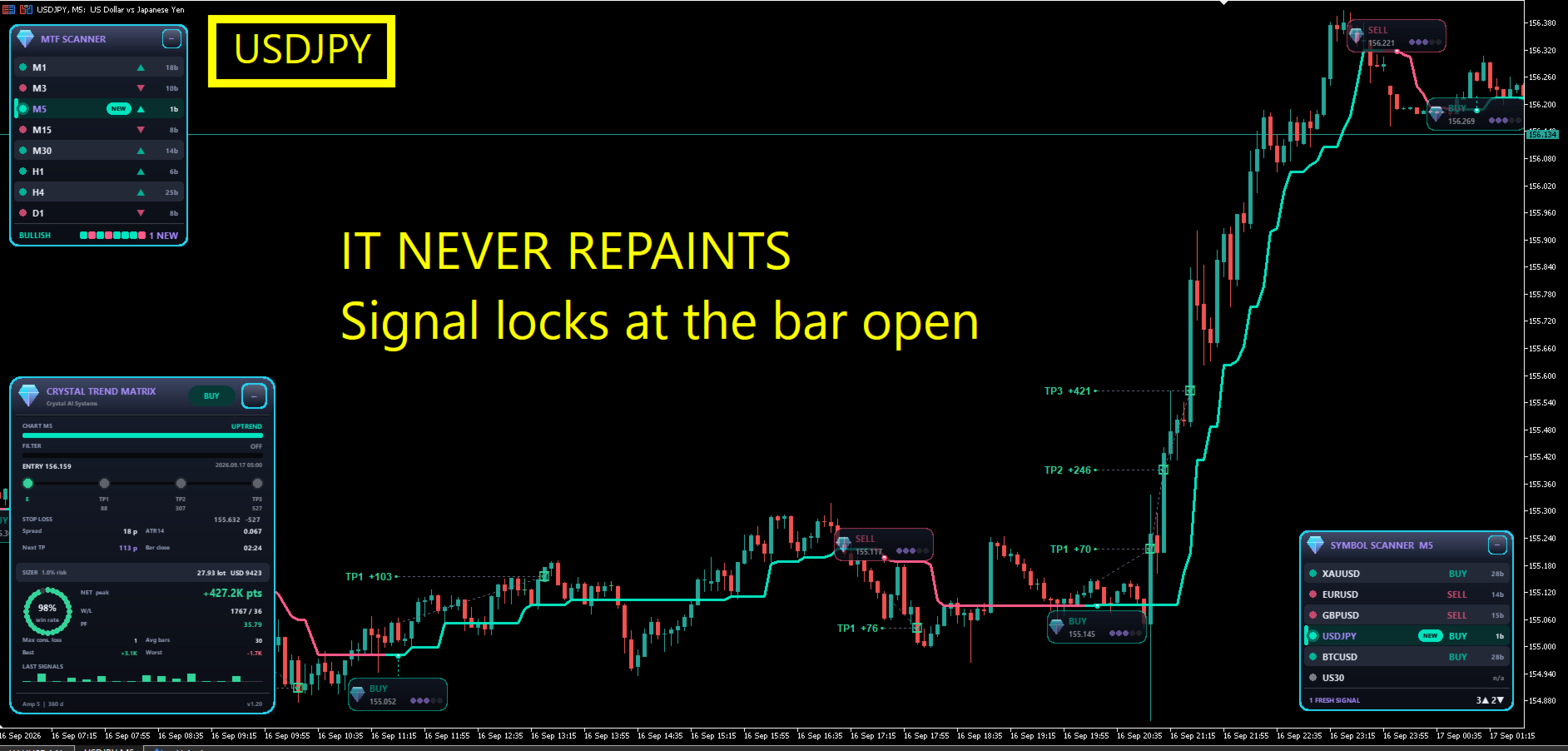
The signal is decided on a closed bar and printed at the open of the next one. Once it is on the chart it never moves, never disappears and never changes direction. What you see in history is exactly what you would have seen in real time.
How it works
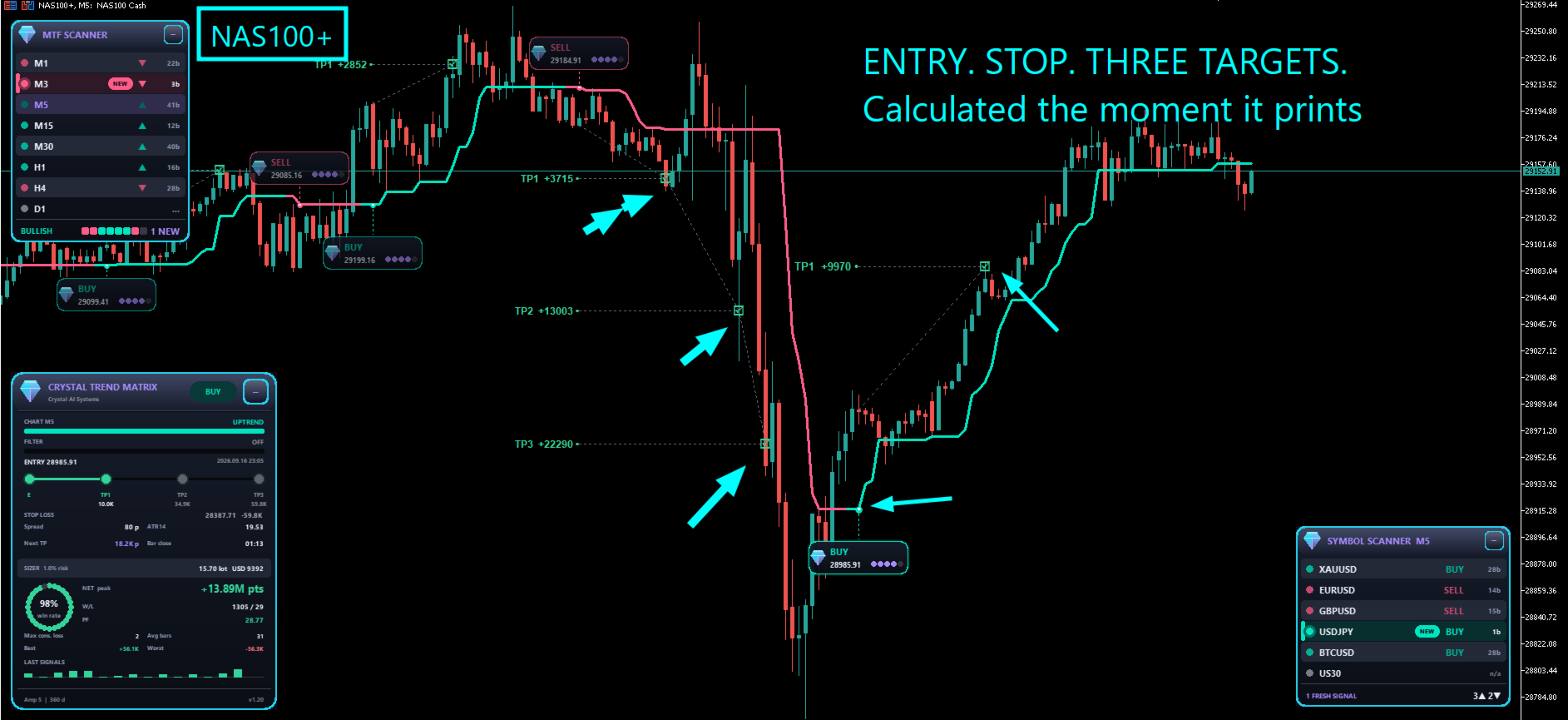
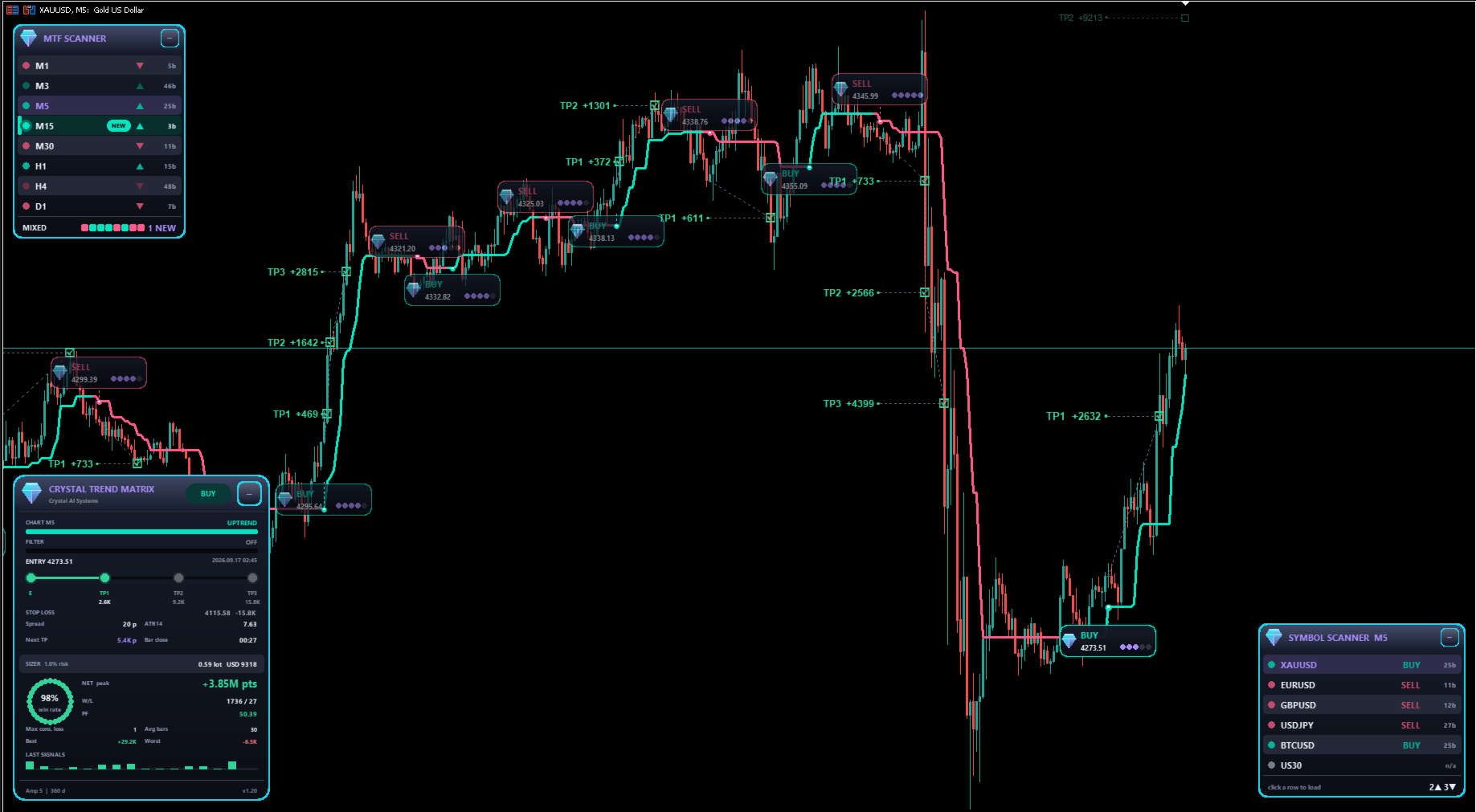
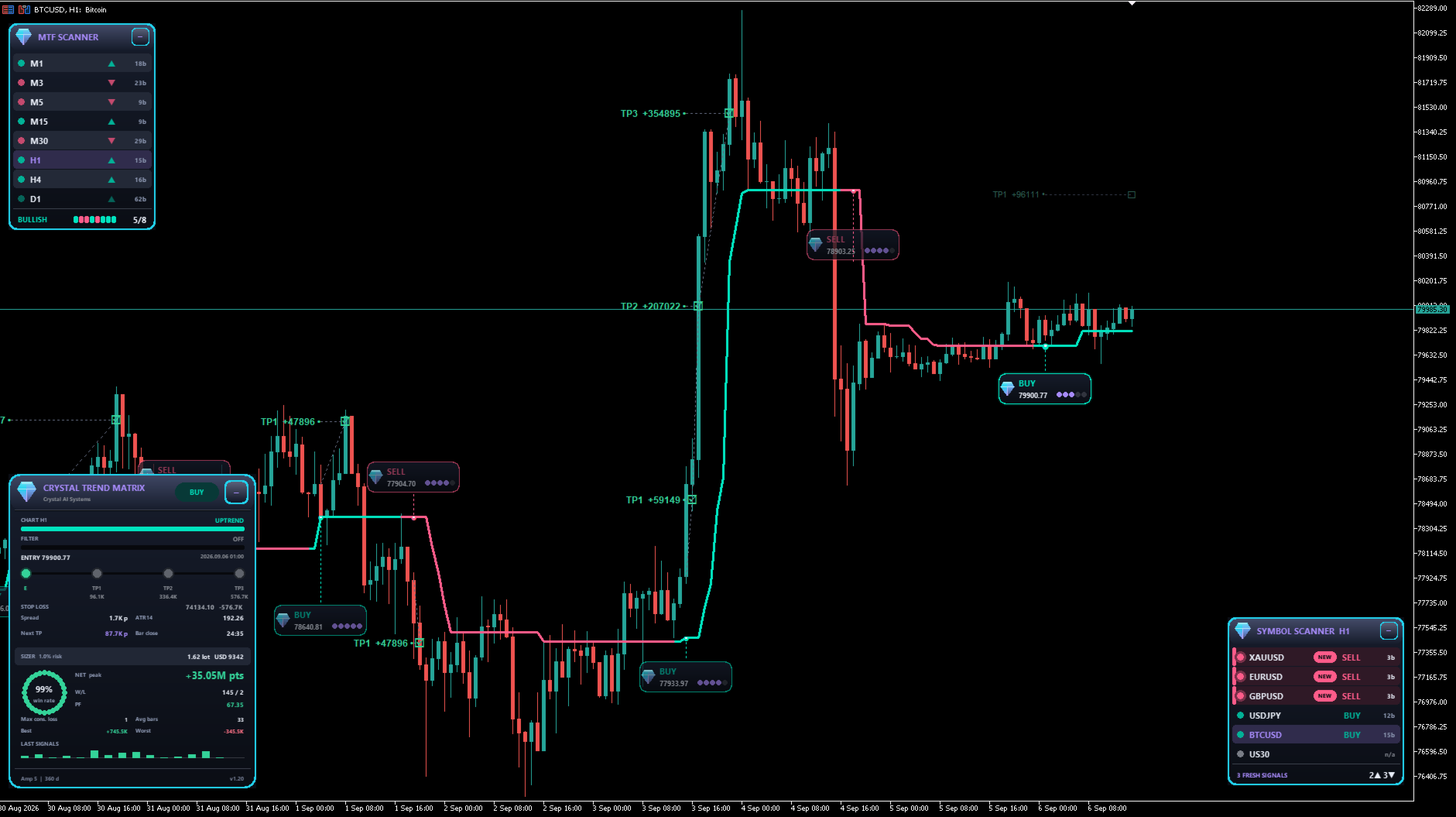
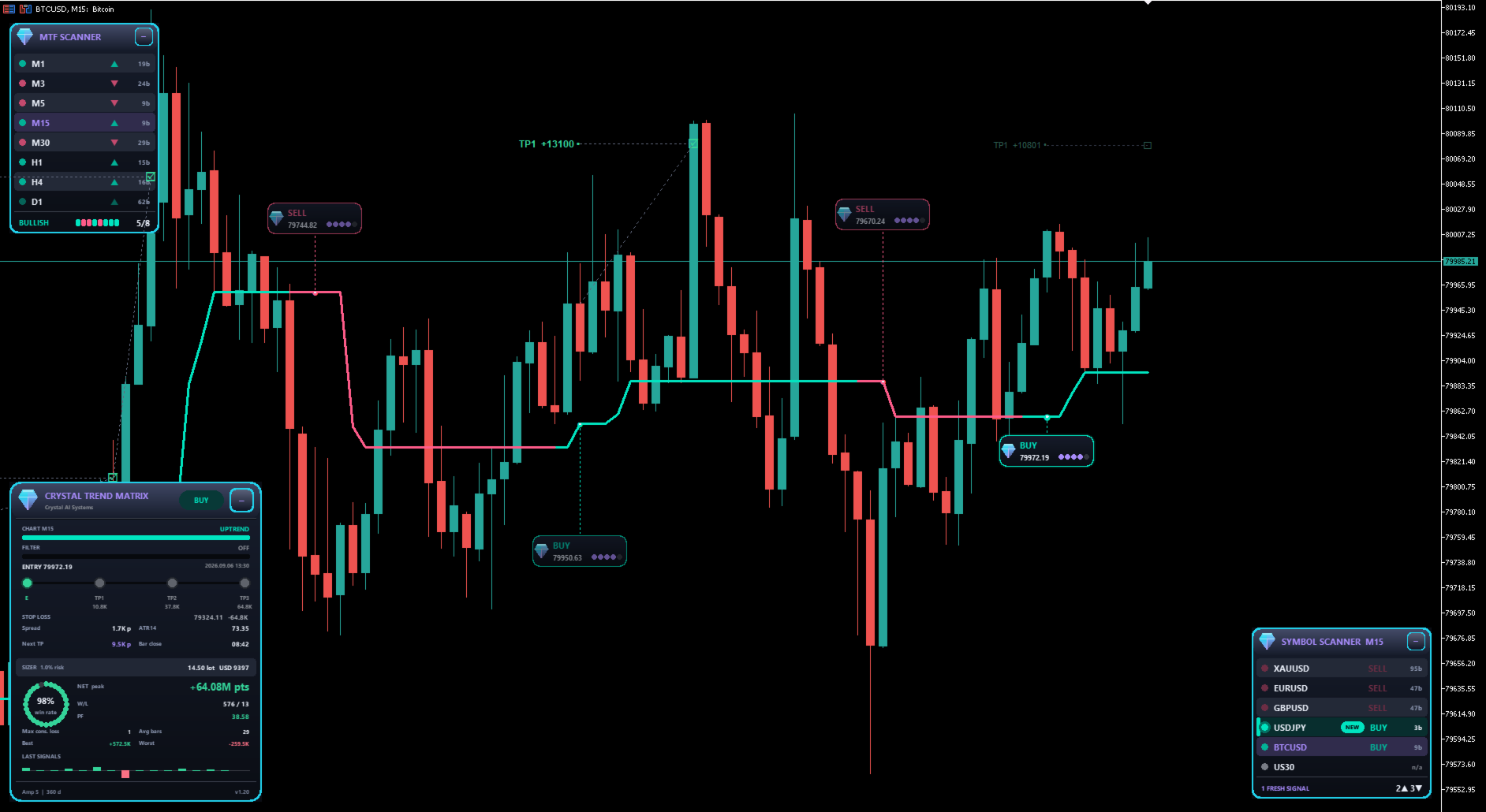
An adaptive step band tracks the market using swing extremes and their moving averages. When the band flips state on a closed bar, the reversal is confirmed. On the open of the very next candle the indicator prints a signal badge and locks in the entry price, the stop loss and three take-profit targets.
From that moment the indicator does the bookkeeping for you. Every level is monitored bar by bar. Reached targets are ticked off and connected back to the entry, and the levels a trade never reached are removed from history, so old signals stay clean and show only what actually happened.
What you get
| Feature | What it does for you |
| Non-repainting signals | Confirmed on a closed bar, printed at the next open, fixed forever |
| Entry badge | Direction, entry price and quality score on a clean on-chart card |
| TP1, TP2, TP3 and SL | All four levels drawn from the entry and tracked until they are hit |
| Self-cleaning history | Levels a trade never reached are removed, so the chart shows facts only |
| Signal quality score | Five independent checks graded 1 to 5, with a minimum-quality filter |
| Main dashboard | Trend, filter, live target progress, spread, ATR, bar countdown, statistics |
| MTF scanner | Eight timeframes of the current symbol with a consensus reading |
| Symbol scanner | Up to six symbols with automatic broker suffix detection |
| Fresh signal marking | Just-turned rows are highlighted, so new setups stand out instantly |
| Position sizer | Lot size and money at risk from your risk percentage and the stop distance |
| Full alert set | Entry, TP1, TP2, TP3 and SL via pop-up, mobile push, email and sound |
| Statistics engine | Net result, win rate, profit factor, best and worst, consecutive losses |
| CSV export | Every closed signal written to file for your own analysis |
| Four colour themes | Prism, Obsidian Emerald, Carbon Rose and Daylight, plus full custom colours |
| EA ready | Fifteen documented buffers for automation through iCustom |
The three panels
| Panel | Position | Shows |
| Dashboard | Lower left | Chart and filter trend, entry, target progress stepper, stop loss, spread, ATR, distance to the next target, bar countdown, lot suggestion, win rate gauge, profit factor and a sparkline of recent results |
| MTF Scanner | Upper left | M1, M3, M5, M15, M30, H1, H4 and D1 direction with bars since the turn, plus an overall consensus reading |
| Symbol Scanner | Lower right | Up to six instruments on the current timeframe with direction, signal age and fresh signal marking |
Every panel has its own collapse button and keeps a summary visible when closed. Click a scanner row to load that timeframe or symbol straight onto the chart. Keyboard shortcuts: D for the dashboard, T for the MTF scanner, S for the symbol scanner, and H to hide everything for a clean screenshot.
Signal quality score
Not every reversal is worth the same. Each signal is graded from 1 to 5 against five independent checks, and you can refuse to print anything below your chosen grade.
| Check | Point awarded when |
| Filter alignment | The higher timeframe agrees with the signal direction |
| Volatility health | Current ATR sits in a sane range against its own average, so the market is neither dead nor spiking |
| Entry extension | Entry is close to the band rather than far extended away from it |
| Trend maturity | The previous leg lasted long enough to be a real trend and not chop |
| Cost efficiency | TP1 is far enough away to comfortably clear the spread |
Take profit and stop loss modes
| Mode | Levels measured from | Suits |
| Swing Range | The high to low range of the last N bars | Forex, metals, most conditions. Default. |
| ATR Multiples | A multiple of Average True Range | Crypto and indices, where volatility shifts hard |
| Fixed Points | A fixed point distance you set | Traders working to a fixed target plan |
TP1, TP2, TP3 and the stop are each a multiplier of that base unit, so you can shape the reward profile to your own style without touching the entry logic.
Statistics: two honest views
The panel can measure closed signals two different ways, and it always tells you which one is active.
| Mode | How a signal is scored |
| Peak | Once TP1 is secured the trade can no longer be counted as a loss, and the best excursion it reached is what counts, capped at TP3. A negative result is only possible when the stop is hit before TP1. |
| Realistic | One third of the position is treated as closed at each take profit. Whatever is still open when the stop or the reversal arrives closes there. |
Peak shows what the move offered. Realistic shows what a mechanical thirds-based exit would have produced. Run both. The difference between them tells you how much of each move your exit plan is actually capturing.
Recommended use
| Style | Timeframes | Amplitude | Base mode | Filter timeframe |
| Scalping | M1 to M5 | 3 to 5 | Swing Range or ATR | M15 or M30 |
| Intraday | M15 to H1 | 5 to 8 | Swing Range | H4 |
| Swing | H4 to D1 | 8 to 12 | Swing Range | D1 or W1 |
| Market | Notes |
| Gold and forex majors | Swing Range base works well across sessions. Turn the session filter on if you want to skip the illiquid hours. |
| Indices | ATR base handles the volatility around the open and close better than a fixed range. |
| Crypto | ATR base, and a slightly higher amplitude to filter the noise on lower timeframes. |
The indicator works on every symbol and every timeframe your broker offers. Nothing is hard coded to a single market.
Quick start
- Attach the indicator to a chart and leave the defaults for the first look.
- Open the MTF scanner and check whether the higher timeframes agree with the chart you are on.
- Turn the filter timeframe on and set it one or two steps above your trading timeframe.
- Raise the minimum quality if you want fewer and stronger signals, lower it if you want more.
- Set your risk percentage so the dashboard can suggest a lot size for each setup.
- Enable the alerts and channels you actually want, and add your symbols to the symbol scanner.
Key inputs
| Input | Purpose |
| Amplitude | Sensitivity of the trend band. Lower reacts faster, higher filters more noise. |
| Calculation Range | How many days of history are drawn and included in the statistics. |
| Multiplier base | Chooses Swing Range, ATR or Fixed Points for the level distances. |
| TP and SL multipliers | Shapes the reward and risk profile of every signal. |
| Minimum quality | Refuses to print signals graded below your threshold. |
| Use filter timeframe | Only allows signals that agree with a higher timeframe. |
| Session filter | Blocks a time window, or allows trading only inside one. |
| Max signals per day | Caps how many setups can print in a single session. |
| Statistics mode | Switches the panel between the Peak and Realistic views. |
| Colour theme | Four presets plus a full custom palette. |
| Scanner symbols | Up to six instruments, with broker suffixes detected automatically. |
| Scanner font size | Scales the whole scanner readout for your screen and resolution. |
For EA developers
Every value the indicator calculates is exposed through numbered buffers, so you can automate the signals with your own Expert Advisor through iCustom. The buffer map is also printed inside the input list for quick reference.
| Buffer | Contents |
| 0 and 1 | Trend band, up track and down track |
| 2, 3, 4 | Take profit 1, 2 and 3 prices |
| 5 | Stop loss price |
| 6 | Direction: 1 for buy, -1 for sell, 0 for none |
| 7 and 8 | Buy and sell arrows, sparse |
| 9 | Trend state: 0 up, 1 down |
| 10 and 11 | Buy and sell entry trigger prices, sparse |
| 12 and 13 | Filter timeframe band, up and down tracks |
| 14 | Signal quality, 1 to 5, on the signal bar |
Buffers 2 to 6 and 9 carry live values on every bar, so an Expert Advisor can read the current targets at any time. A new signal is present when buffer 10 or 11 holds a value at shift 0.
Good to know
- Built for MetaTrader 5. Works on any symbol, any timeframe and any account type.
- The band engine advances one bar at a time, so the indicator stays light even with a year of history loaded.
- The two scanners run on live charts. They are switched off inside the Strategy Tester, where other symbols are not reliably available.
- All statistics on the panel are calculated from the signals shown on your own chart, with your own settings. Past behaviour of any indicator is not a promise of future results, and no indicator removes the need for your own risk management.
Developed by Crystal AI Systems. If you have a question about settings, or you want a configuration tuned for your market, leave a comment on the product page and I will help.