Minty Breakout
- Experts
- Version: 5.12
- Updated: 6 October 2026
- Activations: 5

Trend-following support/resistance breakouts on H1, built for XAUUSD (gold) only. Pure logic: no AI, no martingale, no grid. Every trade has a stop loss. Two settings.
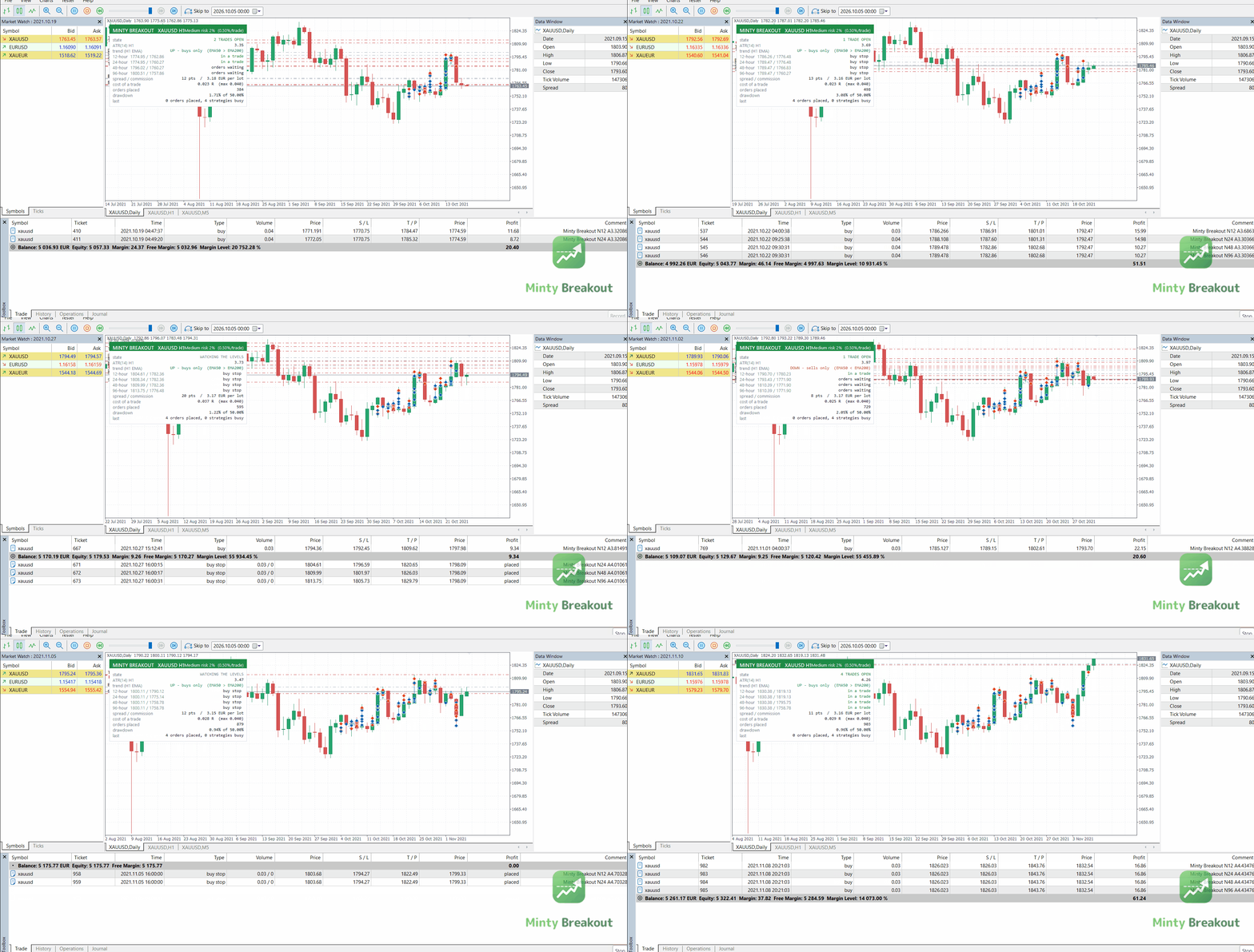
Minty Breakout runs four breakout strategies side by side, watching the 12-, 24-, 48- and 96-hour highs and lows. In an uptrend it waits with a Buy Stop above resistance; in a downtrend, with a Sell Stop below support. When price breaks out, the trade follows the move with an ATR-based stop loss, take profit and trailing stop.
Gold only. Minty Breakout is built and tested to trade XAUUSD (gold) only. All of its fixed settings were tuned on gold, and gold is the only market where it showed a reliable edge. It is not designed for forex pairs, indices, other metals or crypto.
What to expect
Minty Breakout does not guarantee a steady profit. It is built to make its profit over a long period of trading, not week by week:
- Losing weeks and months are normal. Only about half of the trades win, and losing streaks of several trades happen regularly.
- Its edge is the win-to-loss ratio. Losses are cut at the stop or reduced by the trailing stop, while winners are allowed to run, so the average win is larger than the average loss. In the 2013–2026 gold backtest, the average win was +0.83 R against an average loss of −0.68 R, about 1.2 to 1.
- Many trades are needed. That small advantage per trade only adds up over hundreds of trades. Judge the EA over months and years, not days.
Features
- Trades with the trend only. EMA 50 vs EMA 200 on H1 decides the direction. Breakouts against the trend, which lost money in testing, are never taken.
- Four independent breakout strategies. Each window holds at most one trade.
- Adaptive exits. Stop loss (2 × ATR), take profit (4 × ATR) and trailing stop (1.5 × ATR, starting at 1 ATR profit) all scale with volatility. Once trailing starts, a trade can lose at most a quarter of its planned risk.
- Automatic cost control. It learns your broker's commission from your own trade history, adds the live spread and slippage, and only trades when the total cost is at most 4% of the risk.
- One risk setting: your maximum drawdown. You choose how far the account may fall from its peak, from 0.01% to 100%, and the EA sizes every trade from it (see Settings below).
- Drawdown protection. Trades get smaller once half of your limit is used, no trade is opened that could take the account past the limit, and at the limit everything is closed and the EA stops.
- Daily pause. Losing half of the limit in one day closes everything until the next day.
- Broker-safe order handling. Lot sizes respect the broker's volume limits, and orders or trades too close to the price to be changed are retried on the next tick instead of being rejected.
- Time exit, 2-hour order expiry and Friday stop. No forgotten trades and no new orders before the weekend gap.
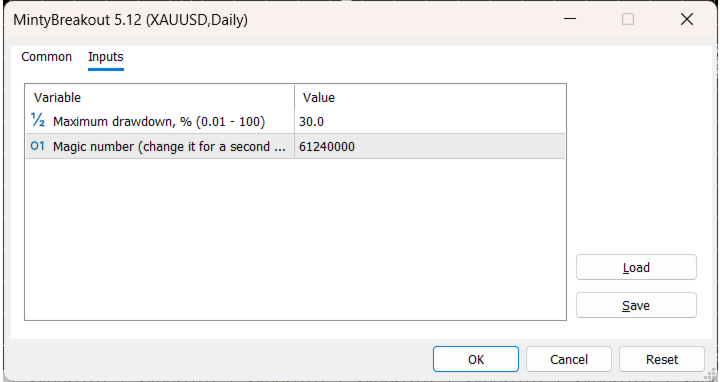
- Two settings: maximum drawdown and magic number. Everything else is fixed at the tested values or measured automatically.
- Information panel and light chart theme. The panel shows the trend, every strategy's levels and state, the trade cost, commission and drawdown. The chart switches to a matching light theme, and your own colours come back when the EA is removed.
Recommendations
- Symbol: XAUUSD (gold) only. The EA is built for gold. In our tests on 28 forex pairs, silver and bitcoin it did not make money over the long run (forex averaged −0.02 R per trade), so other symbols are not supported. If your broker names gold differently (for example XAUUSD.r or GOLD), attach it to that symbol.
- Timeframe: any. The EA always reads H1.
- Account: a hedging account with low spreads (ECN/raw).
- Minimum deposit: a 0.01-lot trade at the 2 × ATR stop risks about $34, so the smallest trade needs about $5,700 at the default 30% maximum drawdown (see the table under Settings).
- VPS: recommended.
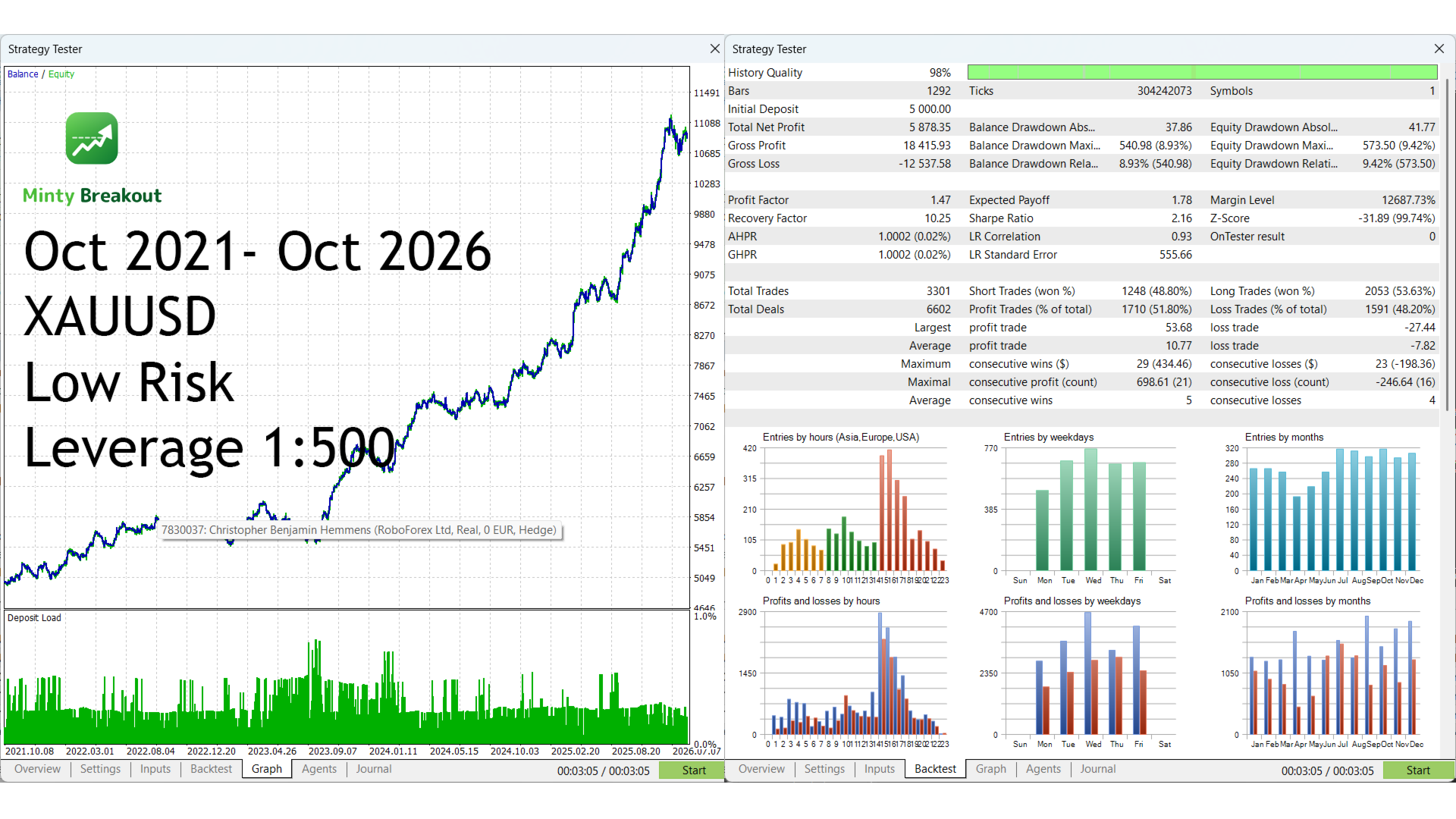
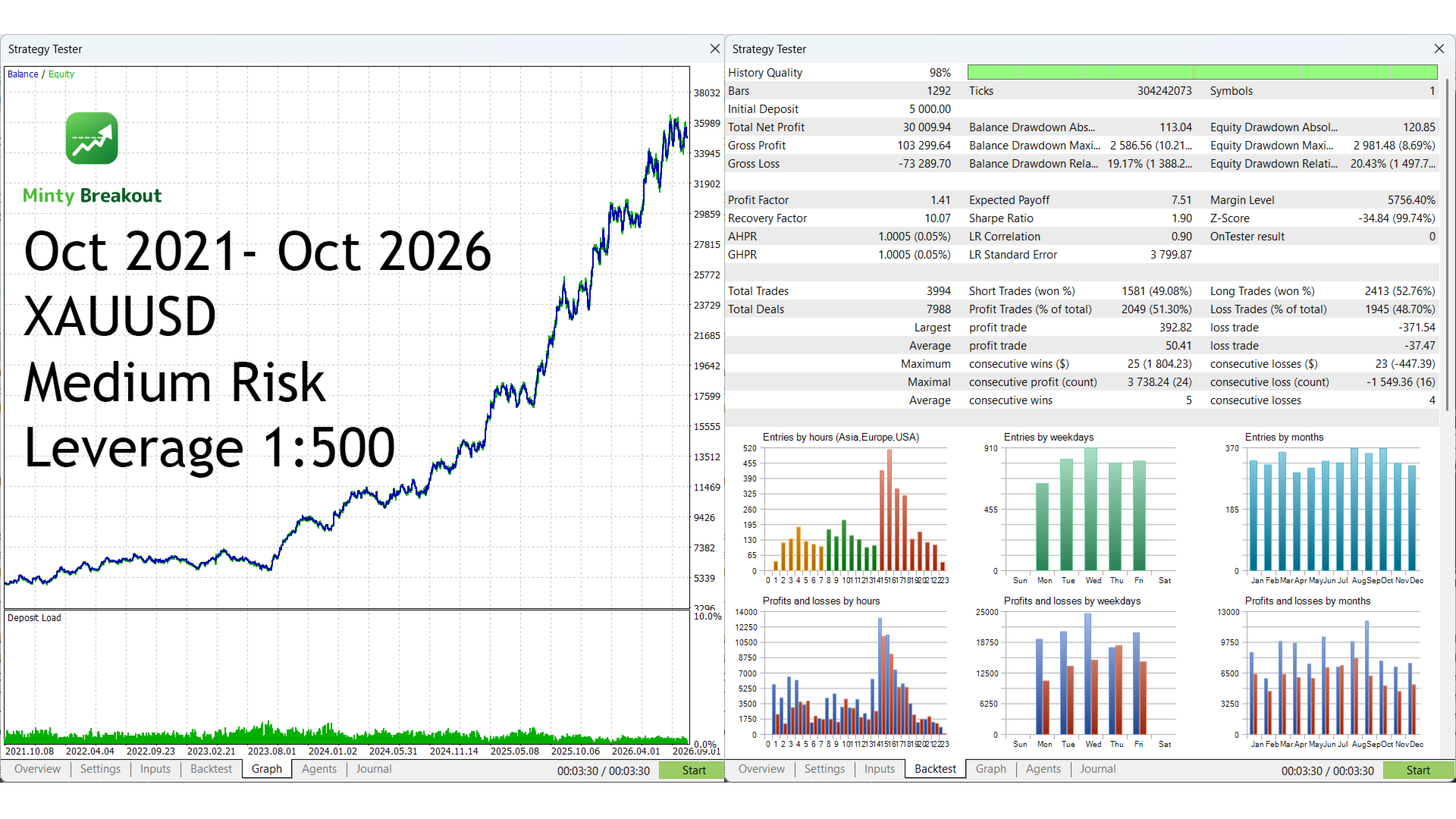
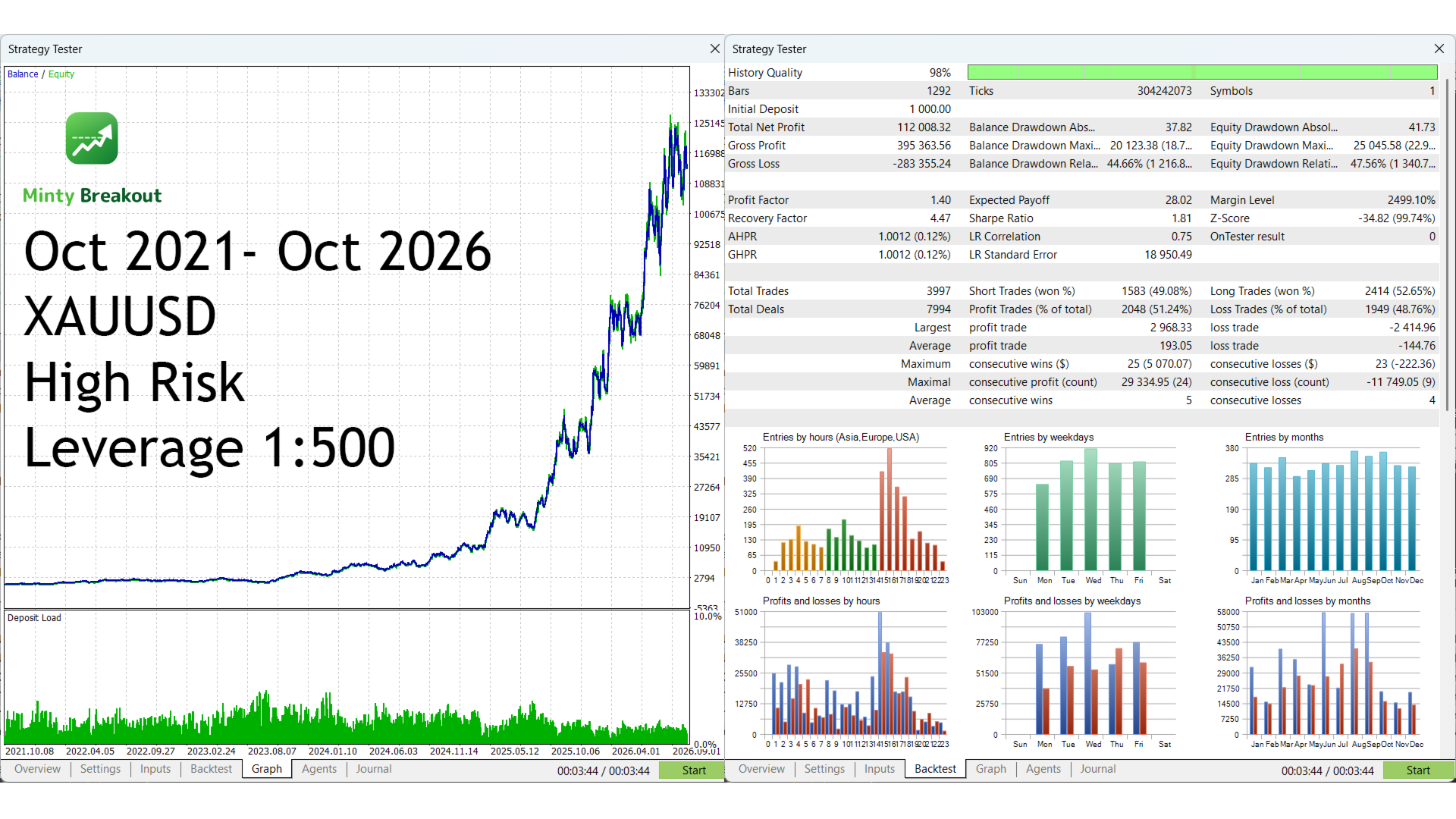
Backtest (XAUUSD, 2013–2026)
Simulated on M5 data at today's spread of about 20 points (scaled with price), with every trade sized from the equity at that moment, as the EA does.
| Result | Value |
|---|---|
| Trades | about 15 a week |
| Winners | 50.5% (average win +0.83 R, average loss −0.68 R) |
| Average per trade | +0.083 R |
R is the amount risked per trade.
| Maximum drawdown setting | Per year | Worst drawdown in the test | Worst year |
|---|---|---|---|
| 10% | +10.9% | 9.8% | −0.4% |
| 20% | +22.7% | 19.3% | −1.4% |
| 30% (default) | +35.0% | 28.6% | −3.1% |
| 50% | +60.8% | 46.0% | −8.1% |
| 100% | +122.2% | 79.3% | −27.6% |
Each setting uses most of its limit: in the test the worst drawdown came close to the setting, so expect drawdowns of that size. Worse live conditions or a price gap through the stops can reach or overshoot the limit, and then the EA stops.
The fixed settings were chosen on this data, keeping only changes that improved both 2013–2019 and 2020–2026, so live results are likely to be weaker. With the much wider spreads some brokers charged in earlier years, the cost limit keeps the EA largely out of the market. Past and backtested results do not guarantee future returns. Trading involves risk; only trade money you can afford to lose.
Settings
| Setting | Default | Description |
|---|---|---|
| Maximum drawdown | 30% | How far your account may fall from its highest point, from 0.01% to 100%. It sets the trade size, the daily pause and the point where the EA stops. |
| Magic number | 61240000 | Change it only to run two copies on the same symbol. |
How the maximum drawdown works
- Trade size: each trade risks 2% of your limit (0.6% of equity per trade at 30%, 1% at 50%, 2% at 100%). Commission is included, so a trade that hits its stop loses exactly that.
- Smaller trades in a drawdown: once half of the limit is used, new trades get smaller step by step, down to nothing at the limit.
- Never past the limit: a new trade may only risk what is left above the limit after all open stops.
- At the limit: all trades are closed and the EA stops. Remove it from the chart and attach it again to start fresh.
- Daily pause: losing half of the limit in one day closes everything until the next day.
- The peak is the highest equity since the EA was attached, and is remembered through restarts.
Choosing your maximum drawdown
| Maximum drawdown | Risk per trade | Backtest per year | Minimum deposit for 0.01 lot (gold) |
|---|---|---|---|
| 10% | 0.2% | +10.9% | about $17,000 |
| 20% | 0.4% | +22.7% | about $8,500 |
| 30% (default) | 0.6% | +35.0% | about $5,700 |
| 50% | 1.0% | +60.8% | about $3,400 |
| 100% | 2.0% | +122.2% | about $1,700 |
A lower limit gives smaller swings and slower growth. The deposit load shown in the Strategy Tester is the margin in use, not the risk, and stays low even at 100%.