Lockjaw MT5
- Experts
-
Yogeswaran Suppiah
 Independent MetaTrader developer based in Malaysia, publishing chart analysis tools for discretionary traders. On MQL5 since 2015.
 - Version: 1.10
- Updated: 1 September 2026
- Activations: 5
The daily loss cap survives a restart or VPS reboot - the technicality that fails most prop firm EAs. 13 instruments, hard stop on every trade.
13 instruments, one scalper, a published minimum deposit for each - 50 USD on NZDUSD up to XAUUSD gold. Prop firm risk rules on all of them.
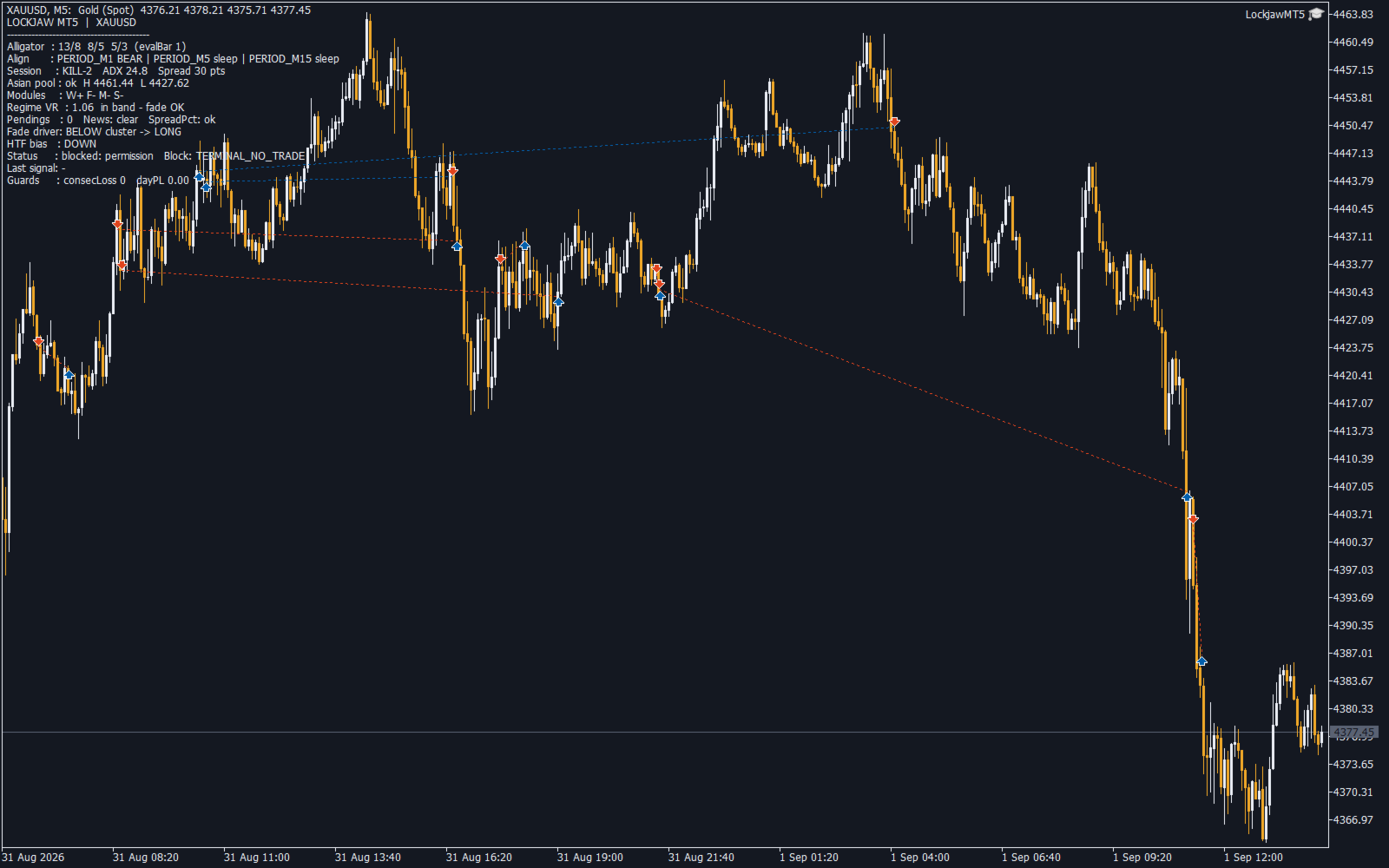
An XAUUSD gold scalper for MetaTrader 5, built to prop firm risk rules: a hard stop loss on every trade and a daily loss cap that survives a restart.
No grid. No martingale. No recovery. No averaging. One trade at a time.
Put plainly: a prop firm scalper. A prop firm gold EA that trades XAUUSD M1 and XAUUSD M5 against the same risk rules a challenge and funded account are graded on.
Why most prop firm EAs fail on a technicality
Most Expert Advisors re-read the day's opening balance when the terminal starts. A VPS reboot then hands the account a second full daily loss limit, and the rule is broken before the next trade. Lockjaw persists its daily anchor, so the daily loss cap survives a restart, a re-attach and a VPS reboot.
That is the design priority throughout: risk behaviour you can verify by reading the code and watching it run, rather than performance you have to take on faith.
Risk layer (all active by default)
- Mandatory hard stop loss on every trade — a real broker-side hard stop-loss, never a virtual stop.
- Daily loss cap, persisted across restarts and VPS reboots. This is the daily loss limit that a prop firm challenge or funded account rule set actually measures.
- Drawdown circuit breaker with an automatic timed reset — it pauses trading, it does not kill the account.
- Consecutive loss cooldown: a consecutive-loss streak pauses new entries.
- One trade at a time. No grid, no martingale, no recovery, no lot scaling.
Execution layer
- Resting limit entry instead of paying the spread on entry.
- Cost gate — like any gold robot it lives or dies on cost control, so a setup whose target does not clear the round-trip cost is refused before entry.
- Stop scaled to the target and capped by volatility.
- ATR-relative spread filter, so it adapts to each symbol with no retuning.
- Adaptive stale-feed guard that normalises to the symbol's own tick rate — a fixed threshold blocks thin symbols and misses frozen feeds on busy ones.
- Economic calendar news filter — blackout around high-impact events.
- Session router with configurable killzones for the London session and the New York session.
The strategy
A mean reversion EA at heart: it fades extension away from a smoothed moving-average cluster and targets the return to the mean. Three-timeframe ladder — M1 trigger, M5 setup, M15 context, H4 directional bias — so it works as an M1 scalper that still needs higher-timeframe permission. A liquidity sweep module covers the London and New York killzones, where ranges and whipsaws make fading unreliable.
Instruments
One EA, thirteen instruments, no per instrument retuning and no per-symbol set files: XAUUSD (Gold), XAGUSD (Silver), EURUSD, GBPUSD, USDJPY, AUDUSD, USDCAD, USDCHF, NZDUSD, BTCUSD (Bitcoin), ETHUSD (Ethereum), XTIUSD (WTI Crude Oil), XBRUSD (Brent Crude). Spreads from 12 to 2,653 points, on 2-, 3- and 5-digit symbols.
It is a gold scalper EA too: XAUUSD (XAU/USD) gold scalping on M1 and M5 is the best-sampled configuration, and it runs as an XAUUSD scalper on defaults. Run it on gold M1 or gold M5, one chart per symbol, and the same XAUUSD EA settings carry unchanged to the other twelve.
Minimum deposit by instrument
One licence covers every instrument below. Pick the one your account can carry - the EA does not change, only the instrument does.
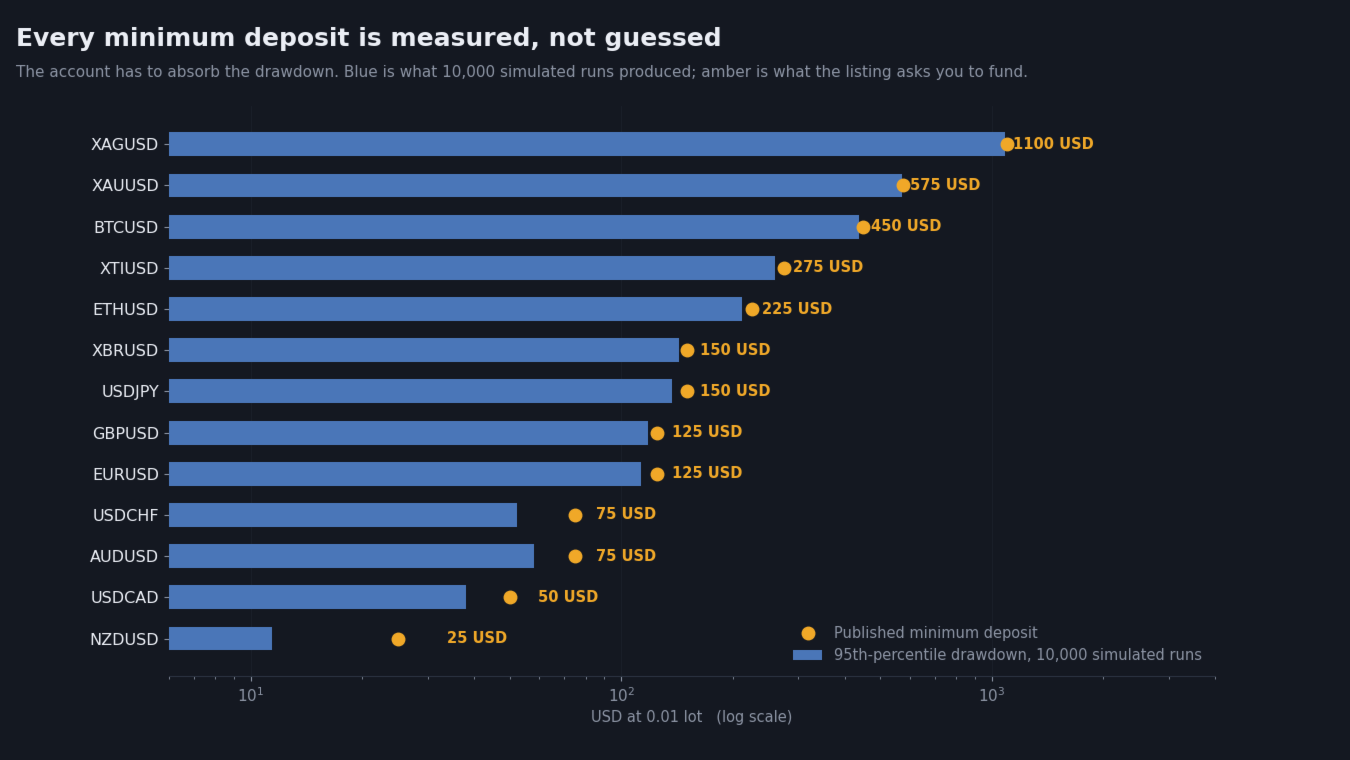
These are not rule-of-thumb numbers. Each figure comes from 10,000 block-bootstrap resamples of the EA's own trade sequence on that instrument, 0.01 lot, July 2024 to August 2026. "From" is the account that absorbs the 95th-percentile drawdown of those runs. "Comfortable" keeps that same drawdown at 20% of the account.
NZDUSD: from 25 USD, comfortable at 100 USD. The cheapest instrument to run and a genuinely low deposit start.
USDCAD: from 50 USD, comfortable at 200 USD.
AUDUSD: from 75 USD, comfortable at 300 USD.
USDCHF: from 75 USD, comfortable at 300 USD.
EURUSD: from 125 USD, comfortable at 600 USD.
GBPUSD: from 125 USD, comfortable at 600 USD.
USDJPY: from 150 USD, comfortable at 700 USD.
XBRUSD (Brent Crude): from 150 USD, comfortable at 750 USD.
ETHUSD (Ethereum): from 225 USD, comfortable at 1,100 USD.
XTIUSD (WTI Crude Oil): from 275 USD, comfortable at 1,350 USD.
BTCUSD (Bitcoin): from 450 USD, comfortable at 2,200 USD.
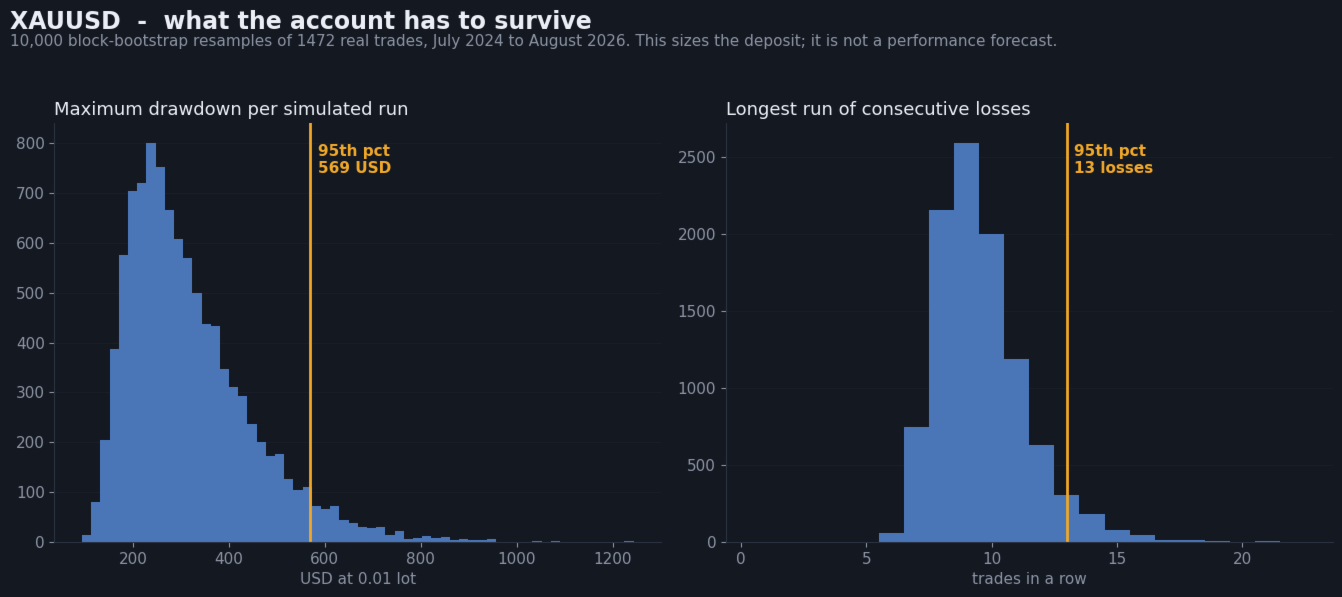
XAUUSD (Gold): from 575 USD, comfortable at 2,900 USD. Gold moves the most, so it asks for the most.
XAGUSD (Silver): from 1,100 USD, comfortable at 5,450 USD. One average loss on silver is larger than a whole small account.
Works on a small account, and says so with numbers instead of adjectives. Your broker's contract size, spread and lot minimum will move these figures, so check them against your own account before you size up. Deposit below the "from" figure and a normal drawdown can end the account - that is arithmetic, not pessimism.
Where the risk numbers come from
Every deposit figure above comes from a block bootstrap of this EA's own trade sequence on that instrument: 10,000 resampled runs, in blocks of five consecutive trades so that losing streaks survive the resampling instead of being shuffled away. Two of the screenshots show the output - the drawdown and losing-streak distributions on XAUUSD, and the deposit floor for all 13 instruments set against the drawdown it has to absorb.
The method is published so you can reproduce it, not so you have to trust it. A bootstrap resamples the past; it is not a forecast, and nothing here is a claim about future returns.
Engineering
- Symbol- and timeframe-agnostic multi symbol design. No per-instrument optimisation needed — every gate is volatility-relative, not a fixed point value.
- Works out of the box on compiled defaults. No set file required.
- No DLL. No WebRequest. No file access.
- Broker stops level respected, lots normalised to volume step, filling modes handled automatically.
Setup — three steps
1. Attach to one chart per symbol. Any chart timeframe; the EA reads its own.
2. Enable AutoTrading.
3. Check the Journal for the broker GMT offset line, then leave it alone.
Who this is for
Traders who want auditable risk machinery — prop firm participants, anyone who has had an EA breach a daily loss limit, and developers who want a solid execution layer under their own signal.
Who this is not for
Anyone looking for a hands-off profit machine. This is an execution framework. No performance claims are made, no historical results are presented as an indication of future returns, and you should test on demo before risking capital.