Machine Intelligence in Trading: Evolutionary AI, Reinforcement Learning and Cybernetic Systems Explained

The market does not care how hard you worked on your strategy. It rewards one thing: decisions that are more accurate, more disciplined, and more adaptive than the next participant's. For a long time, this meant algorithm engineering. Today, it means machine intelligence — and not one form of it. Three distinct paradigms are now converging in live trading systems on MetaTrader 5.
Evolutionary artificial intelligence. Reinforcement learning. Cybernetic control theory. Each addresses a different weakness of conventional algorithmic trading. Each produces fundamentally different behavior at runtime. And each, when implemented correctly, gives the system an edge that no hardcoded rule set can match.
This article breaks down all three. Real engineering, real concepts, real production grade examples — all available on MQL5 today.
PARADIGM I: EVOLUTIONARY AND PLASTIC INTELLIGENCE
What MAP Elites Does That Standard Optimization Cannot
Most optimization algorithms search for the single best solution. They converge on a peak in the performance landscape and stop there. The problem is that markets are nonstationary — the best solution today is not the best solution in three weeks. A system locked onto one optimal policy has no fallback when conditions shift.
MAP Elites is a quality diversity algorithm. Instead of converging on one optimum, it maintains an archive of diverse elite strategies, each representing the best known solution within a specific behavioral niche. The "MAP" refers to the multi dimensional nature of this archive — strategies are indexed not just by performance, but by what kind of market behavior they produce: trend following vs. mean reversion, high frequency vs. selective, aggressive vs. defensive.
In live operation, the system selects from this archive based on current market conditions. When volatility spikes, it pulls the elite strategy from the high volatility niche. When a low momentum compression regime is detected, it switches to the appropriate niche's top performer. The archive is continuously maintained through competition: new candidate strategies are generated, evaluated, and replace incumbents only if they outperform within their specific niche.
The result is a system that covers the strategy space — not just the current optimum within it.
Differentiable Plasticity: Neural Weights That Learn While Trading
Standard neural networks have fixed weights after training. They apply the same transformations in live operation as they did when the training process finished. This is efficient, but it means the network cannot adapt to new patterns without retraining.
Differentiable Plasticity, grounded in Hebbian neuromodulation, changes this. Each synaptic connection in the network carries two components: a fixed weight (the slowly learned base) and a plastic component (a fast adapting trace that modifies the connection strength based on recent coactivation patterns). When two neurons fire together repeatedly, their plastic component strengthens — in real time, during live operation.
In trading terms: the network's response to market patterns can shift within the current session as new correlations emerge. It is not retraining — the base weights remain stable. It is rapid in context adaptation at the connection level, governed by biologically inspired learning rules that require no gradient computation.
Hindsight Experience Replay: Learning From Trades That Did Not Work
A standard reinforcement learning agent learns only from rewarded outcomes. Failed trades contribute nothing to the learning signal — which is unfortunate, because a failed trade contains structural information about the market.
Hindsight Experience Replay (HER) reframes this. After a failed trade, the system relabels the experience retroactively: it asks, "What outcome would have made this action correct?" It then uses that counterfactual goal to generate a synthetic positive learning signal. The agent learns not just from what worked, but from what the market was actually rewarding at the time the trade failed.
In volatile, breakout driven markets — where entries are frequently wrong in the short term but correct in the medium term — this is a meaningful advantage. The system extracts learning value from experiences that would otherwise be discarded entirely.
Gruenwald Letnikov Fractional Calculus: Long Memory Feature Channels
Standard technical indicators operate on integer order derivatives and moving averages. They measure change over a fixed window — one bar, five bars, twenty bars — and discard everything outside that window. Markets, however, carry memory that decays gradually rather than cutting off cleanly. A breakout from six weeks ago may still influence price behavior today in ways that a twenty period ATR cannot detect.
Fractional calculus, formalized by Gruenwald and Letnikov, extends the concept of differentiation to noninteger orders. A fractional derivative of order 0.45 produces a feature that blends the sensitivity of a first order derivative with the memory retention of a moving average — capturing long range dependencies at a time scale that integer order indicators cannot reach. Applied to price and volatility series, these fractional feature channels provide the network with structural information about market state that exists below the resolution of conventional indicators.
Production Implementation: ICONIC BTC AI+
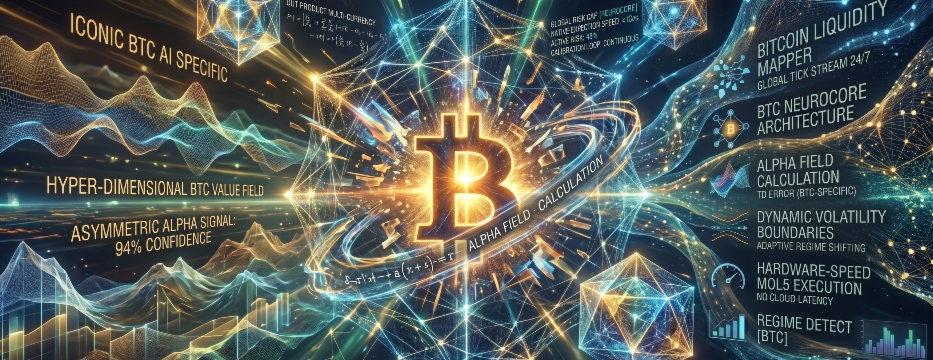
All four mechanisms above are implemented in the ICONIC BTC AI+, running under the SYNAPSE.PHENOTYPE S6 ENGINE on MetaTrader 5. The strategy targets BTCUSD using Daily and Previous Day High/Low breakout structure as its primary signal framework. The AI layer operates in RAM using native MQL5 matrix and vector types — no DLLs, no external APIs, no data transmission.
- 3x3 In RAM MAP Elites archive with Phenotypic diversity indexing
- Differentiable Plasticity via Hebbian Neuromodulation (real time plastic connection updates)
- Hindsight Experience Replay engine (counterfactual goal relabeling)
- Gruenwald Letnikov Fractional Calculus at order 0.45 for long memory feature streams
- Riemannian Metric Tensor for geodesic correct niche elite blending
No grid. No martingale. Hard stop loss defined before every execution. ATR based dynamic stop placement. Automatic break even logic.
Minimum recommended setup: 500 USD, 1:500 leverage, low spread with zero or near zero commission.
ICONIC BTC AI+ on MQL5
PARADIGM II: REINFORCEMENT LEARNING AND INFORMATION THEORETIC COORDINATION
Q Learning With Eligibility Traces: The Core of Adaptive Decision Making
Reinforcement learning places an agent in an environment where it must discover effective behavior through interaction. The agent observes a state, selects an action, receives a reward, and updates its policy. No labeled training data required. No human defined rules for what constitutes a good trade. The agent learns what works by doing it — and by paying the cost when it does not.
Q learning estimates the expected cumulative reward for every state action pair. The agent selects the action with the highest estimated value. Over time, through repeated market interactions, the Q function converges toward an accurate model of which actions produce the best outcomes in which conditions.
Eligibility traces extend this with temporal credit assignment. After any outcome, the system distributes credit backward through time to past decisions that contributed to the result. In trading, where the full consequences of an entry often materialize several bars later, this is essential. The agent does not learn only from the most recent action — it learns from the entire sequence of decisions that led to the current trade outcome.
The feature weight model that drives the Q function is updated continuously during live operation. The system adapts its trading policy in real market conditions, without offline retraining cycles between sessions.
Transfer Entropy: Directed Information Flow Between Assets
Standard correlation is symmetric. It tells you whether two assets move together. It does not tell you which one leads. Two instruments can be correlated because one causes the other, because both respond to a shared external driver, or by coincidence within a specific window. Correlation is blind to the difference.
Transfer Entropy, derived from Shannon information theory, resolves this. It measures the directional flow of information between two time series — specifically, how much knowing the recent history of asset A reduces uncertainty about the next state of asset B, computed separately in each direction. The result is a directional signal: not just whether BTC and Gold are correlated, but whether BTC is currently informing Gold, or Gold is informing BTC.
A system that can detect this causal direction in real time has structurally different information than one relying on symmetric correlation. It can prioritize signals from the leading instrument and reduce exposure to the lagging one — before the lagging asset has fully reacted.
Echo State Reservoir Computing: Regime Detection Without Expensive Retraining
Recurrent neural networks can capture temporal patterns, but training them requires backpropagation through time — computationally intensive and sensitive to regime change. In a live trading environment where old patterns become misleading, this is a real operational constraint.
Echo State Reservoir Computing addresses this differently. A large, randomly connected reservoir of neurons is fixed at initialization and never trained. Only the output weights that read from the reservoir are learned. The reservoir projects input time series into a rich high dimensional representational space, where complex temporal dependencies become linearly separable. Training time is orders of magnitude lower. The fixed reservoir dynamics are robust to noise and do not overfit to historical regimes.
Applied to multi symbol market data, the reservoir acts as a regime extractor: transforming raw price and volatility inputs into a compressed feature vector that captures the current structural state of the market, updated every tick.
Production Implementation: ICONIC NEUROCORE AI+
ICONIC NEUROCORE AI+ trades both BTCUSD and XAUUSD simultaneously through the OMNI-NEXUS coordination layer — a centralized architecture that manages signal timing, position sizing, and capital allocation across both instruments from a single EA instance. Two isolated AI engines operate per symbol. The OMNI-NEXUS layer governs cross engine behavior.
- Per engine Q learning with eligibility traces (5-action Boltzmann policy) and adaptive feature weight model
- Transfer Entropy directed flux measurement (BTC to Gold) as an inter engine timing signal
- In RAM sparse Echo State Reservoir with online regularized readout for regime extraction
- Covariance Risk Parity capital budgeting across both trading engines
- Margin utilization governor with real time enforcement
The system updates its policy during live operation. No offline retraining. No external data feeds. All computation runs in RAM using native MQL5 matrix and vector types.
No grid. No martingale. Hard stop loss before every trade. ATR based dynamic stops. Automatic break even logic.
Minimum recommended setup: 500 USD, 1:500 leverage, low spread with zero or near zero commission.
ICONIC NEUROCORE AI+ on MQL5
PARADIGM III: CYBERNETIC SYSTEMS AND GAME THEORETIC OPTIMIZATION
What Cybernetics Actually Means for a Trading System
Cybernetics is the science of self regulating systems. Its foundational principle is feedback: a system monitors its own output, compares it against a desired state, and adjusts its behavior to close the gap. This loop — sense, compute, correct — operates continuously. The system does not execute a fixed plan. It maintains a model of desired behavior and converges toward it in real time.
In trading, the implications are precise. A cybernetic system does not just follow an entry rule. It monitors its own exposure, compares it to a risk budget, and adjusts position sizing accordingly. It monitors information flow between instruments, compares it against signal thresholds, and gates entries accordingly. It monitors capital allocation between engines, compares it against an optimal distribution, and rebalances accordingly. Every decision layer has a target state and a feedback mechanism.
This is not a design philosophy. It is a structural requirement: without feedback loops at every level, a trading system is open loop and incapable of responding to its own state.
Causal Gating via Bidirectional Transfer Entropy
The NEUROCORE OMNI-NEXUS measures a single directed Transfer Entropy value to detect which market is currently informing the other. The KYBERNETIC architecture extends this: both directions are measured continuously and separately, producing real time signals for BTC to Gold information flow and Gold to BTC information flow as independent values.
This bidirectional measurement enables a causal gate: a structural filter that determines, on every bar, which market is the current information source and which is the receiver. The gate governs entry timing — signals from the leading market receive priority weighting, and entries in the lagging market are filtered until the information relationship stabilizes. During periods where neither direction shows significant Transfer Entropy, the gate suppresses both engines until causal structure reestablishes.
The architecture is implemented as a Directed Acyclic Graph (DAG): each causal relationship between instruments is modeled as a directed edge, and the DAG structure is updated continuously from Transfer Entropy readings. This is not heuristic cross instrument filtering — it is information theoretic causal inference running natively in the EA.
Liquid State Machines: The 500-Node Reservoir
Liquid State Machines are a form of reservoir computing where the reservoir is large and dynamically rich enough to produce genuinely complex temporal representations. ICONIC KYBERNETIC AI uses a 500-node echo state reservoir — larger and more expressive than the regime detector in NEUROCORE. The reservoir projects raw market data from both instruments simultaneously into a high dimensional feature space that reflects joint market dynamics across multiple time horizons. Output weights are trained with ridge regression and updated online. The 500-node architecture provides representational capacity that a simpler reservoir cannot match.
Physics Informed Margin Axiom: Hard Safety Boundaries
Physics Informed Neural Networks (PINNs) embed physical laws directly into the learning objective — the network cannot learn solutions that violate the governing equations of the system. In a trading context, "physics" translates to hard financial constraints: margin availability, maximum drawdown, position limits.
The Physics Informed Margin Axiom in ICONIC KYBERNETIC AI implements a hard 35% free margin floor. The system continuously monitors margin utilization against this boundary. If any proposed position would breach the floor, it is blocked — regardless of signal strength, regardless of Q function confidence, regardless of STUN allocation output. The axiom is enforced at the order level, not at the strategy level. It cannot be bypassed by upstream logic.
This provides a structural safety property that risk percentage based position sizing alone cannot guarantee, particularly in fast moving markets where multiple positions open simultaneously across both instruments.
Stochastic Tunneling Nash Equilibrium: Game Theoretic Capital Allocation
When two trading engines share the same capital pool, the allocation question becomes strategic. Equal split ignores performance asymmetry. Risk parity is more principled but treats allocation as a single objective optimization problem solved in isolation from the other engine.
Nash equilibrium addresses the strategic dimension directly. Each engine is modeled as an agent with a stake in the available risk budget. The Nash equilibrium allocation is the point at which neither engine can increase its contribution to total system performance by claiming more capital, given the other engine's current behavior. It is the stable, mutually rational solution.
Finding this equilibrium in a dynamic environment — where both engines' performance profiles shift continuously with market conditions — requires an optimizer that can search a nonstationary landscape without getting trapped in local optima. Stochastic Tunneling, derived from simulated annealing, applies probabilistic transitions that allow the optimizer to escape local minima and converge on globally stable configurations. The "tunneling" metaphor is precise: the algorithm can pass through suboptimal regions of the allocation landscape to reach superior configurations that gradient based methods would never reach.
The result is a dynamic, market responsive capital split that continuously rebalances toward the optimal Nash Pareto allocation — not a static setting that decays in relevance as conditions evolve.
Production Implementation: ICONIC KYBERNETIC AI
ICONIC KYBERNETIC AI trades BTCUSD and XAUUSD from a single chart instance. Drop it on any chart — it configures both instruments autonomously, managing isolated AI brains per symbol within the OMNI-NEXUS CYBERNETIC CORE. All four cognitive technologies run natively in RAM with MQL5 matrix and vector types. No DLLs. No external APIs.
- Bidirectional Transfer Entropy causal gating with DAG modeling (BTC to Gold and Gold to BTC as separate real time signals)
- 500-node Liquid State Machine echo state reservoir for joint temporal feature extraction across both instruments
- Physics Informed Margin Axiom with hard 35% free margin floor enforced at order level
- Stochastic Tunneling Nash Pareto budget allocator — game theoretic capital distribution between BTC and Gold engines
- Per engine Q learning with eligibility traces and adaptive feature weight model (isolated AI brains)
No grid. No martingale. Hard stop loss before every execution. ATR based dynamic stops. Automatic break even logic. Single chart. Two markets. Full cybernetic coordination.
Minimum recommended setup: 500 USD, 1:500 leverage, low spread with zero or near zero commission.
ICONIC KYBERNETIC AI on MQL5
CONCLUSION: THREE PARADIGMS, ONE ECOSYSTEM
Evolutionary intelligence for a single symbol breakout system that adapts its strategy archive in real time. Reinforcement learning for dual market coordination where the agent discovers policy through live interaction. Cybernetic control for a full adaptive system that senses, computes, gates, and rebalances continuously across two markets with game theoretic precision.
These are not marketing labels. They are engineering choices — each addressing a specific limitation of the systems that came before them. The ICONIC.FX product ecosystem represents three distinct answers to the same question: how does a trading system remain effective in a market that continuously changes?
The technology is available. The only remaining variable is whether you intend to use it.
Explore the full ICONIC.FX lineup on MQL5. Developer profile: mauriceprg
Community and live updates: t.me/iconicfxofficial
ICONIC BTC AI+ — SYNAPSE.PHENOTYPE S6 ENGINE | Breakout Strategy for BTCUSD
ICONIC NEUROCORE AI+ — OMNI-NEXUS EDITION | Q Learning + TE + Echo State | BTCUSD + XAUUSD
ICONIC KYBERNETIC AI — OMNI-NEXUS CYBERNETIC CORE | Causal TE + LSM + STUN Nash | BTCUSD + XAUUSD