Stress-testing a gold strategy: the three failures we look for before release

Every strategy we have ever discarded looked good at first. That is not bad luck, it is selection: you only stress-test the candidates that already passed the easy filters.
So the real question in strategy development is not "does the equity curve go up?". It is "which specific failure is hiding behind this nice curve?". After generating and filtering thousands of candidate strategies on gold, we found that almost every failure fits one of three patterns. Before any EA of ours reaches the Market, we hunt for all three.
Failure 1: the one-year wonder
Some strategies earn their entire backtest profit in a single year, usually a year with one dominant regime. Gold makes this trap easy: a strategy tuned to a strong trending phase can print a beautiful seven-year curve where six years are flat noise and one year does all the work.
The curve looks fine. The strategy is not: you are looking at a bet on one regime repeating.
How we test it: we break the backtest into separate calendar years and look at each one alone. We want to see the strategy survive different regimes, not excel in one. For our upcoming gold portfolio, the combined MT5 backtest closed positive in each of the seven tested years, 2020 through 2026. That does not predict year eight. It does tell us the result is not an artifact of a single lucky period. These are backtest figures, and past performance does not guarantee future results.
Failure 2: the knife-edge parameter set
Take a strategy with, say, a period setting of 20. Change it to 18, then to 22, and rerun the backtest. If profit collapses on both sides, you do not have a strategy. You have a coordinate: one precise point in parameter space where historical noise happened to line up.
Markets drift. A system that only works at exactly one setting is already broken, it just has not told you yet.
How we test it: we nudge every meaningful input up and down and rerun the test. We accept that results get worse away from the chosen values, that is normal. What we reject is a cliff: small changes that turn a profitable backtest into a losing one. We also rely on out-of-sample selection during generation, so parameters are chosen on one slice of data and must survive on data they never saw. A robust engine degrades gently. A curve-fit engine falls off a knife edge.
Failure 3: costs that only exist on paper
Gold is not EURUSD. The spread is wider, it widens further during news and at rollover, and slippage on stops is real. A strategy that earns a few dollars per trade in a zero-cost simulation can be a consistent loser once you charge it honest costs.
Short-timeframe systems are the most exposed: the smaller the average profit per trade, the larger the share that costs eat.
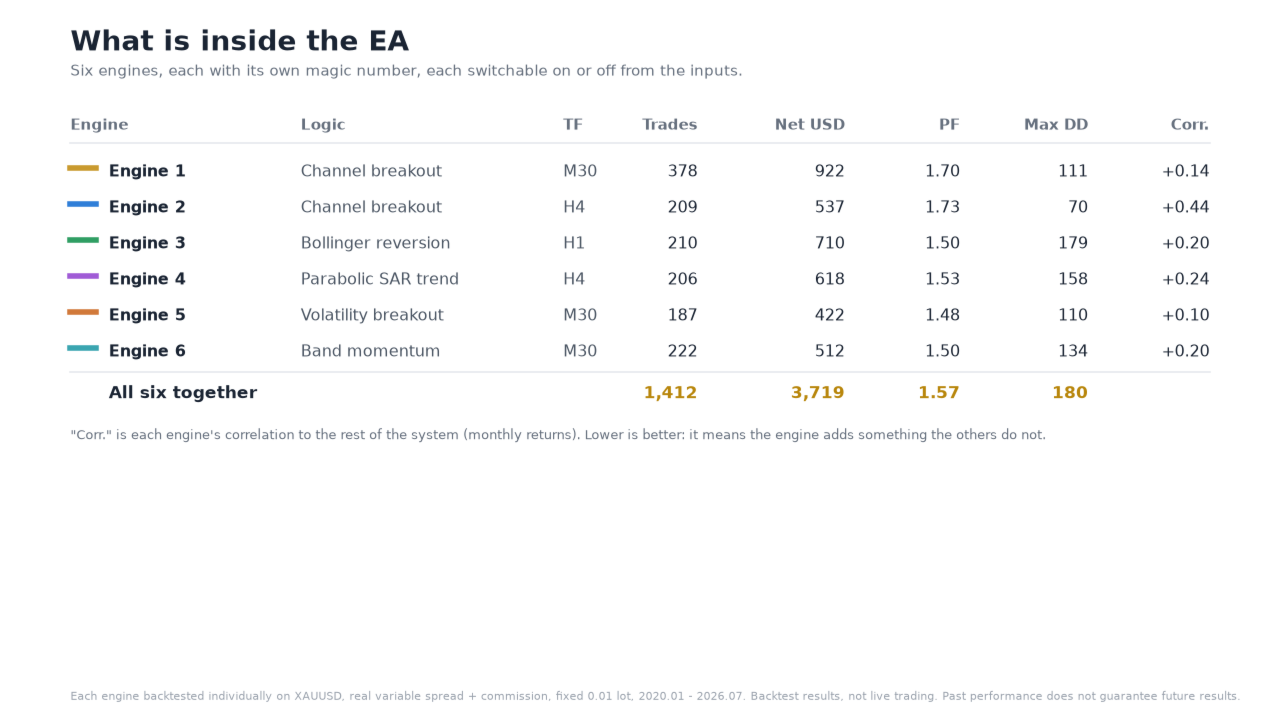
How we test it: we rerun the backtest with spread set above the typical live value for XAUUSD, not at the broker's optimistic advertised minimum, and we add slippage on entries and stops. Then we check the average profit per trade against those costs. In the current gold portfolio backtest, 1,425 trades produced a net profit of 4,512 USD with 0.01 lots per engine, costs included, with a profit factor of 1.67 and a maximum drawdown of 326 USD. Again: backtest numbers, under stressed cost assumptions, and past performance does not guarantee future results.
Why three tests and not thirty
There are fancier methods: Monte Carlo reshuffling, walk-forward matrices, regime clustering. We use some of them during generation. But in our experience, when a released strategy dies in the wild, the autopsy almost always points back to one of these three causes: it depended on one regime, it depended on one parameter point, or it depended on costs staying politely small.
Three failure modes, three targeted tests. Everything else is refinement.
What you can do with this today
You do not need our tools to apply the idea. Next time you evaluate any EA, yours or anyone's, ask the seller (or your own tester) three questions: how does each year look on its own, what happens if I change the inputs slightly, and what spread was the backtest charged?
If you want to practice on something concrete, Wonder 8 is free (MT5, and MT4): run its backtest yourself, raise the spread, split the years, and see how it holds up. And if gold is your market, our existing Wonder Gold was built under the same three tests.
All performance figures in this article are backtest results. Backtests are hypothetical, past performance does not guarantee future results, and trading involves risk of loss.